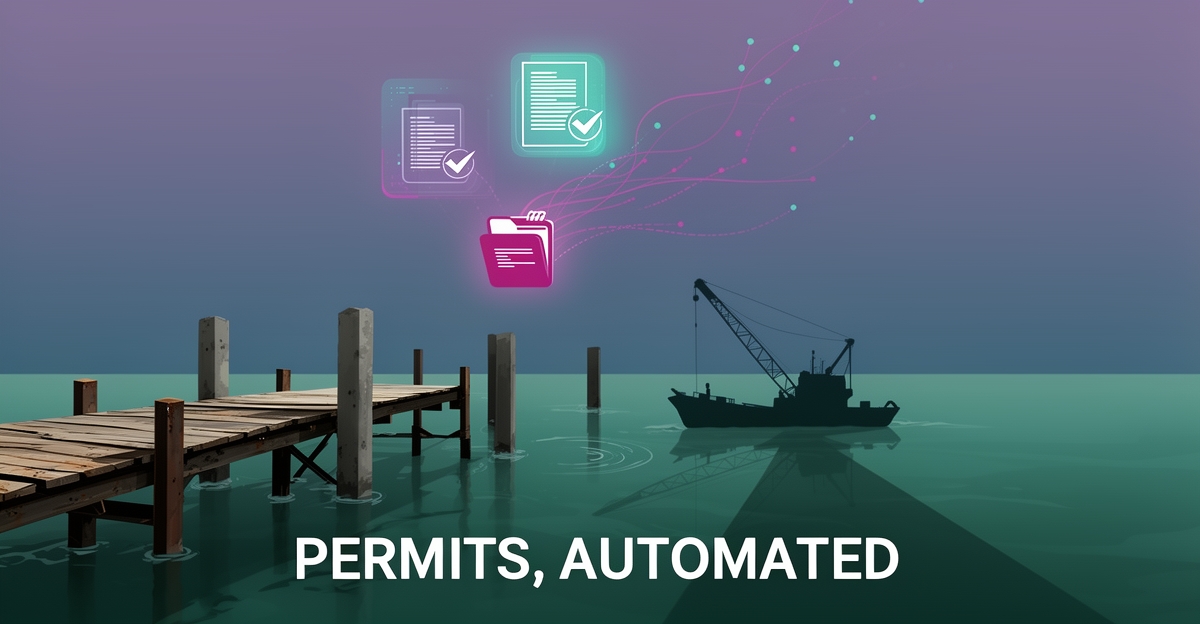
How Dock & Seawall Builders Can Use AI to Automate Permit Applications and Reduce Delays
Key Facts
- Multi-agency permitting routinely extends dock and seawall project timelines beyond original schedules
- AI document processing can extract line-item data from marine construction documents with accuracy levels well above manual entry
- Seasonal construction windows make every week of permit delay disproportionately costly for marine builders
- Material costs for steel and concrete can swing significantly year to year, amplifying the cost of stalled projects
- AI automation typically reduces permit and invoice processing time from days to hours for marine builders
- Custom AI workflow builds typically deploy in a matter of weeks, phased and fixed-price; AI employees can launch in as little as two weeks
Hire a team member that works 24/7 — for less than a part-time wage.
AI receptionists, SDRs, dispatchers and 99+ roles. Trained on your business, fully managed.
Not sure where to start? Ask our AI planner
The Permit Bottleneck: Why Dock & Seawall Projects Stall Before They Start
The marine construction permit process often becomes a silent project killer before ground is even broken. Dock and seawall builders routinely encounter a labyrinth of federal, state, and local agencies, each with unique documentation requirements, review timelines, and submission portals. This fragmentation creates significant delays, extends project timelines, and complicates retainage tracking—a critical financial concern for contractors managing cash flow against milestone-based payments. The burden isn't just temporal; it consumes valuable engineering and administrative hours that could be directed toward design refinement or field preparation.
These delays stem from document-heavy workflows where permit applications demand extensive technical drawings, environmental impact assessments, hydraulic calculations, and compliance narratives. Preparing these packages manually requires cross-referencing regulatory checklists, formatting documents to agency-specific standards, and tracking version control across multiple submissions. Engineering teams spend days validating data against evolving USACE permit line items and state grant requirements, while administrative staff chase signatures, manage courier logistics, and monitor portal statuses. This administrative drain diverts skilled labor from core construction activities, exacerbating inefficiencies during already compressed seasonal work windows.
The cumulative effect is a permitting bottleneck that doesn't just delay start dates—it erodes profitability through extended overhead, missed early-payment discounts, and strained client relationships. When projects stall at the permitting stage, retainage releases become unpredictable, making it difficult to verify completed work against regulatory milestones for subcontractor billing. This uncertainty ripples through the supply chain, affecting material vendors and equipment rental companies who rely on timely payments to sustain their own operations. For dock and seawall builders already exposed to material cost volatility, these preventable delays amplify financial risk at the worst possible moment. Addressing this bottleneck requires more than incremental process tweaks—it demands a fundamental shift in how permit documentation is generated, validated, and submitted.
AI-Powered Permit Automation: Extract, Validate, Submit
Permit paperwork can stall a dock or seawall project long before the first pile hits the water. Engineers and admin teams spend valuable hours pulling data from plans, cross-checking USACE and state requirements, and reformatting submissions for each agency.
AI automates the entire permit documentation loop by reading plans and specifications, extracting the required data points, and validating them against regulatory checklists before submission. This extract, validate, submit workflow removes manual re-keying and reduces the errors that trigger agency rejections and costly resubmissions.
The same document-processing capabilities that drive high accuracy in invoice and AP automation apply directly to permits. Modern AI extraction reliably pulls line-item data from drawings, geotechnical reports, and material schedules, then maps it to USACE permit line items and state grant reimbursement requirements. Validation rules flag missing signatures, mismatched quantities, or non-compliant specifications before the package leaves the office. Formatting engines then generate agency-specific forms and supporting PDFs, ready for portal upload.
Processing time shifts dramatically under automation. Workflows that once took days of manual data entry and cross-checking typically compress to hours once extraction and validation are standardized—a pattern marine builders see across both permit packages and invoice processing.
A typical AI-powered permit automation flow includes:
- Plan and document ingestion with automated data extraction
- Rule-based validation against USACE, state, and local requirements
- Auto-formatting and submission packaging for each regulatory body
- Audit trail and status tracking integrated with project management and accounting systems
AIQ Labs builds these systems two ways. A Workflow Build rebuilds the one workflow that costs you the most—here, permit preparation—at a fixed price, delivered in phases you sign off on. For ongoing follow-up work, AI Employees can monitor permit status, follow up with agencies, and chase missing information from subcontractors, typically launching in as little as two weeks and running at a fraction of the cost of adding a full-time hire. For builders ready to connect permits, billing, and project management into one layer, an AI Operating System ties it together—and you own it outright.
The result is fewer delays during seasonal construction windows, cleaner retainage release, and engineering time redirected to design and field oversight instead of paperwork.
From Strategy to Submission: Implementing AI Permit Workflows with AIQ Labs
Knowing what AI can do for your permit process is one thing—actually getting a system live and working is another. The gap between strategy and submission is where most automation efforts stall, and it's worth understanding exactly how a structured implementation unfolds before committing time or budget.
The path starts with the Fit Check: a two-minute application that tells us where you are and whether a clear win exists. If it looks promising, the next step is a free 30-minute strategy call—a working session to assess your current systems and identify the highest-ROI automation opportunities within your permit workflows and broader operations. There's no obligation, and if there isn't a clear win, you'll hear that too.
If the fit makes sense, implementation follows a defined sequence:
- Deploy AI-powered document processing that extracts, validates, and formats permit applications, invoices, and compliance documentation automatically
- Integrate the system with your existing project management and accounting tools for real-time data synchronization
- Establish governance practices covering compliance and risk management specific to marine construction and environmental regulations
- Monitor and optimize continuously, with regular check-ins to ensure measurable ROI as requirements evolve
The integration step matters more than most builders expect. Automation that isn't connected to the systems your team already uses tends to become another silo—exactly the failure mode that derails AI projects. Matching permit milestones to project codes and pay applications is what turns a document tool into an operational asset.
The results from comparable document workflows are concrete: extraction accuracy well above manual entry, processing time cut from days to hours, and faster month-end close when pay applications, lien waivers, and permit checkpoints are matched automatically.
AIQ Labs structures engagement around three payment models so builders can match investment to risk tolerance: Start Monthly (a flat plan that includes build, training, integrations, and monitoring, pausable anytime), Build in Milestones (pay per phase and keep everything built), or Own It Outright (full ownership of code, agents, and data). Real numbers are provided in writing after the strategy call—no fake price anchors. Current details are on the pricing page.
If your permit process is eating engineering hours you'd rather spend in the field, the fastest way to find out what's possible is to start the two-minute Fit Check, then book a free 30-minute strategy call at aiqlabs.ai/book. It's a working session with an AI engineer, not a sales pitch—and if there isn't a clear win, you'll hear that too.
Still paying for 10+ subscriptions that don’t talk to each other?
We build custom AI systems you own outright. No vendor lock-in. Full control.
Not sure where to start? Ask our AI planner
Frequently Asked Questions
How much time can AI-powered permit automation save for dock and seawall builders?
What accuracy rate does AI achieve when extracting data from permit documents and drawings?
How do multi-agency permitting delays impact project timelines and retainage tracking?
What is the typical implementation timeline for a custom AI permit automation system?
How does AI integration with existing systems prevent automation failures in marine construction?
What payment models does AIQ Labs offer for AI permit automation systems?
From Permit Purgatory to Project Kickoff
The permit bottleneck doesn't have to be the silent project killer that delays start dates and strains cash flow. By automating the extract, validate, submit workflow, you can cut processing time from days to hours and reclaim the engineering hours currently lost to paperwork. The path forward starts with understanding your specific bottlenecks—not with a sales pitch, but with a working session to map high-ROI automation opportunities. AIQ Labs offers a free 30-minute strategy call where you'll get clarity on whether a workflow build, AI employees, or a full AI operating system makes sense for your operation—and if there isn't a clear win, you'll hear that too. The seasonal construction windows won't wait, and neither should your permit process. Start the two-minute Fit Check to see what's possible when permits stop being the constraint and start being the catalyst for on-time project delivery.
Make AI your competitive advantage — not just another tool.
Strategy, implementation and ongoing optimization. One partner, end to end.
Not sure where to start? Ask our AI planner