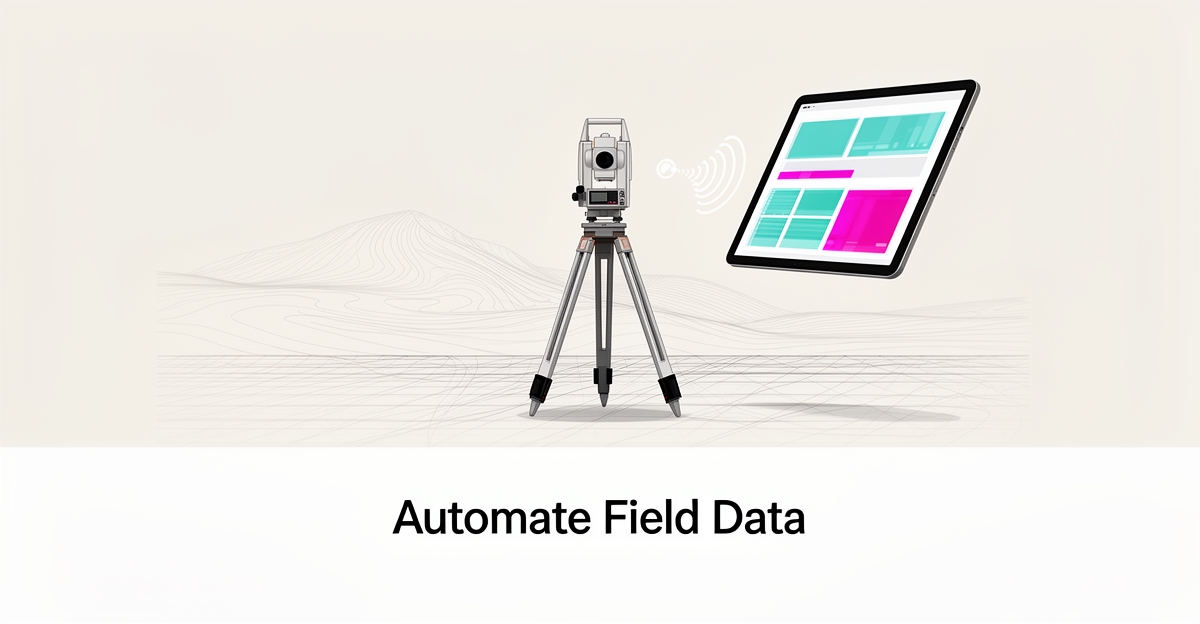
How Land Surveying Companies Can Automate Field Data Entry with AI
Key Facts
- Surveyors typically spend hours per job transcribing handwritten notes, GPS coordinates, and measurements into office systems
- AI can convert voice notes, site photos, and raw instrument readings into structured data in real time
- Automated validation and sensor fusion reduce transcription errors that lead to rework and site revisits
- A phased rollout—pilot, parallel run, then expansion—lets firms adopt AI without disrupting active fieldwork
- AIQ Labs has deployed 200+ multi-agent systems and runs 4 live SaaS products daily
- AIQ Labs rebuilds the one workflow that costs the most through fixed-price AI Workflow Builds
Hire a team member that works 24/7 — for less than a part-time wage.
AI receptionists, SDRs, dispatchers and 99+ roles. Trained on your business, fully managed.
Not sure where to start? Ask our AI planner
The Hidden Cost of Manual Field Data Entry in Surveying
Manual field data entry remains a persistent bottleneck in land surveying workflows, where surveyors spend valuable time transcribing handwritten notes, GPS coordinates, and measurements into digital systems. This repetitive task not only slows down project timelines but also introduces avoidable errors that compound downstream. As infrastructure demands grow, the pressure to deliver accurate, timely survey data has never been higher.
Aging infrastructure and ongoing public investment in roads, utilities, and development continue to drive demand for precise surveying. In this environment, even small inefficiencies in data entry can delay critical projects and increase costs. Firms that still rely on end-of-day transcription are competing against shops that deliver structured data the same afternoon.
The consequences of manual data entry extend beyond lost time. Errors in transcribing field notes or misrecorded coordinates often require costly rework, revisits to site, and delays in deliverables. Survey teams may spend hours correcting preventable mistakes—time that could be better spent on analysis, quality control, or taking on additional projects. These inefficiencies directly impact productivity and profitability, especially for firms managing multiple concurrent jobs.
- Increased likelihood of transcription errors in GPS coordinates and measurements
- Hours lost per job to manual data entry and correction cycles
- Delayed project timelines due to rework and verification
- Reduced capacity to take on new work due to administrative bottlenecks
- Higher operational costs from labor-intensive data processing
AIQ Labs helps surveying firms address these challenges by building custom AI systems that automate the capture and interpretation of field data in real time. For firms with one clearly defined bottleneck—say, the field-to-office transcription pipeline—a fixed-price AI Workflow Build rebuilds exactly that workflow in phases. By integrating with existing surveying equipment and software, these solutions eliminate manual entry while preserving data integrity—allowing teams to focus on high-value tasks rather than paperwork.
How AI Eliminates Manual Data Entry in Real Time
Surveyors often spend hours after fieldwork transcribing notes, converting measurements, and entering data into office systems—time that could be spent on analysis or client work. AI-powered systems now eliminate this bottleneck by capturing, interpreting, and organizing field data in real time directly from survey equipment, without requiring changes to how surveyors operate in the field. Using voice-to-text, image recognition, and sensor fusion, these tools transform spoken observations, photos of site conditions, and raw instrument readings into structured, usable data instantly. Modern AI models as of late 2026 handle unstructured field inputs—voice memos, annotated sketches, site photos—and convert them into standardized formats with a level of accuracy that was impractical just a few years ago.
This real-time automation significantly reduces the manual effort and error rates associated with traditional data entry workflows. AI-driven automation in field operations typically cuts processing time dramatically while improving data consistency, particularly when integrating GPS coordinates, field sketches, and sensor outputs into a unified dataset. For example, AI-powered image recognition can automatically identify and label features in field photos—such as property markers, utility lines, or terrain changes—tagging them with spatial coordinates and saving them directly to project files. Similarly, voice-to-text systems trained on surveying terminology can convert verbal notes about soil conditions or boundary observations into searchable, structured logs, eliminating the need for post-field transcription.
AI-powered field data automation reduces manual entry errors and saves hours per job by creating a seamless flow from instrument to insight. Sensor fusion techniques further enhance accuracy by combining data from multiple sources—like total stations, GPS units, and laser scanners—using AI to resolve discrepancies and generate a single, reliable dataset. This approach not only speeds up office processing but also minimizes the risk of transcription mistakes that can lead to costly rework or legal disputes.
- Voice-to-text conversion of field observations into structured logs
- Image recognition for automatic feature identification and tagging
- Sensor fusion to combine GPS, laser, and total station data
- Real-time data organization into project-ready formats
- Error reduction through automated validation and cross-checking
By embedding AI directly into the field workflow—through ruggedized tablets, voice-enabled data collectors, or integrated software platforms—surveying firms can maintain their existing practices while gaining the speed and precision of automation. AIQ Labs builds custom AI systems that connect seamlessly with existing equipment and office software, enabling real-time data capture without disrupting field crews or requiring retraining. The result is a faster, more accurate path from field measurement to final deliverable, where data enters the system correctly the first time—every time.
Implementing AI Without Disrupting Field Operations
The biggest risk in adopting AI isn't the technology—it's the disruption. Surveying crews work against weather windows, project deadlines, and client expectations, so any implementation that slows the field down will be abandoned quickly. A phased, structured rollout avoids that fate.
Start with a workflow assessment. Map how field data currently moves from a surveyor's notes, GPS units, and measurements into final deliverables, and identify exactly where manual entry introduces delays and errors. This is the first step in any serious AI engagement: pinpoint where automation will improve efficiency, accuracy, and decision-making before writing a line of code.
Next, choose tools that fit your existing stack rather than replacing it. AI automation should integrate with the GPS receivers, data collectors, and CAD software your crews already use, capturing field notes and coordinates in real time without changing how surveyors work in the field. Off-the-shelf low-code platforms can handle simple capture tasks, but custom-built systems offer deeper integration with surveying-specific ecosystems and deliver far more reliable results at scale.
Training comes third, and it matters more than most firms expect. The most common barrier to AI adoption in technical fields is lack of skills and awareness—not the technology itself. Build role-specific training so field crews, office staff, and project managers each understand what changes for them—and what doesn't.
Then deploy in phases:
- Pilot with a single crew or project type to validate accuracy against existing workflows
- Run the AI system in parallel with manual entry until results are proven reliable
- Expand to additional crews once data quality benchmarks are consistently met
- Establish human-in-the-loop review for critical measurements and regulatory compliance
- Track time savings and error reduction to quantify return on investment
This phased approach reflects how experienced implementation partners operate. AIQ Labs structures engagements the same way—discovery and architecture first, then development and integration with existing tools, followed by deployment, role-specific training, and ongoing optimization. Firms can start monthly, build in milestones, or own the system outright—no recurring lock-in required. And the approach scales beyond a single workflow: AIQ Labs' AI Operating Systems connect scheduling, dispatch, billing, and field data into one operating layer built in phases and owned outright, while managed AI Employees handle the office-side follow-up—calls, scheduling, and client communication—at a fraction of the cost of additional hires.
The payoff justifies the discipline. With a structured rollout, your field crews keep working exactly as they do today—while the paperwork disappears behind them.
Still paying for 10+ subscriptions that don’t talk to each other?
We build custom AI systems you own outright. No vendor lock-in. Full control.
Not sure where to start? Ask our AI planner
Frequently Asked Questions
How much time can AI actually save my surveying crews on data entry?
Will I have to change how my crews work in the field?
Can AI handle voice notes and photos from the field, or just digital data?
What's the best way to roll out AI without disrupting active projects?
Is the data from AI field capture accurate enough for legal and compliance purposes?
Why should surveying firms invest in AI now?
From Field Notes to Future-Ready Workflows
Manual field data entry remains a costly bottleneck for land surveying firms, consuming valuable time, introducing preventable errors, and delaying project delivery. AI-powered automation eliminates this friction by capturing voice notes, GPS data, and field observations in real time, improving data integrity through sensor fusion and intelligent validation. The result isn't just faster paperwork—it's more billable hours, fewer site revisits, and the capacity to take on new work without expanding headcount. For surveying companies ready to modernize without disrupting field crews, the path forward starts with assessing your current workflow to pinpoint where AI can deliver the greatest impact. Take the first step with AIQ Labs' free 30-minute strategy call—because in surveying, every minute saved in data entry is a minute gained for precision, productivity, and growth.
Make AI your competitive advantage — not just another tool.
Strategy, implementation and ongoing optimization. One partner, end to end.
Not sure where to start? Ask our AI planner