How Last-Mile Delivery Companies Can Automate Delivery Confirmations and Reduce No-Shows
Key Facts
- Last-mile delivery typically accounts for the majority of total shipping costs according to industry data
- Labor typically consumes 50-60% of last-mile expenses per shipping statistics
- Failed deliveries commonly cost in the range of $15-18 per attempt in last-mile analysis
- A large share of failed deliveries stem from address errors according to failure data
- A meaningful share of consumers refuse to reorder after a single failed delivery from retail loss research
- AI-driven ETA updates and dynamic routing can meaningfully cut delivery delays in last-mile use cases
- Most consumers actively track packages per consumer tracking stats
Hire a team member that works 24/7 — for less than a part-time wage.
AI receptionists, SDRs, dispatchers and 99+ roles. Trained on your business, fully managed.
Not sure where to start? Ask our AI planner
The Last-Mile Cost Crisis and No-Show Problem
The last-mile delivery crisis is hitting businesses hard. As of late 2026, industry analyses consistently show the last mile consuming the majority of total shipping costs, with labor alone typically making up 50-60% of those expenses. Every missed delivery turns into a significant financial hit—failed attempts commonly cost somewhere in the range of $15-18 each, and the cumulative effect on retail losses runs into the billions annually.
Consumer expectations have intensified the pressure. Most shoppers actively track their packages, and many check multiple times daily. A large share now expect fast delivery windows, yet a substantial portion of failures stem from address errors—and a meaningful share of customers refuse to reorder after a bad delivery experience. The exact percentages vary by study, but the pattern is consistent: one failed attempt can cost you the customer.
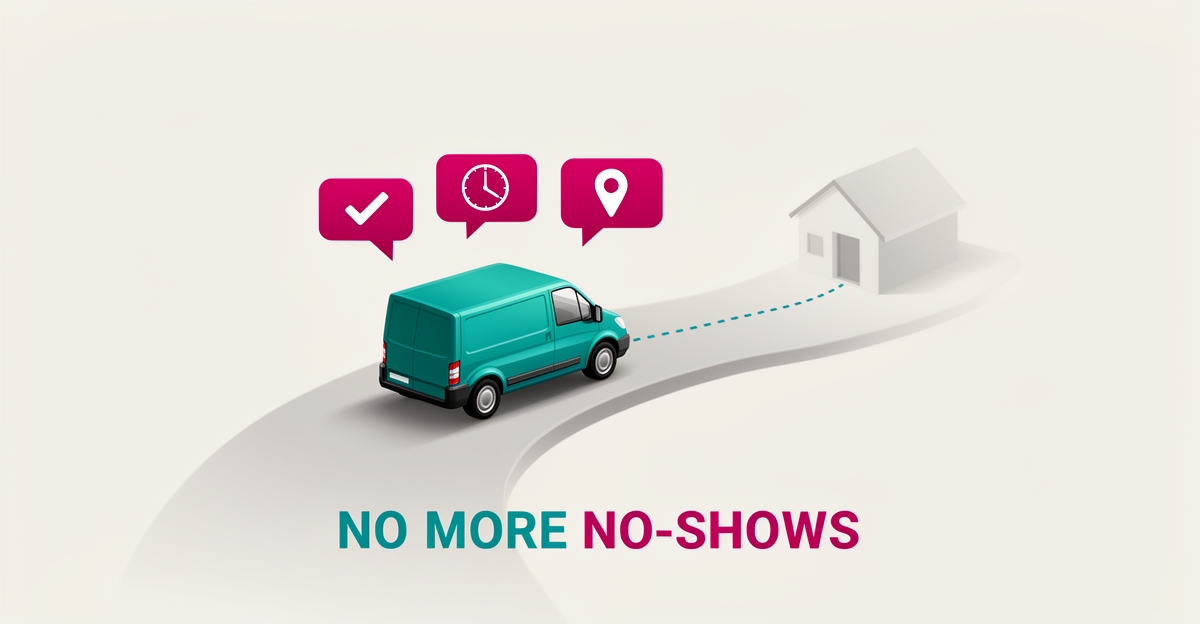
Automated delivery confirmations via SMS, email, or app notifications directly combat these no-shows by engaging customers at critical moments. SMS remains one of the most reliable channels for time-sensitive updates, with open rates that consistently outperform email. Real-time reminders reduce missed deliveries by enabling two-way communication for instructions or rescheduling. AIQ Labs' AI systems enhance this further by personalizing confirmations and tracking compliance, turning delivery touchpoints into opportunities for retention rather than risk.
- SMS alerts remain the highest-reach channel for time-sensitive delivery updates
- Address errors drive a large share of failed deliveries—a key target for proactive confirmation systems
- A meaningful share of consumers won't reorder after a single failed delivery, amplifying long-term revenue impact
How AI-Powered Confirmations Reduce Missed Deliveries
Missed deliveries cost last-mile companies more than just time—they erode trust and revenue. With most consumers actively tracking their packages and many checking multiple times daily, expectations for real-time communication have never been higher. AI-powered delivery confirmations meet this demand by sending personalized, multi-channel notifications that keep customers informed and engaged throughout the delivery process.
SMS remains the most reliable channel for time-sensitive updates, with open rates that consistently outperform email. When combined with email and app notifications, these systems ensure customers receive critical information regardless of their preferred communication method. AI-driven platforms enhance this by delivering real-time ETA updates that dynamically adjust based on traffic, weather, and route changes—industry use cases show this can meaningfully reduce delivery delays. This transparency reduces uncertainty and increases the likelihood customers will be available to receive their packages.
Personalization further strengthens success rates. AI systems analyze historical delivery patterns and customer preferences to suggest optimal delivery windows, increasing the chance of first-attempt success. Two-way communication allows customers to reschedule or provide specific instructions directly through the confirmation system, turning potential failures into successful deliveries. When integrated with dynamic routing and dispatch, these responses trigger instant route adjustments, enabling predictive scheduling that improves on-time performance and reduces unnecessary reattempts.
For businesses seeking to implement these capabilities, AIQ Labs offers AI Employees designed for logistics workflows—such as AI Dispatcher and AI Service Coordinator roles—that can manage automated confirmations, track compliance, and integrate with routing systems to close the loop between customer communication and operational execution. By aligning communication with intelligent dispatch, companies transform delivery confirmations from simple notifications into a proactive system that reduces no-shows, lowers costs, and builds long-term customer retention.
Implementation Roadmap for Delivery Teams
Successfully implementing automated delivery confirmations requires a structured approach that balances technology deployment with operational readiness. Last-mile delivery teams can follow a proven roadmap to minimize risk and maximize adoption. The process begins with defining clear KPIs such as on-time delivery rates, cost per failed attempt, and customer satisfaction scores, then establishing a 30-day baseline to measure current performance industry guidance confirms. This foundational step ensures improvements are quantifiable and tied directly to business outcomes like reducing the cost per failed delivery research shows.
Next, teams should launch a 90-day pilot in a single delivery zone to test system functionality, validate technical integration, and gather real-world feedback before scaling best practices recommend. During this phase, evaluating technical fit with existing route optimization and dispatch systems is critical—especially ensuring APIs support real-time ETA updates and two-way communication studies indicate. Scaling gradually follows, paired with comprehensive driver training to address workflow changes and build confidence in the new tools. Deploying multi-channel confirmations via SMS, email, and app notifications maximizes reach, leaning on SMS's high open rates for critical alerts data confirms. Integrating with route optimization enables dynamic adjustments when customers reschedule or provide delivery instructions, while continuous monitoring allows teams to refine timing, messaging, and channel preferences based on performance data. For owned, production-ready systems tailored to specific operational needs, AIQ Labs' Workflow Builds rebuild the one workflow that costs you the most at a fixed price, in phases—while AI Employees provide managed staffing for ongoing confirmation and dispatch work. Companies that want confirmations, dispatch, and routing connected in one layer can graduate to an AI Operating System built in phases and owned outright.
- Define KPIs and establish 30-day baseline
- Run 90-day pilot in one zone
- Evaluate technical fit and integration readiness
- Scale with driver training and multi-channel deployment
- Integrate with route optimization and enable two-way communication
- Monitor continuously and optimize based on performance
Still paying for 10+ subscriptions that don’t talk to each other?
We build custom AI systems you own outright. No vendor lock-in. Full control.
Not sure where to start? Ask our AI planner
Frequently Asked Questions
How much do missed deliveries actually cost last-mile companies?
Why do so many deliveries fail in the first place?
Will customers actually read delivery confirmation messages?
Can automated confirmations really reduce no-shows?
What happens to customer loyalty after a failed delivery?
Is it hard to implement automated delivery confirmations?
Turning Delivery Touchpoints into Trust-Building Opportunities
Automated delivery confirmations do more than prevent missed deliveries—they transform a pain point into a retention lever. By leveraging AI-powered SMS, email, and app notifications with high-reach channels, last-mile companies can reduce failed attempts, cut the cost per no-show, and address address-related failures before they happen. This proactive approach lowers operational waste and protects the customers who won't give you a second chance after a bad experience, turning delivery compliance into a measurable driver of long-term revenue. For teams ready to move from reactive fixes to strategic automation, the path forward is clear: define your KPIs, run a focused 90-day pilot, and scale with integrated two-way communication that aligns with dynamic routing. AIQ Labs supports this journey with AI Employees like the AI Dispatcher and AI Service Coordinator, Workflow Builds that rebuild your costliest delivery workflow at a fixed price, and AI Operating Systems you own outright. To explore how this could work in your specific delivery workflow, start with the 2-minute Fit Check, then book a free 30-minute strategy call to map your highest-impact automation opportunity. You can also reach the team directly at [email protected].
Make AI your competitive advantage — not just another tool.
Strategy, implementation and ongoing optimization. One partner, end to end.
Not sure where to start? Ask our AI planner