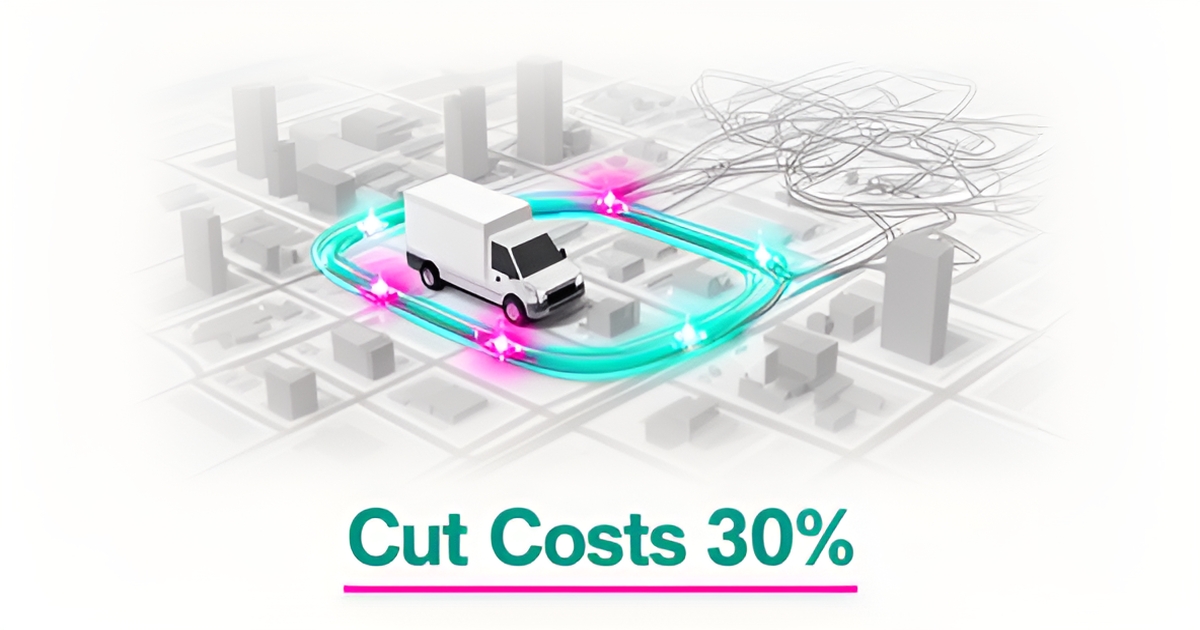
# How Last-Mile Delivery Companies Can Cut Driver Costs by 30% with AI Route Optimization
**Quick Answer:** AI route optimization cuts driver costs by 20-30% by reducing fuel use and delivery time—tackling idle time, failed attempts, and wasted miles with real-time routing that adapts to traffic, weather, and address errors.
## Key Facts
- Last-mile delivery is widely reported to account for roughly half of total shipping costs despite covering the shortest distance
- Industry studies report AI-powered route optimization reducing fuel consumption by around 20% and delivery times by up to 25%
- A majority of failed deliveries trace back to inaccurate address data, turning single errors into costly re-attempts
- Drivers reportedly spend 15-25% of shift time on non-driving tasks like finding entrances and waiting at docks
- Static routes can cause vehicles to travel meaningfully farther than necessary due to lack of real-time adjustments
- AI route optimization is reported to improve first-attempt delivery success rates through predictive analytics
## Table of Contents
1. [The Hidden Cost Drivers in Last-Mile Delivery Operations](#the-hidden-cost-drivers-in-last-mile-delivery-operations)
2. [How AI Route Optimization Reduces Driver Costs by 20-30%](#how-ai-route-optimization-reduces-driver-costs-by-20-30)
3. [Implementing AI Route Optimization: From Assessment to Owned AI Systems](#implementing-ai-route-optimization-from-assessment-to-owned-ai-systems)
## The Hidden Cost Drivers in Last-Mile Delivery Operations
Last-mile delivery has quietly become the most expensive leg of the entire supply chain, consuming roughly **half of total shipping costs** despite covering the shortest distance. The problem isn't distance—it's the compounding inefficiencies that traditional routing tools simply weren't built to solve. Drivers sit idle waiting for access codes, burn fuel circling incorrect addresses, and return packages to depots when recipients aren't home. Delivery industry research consistently shows that a majority of failed deliveries trace back to inaccurate address data, turning a single bad data point into a cascade of wasted hours, fuel, and customer frustration.
**Idle time** is the silent profit killer. When drivers wait at gated communities, navigate poorly marked loading zones, or sit in traffic that static routes couldn't anticipate, the meter keeps running. **Fuel waste** follows naturally—vehicles traveling farther than necessary because routes were optimized once at 6 AM and never adjusted. AI-powered route optimization reduces fuel consumption precisely because it recalculates in real time, factoring in live traffic, weather, and delivery window changes. **Failed delivery attempts** multiply the damage: each re-attempt doubles the labor cost for that package while eroding customer trust.
The cost drivers stack up in ways that spreadsheets obscure:
- Drivers spending 15-25% of shift time on non-driving tasks—finding entrances, calling customers, waiting at docks
- Static routes that ignore real-time constraints like school zones, construction, or time-window changes
- Address inaccuracies forcing multiple delivery attempts or returns to depot
- No feedback loop between today's exceptions and tomorrow's route plans
- Capacity misalignment—too many vehicles on light days, too few during peaks
AIQ Labs works with logistics operators to replace these blind spots with AI workflow systems that ingest live data—traffic, weather, access codes, customer preferences—and continuously re-optimize routes across the
AI Employees
Hire a team member that works 24/7 — for less than a part-time wage.
AI receptionists, SDRs, dispatchers and 99+ roles. Trained on your business, fully managed.
See If You’re a Fit — AI Employees from $700/mo
Not sure where to start? Ask our AI planner
fleet. The result isn't just shorter routes; it's a decision layer that connects orders, capacity, drivers, and real-time execution so the exceptions stop becoming expenses.
## How AI Route Optimization Reduces Driver Costs by 20-30%
AI-powered route optimization directly reduces driver-related expenses by targeting two of the most significant cost drivers in last-mile delivery: fuel consumption and delivery time. Industry research reports that AI-powered route optimization can cut fuel consumption by around 20% and reduce delivery times by up to 25%, leading to substantial savings on labor, vehicle wear, and operational overhead. These improvements stem from dynamic routing that continuously adapts to real-time conditions, minimizing unnecessary mileage and idle time.
The mechanism behind these savings lies in AI's ability to process large volumes of data—including traffic patterns, delivery density, time windows, and vehicle capacity—to generate the most efficient routes possible. Unlike static planning, which relies on fixed schedules and historical averages, AI systems recalculate optimal paths in real time, responding to congestion, weather, or last-minute order changes. This dynamic adaptation reduces detours and stop-and-go driving, which are major contributors to fuel inefficiency. AI-driven routing doesn't just find shorter paths—it optimizes for fuel efficiency by balancing speed, acceleration, and load distribution across the fleet.
Predictive analytics further enhances these gains by forecasting demand spikes and traffic bottlenecks before they occur, allowing companies to pre-position drivers and adjust schedules proactively. For example, AI can anticipate rush-hour congestion in urban zones and reroute deliveries to off-peak times or alternative corridors, avoiding delays that would otherwise increase driver hours and overtime costs. This foresight also improves first-attempt delivery success rates, reducing the need for costly re-deliveries that inflate labor expenses and frustrate customers.
Together, these capabilities create a compounding effect: less fuel burned, fewer miles driven, and more deliveries completed per shift. When drivers spend less time stuck in traffic or making inefficient loops, their productive hours increase without raising payroll costs. AIQ Labs' custom AI workflow systems integrate these optimization engines directly into logistics platforms, enabling automation that scales with business needs. The result is a leaner, more responsive delivery operation where driver costs drop not through cutbacks, but through smarter, data-driven execution.
## Implementing AI Route Optimization: From Assessment to Owned AI Systems
Last-mile delivery operations face mounting pressure to control costs while meeting rising customer expectations. AI route optimization offers a proven path to cut driver expenses by up to 30% through smarter planning and real-time adjustments.
The journey begins with a thorough assessment of current operations. Companies must analyze delivery patterns, driver utilization, fuel consumption, and address accuracy—since a majority of failed deliveries stem from incorrect address data. This baseline identifies bottlenecks where AI can deliver the greatest impact, such as reducing idle time or eliminating redundant miles.
Next, integration with existing logistics platforms ensures seamless data flow. AI systems connect to order management, GPS tracking, and dispatch tools via APIs, enabling dynamic route adjustments based on traffic, weather, and delivery windows. Unlike rigid static planning, AI-powered optimization continuously refines routes in real time, cutting delivery times and fuel consumption as demonstrated in industry studies.
Final
AI Development
Still paying for 10+ subscriptions that don’t talk to each other?
We build custom AI systems you own outright. No vendor lock-in. Full control.
See If You’re a Fit — AI Employees from $700/mo
Not sure where to start? Ask our AI planner
ly, deploying custom AI workflows that clients own outright avoids vendor lock-in while maximizing ROI. AIQ Labs builds production-ready systems that integrate directly with your existing CRM, dispatch, and scheduling software. These owned solutions scale with business growth, delivering sustained savings without ongoing subscription fees—turning route optimization into a permanent competitive advantage. You can start small with a single workflow build and expand as the savings compound.
## Frequently Asked Questions
**How much can AI route optimization actually reduce driver costs in last-mile delivery?**
AI-powered route optimization can reduce driver costs by 20-30% by cutting fuel consumption by around 20% and delivery times by up to 25%, leading to lower labor, vehicle wear, and overhead expenses.
**Why do failed delivery attempts increase costs so much in last-mile logistics?**
Each failed delivery doubles labor costs for that package and erodes customer trust. Industry research consistently traces most failed deliveries back to inaccurate address data that forces re-attempts or returns to depot.
**What makes AI route optimization better than static routing systems?**
Unlike static routes planned in advance, AI systems recalculate optimal paths in real time using live traffic, weather, and delivery changes, reducing unnecessary mileage and idle time while improving first-attempt success rates.
**How does AI address idle time and non-driving tasks that waste driver hours?**
AI reduces idle time by dynamically adjusting routes for access codes, traffic, and customer availability, cutting the 15-25% of shift time drivers typically spend on non-driving tasks like finding entrances or waiting at docks.
**Can companies own their AI route optimization system instead of relying on subscriptions?**
Yes. AIQ Labs builds custom AI workflow systems that clients own outright, avoiding vendor lock-in and ongoing fees while integrating with existing logistics platforms for scalable, long-term savings.
**What data does AI use to continuously improve delivery routes in real time?**
AI ingests live data including traffic patterns, weather, access codes, customer preferences, and delivery windows to re-optimize routes across the fleet and prevent exceptions from becoming expenses.
## Turn Delivery Inefficiencies into Sustainable Savings
Last-mile delivery doesn't have to drain your bottom line. Hidden costs like idle time, fuel waste from static routing, and failed attempts due to poor address data quietly erode profitability—yet they're also the most fixable with the right AI-driven approach. By dynamically optimizing routes using live traffic, weather, and delivery constraints, companies can cut fuel use and delivery times significantly, directly reducing driver-related expenses without cutting corners or headcount. The real advantage lies not just in saving money, but in building a responsive, owned system that scales with your business—turning route planning from a recurring cost center into a strategic asset. If you're ready to assess where AI can make the biggest impact in your operations, start with a free, no-obligation Fit Check to map your biggest bottlenecks and explore high-ROI automation opportunities. It's a real working session with an AI engineer—not a sales pitch—to see if there's a clear win for your business.
AI Transformation Partner
Make AI your competitive advantage — not just another tool.
Strategy, implementation and ongoing optimization. One partner, end to end.
See If You’re a Fit — AI Employees from $700/mo
Not sure where to start? Ask our AI planner