How Medical Supply Distributors Can Cut Inventory Errors with AI-Driven Reordering Systems
Key Facts
- AI-driven reordering systems improved forecast accuracy by ~35% at Unilever's Tinsukia factory according to documented case studies
- Unilever cut its planning freeze window from 14 days to just 1 day using AI-enabled planning based on industry research
- AI implementation reduced finished goods inventory by ~16% at Unilever's Tinsukia factory per supply chain expert analysis
- 17% of healthcare workers admitted to using unauthorized AI tools in the workplace per US healthcare survey
- 39% of frontline healthcare staff use generic free AI tools weekly or more according to workforce studies
- AI systems can spot behaviors and patterns to identify problems long before bigger mistakes are made per IBM's supply chain research
Hire a team member that works 24/7 — for less than a part-time wage.
AI receptionists, SDRs, dispatchers and 99+ roles. Trained on your business, fully managed.
Not sure where to start? Ask our AI planner
The Real Cost of Inventory Errors in Medical Supply Distribution
When a hospital runs out of critical supplies, patient care stops. When a distributor overorders perishable medical products, capital dies on the shelf. This is the daily tightrope medical supply distributors walk—and the margin for error keeps shrinking.
The core problem isn't disruption itself—it's decision latency, the gap between detecting a demand shift and acting on it. As supply chain expert Ghritachi Paul explains, "By the time teams detect a demand shift or production imbalance, the cost is already locked in: excess inventory, rushed schedules, missed service levels." For medical distributors, that locked-in cost carries consequences far beyond the balance sheet.
Stockouts in medical supply aren't just lost sales—they're patient care failures. When a distributor can't fulfill an order for surgical supplies, diagnostic reagents, or chronic care products, the downstream effect cascades through clinics, hospitals, and ultimately to patients waiting for treatment.
Overstocking creates the opposite but equally damaging problem. Medical products often carry expiration dates, temperature requirements, and regulatory constraints that make excess inventory a ticking clock. Every pallet of unsold product represents capital that can't be deployed elsewhere—and in many cases, inventory that will eventually be written off entirely.
The result is a punishing cycle where distributors swing between two failure modes:
- Reactive stockouts — demand spikes detected too late, leaving customers scrambling for alternatives
- Costly overstocking — capital frozen in slow-moving or expiring inventory
- Manual reordering errors — human guesswork applied to thousands of SKUs with wildly different demand patterns
- Missed service levels — damaged relationships with healthcare providers who depend on reliable supply
Traditional inventory planning relies on fixed reorder points, periodic reviews, and long planning freeze windows. In a documented case study, Unilever's AI-enabled planning system cut its planning freeze window from 14 days to just 1 day—while improving forecast accuracy by approximately 35% and reducing finished goods inventory by roughly 16%. Those numbers highlight what manual processes leave on the table.
Most medical supply distributors still operate closer to the 14-day model. Planners review spreadsheets, apply historical averages, and make judgment calls under time pressure. The process works—until it doesn't. A sudden flu season, a product recall, or a shift in prescribing patterns can render weeks of careful planning obsolete overnight.
IBM's research on AI in supply chains notes that AI systems can "spot behaviors and patterns" to identify problems "long before bigger mistakes are made." That predictive capability is precisely what manual reordering lacks. By the time a human planner spots the trend in a weekly report, the optimal response window has already closed.
The cost of inventory errors isn't just operational—it's strategic. Distributors who consistently miss service levels lose contracts. Those who overstock erode their margins and limit their ability to invest in growth. Both failure modes compound over time, widening the gap between reactive distributors and those building intelligent, responsive supply chains.
How AI-Driven Reordering Systems Actually Work
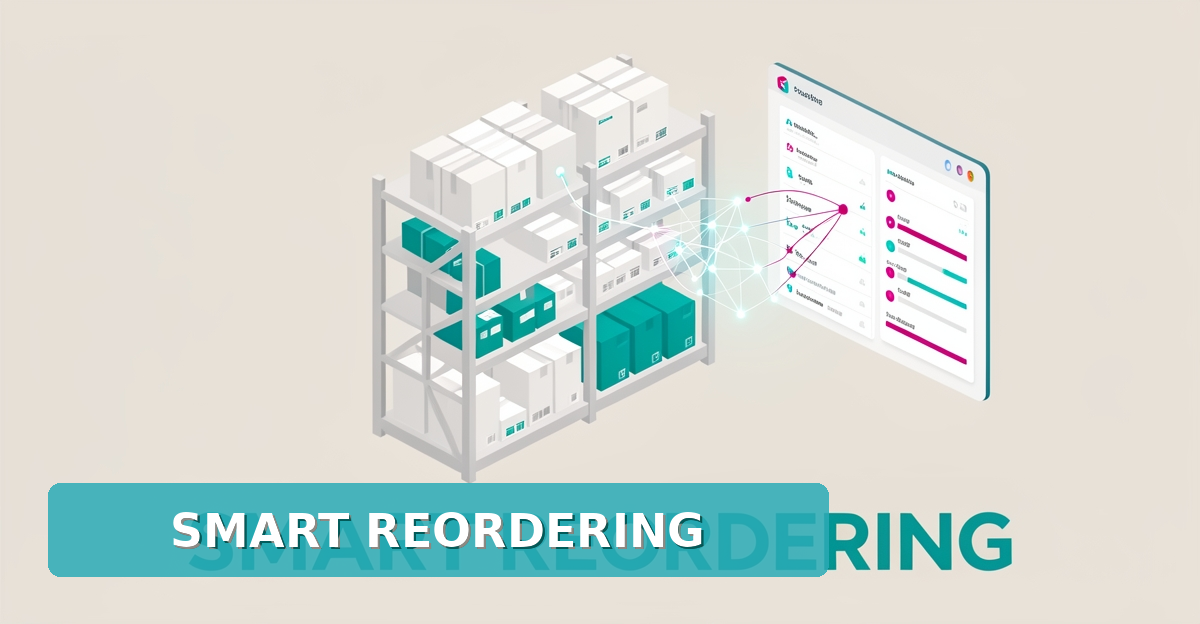
AI-powered reordering systems transform inventory management by turning reactive processes into proactive, data-driven workflows. They begin by ingesting real-time data from ERP systems, sales platforms, and supply chain sensors to create a unified view of inventory levels, demand signals, and order patterns. This continuous data flow eliminates the lag between detecting a shift and taking action, addressing the core issue of decision latency that plagues traditional supply chains. Industry research highlights how this integration enables teams to act while there is still room to maneuver, preventing costly overstock or stockout scenarios before they escalate.
At the heart of these systems is predictive analytics that analyzes historical sales, seasonality, and order behavior to forecast demand with significantly greater accuracy than manual or rule-based methods. Machine learning models continuously refine their predictions as new data flows in, adapting to market changes, supplier performance, and external factors like regional health trends. This dynamic forecasting capability was demonstrated in a documented case study where AI implementation led to a ~35% improvement in forecast accuracy and a ~16% reduction in finished goods inventory, while cutting the planning freeze window from 14 days to just 1 day. The Unilever case study shows how tighter, more responsive planning windows free up capital and reduce waste without sacrificing service levels.
Beyond forecasting, AI-driven systems employ agentic AI agents that can sense inventory thresholds, decide optimal reorder quantities, and act autonomously by triggering purchase orders or alerts within integrated ERP platforms. These agents operate continuously, monitoring for anomalies such as sudden demand spikes or supplier delays, and initiate corrective actions without waiting for human intervention. As described in enterprise AI frameworks, agentic systems move beyond simple automation to orchestrate complex supply chain workflows—such as supplier communications, warehouse slotting, and load optimization—through coordinated, goal-directed behavior. Microsoft's Dynamics 365 platform illustrates how agent-ready ERP environments enable autonomous actions that shift operations from reactive to proactive, improving both speed and accuracy in inventory replenishment.
For medical supply distributors, this level of automation is especially valuable given the critical nature of their products and the risks associated with manual errors. AIQ Labs helps organizations implement these capabilities through AI Workflow Builds—rebuilding the one workflow that costs the most, at a fixed price and in phases—so reordering systems integrate seamlessly with existing ERP tools, with real-time data synchronization and intelligent reorder triggers tailored to specific product lifecycles, regulatory requirements, and demand variability. By combining predictive analytics with agentic decision-making, distributors can reduce reliance on manual checks, minimize human error, and maintain optimal stock levels across diverse SKUs—from high-turnover consumables to low-volume, high-value specialty items. The result is a more resilient, responsive inventory operation that aligns supply with actual clinical need.
Why ERP Integration Is the Make-or-Break Factor
An AI reordering system that can't talk to your ERP is just an expensive dashboard. The single biggest determinant of success isn't the algorithm—it's whether the AI can read live stock levels, write purchase orders, and act inside the systems your team already runs.
The evidence for deep integration is consistent across the industry. IBM notes that AI can streamline an enterprise resource planning framework and be directly embedded within it, learning repetitive tasks like inventory tracking and completing them quickly and accurately. Microsoft takes the same position, emphasizing that agent-ready platforms bring together secure cloud services with unified ERP capabilities so autonomous agents can act on real operational data rather than stale exports.
The practical challenge is interoperability. Medical supply distributors typically run a patchwork of ERP, warehouse management, and supply chain tools—and ripping them out to accommodate an AI system is neither realistic nor necessary. This is where the Model Context Protocol (MCP) changes the equation. Microsoft describes MCP as a universal intermediary that unlocks unified access to platform and app data, modernizing how AI agents interoperate with existing applications. In plain terms, MCP lets an AI agent work within your current stack—querying the ERP, updating the WMS, triggering workflows—instead of replacing it.
Distributors evaluating AI agents should also understand the spectrum of build options:
- First-party agents — prebuilt by the platform provider, such as Microsoft's Supplier Communications Agent, designed for common procurement use cases
- Partner agents — built by third-party vendors like MCA Connect or RSM, often specialized for specific industries such as warehouse slotting or inventory rebalancing
- Custom agents — built to a distributor's exact requirements, integrating directly with its own ERP, WMS, and supplier data
For medical supply distribution, where order patterns, product expirations, and compliance requirements are highly specific, custom-built agents connected through deep two-way integrations often deliver the most reliable results. This is the approach AIQ Labs takes with AI Operating Systems—one connected operating layer built in phases and owned outright by the distributor, with AI inventory and reordering systems that plug directly into existing ERP tools for real-time, accurate inventory management.
Integration also solves the adoption problem. When an AI agent works inside familiar systems, staff don't need to learn a new interface, and the shadow-AI risk documented in healthcare—where 17% of healthcare workers admit to using unauthorized AI tools—is largely avoided because the approved tool is genuinely easier to use.
The takeaway: evaluate any AI reordering system first by its integration depth. The forecasting accuracy gains—up to 35% in documented cases—only materialize when the AI can act on your data, in your systems, in real time.
A Practical Roadmap for Implementing AI Reordering
Medical supply distributors face constant pressure to balance inventory accuracy with patient safety and operational efficiency, and AI-driven reordering offers a practical path forward. By grounding implementation in clear operational goals and healthcare-specific governance, teams can transform inventory management from reactive to proactive. The process begins with building real-time data visibility across ERP systems to detect shifts before they become costly errors, as demonstrated in a case study where planning freeze windows dropped from 14 days to just one day through AI-enabled planning.
Success hinges on clarifying the specific problem to solve—whether reducing stockouts of critical supplies or minimizing waste from expired products—before selecting any technology. As one supply chain expert noted, the first question isn't which model to use, but which operational need wants improvement, preventing AI from becoming another layer of complexity. Once goals are defined, ensuring data quality becomes essential; AI models trained on clean historical data deliver far more reliable forecasts, with documented improvements of approximately 35% in accuracy and 16% in finished goods inventory reductions at scale.
The implementation roadmap then progresses through scenario modeling to test "what-if" situations, automating reorder triggers based on predictive insights, and establishing continuous improvement cycles where the system learns from new data. Throughout this journey, healthcare distributors must establish governance frameworks that include IT, security, and operational leaders to address compliance risks, particularly given that 17% of healthcare workers admit to using unauthorized AI tools in the workplace. Keeping human judgment in the loop remains vital—teams should trust AI recommendations but retain confidence to override them when clinical realities demand it, ensuring technology augments rather than replaces supply chain expertise.
Avoiding the Pitfalls That Derail AI Inventory Projects
AI-driven reordering systems promise significant gains, but their success hinges on avoiding common pitfalls that derail implementation. Poor data quality remains a critical risk, as AI can amplify inaccuracies rather than correct them—essentially making weak inputs move faster when foundational data is flawed. The research emphasizes that information from inventory systems must be accurate enough to guide decisions, or AI will simply accelerate errors instead of preventing them.
Unauthorized AI use, or "shadow AI," presents another substantial challenge, particularly in healthcare-adjacent fields like medical supply distribution. Surveys show 17% of healthcare workers admitted to using unauthorized AI tools in the workplace, while 39% of frontline staff rely on generic, free AI tools weekly or more. This creates security vulnerabilities, privacy risks, and the potential for incorrect guidance that could compromise patient safety or regulatory compliance.
Workforce training gaps frequently stall adoption, as technical capability is rarely the bottleneck—organizational knowledge and willingness to use new tools are. IBM warns that downtime during training is likely and should be scheduled accordingly, while Johnson & Johnson's investment in clinician training highlights that the real barrier is often "will anyone actually use it" rather than "can we build it." Without proper training, even sophisticated AI systems sit underutilized or are misapplied.
Perhaps most dangerously, overreliance on AI without human oversight can erode the very judgment needed to handle exceptions. IBM cautions that AI is a tool that cannot build relationships, and teams must retain the confidence to override recommendations when reality demands it. Human-in-the-loop controls remain essential for critical decisions, ensuring AI augments rather than replaces expert judgment.
These challenges are solvable with the right partner and governance framework. AIQ Labs helps medical supply distributors build custom, owned AI systems that integrate with existing ERP tools, ensuring data quality from the start. The approach includes comprehensive workforce training, continuous monitoring, and ongoing optimization—addressing shadow AI risks through authorized, easy-to-use alternatives while establishing clear governance for responsible AI use. Whether a distributor needs a single workflow rebuilt at a fixed price, managed AI employees handling procurement and dispatch roles, or a full AI Operating System owned outright, the build is phased so value shows up early and risk stays low.
Still paying for 10+ subscriptions that don’t talk to each other?
We build custom AI systems you own outright. No vendor lock-in. Full control.
Not sure where to start? Ask our AI planner
Frequently Asked Questions
How do AI-driven reordering systems actually reduce inventory errors for medical distributors?
What kind of measurable improvements can we expect from AI inventory management?
Is ERP integration really required, or can AI work as a standalone dashboard?
What's the difference between first-party, partner, and custom AI agents for inventory?
How do we avoid shadow AI risks when staff start using unauthorized tools?
What's the first step to implement AI reordering without adding complexity?
From Reactive Stockouts to Resilient Supply
Medical supply distribution will always live on a tightrope between stockouts that threaten patient care and overstock that locks capital in expiring inventory. The core issue isn't disruption itself, but decision latency — and AI-driven reordering closes that gap with real-time ERP integration, predictive forecasting, and agentic systems that can sense thresholds and trigger purchase orders without waiting for weekly reviews. When built on clean data and human-in-the-loop governance, these systems shorten planning windows, improve forecast accuracy and reduce finished goods inventory, as seen in documented cases with ~35% improvement in forecast accuracy at Unilever's Tinsukia factory. For distributors ready to move forward, start by clarifying the one operational pain point to solve first, audit data quality across ERP and WMS, and evaluate any solution on integration depth, not just algorithms. AIQ Labs helps distributors build custom, owned AI reordering systems that plug directly into existing ERP tools for real-time, accurate inventory management—whether as a single fixed-price workflow build or a full AI Operating System. Start the 2-minute Fit Check at aiqlabs.ai/apply, then book a free 30-minute strategy call at aiqlabs.ai/book to map your biggest bottleneck and highest-ROI automation opportunities.
Make AI your competitive advantage — not just another tool.
Strategy, implementation and ongoing optimization. One partner, end to end.
Not sure where to start? Ask our AI planner