How Moving Companies Can Use AI to Track Delivery Times in Real Time
Key Facts
- Tens of millions of Americans relocate every year, generating billions in annual spending on moving services, according to industry statistics
- A large share of U.S. moving companies have adopted some form of artificial intelligence, though adoption often stops at virtual estimates based on industry research
- A majority of consumers report preferring to book moves through apps with smart scheduling and AI-based guidance per consumer preference data
- A growing share of long-distance moving companies now offer AI-based virtual estimates as reported in industry analysis
- The average interstate move covers several hundred miles per moving industry data
- Only a small fraction of Americans move across state lines in a given year, making each interstate job a high-stakes delivery according to relocation statistics
Hire a team member that works 24/7 — for less than a part-time wage.
AI receptionists, SDRs, dispatchers and 99+ roles. Trained on your business, fully managed.
Not sure where to start? Ask our AI planner
The Cost of Blind Spots: Why Moving Companies Lose Trust Without Real-Time Tracking
Every unanswered "Where's my truck?" call erodes the trust moving companies spend years building. With tens of millions of people moving annually in the United States alone, the cumulative cost of those blind spots isn't just operational—it's reputational.
Manual tracking creates a domino effect of friction. Dispatchers rely on driver check-ins that arrive late or not at all. Customers refresh tracking pages that haven't updated in hours. When an ETA shifts, the news reaches the client after the appointment window has already passed. The result: missed delivery windows, rescheduled moves, and a stream of one-star reviews that outpace any marketing budget.
- Drivers stuck in traffic with no automated rerouting alerts
- Customers taking days off work for deliveries that never arrive
- Support teams fielding the same "where is my shipment?" question dozens of times daily
- Revenue lost to refunds, discounts, and cancelled repeat business
The expectation gap is widening. A majority of consumers now say they prefer booking moves through apps or platforms with smart scheduling and AI-based guidance, yet many operators still run on spreadsheets and phone trees. A large share of U.S. moving companies have already adopted some form of artificial intelligence, but adoption often stops at virtual estimates—leaving the most visible part of the journey, the delivery itself, in the dark.
Real-time visibility into delivery status improves customer trust and reduces no-shows. AIQ Labs builds AI systems that integrate with GPS and scheduling software to provide live tracking updates, turning the delivery phase from a liability into a competitive advantage. The technology exists. The only question is how many more moves a company can afford to run blind.
How AI-Powered Dashboards Turn GPS and Scheduling Data into Live Delivery Visibility
When a customer books a move, the clock starts ticking on their expectations — and every hour without an update chips away at their confidence. AI-powered dashboards solve this by pulling live data from GPS trackers, scheduling platforms, and CRM systems into a single view that keeps both your team and your customers informed at every stage of the job.
The demand for this kind of visibility is growing fast. According to industry research, a large share of U.S. moving companies have already adopted some form of AI, and most consumers say they prefer booking through platforms that offer smart scheduling and AI-based guidance. Companies that still rely on phone calls and manual status checks are falling behind these shifting expectations.
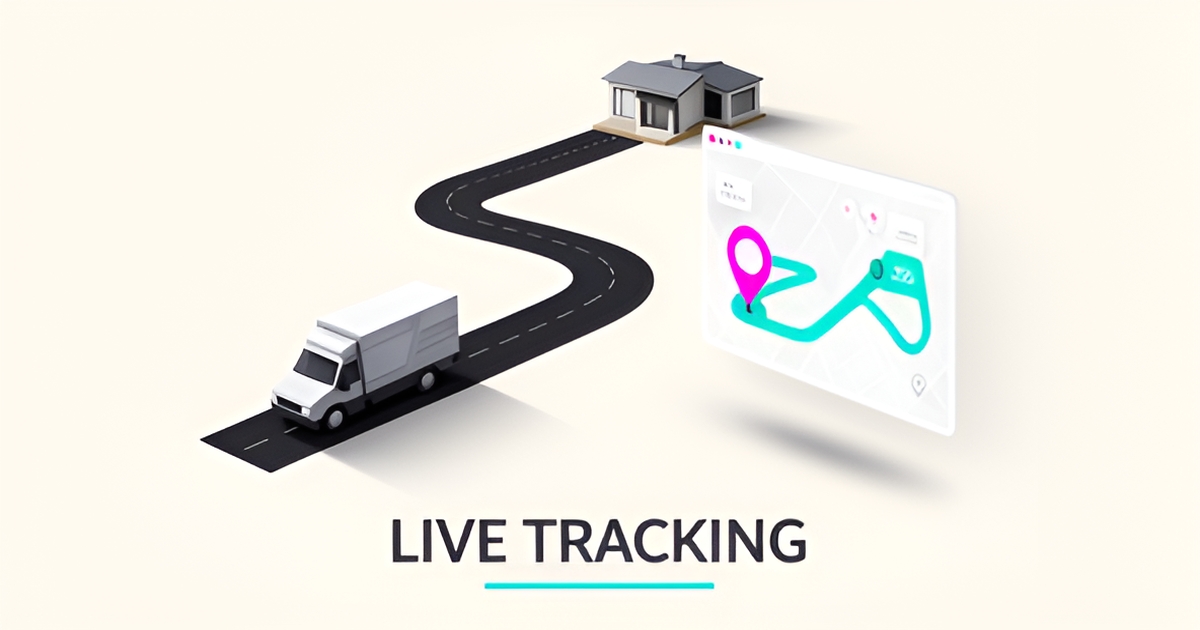
An AI-powered tracking dashboard connects three core data streams. GPS devices on each truck feed real-time location data into the system. Your scheduling software provides job timelines, crew assignments, and delivery windows. Your CRM holds customer contact details and communication preferences. The AI layer sits on top of all three, continuously processing this information to monitor job progress and flag deviations before they become problems.
Here is what the system handles automatically once these integrations are in place:
- Compares actual GPS positions against scheduled arrival times to calculate live ETAs
- Detects delays from traffic, weather, or loading overruns and recalculates delivery windows
- Triggers automated alerts to dispatchers when a job falls behind schedule
- Sends proactive status updates to customers via SMS or email without manual intervention
- Logs every event for post-job analysis and performance reporting
The real power of an AI dashboard is not just showing where a truck is right now — it is predicting where things will go wrong. AI systems trained on historical job data learn patterns like which routes consistently run long, which time slots produce the most delays, and how variables like distance affect job duration. That predictive capability matters in an industry where moving industry data shows the average interstate move covers several hundred miles, and tens of millions of Americans relocate each year.
AIQ Labs builds these systems using multi-agent architecture, where specialized AI agents handle distinct tasks — one processes incoming GPS signals, another cross-references scheduling data, and a third manages customer-facing communications. This is the same architecture AIQ Labs runs daily across its own operations: 200+ multi-agent systems deployed for clients and 4 live SaaS products the company runs every day, processing real-time data in production.
For dispatchers, the dashboard replaces a wall of sticky notes and a phone that never stops ringing. They see every active job on a map, color-coded by status, with AI-generated alerts surfaced to the top. For customers, it means receiving a text when the crew is 30 minutes away instead of waiting through a four-hour window with no information.
The result is fewer inbound "where is my truck?" calls, fewer no-shows caused by miscommunication, and a measurable lift in customer trust. As real-time tracking research confirms, AI-driven visibility gives logistics teams the ability to act on live conditions rather than reacting after problems have already cost time and money.
Building this kind of system does not require replacing your existing tools. Modern AI platforms integrate with the GPS trackers, scheduling software, and CRM systems your company already uses through API connections. The AI layer unifies the data and adds intelligence on top — turning disconnected streams into a single source of operational truth your entire team can act on. If dispatch is the workflow that costs you the most, AIQ Labs' AI Workflow Builds rebuild exactly that one process at a fixed price, in phases.
From Alerts to Action: Implementing AI Tracking That Reduces No-Shows and Builds Customer Trust
Implementing AI-powered tracking transforms how moving companies manage delivery timelines and customer communication. Real-time visibility into job progress allows teams to anticipate delays before they impact schedules, turning potential no-shows into proactive service opportunities. AIQ Labs builds systems that integrate GPS data with scheduling software to provide live tracking updates, enabling dispatchers to intervene early when routes deviate or delays emerge — a direct answer to the majority of consumers who now prefer booking moves through apps with smart scheduling and AI-based guidance, per industry research.
The implementation workflow begins with setting up AI-driven alerts that monitor key milestones—such as departure times, transit progress, and estimated arrival windows—against predefined thresholds. When the system detects a delay risk, it triggers automated notifications to dispatchers via SMS or dashboard alerts, while simultaneously initiating customer updates through preferred channels. This dual-path approach ensures internal teams can reroute resources or adjust crews while customers receive transparent, timely communication about their move's status. For moving companies adopting AI, this reduces uncertainty in an industry where a large share of operators have already brought some form of AI into their operations.
Automated customer updates form the cornerstone of trust-building in this process. Instead of waiting for inquiries, the AI system sends proactive messages at key stages: when the crew is en route, if traffic delays shift the arrival window, or upon successful delivery. These updates can be customized via SMS or email, reducing the burden on support staff while keeping customers informed. Payment models like Build in Milestones and Own It Outright mean moving companies retain full control over data, customization, and future enhancements without vendor lock-in — you own the system outright rather than renting it from a third-party platform. Companies that prefer to start small can begin with a monthly engagement and scale as results come in.
To maximize impact, dispatchers gain intervention tools that turn alerts into action. A centralized dashboard displays live vehicle locations, delay predictions, and suggested actions—such as contacting the next customer to adjust expectations or deploying a backup crew. When AI flags a high-risk delay, dispatchers can override automated messages with personalized communication, ensuring the human touch remains where it matters most. This balance of automation and oversight supports the industry's shift toward AI-powered moving, where predictive analytics and route optimization directly contribute to higher customer satisfaction and lower operational costs. As AI adoption grows—with a rising share of long-distance movers now offering AI-based virtual estimates—companies that own their tracking systems gain a scalable advantage in reliability and service quality.
Still paying for 10+ subscriptions that don’t talk to each other?
We build custom AI systems you own outright. No vendor lock-in. Full control.
Not sure where to start? Ask our AI planner
Frequently Asked Questions
How does AI-powered tracking actually reduce the number of 'Where's my truck?' calls moving companies receive?
What specific data sources does an AI tracking system use to provide real-time delivery visibility for moving jobs?
Have most moving companies already adopted some form of AI, and if so, what are they typically using it for?
Can AI tracking systems predict delays before they happen, or do they only react after a truck is already late?
Do moving companies need to replace their existing GPS trackers or scheduling software to implement AI-powered tracking?
Do consumers prefer booking moves through apps or platforms that offer AI-based guidance and smart scheduling?
Stop Running Moves Blind
Real-time visibility changes the delivery conversation from reactive damage control to proactive service. By connecting GPS, scheduling and CRM data through AI-powered dashboards, moving companies can calculate live ETAs, flag delays before they happen, and send automated updates that keep customers informed without adding support load. That shift directly protects trust, reduces no-shows, and turns the most visible part of the move into a competitive advantage.
The technology is already spreading across the industry, with a large share of U.S. moving companies adopting some form of AI and most consumers saying they prefer booking through platforms with smart scheduling and AI-based guidance, per industry research. The next step is making that visibility actionable for your team.
If you want to see how live tracking can fit your existing GPS and scheduling stack, start with the 2-minute Fit Check at aiqlabs.ai/apply, then book a free 30-minute strategy call at aiqlabs.ai/book to map your biggest delivery bottleneck. Prefer to start with the people side? AIQ Labs' AI Employees can handle dispatch and customer communications at roughly 80% less cost than a human hire. You can also reach the team directly at [email protected].
Make AI your competitive advantage — not just another tool.
Strategy, implementation and ongoing optimization. One partner, end to end.
Not sure where to start? Ask our AI planner