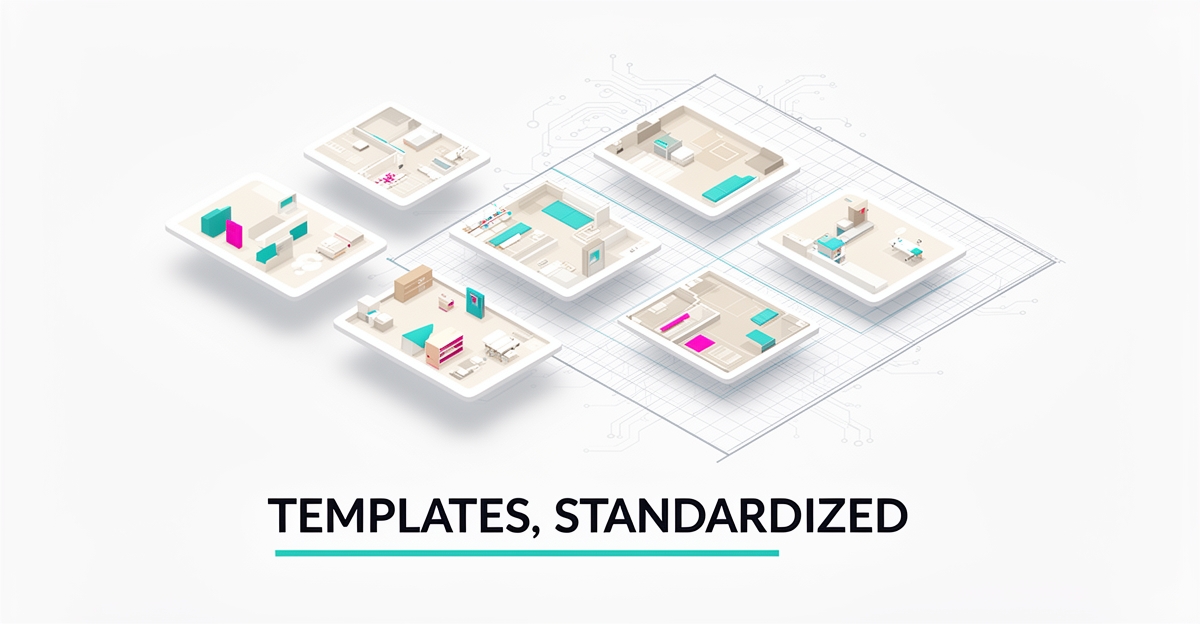
How Space Planning Firms Can Use AI to Standardize Design Templates
Key Facts
- Much of a typical firm's critical facility data lives in unstructured formats like PDF floor plans, legacy blueprints, and disconnected spreadsheets — a common bottleneck AI document ingestion can address.
- Teams using AI-assisted space planning commonly report reclaiming several hours per day from routine layout and drafting tasks.
- Template-driven AI approaches are designed to scale one standardized strategy across multi-site portfolios while preserving site-specific adjustments.
- AI-powered space planning tools can compress the iteration cycle significantly, letting teams explore more alternatives in less time.
- Standardization does not mean sameness: AI generates layouts within constraints your designers define and approve.
Hire a team member that works 24/7 — for less than a part-time wage.
AI receptionists, SDRs, dispatchers and 99+ roles. Trained on your business, fully managed.
Not sure where to start? Ask our AI planner
Introduction
Space planning firms often spend more time hunting for data than designing. Floor plans arrive as scanned PDFs, dimensions live in legacy blueprints, and program requirements sit in disconnected spreadsheets. Manual consolidation slows every project before design work even begins.
AI changes that bottleneck by turning fragmented inputs into consistent, brand-aligned templates. Firms can define project types once — retail stores, offices, clinics — and let automation generate layouts that respect adjacency, circulation, and brand standards. The result is faster iteration and higher design quality without losing the human decisions that matter.
Teams adopting these tools commonly report meaningful daily time savings, as generative design algorithms produce options against user-defined constraints that designers then refine in their traditional tools. The exact numbers vary by firm and portfolio size, but the pattern is consistent: less time on repetitive drafting, more time on judgment calls.
Scale becomes practical, too. Template logic travels across locations while keeping local requirements intact — one standardized strategy can drive layouts for dozens of similar sites, with the AI adjusting for dimensions, zoning, and accessibility rules at each one.
For space planning firms, standardization does not mean sameness. It means:
- Reusable template libraries for common project types like retail stores and offices
- Automatic brand-aligned constraints for materials, signage, and circulation
- Faster concept-to-feasibility cycles with fewer manual iterations
- Consistent documentation that integrates with existing BIM and project workflows
The shift is from one-off customization to intelligent template generation that learns from past projects. Firms keep creative control while AI handles repetitive layout exploration and data normalization.
AIQ Labs builds these automation systems with real-world industry requirements in mind, focusing on production-ready workflows rather than prototypes. The approach aligns with how architects and designers actually work: define constraints, generate options, refine intentionally. If your firm's biggest bottleneck is a recurring workflow rather than design itself, AI Workflow Builds rebuild that one process at a fixed price.
As adoption grows across architecture and commercial design, the competitive advantage moves to firms that can deliver consistent quality faster. AI-powered space planning tools do not eliminate complexity, but they compress the iteration cycle, freeing teams to focus on the high-level design decisions that clients value most.
Key Concepts
AI is transforming space planning by automating design template creation and standardizing workflows across project types. Space planning firms can leverage AI to generate consistent, brand-aligned layouts for common environments like retail stores and offices, reducing manual customization time while maintaining design integrity. This approach shifts focus from repetitive drafting to strategic decision-making, improving both efficiency and output quality. Teams using AI-assisted planning tools typically reclaim hours each day, freeing capacity for higher-value activities. AI tools also enable rapid iteration — compressing design cycles without eliminating the inherent complexity of spatial optimization, so firms can explore more alternatives in less time.
AI-driven template systems work by learning from historical project data, brand guidelines, and functional requirements to produce reusable design frameworks. These templates adapt dynamically to site-specific constraints such as dimensions, zoning rules, and accessibility standards, ensuring compliance while preserving brand consistency. For example, a retail chain can deploy AI-generated store layouts that maintain uniform customer flow and fixture placement across locations, adjusting only for local variations. By anchoring templates in proven spatial patterns and performance data, firms reduce errors and rework during later design phases.
Implementing AI for template standardization requires integrating generative design algorithms with rule-based logic and brand parameters. Firms should begin by defining core project types, documenting recurring spatial needs, and training AI models on approved past designs. Once deployed, these systems continuously improve through feedback loops, refining templates based on real-world performance and user input. Because so much critical facility data sits in unstructured formats like PDF floor plans and legacy blueprints, AI's ability to extract and interpret that information is essential for effective template generation. When combined with workflow automation, space planning firms can create self-improving systems that evolve with project demands and design trends — supporting long-term operational efficiency while elevating the quality and consistency of delivered spaces.
Best Practices
Space planning firms looking to standardize design templates can start by identifying recurring project types — like retail stores or office layouts — and using AI to generate consistent, brand-aligned foundations that reduce repetitive work. Teams that automate routine layout tasks typically reclaim several hours per day, freeing designers to focus on higher-value creative decisions. That efficiency gain is critical when scaling template use across multiple projects or locations.
To build effective templates, firms should first define clear constraints for each project type — such as circulation paths, zoning requirements, or adjacency rules — and feed these parameters into AI tools that use generative design algorithms to produce compliant layouts. These systems excel at compressing iteration cycles, allowing teams to rapidly test alternatives without starting from scratch each time. When core constraints are standardized, one template strategy can drive layouts across an entire multi-site portfolio, with the AI handling site-by-site adjustments.
Successful implementation also requires attention to data quality and workflow integration. Since much critical facility data exists in unstructured formats like PDFs or legacy blueprints, firms should invest in preprocessing this information — extracting dimensions, room labels, and spatial relationships — before feeding it into AI systems. Clean, structured inputs ensure the AI generates accurate, usable templates that align with real-world conditions. Pairing this with gradual rollout — starting with one project type, refining based on designer feedback, then expanding — helps build trust and ensures the templates enhance rather than restrict creativity.
AIQ Labs supports this transformation by developing custom AI workflows that integrate with existing design tools, automating template generation while preserving designer control. Payment is straightforward — start monthly, build in milestones, or own the system outright — so firms can match the investment to their confidence in the approach. By anchoring AI in proven space planning practices, firms turn standardization into a strategic advantage: faster, more consistent results without sacrificing design integrity.
Implementation
AIQ Labs helps space planning firms implement AI-driven template systems that standardize design outputs while preserving brand integrity. The process begins with mapping common project types — such as retail stores, offices, or healthcare facilities — to their recurring spatial requirements, circulation patterns, and compliance constraints. By feeding historical project data, brand guidelines, and jurisdictional codes into a multi-agent AI framework, firms can train models to generate baseline layouts that meet both functional and aesthetic standards. This reduces the need to start from scratch on each new project, and teams using these tools commonly reclaim hours each day previously spent on manual drafting and iteration — redirecting that effort toward client-specific refinements and high-value design decisions.
The implementation workflow integrates with existing design tools through API connections to platforms like Revit, SketchUp, or AutoCAD, ensuring AI-generated templates export cleanly into familiar environments. Firms can define parameterized rules — for example, minimum aisle widths in retail layouts or required proximity between workstations and collaborative zones in offices — that the AI enforces automatically across all generated options. This creates a library of validated starting points that maintain consistency across projects while allowing designers to explore variations within approved boundaries. And because so much critical facility data sits in unstructured formats such as legacy PDFs or scattered spreadsheets, the systems include document ingestion agents that extract and normalize spatial data from these sources, turning dormant assets into training inputs for template generation — essential for firms looking to leverage years of project history without manual re-entry.
To ensure adoption, AIQ Labs recommends a phased rollout: pilot the system on one high-volume project type, measure output accuracy against past designs, and gather feedback from senior designers on usability and creative flexibility. Training sessions focus on how to prompt the AI effectively, interpret generated options, and override parameters when site-specific constraints require deviation — positioning the tool as a collaborative assistant rather than a replacement for professional judgment. Over time, the system learns from designer adjustments, refining its template suggestions to better align with firm-specific preferences and evolving brand standards. As a result, space planning teams not only accelerate delivery timelines but also elevate design quality by starting from stronger, more consistent foundations — proving that automation, when thoughtfully implemented, enhances rather than diminishes the designer's role. AIQ Labs has deployed 200+ multi-agent systems across industries, and the same phased approach applies here: prove the win on one workflow, then expand.
Conclusion
The firms that thrive in the next decade of space planning will be the ones that stop treating every project like a blank slate. With so much critical facility data trapped in unstructured formats like PDF floor plans and disconnected spreadsheets, the opportunity to systematize design templates isn't just a convenience — it's a competitive necessity.
AI-powered space planning tools don't remove the complexity of design work, but they compress the iteration cycle significantly. That compression is exactly what makes standardization possible: once common project types like retail stores or offices are encoded as repeatable templates, teams can generate consistent, brand-aligned starting points in minutes instead of days. Teams adopting these tools commonly reclaim hours per day, and templated intelligence scales across portfolios, not just single projects.
For space planning firms ready to move forward, the path is clear:
- Audit your most common project types and document the constraints — adjacency requirements, usable-area targets, brand standards — that define them.
- Start with one template category, such as office layouts, and pilot AI-generated variations against your firm's existing standards.
- Integrate AI outputs with your existing tools, refining designs in traditional software and returning to the AI for alternative testing during design development.
- Measure results in customization time saved and design consistency, then expand to additional project types.
The firms that get this right will spend less time rebuilding the same layouts and more time on the high-level design decisions that actually differentiate their work. This is where purpose-built automation matters. AIQ Labs builds these systems with real-world industry requirements in mind — custom, owned systems rather than off-the-shelf subscriptions, so the templates and processes your firm standardizes remain your intellectual property.
The technology is proven, the workflow benefits are documented, and the firms adopting AI-driven standardization now will set the benchmark their competitors scramble to match. If you want to map where template automation fits into your firm's operations, start with the 2-minute Fit Check, then book a free 30-minute strategy call — a working session to identify your biggest bottleneck and whether there's a clear win, with no obligation. You can also reach the team directly at [email protected].
Still paying for 10+ subscriptions that don’t talk to each other?
We build custom AI systems you own outright. No vendor lock-in. Full control.
Not sure where to start? Ask our AI planner
Frequently Asked Questions
How much time can AI-powered space planning actually save my firm?
Will AI-generated templates make all our designs look the same?
Our facility data is stuck in old PDFs and spreadsheets. Can AI still work with that?
Can AI template systems scale across a multi-site portfolio, like a retail chain?
Will AI tools integrate with the software we already use, like Revit or AutoCAD?
How do we roll out AI template generation without disrupting our designers' workflow?
Turn Template Chaos into Design Momentum
Space planning firms no longer need to choose between consistency and creativity. By turning fragmented data into intelligent, reusable templates, AI lets teams reclaim hours each day while maintaining brand integrity across projects. The result isn't sameness, but scalable design excellence: faster concept cycles, fewer manual iterations, and more time for the high-value decisions that win clients. Start by auditing your most common project types and piloting AI-generated layouts against your existing standards. Measure the time saved and consistency gained, then expand. If you're ready to see where template automation fits into your workflow, start with AIQ Labs' 2-minute Fit Check and book a free 30-minute strategy call — a working session to identify your biggest bottleneck and whether there's a clear win. No obligation, just clarity.
Make AI your competitive advantage — not just another tool.
Strategy, implementation and ongoing optimization. One partner, end to end.
Not sure where to start? Ask our AI planner