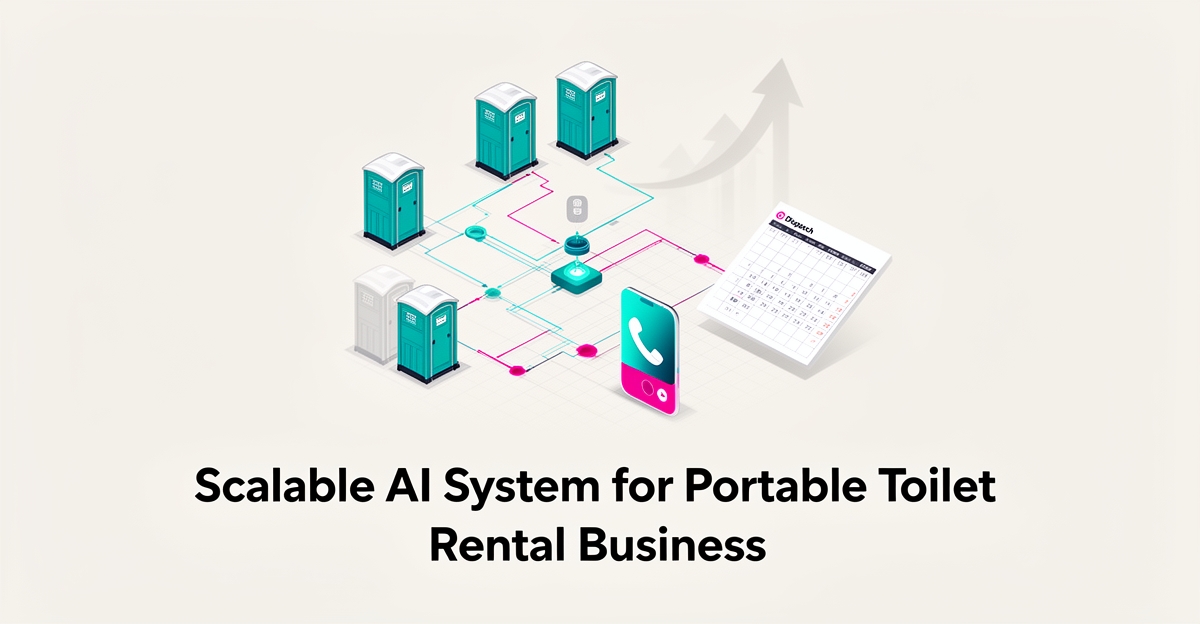
How to Build a Scalable AI System for a Growing Portable Toilet Rental Business
Key Facts
- Data often acts as the first bottleneck in AI systems according to F5
- Enterprises typically transition from a single model to many task-specific variants according to F5
- High-throughput data pipelines are necessary to support training and inference without overloading resources according to F5
- Even the most robust hardware can’t make up for weak operations according to F5
- A deliberate enablement strategy separates AI-fluent organizations from those that stall according to GitHub
Hire a team member that works 24/7 — for less than a part-time wage.
AI receptionists, SDRs, dispatchers and 99+ roles. Trained on your business, fully managed.
Not sure where to start? Ask our AI planner
Why Your Portable Toilet Rental Is Hitting the Scaling Wall
Growth brings opportunity—but also strain. For a portable toilet rental business, scaling means more units, more sites, and more customer touchpoints, all piling pressure onto manual systems. Missed calls pile up as phones ring during job sites, double-booked units create costly conflicts, and dispatch becomes a guessing game when relying on sticky notes and spreadsheets. Data lives in disconnected tools—scheduling apps, accounting software, and email threads—making it impossible to see the full picture or act fast. This operational chaos isn’t just frustrating; it’s the first sign you’ve hit the scaling wall.
The core issue isn’t just workload—it’s data. As F5’s research on scalable AI confirms, data often acts as the first bottleneck, especially when pipelines can’t reliably pull real-time information from multiple sources. Without clean, synchronized data flowing between booking, inventory, and dispatch, even the smartest AI tools stumble. High-throughput data pipelines are essential to support training and inference without overloading systems or disrupting workflows, yet most growing businesses lack this foundation. They’re stuck trying to force AI onto fractured processes instead of fixing the data flow first.
Most businesses stall at the pilot stage, experimenting with isolated tools that promise quick wins but fail to scale. They automate one task—like call routing—only to hit another wall when inventory data doesn’t sync or billing lags behind. True scaling requires more than piecemeal AI; it demands a structured system where data, models, and operations grow together. That’s where a strategic approach separates temporary fixes from lasting transformation. AIQ Labs helps businesses move beyond pilots by assessing workflows, designing integrated AI systems, and ensuring data scales with ambition—turning chaos into a coordinated, intelligent operation.
The Four Layers of a Scalable AI System (Data, Models, Infrastructure, Operations)
Building a scalable AI system for a growing portable toilet rental business starts with understanding the four essential layers: data, models, infrastructure, and operations. Each layer must be designed to scale independently while working in concert to support real-time decision-making across dispatch, quoting, and collections workflows. Without this layered approach, even the most advanced AI models will falter under increasing demand.
Data forms the foundation, requiring unified pipelines that ingest bookings, fleet availability, route optimization, and customer records in real time. According to F5's research on scalable AI, data often acts as the first bottleneck, and high-throughput pipelines are necessary to support training and inference without overloading resources. For a portable toilet rental business, this means synchronizing GPS data from service trucks, maintenance logs, and customer history to enable predictive dispatch and dynamic routing. Without reliable data flow, AI models cannot learn or act effectively.
Model scaling goes beyond simply increasing parameters—it involves orchestrating multiple specialized models and agents for different tasks. Enterprises typically transition from single models to many task-specific variants, requiring robust versioning, rollback capabilities, and distributed inference to balance load and reduce latency. In this context, one model might optimize delivery routes based on traffic and location density, another generates dynamic quotes using seasonal demand and service frequency, while a third handles collections outreach with personalized payment reminders. Coordinating these models ensures each workflow operates efficiently without interfering with others.
Infrastructure must provide the compute, storage, and networking needed to keep systems fed with data and avoid I/O bottlenecks. High-bandwidth networking keeps data flowing to processors, while high-throughput storage enables parallel access to large datasets during training and peak inference periods. For a rental business scaling across multiple service zones, this infrastructure supports real-time adjustments to fleet deployment as demand fluctuates—critical during events or seasonal spikes.
Finally, operational scaling ensures the system remains reliable, observable, and cost-effective over time. Even the most robust hardware fails without strong operations, as F5 emphasizes. Businesses need observability for latency, throughput, cost per inference, and incident response to detect model drift and prevent cost creep. Automated deployment pipelines, policy enforcement, and governance protect model endpoints and maintain compliance. For AIQ Labs, this means embedding monitoring and continuous optimization into every AI system we build—because sustainable scaling isn’t just about technology; it’s about maintaining performance as the business grows.
Building the System: A Phased Roadmap from Workflow Fix to Full AI Operations
Most portable toilet rental businesses don’t fail at AI because the technology doesn’t work — they fail because they try to automate everything at once instead of fixing the one workflow bleeding the most time. A phased build sequence turns AI from an overwhelming project into a series of small, provable wins.
The sequence starts with a sharply defined problem statement. According to Contus’s guide to building AI software, step one is identifying the exact problem and how AI will solve it. For a rental operator, that might sound like: “We miss a large share of after-hours calls and lose weekend event bookings.” That specificity points directly to a solution — a 24/7 AI receptionist that answers, qualifies, and books.
Next comes data. Contus emphasizes collecting high-quality data and cleaning, labeling, and organizing it early to speed up development. In practice, that means consolidating your customer records, service addresses, unit inventory counts, and delivery histories out of spreadsheets and inboxes into one structured system. This step matters more than most owners expect — F5’s research on scalable AI identifies data as the first bottleneck in most AI systems, and poor data quality is a leading cause of model drift and pipeline failure.
With clean data in place, you select the right AI approach for each workflow rather than forcing one tool to do everything:
- AI dispatcher — optimizes driver routes, schedules deliveries and pump-outs, and adjusts in real time when a job runs long
- AI receptionist — answers every call 24/7, books rentals, and captures after-hours event leads
- Lead qualification agent — scores inbound inquiries by event size, duration, and location so your team quotes the best jobs first
- Invoice automation — captures, codes, and routes invoices without manual data entry
Then you deploy one workflow, monitor it, and expand. This is where most businesses stall — GitHub’s AI workforce playbook notes that the difference between a high-performing, AI-fluent organization and one that stalls is a deliberate strategy for enablement, including visible leadership sponsorship and clear usage guardrails. Start with the workflow fix, prove the ROI, then scale department by department — dispatch first, then sales, then billing.
This phased approach is exactly how AIQ Labs structures engagements. Start with a single [workflow build](/workflow-builds) — rebuilding the one workflow that costs you the most at a fixed price — or bring on managed [AI employees](/ai-employees) like receptionists and dispatchers who handle calls and bookings around the clock at a fraction of a human hire's cost. Then build in milestones — approving and paying per phase, keeping everything built so far — until the system grows into a full [AI operating system](/ai-operating-systems) the business owns outright. As AI adoption accelerates across service industries, the operators who build methodically this year will hold a structural advantage over competitors still dispatching by phone tag.
Governance, Guardrails, and Getting Your Team On Board
Technology alone won't determine whether your AI system scales—your people will. GitHub's internal playbook for building an AI-powered workforce puts it bluntly: the difference between a high-performing, AI-fluent organization and one that stalls is a deliberate strategy for enablement.
Executive sponsorship is the first non-negotiable. Visible leadership support provides the strategic vision and investment needed to get started, but it goes deeper than budget approval. Leaders must address the reality of job changes honestly and provide a clear strategy for upskilling and role evolution—especially in a portable toilet rental business where dispatchers, drivers, and office staff may wonder what AI means for their day-to-day work. Leaders should also challenge managers to rethink their teams' workflows, identify tasks ripe for automation, and redefine what high-value work looks like.
Next, establish clear policies before problems emerge. GitHub's playbook calls a clear and accessible Acceptable Use Policy a critical prerequisite for success, and recommends a tiered approach to tooling as a simple framework for safe decisions:
- Fully vetted and approved tools for confidential company and customer data—think customer payment details, service addresses, and contract terms
- Unvetted public and consumer tools restricted to public, non-sensitive data only
- Regular policy reviews as new tools and use cases emerge across the business
This matters more than most growing businesses realize. According to F5's analysis of scalable AI, even the most robust hardware can't make up for weak operations—automated pipelines for policy enforcement and governance are essential to protect model endpoints, enforce access rules, and ensure compliance. Governance isn't bureaucracy; it's the foundation that lets you scale without breaking trust.
Finally, build adoption from the ground up with an AI advocates program. GitHub describes this volunteer network of internal champions as a powerful mechanism for scaling influence—advocates act as local experts, community builders, and vital feedback channels. In a portable sanitation business, that might be the dispatcher who masters AI-assisted routing first, then shows the rest of the team what works.
This people-first structure mirrors how AIQ Labs approaches transformation engagements: governance frameworks, role-specific training, and adoption strategies built into every implementation roadmap, so AI becomes a capability your team owns rather than a tool imposed on them.
Owning the System: Why Ownership Beats Subscription Chaos
Scaling an AI system for dispatch, sales and billing means every new subscription you add becomes a future bottleneck. As portable toilet rental operations grow, vendor lock-in and subscription sprawl quietly erode margins and slow decisions.
Owning your AI infrastructure outright changes that trajectory. A custom-built system replaces a patchwork of point tools with one integrated asset you control, eliminating the integration tax and per-seat fees that multiply as teams expand. Scalable AI demands compute, storage and networking that stay fed with data instead of stalling on congested links.
Subscription chaos also creates operational risk. Enterprises typically move from a single model to many variants—distilled versions, task-specific variants, and fine-tuned models—and model scalability means more than just increasing parameters. Without ownership, you cannot orchestrate versioning, rollouts and rollbacks on your own timeline.
The market is moving fast. Industry research points to rapid AI market growth through 2030, and AI development tooling keeps maturing. That growth is fueling more vendors, more contracts, and more data silos for growing rental businesses.
Ownership gives you three practical advantages as you scale:
- Control over data pipelines that reliably and securely pull real-time data from multiple sources
- Full IP and code ownership with no vendor lock-in or platform dependencies
- Flexible cost structure that scales with usage, not with headcount
AIQ Labs builds production-ready systems where clients receive full ownership of custom-built systems. That aligns with a phased AI implementation roadmap from assessing current workflows to deploying scalable AI agents.
Engagement can match your growth stage. Start Monthly brings on a managed AI employee with setup plus a flat monthly plan, with build, training, integrations, monitoring and improvements included and the ability to pause or adjust anytime. Build in Milestones splits a workflow or department system into phases you approve and pay for as they ship, keeping everything built so far. Own It Outright delivers a full AI operating system with one project price or a monthly Build Partnership, with full ownership of code, agents and data when complete. You can review the details on our [pricing](/pricing) page.
With ownership, you avoid the subscription sprawl that stalls most pilots. The real challenge in AI today isn’t just building an agent—it’s scaling it reliably in production. A free strategy call maps your highest-ROI starting point for dispatch, sales and billing and clarifies the cheapest way to get the win your business is after.
Still paying for 10+ subscriptions that don’t talk to each other?
We build custom AI systems you own outright. No vendor lock-in. Full control.
Not sure where to start? Ask our AI planner
Frequently Asked Questions
Why does our portable toilet rental business keep hitting operational walls as we grow?
What's the biggest mistake companies make when trying to implement AI for dispatch and scheduling?
Do we need to replace all our current software to build a scalable AI system?
How do we prevent AI from creating compliance or data security risks with customer payment details and contracts?
What's the difference between buying AI tools and owning a custom AI system?
How do we get our dispatchers and drivers to actually adopt AI instead of resisting it?
From Manual Chaos to AI-Powered Growth: Your Next Step
Scaling a portable toilet rental business isn’t about adding more trucks or hiring more staff—it’s about fixing the data bottlenecks and broken workflows that hold growth back. As we’ve seen, a scalable AI system starts with unified data pipelines, purpose-built models for dispatch, sales, and billing, infrastructure that keeps up with demand, and operations that ensure reliability and trust. Most importantly, it requires a phased approach: solve one painful workflow first, prove the ROI, then expand. Ownership of your AI system means no subscription sprawl, full control over your data, and the flexibility to scale on your terms. The businesses that win aren’t those chasing AI trends—they’re the ones building methodically, with clear governance and team adoption from the start. If you’re ready to stop patching together tools and start building an AI system that grows with you, the first step is clarity. Take the two-minute [Fit Check](/apply) to see where your highest-ROI opportunity lies—then book a free 30-minute strategy call to make it real, with no obligation and no pressure.
Make AI your competitive advantage — not just another tool.
Strategy, implementation and ongoing optimization. One partner, end to end.
Not sure where to start? Ask our AI planner