How to Build a Scalable AI System for Your Growing Auto Shop
Key Facts
- AI systems often stall at production scale due to unready data pipelines or concurrency issues according to F5
- Modular AI design lets you scale diagnostics, inventory, and scheduling independently as demand grows
- Poor traffic management and inefficient inference paths can sharply increase cloud expenses per F5
- AI is only as smart as its data—bad data breaks everything, good data builds the future
- Single-node GPU workloads (1–8 GPUs) are typically ideal for prototyping before scaling to cloud-native architecture per Splunk
- Cost is a silent killer—use small models for basic tasks and monitor token usage from day one
- Distributed deployment runs lighter models locally for low-latency tasks while reserving heavy models in the cloud per Splunk infrastructure patterns
Hire a team member that works 24/7 — for less than a part-time wage.
AI receptionists, SDRs, dispatchers and 99+ roles. Trained on your business, fully managed.
Not sure where to start? Ask our AI planner
Why Most Auto Shop AI Systems Break When You Grow
Picture this: your shop's AI booking assistant works flawlessly at one location, handling forty cars a week. Then you open a second bay, add a location, or triple your service volume—and suddenly appointments slip, diagnostics lag, and your "smart" system becomes the bottleneck. The problem isn't the AI itself; it's that scalability was never designed in from day one.
As F5 defines it, scalable AI is the ability of systems, models, data pipelines, infrastructure, and operations to maintain performance, reliability, and cost efficiency as demand and complexity increase. That's a tall order for any system bolted together as a quick fix. F5's research notes that a model working in development often stalls at production scale—data pipelines aren't ready, inference endpoints struggle under concurrency, or networking becomes the bottleneck instead of compute.
For an auto shop, that failure shows up in familiar ways: scheduling AI that can't handle two locations' worth of appointments, or inventory predictions built on one-off datasets instead of real-time feeds from your diagnostic tools and parts systems.
The four pillars every scalable AI system needs
Sustainable AI growth rests on four synchronized dimensions, according to F5's scalable AI framework:
- Data scaling — moving from manual record-keeping to automated, high-throughput pipelines feeding diagnostics, scheduling, and inventory systems
- Model scaling — expanding from a single diagnostic model to many specialized models for forecasting, retention, and pricing
- Infrastructure scaling — ensuring compute, storage, and networking keep pace with added service bays and locations
- Operational scaling — maturing release processes, monitoring, and cost management as usage grows
The hidden cost of retrofitting
Here's what most shop owners don't see coming. F5 warns that operational costs rise rapidly from inefficient inference paths, unmanaged concurrency, and poorly shaped traffic—which can sharply inflate cloud expenses. Worse, AI failures rarely announce themselves with a full outage. Instead, they degrade quietly: latency spikes, data pipeline stalls, and model overload that erode reliability one slow response at a time.
Each degraded interaction chips away at customer trust. A missed reminder or a double-booked bay is a small failure, but at scale, small failures compound into reputation damage that's far more expensive to repair than the system itself.
The lesson from teams who've scaled successfully: in production, simplicity scales—the best systems have more modularity than magic. That's exactly the principle behind how AIQ Labs approaches AI Workflow Builds: rebuilding the one workflow that costs you the most, at a fixed price, in phases—designed for your next stage of growth, not just your current one.
The Modular Architecture: Build AI Like a Service Bay Network
Forget the all-knowing AI brain—it's a demo trap. Real scalability starts with breaking your system into specialized, independent parts that grow with your shop, just like adding service bays as demand increases.
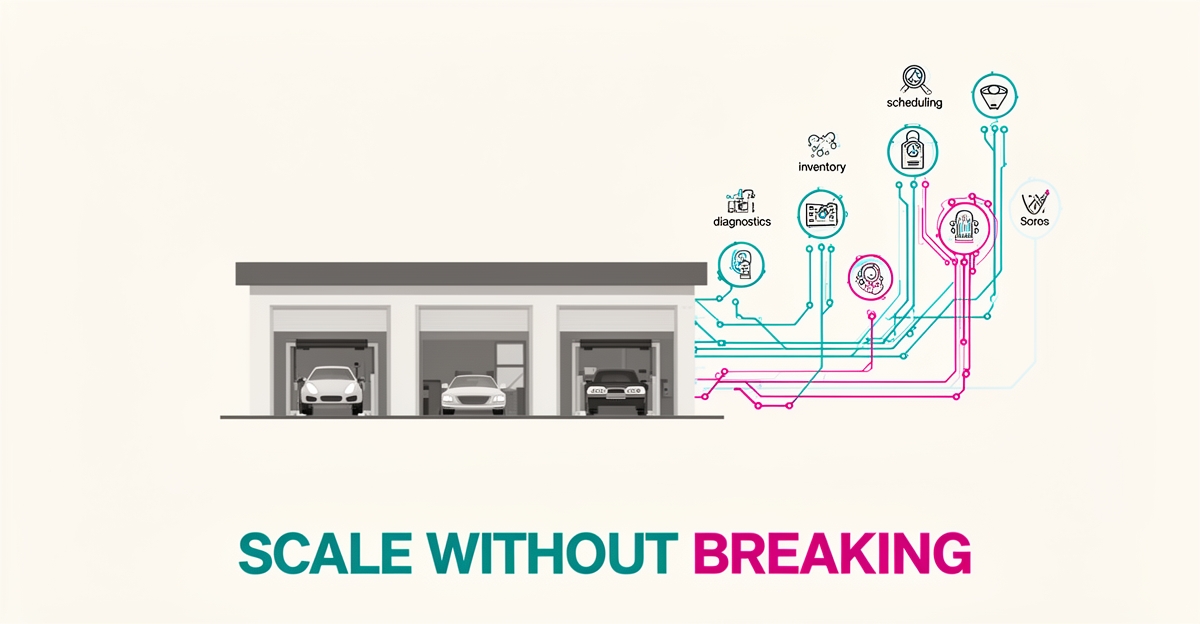
Modular design splits your AI into distinct components—diagnostics, inventory forecasting, scheduling, and customer communication—each handling a specific function without tight coupling. Monolithic agents that try to plan, act, store memory, and communicate all at once are demo-friendly but production-toxic, because they create bottlenecks under real-world load. Instead, separate the planner, executor, and memory modules so each can scale independently when workload spikes—like adding more diagnostic bays during winter tire season.
This approach mirrors how AIQ Labs builds production systems: orchestrating specialized roles as multi-agent workflows, with clean data pipelines feeding each module. Start with single-node GPU workloads for prototyping, then shift to cloud-native architecture with auto-scaling as your service volume grows ensuring infrastructure keeps pace with demand. By designing for independent scaling from day one, your AI system avoids the costly rewrite trap and grows reliably alongside your shop—whether you're adding a second location or expanding into EV servicing. For shops that want a fully connected layer across every workflow, an AI Operating System takes this same modular principle shop-wide, built in phases and owned outright.
From Pilot to Production: The Five-Step Scaling Path
Moving from a single AI agent to a production-ready system requires a deliberate scaling path that anticipates growth from day one. Many auto shops begin with a pilot—perhaps an AI tool for parts lookup or appointment reminders—only to find it buckles under real-world demand. As F5 notes, a model that works in development often stalls at production scale: data pipelines aren't ready, inference endpoints struggle under concurrency, or networking becomes the bottleneck instead of compute. To avoid this, follow a structured five-step process that transforms isolated experiments into resilient, production-grade capabilities.
The journey begins by scaling from a single agent to multi-agent workflows that mirror your shop's operational complexity. Instead of one monolithic AI handling everything, decompose tasks into specialized roles—such as a diagnostic planner, parts checker, and scheduling executor. This modularity allows each component to scale independently as service volumes grow, preventing bottlenecks when, for example, a surge in brake repairs overloads a unified system. Next, automate the entire workflow through event-driven triggers: a new service request initiates diagnostic analysis, which prompts a parts inventory check, updates the shop schedule, and sends a customer notification—all without manual intervention. Use task queues like RabbitMQ or SQS for reliability, webhooks for real-time responses, and Redis for caching frequent lookups.
Deployment and operational maturity follow. Containerize your agents with Docker and deploy via Kubernetes or cloud-managed services to enable horizontal scaling during peak hours (Splunk). From the first day, embed observability: track latency, token usage, and error rates, while implementing guardrails that prevent unsafe actions—such as approving unnecessary repairs—and audit trails for compliance. Simultaneously, enforce security layers including identity management, API protection, and data governance, recognizing that AI is not just a model problem—it's an identity, data, endpoint, API, and governance problem. By treating scalability as a systemic design challenge—not just a model upgrade—auto shops ensure their AI evolves alongside their bays, staff, and customer base. For shops ready to architect this foundation, start with the two-minute Fit Check to map your scaling path.
Scaling Costs, Data Quality, and Multi-Location Growth
Scaling an AI system for your auto shop isn't just about adding more power—it's about building smarter from the start. Many shops hit unexpected cost overruns or data quality issues when trying to expand AI across multiple locations, turning what should be a growth asset into a budget drain. The reality is that scalability fails not from lack of ambition, but from overlooking operational fundamentals like cost control, data integrity, and architectural foresight.
Cost management is often the silent killer of AI initiatives. Every token, every API call adds up—monitor usage early. Use small models for basic steps, and don't throw frontier models at a sorting task. For example, using a large language model to simply categorize service types or check appointment availability wastes resources that could be better spent on complex diagnostics or predictive maintenance. Tracking cost per inference from day one helps identify inefficiencies before they scale—something F5 notes can sharply inflate cloud expenses when traffic management is poor.
Data quality follows the timeless principle: garbage in, garbage out. AI is only as smart as its data—bad data breaks everything, good data builds the future. For auto shops, this means ensuring service records, customer histories, and parts inventory data are clean, deduplicated, and consistently formatted before AI processes them. A single misentered VIN or inconsistent service code can cascade into faulty diagnostics or incorrect parts recommendations, eroding trust in the system across all locations.
Finally, designing for multi-location growth requires thinking beyond a single shop. Scalable AI systems use distributed deployment—running lighter models at each location for low-latency tasks like check-in automation or basic troubleshooting, while reserving heavier models in the cloud for complex analysis across the entire network. This approach, aligned with Splunk's cloud-native architecture patterns, allows shops to scale inference efficiently as they add bays or open new locations. Pair this with continuous improvement loops—where reviewer agent outputs refine memory stores and retrain models—and you create a system that doesn't just grow, but gets smarter with every service cycle. AIQ Labs has deployed 200+ multi-agent systems and runs four live SaaS products daily, and helps shops build exactly this kind of resilient, self-optimizing foundation.
Your Next Move: Audit Before You Automate
Most auto shops don't need another tool — they need clarity on where AI actually pays off. According to F5, scalable AI means maintaining performance and cost efficiency as demand increases, yet many businesses skip the foundation and jump straight to deployment. The result? Pilot projects that stall at production scale because data pipelines aren't ready or inference endpoints buckle under concurrency. AIQ Labs has seen this pattern across industries: the difference between a demo and a durable system comes down to what you audit before you automate.
- Assess current data readiness — clean, consistent records across service history, inventory, and customer profiles
- Identify the single highest-ROI workflow to fix first (dispatch, scheduling, or parts lookup)
- Choose an ownership model that avoids vendor lock-in and keeps your IP portable — AIQ Labs offers Start Monthly, Build in Milestones, or Own It Outright, so you pick the payment structure that fits your risk tolerance
AI is only as smart as its data, and bad data breaks everything. Monolithic agents are demo-friendly but production-toxic — modularity lets you scale parts independently. The shops that win start small, measure ruthlessly, and build on infrastructure they own. For routine front-desk work like call answering, booking, and follow-up, managed AI Employees can handle those roles at roughly 80% less than the cost of a human hire—freeing your team for the work that actually needs a human. AIQ Labs runs a free Fit Check and strategy call — a no-obligation working session with an AI engineer to map your bottlenecks, pressure-test your data, and identify the one automation that moves the needle. If there isn't a clear win, we'll say so.
Still paying for 10+ subscriptions that don’t talk to each other?
We build custom AI systems you own outright. No vendor lock-in. Full control.
Not sure where to start? Ask our AI planner
Frequently Asked Questions
What are the four pillars of a scalable AI system for an auto shop?
Why does a monolithic AI system fail when my auto shop grows?
How can I avoid unexpected cost overruns when scaling my auto shop's AI?
What's the first step I should take before automating any workflow in my auto shop?
How should I design my AI system to support multiple shop locations?
What does a production-ready AI system for an auto shop look like in practice?
Your AI-Powered Growth Starts With One Smart Step
Building a scalable AI system isn't about chasing the latest model—it's about designing for growth from the ground up. As we've seen, auto shops that succeed focus on four pillars: clean data pipelines, modular AI components, infrastructure that scales with demand, and operational practices that keep costs and reliability in check. The most expensive mistake isn't over-investing—it's bolting on AI without a foundation, only to watch it crumble under real-world volume. The good news? You don't need to overhaul everything today. Start by auditing your data readiness, picking one high-impact workflow like scheduling or parts lookup, and choosing an ownership model that keeps you in control. AIQ Labs helps shops like yours make that first move with a free 30-minute strategy call—no pressure, just clarity on where AI actually drives value. If you're ready to build AI that grows with your bays, not against them, take the two-minute Fit Check to see where your biggest opportunity lies.
Make AI your competitive advantage — not just another tool.
Strategy, implementation and ongoing optimization. One partner, end to end.
Not sure where to start? Ask our AI planner