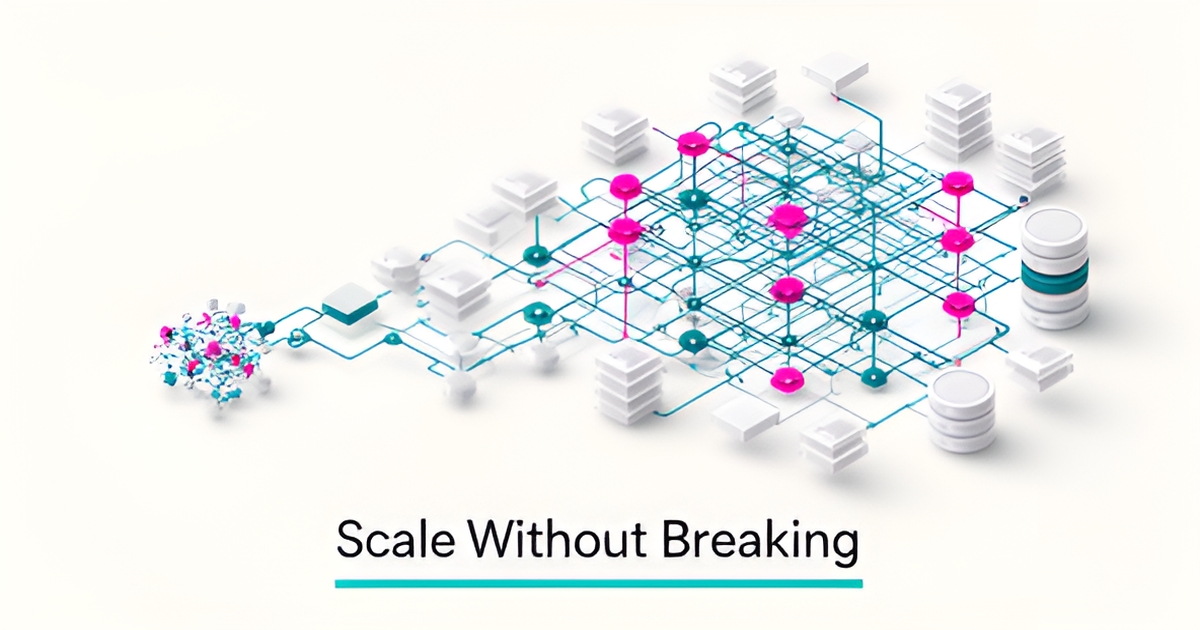
How to Build a Scalable AI System for Your Growing Feed Business
Key Facts
- A multinational bank automated a large share of loan origination and cut compliance errors significantly according to Fortune 500 case studies
- A major retailer deployed AI forecasting across most of its stores, reducing stockouts in the first year per 2026 case studies
- A pharmaceutical giant cut R&D cycle times using AI drug discovery per 2026 case studies
- Latency-sensitive applications cannot tolerate 100-millisecond cloud processing delays per infrastructure analysis
- Cloud platforms let teams spin up GPUs and scale back down, paying only for usage per scalable infrastructure guide
- AIQ Labs has deployed 200+ multi-agent systems and runs 4 live SaaS products daily
Hire a team member that works 24/7 — for less than a part-time wage.
AI receptionists, SDRs, dispatchers and 99+ roles. Trained on your business, fully managed.
Not sure where to start? Ask our AI planner
The Scaling Trap: Why AI Systems Break Between 10 and 100 Clients
Most teams don't hit a compute wall when they grow from ten clients to a hundred. They hit a design wall. The system that hummed along with a handful of accounts starts bleeding money on inference calls, choking on mismatched data formats, and drifting because the training pipeline no longer matches what runs in production. Research confirms that most failures happen because of bad system design — unnecessary model calls, inconsistent pipelines, and weak monitoring — not because the hardware ran out of headroom.
- Cost-per-inference spirals when every request hits a premium model instead of a tiered routing layer
- Training-serving skew degrades accuracy as feature engineering diverges between notebook and production
- Inconsistent data pipelines create silent failures that compound across clients
- Pilot purgatory traps teams in endless proof-of-concept cycles without a path to production
The industry calls this "pilot purgatory" — the stage where most organizations get stuck because they treated AI as a project instead of infrastructure. A scalable AI platform is defined by how well the entire system — data infrastructure, service design, API layer, caching, and deployment — handles increasing workloads while keeping speed, cost, and reliability within business requirements. Companies that win are the ones that build with scalability in mind from day one, not the ones that simply add AI features and hope the architecture holds.
This is where the distinction between a model and a system becomes expensive. A model that works in a notebook is one component; the system around it determines whether you can serve a hundred clients without the economics collapsing. Scalability in AI systems refers to the ability to expand and manage increased workload efficiently through patterns like microservices, serverless computing, and containerization that decouple services and simplify maintenance. Legacy IT infrastructure remains a common bottleneck for AI growth, and cloud-native architectures with elastic compute are the foundation for breaking through.
AIQ Labs approaches this as an architecture and strategy problem. Our AI Workflow Builds and AI Operating Systems help feed businesses design systems that scale from ten to a hundred-plus clients by addressing the real bottlenecks — cost-aware inference routing, feature stores that eliminate training-serving skew, and governance frameworks that turn experiments into dependable business engines. The goal isn't just more compute; it's infrastructure that grows smarter, not just bigger.
Architecture That Scales: Microservices, Cloud Elasticity, and Cost-Aware Inference
Most teams launch AI features quickly, then hit problems later: slowed response times, rising inference costs, and messy data pipelines. These failures stem from bad system design, not insufficient computing power. The companies that win are those that build AI systems with scalability in mind from day one, treating the model as one component in a sprawling architecture that must ingest data, serve predictions in milliseconds, and adapt to shifting demand without crashing.
- Decoupled microservices and containerization so components scale independently
- Cloud and hybrid infrastructure for elastic compute without upfront capital
- Tiered inference strategies — caching, smaller models for routine tasks, premium models for complex requests
Patterns like microservices, serverless computing, and containerization allow systems to scale by decoupling services, simplifying updates and maintenance. A microservices architecture breaks down AI systems into smaller, independent services — data preprocessing, model inference, result processing — that can be developed, deployed, and scaled separately. Docker containers package services with dependencies for consistent performance across environments, while Kubernetes automates deployment, scaling, and health monitoring, automatically adding container instances during traffic spikes.
Cloud platforms (AWS, Azure, Google Cloud) provide elastic solutions that remove hardware limitations and offer out-of-the-box machine learning tools. You can spin up additional GPUs to train a large model and scale back down afterward, paying only for the resources you actually use. Many organizations find success with a hybrid approach — experimenting and developing in the cloud while running production workloads on-premises or in private cloud environments. This shifts the burden of hardware limitations to elastic solutions, allowing for real-time scaling without massive upfront investment.
If every user action triggers a premium model call, costs can grow faster than revenue. A scalable AI platform uses tiered logic: caching repeat questions, using smaller models for routine tasks, and reserving premium models for complex requests. This cost-aware inference approach prevents costs from outpacing revenue as client volume grows. AIQ Labs architects these systems end-to-end, helping feed businesses move from 10 to 100+ clients without the infrastructure debt that stalls growth.
Reliability at Scale: Graceful Degradation, Data Governance, and MLOps
Building an AI system that scales from 10 to 100+ clients requires engineering reliability into the foundation, not treating it as an afterthought. As AI workloads grow, the cost of failure increases — slowed response times, rising inference costs, and messy data pipelines become systemic issues when scalability is ignored during initial design. Research confirms that most AI failures at scale stem from poor system design rather than insufficient computing power, making proactive reliability mechanisms essential for sustained performance.
Operational resilience hinges on three interconnected practices: graceful degradation through fallback mechanisms, rigorous data governance, and mature MLOps. Systems must include timeout controls, circuit breakers, and human handoff protocols for critical tasks to maintain functionality when external APIs or models fail. Industry analysis emphasizes that scalable AI should degrade gracefully — preserving core operations while safely managing component failures. This approach prevents cascading outages and ensures continuous service even during partial system stress, directly supporting business continuity as client demand increases.
Data governance frameworks provide the security and compliance backbone for scalable AI, particularly critical in regulated industries handling sensitive feed business data. Effective governance encompasses data security, privacy protection, audit trails, and alignment with industry-specific requirements — transforming AI from a liability into a trusted business asset. Fortune 500 case studies show that successful scaling depends on robust data infrastructure and governance, with one multinational bank cutting compliance errors substantially after automating loan origination with proper safeguards. These practices ensure AI systems remain auditable, secure, and aligned with evolving regulatory expectations.
Finally, MLOps enables continuous monitoring, retraining, and deployment — turning AI models into dependable business engines rather than fragile experiments. By applying DevOps principles to machine learning, organizations establish feedback loops that detect model drift, trigger retraining, and validate deployments before they impact users. Strategic guidance identifies MLOps and DevOps as critical for AI success, ensuring solutions scale reliably while maintaining performance benchmarks. For growing feed businesses, this means AI systems improve over time, adapting to new data patterns and client needs without requiring constant manual intervention — proving that reliability engineered from day one delivers compounding value as scale increases.
From Strategy to Scale: A Phased Implementation Roadmap for Feed Businesses
Starting your AI journey requires a clear, phased approach to avoid common pitfalls like technical debt or stalled innovation. Begin by assessing your current readiness and defining concrete success metrics tied to business outcomes — this foundation ensures every step delivers measurable value. A strategic guide emphasizes that scalability must be strategic from day one, transforming initial investments into systems that grow with data volumes and user demands without degrading performance.
Build one scalable workflow first — such as automating invoice processing or lead scoring — before expanding to other departments. This incremental approach lets you validate ROI, refine your architecture, and build internal confidence without overwhelming resources. As noted in industry research, prioritizing foundational elements like cloud-native architectures and MLOps practices early prevents bottlenecks and supports elastic scaling as your feed business adds clients. Architecture-focused insights confirm that system design — not just hardware — determines long-term scalability, especially when handling increased inference loads across multiple use cases.
Integrate your AI system with existing tools like CRM or accounting platforms in phases, using microservices and containerization to maintain flexibility and avoid legacy system conflicts. Establish governance frameworks concurrently — defining data security protocols, audit trails, and human-in-the-loop controls — to ensure compliance and trust as automation scales. Scalability best practices highlight that decoupled services through microservices and serverless computing simplify updates and reduce single-point failure risks, critical when managing growing workloads.
AIQ Labs' engagement models align with this phased journey: Start Monthly to pilot a single AI Employee (e.g., a receptionist or SDR), Build in Milestones to deploy and validate one workflow at a time, or Own It Outright for a full system once core processes are proven. This structure lets SMBs scale AI capabilities incrementally, turning experimentation into sustainable operational advantage without massive upfront costs.
- Assess readiness and define success metrics
- Build and validate one scalable workflow
- Integrate incrementally with existing systems
- Establish governance and scale with confidence
Each phase reduces risk while creating a reusable foundation for future AI initiatives, ensuring your system evolves alongside your feed business's growth trajectory.
Scaling Without the Overhead: How AIQ Labs Builds Systems That Grow With You
Scaling an AI system from handling a handful of clients to serving 100+ requires more than just adding computing power — it demands a foundation built for growth from the start. Many businesses hit walls with rising costs, slow response times, and fragile data pipelines when they scale too quickly on unstable infrastructure. AIQ Labs eliminates this risk by architecting systems that scale seamlessly, using proven patterns like microservices, containerization, and cloud-native design to handle increased workloads without degrading performance. Our approach ensures your AI infrastructure grows with your business, not against it.
We've validated this approach in our own production environment: 200+ multi-agent systems deployed, and 4 live SaaS products we run daily — spanning personalized content delivery, intelligent chatbots, large-scale marketing automation, and regulated voice AI applications. These systems aren't theoretical — they process thousands of data points in real time, demonstrating our ability to build and operate scalable AI at volume. Every framework we recommend to clients is one we use ourselves daily. When we say your system will scale, it's because we've already done it — at scale, in production, and under real business pressure.
True scalability also means owning your AI outright, with no vendor lock-in or hidden dependencies. At AIQ Labs, clients receive full ownership of custom-built systems — code, agents, data, and all — so you retain complete control over customization, future development, and integration. We offer flexible engagement models — Start Monthly, Build in Milestones, or Own It Outright — each designed to align with your growth trajectory while eliminating upfront risk. Whether you're automating a single workflow or deploying a full AI operating system, you own what we build, and you can pause, adjust, or expand anytime.
Ready to see how this applies to your feed business? Start with the two-minute Fit Check to identify your highest-impact automation opportunity, then schedule a free 30-minute strategy call with our team. We'll map your biggest bottleneck, outline a clear path to scalable AI, and tell you straight if there isn't a win — no obligation, just clarity.
Still paying for 10+ subscriptions that don’t talk to each other?
We build custom AI systems you own outright. No vendor lock-in. Full control.
Not sure where to start? Ask our AI planner
Frequently Asked Questions
Why does my AI system work fine with 10 clients but break down when I scale to 100?
How do I prevent AI inference costs from spiraling out of control as I add more clients?
What's the difference between an AI model and a scalable AI system?
Should I build my AI system in the cloud or on-premises?
What architecture patterns actually work for scaling AI from 10 to 100+ clients?
How do I ensure my AI system stays reliable as it handles more clients and data?
Scale Smarter, Not Harder
Scaling from ten to a hundred clients breaks AI systems through design, not hardware. The companies that win build for scalability from day one — with decoupled microservices and containerization, elastic cloud infrastructure, and cost-aware inference that routes routine work to smaller models and reserves premium capacity for complex requests. Reliability at scale comes from graceful degradation, rigorous data governance, and MLOps that closes the loop between training and serving to prevent drift and silent failures. A phased roadmap lets feed businesses validate ROI with one workflow, integrate incrementally with existing CRM and accounting tools, and establish governance before expanding. AIQ Labs designs systems that grow with you, using production-proven patterns and engagement models like Start Monthly, Build in Milestones, or Own It Outright so you can scale without massive upfront investment. Start with the two-minute Fit Check to identify your highest-impact automation opportunity, then book a free 30-minute strategy call for a clear, no-obligation path to scalable AI.
Make AI your competitive advantage — not just another tool.
Strategy, implementation and ongoing optimization. One partner, end to end.
Not sure where to start? Ask our AI planner