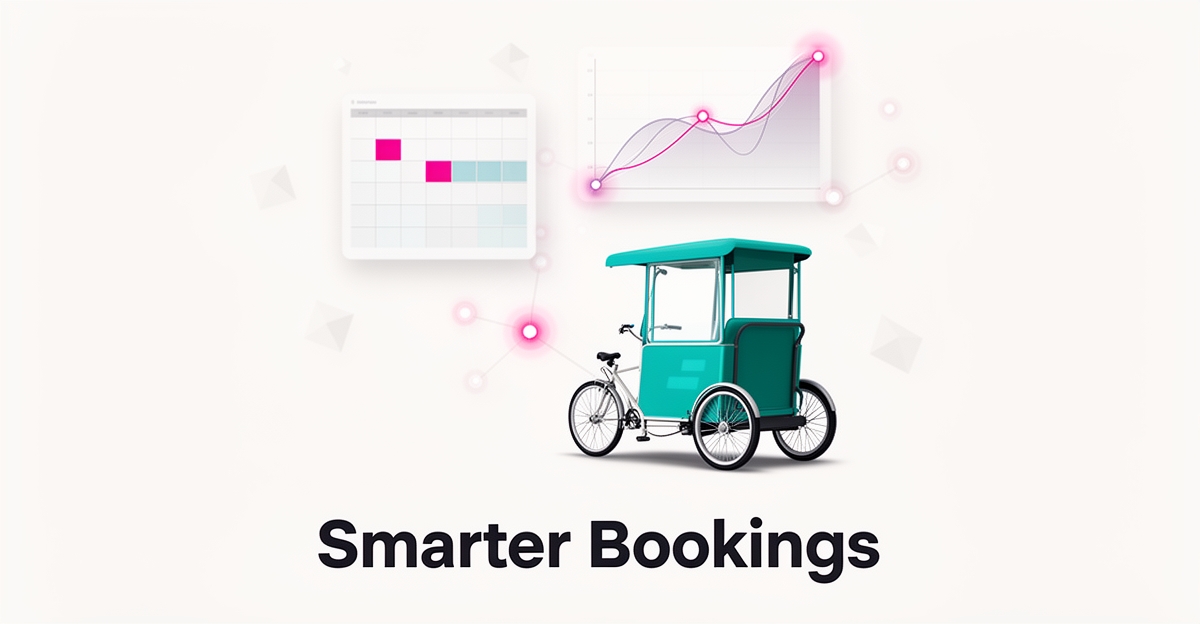
How to Build an AI-Driven Booking System for Your Pedicab Service
Key Facts
- Industry analyses consistently report meaningful conversion gains from AI-driven recommendations and single-digit revenue uplifts from dynamic pricing—results vary by operation
- Most travel and local-transport bookings now start online, and slow mobile experiences directly increase abandonment
- Pedicab operators lose revenue to missed calls, double bookings and static pricing during peak demand
- AI systems can personalize offers, optimize pricing dynamically and reduce friction for riders and drivers
- AIQ Labs has deployed 200+ multi-agent systems and runs 4 live SaaS products daily
Hire a team member that works 24/7 — for less than a part-time wage.
AI receptionists, SDRs, dispatchers and 99+ roles. Trained on your business, fully managed.
Not sure where to start? Ask our AI planner
Why Pedicab Services Need AI-Powered Booking Now
Every summer weekend, pedicab operators lose revenue to the same three problems: a phone that rings while they're pedaling, a paper schedule that double-books two riders at once, and flat pricing that leaves money on the table during peak demand. These aren't minor annoyances—they're structural leaks in a business model that AI-powered booking systems are now built to plug.
The timing is hard to ignore. Booking platforms of every kind are adding intelligence, and as of late 2026 the gap between operators with adaptive booking systems and those running on paper schedules is widening. Local transportation services that wait will find themselves competing against operators who already have a head start.
Consider what manual operations actually cost a pedicab business day to day:
- Missed bookings when calls go unanswered mid-route, since a driver can't stop to take a reservation
- Double-bookings and idle time caused by handwritten schedules and disconnected calendars
- Static pricing that charges the same rate at 2 p.m. on a slow Tuesday as it does during a sold-out festival night
- Hours of administrative work each week spent coordinating riders, confirming times, and chasing payments
The upside of fixing this is measurable, not theoretical. Industry analyses typically find that AI-driven recommendations improve conversion rates meaningfully, and that dynamic pricing alone can deliver a single-digit percentage revenue uplift. For a small fleet, that difference compounds quickly across a season—every recovered missed call and every peak-night fare priced correctly adds up.
There's also a customer-behavior argument. Most travel and ride bookings now happen online, and tourists expect to book a ride from their phone in seconds—not call a dispatch line and hope someone picks up. A slow or clunky booking experience directly increases abandonment, sending would-be riders to rideshare apps instead.
This is where purpose-built AI systems separate themselves from generic scheduling tools. AIQ Labs designs booking engines that adapt to rider preferences and real-time availability, personalize offers, optimize pricing dynamically, and reduce friction for both riders and drivers—capabilities that off-the-shelf calendar apps simply don't offer to a pedicab operation. For operators who want to start smaller, a managed AI receptionist or dispatcher can answer every call and take bookings around the clock at a fraction of a human hire's cost.
The window is open now. The technology is proven, adoption is accelerating, and the operational pain is real. Pedicab businesses that build intelligent booking systems today will capture the riders—and the margins—that slower competitors leave behind.
How AI Transforms Booking: Personalization, Pricing, and Friction Reduction
Rider expectations for instant, relevant booking options are reshaping how pedicab services compete. AI moves booking from a static form to an adaptive conversation that learns, predicts, and acts in real time.
Personalization turns casual interest into completed rides. AI-driven recommendations improve conversion because suggestions reflect past trips, preferred routes, and current context rather than generic slots. For pedicab operators, that means surfacing a sunset river loop to a returning tourist or a quick campus shuttle to a student at peak hours, without manual curation.
Dynamic pricing and availability optimization protect revenue while reducing empty seats. Dynamic pricing typically delivers a single-digit revenue uplift, allowing fares to flex with demand, weather, events, and driver supply. Real-time personalization engines pair this with rider-specific offers, so price moves are perceived as relevance, not penalty.
Friction reduction is the operational payoff. With most bookings now starting online and mobile page speed directly impacting abandonment, AI agents shorten the path to confirmation. Conversational intake captures pickup details, handles changes, and routes requests to the right driver automatically.
Multi-agent systems make this practical at scale. AIQ Labs builds fully integrated AI systems that personalize offers, optimize pricing, and reduce booking friction for both riders and drivers through multi-agent orchestration and real-time personalization engines. The architecture mirrors proven patterns for AI booking:
- Preference learning agents that build rider profiles from booking history and chat interactions
- Availability agents that reconcile driver location, route capacity, and traffic in real time
- Pricing agents that adjust fares within policy guardrails to balance demand and utilization
- Friction-reduction agents that handle rescheduling, confirmations, and support via voice and chat
The market momentum supports the shift. Businesses across hospitality and local transport are automating booking tasks and personalizing experiences, and the operators doing it are seeing higher completion rates, fewer no-shows, and drivers earning more per hour. For pedicab services, the same patterns apply directly.
When personalization, pricing, and friction reduction work together, booking becomes a competitive advantage rather than an administrative cost.
Building Your AI Booking System: A Step-by-Step Implementation Guide
Building an AI-driven booking system transforms how pedicab services connect with riders by combining automation, personalization, and operational intelligence. A structured implementation approach ensures the solution addresses real-world needs while leveraging proven AI frameworks for scalability and reliability.
Start by defining clear business objectives such as reducing booking friction, increasing conversion rates through personalized offers, and optimizing driver availability using predictive scheduling. These goals are measurable from day one—track missed-call recovery, booking completion rate, and revenue per driver-hour as your baseline. AIQ Labs' AI Workflow Builds service is built for exactly this phase: rebuild the one workflow that costs you the most, at a fixed price, delivered in phases so you see value before committing to more.
Next, choose a technology stack built for agentic workflows and real-time tool integration. Modern multi-agent orchestration frameworks and protocols like the Model Context Protocol (MCP) connect AI agents to calendars, payment processors, and CRM systems—enabling AI employees to perform end-to-end tasks like confirming bookings, processing payments, and sending reminders. This foundation supports the development phase, where specialized agents handle rider preferences, dynamic pricing logic, and dispatch coordination using patterns proven in production. AIQ Labs has deployed 200+ multi-agent systems and runs 4 live SaaS products daily, so these patterns are tested under real load, not in demos.
Integrate the system with existing tools such as Google Calendar for availability tracking and Stripe for secure payments, ensuring seamless data flow without disrupting current operations. Rigorous testing follows, validating AI decision-making, fallback systems, and human-in-the-loop controls for edge cases—critical for maintaining trust in automated interactions. Governance and performance standards should be defined before launch, not after.
Finally, optimize continuously by monitoring booking completion rates, customer feedback, and driver utilization. Ongoing support should include performance tuning, feature expansion, and scaling assistance as the pedicab service grows. For operators ready to connect booking with dispatch, payments, and marketing in one place, an AI Operating System provides a single connected operating layer—built in phases and owned outright, with no vendor lock-in. This phased process—Discovery & Architecture, Development & Integration, Deployment & Training, and Optimization & Scale—creates an owned, adaptive booking platform that reduces manual workload while enhancing the rider experience. Start the two-minute Fit Check at https://aiqlabs.ai/apply to begin with a free 30-minute strategy call and map your highest-impact automation opportunity.
Still paying for 10+ subscriptions that don’t talk to each other?
We build custom AI systems you own outright. No vendor lock-in. Full control.
Not sure where to start? Ask our AI planner
Frequently Asked Questions
How much can AI-powered booking actually increase revenue for a small pedicab service?
Why can't I just use a regular calendar app like Google Calendar for my pedicab bookings?
Do riders actually book online now, and how does page speed affect abandonment?
Is building a custom AI booking system too complex for a small pedicab business?
How do AI agents actually work together in a booking system for pedicabs?
What's the first step to building an AI booking system for my pedicab service?
Turn Booking Pain Points into Pedicab Profits
This guide has shown how AI-powered booking solves the real operational leaks in pedicab operations—missed calls, double-booking, flat pricing, and admin overload—by turning scheduling into a smart, adaptive system that personalizes offers, optimizes pricing, and reduces friction for riders and drivers. Every season you run on manual scheduling is a season of recovered revenue left on the table. The path forward starts with a focused look at your biggest bottleneck. Take the two-minute Fit Check at https://aiqlabs.ai/apply to see where AI can deliver the fastest impact for your service—no obligation, just a real conversation about what's possible.
Make AI your competitive advantage — not just another tool.
Strategy, implementation and ongoing optimization. One partner, end to end.
Not sure where to start? Ask our AI planner