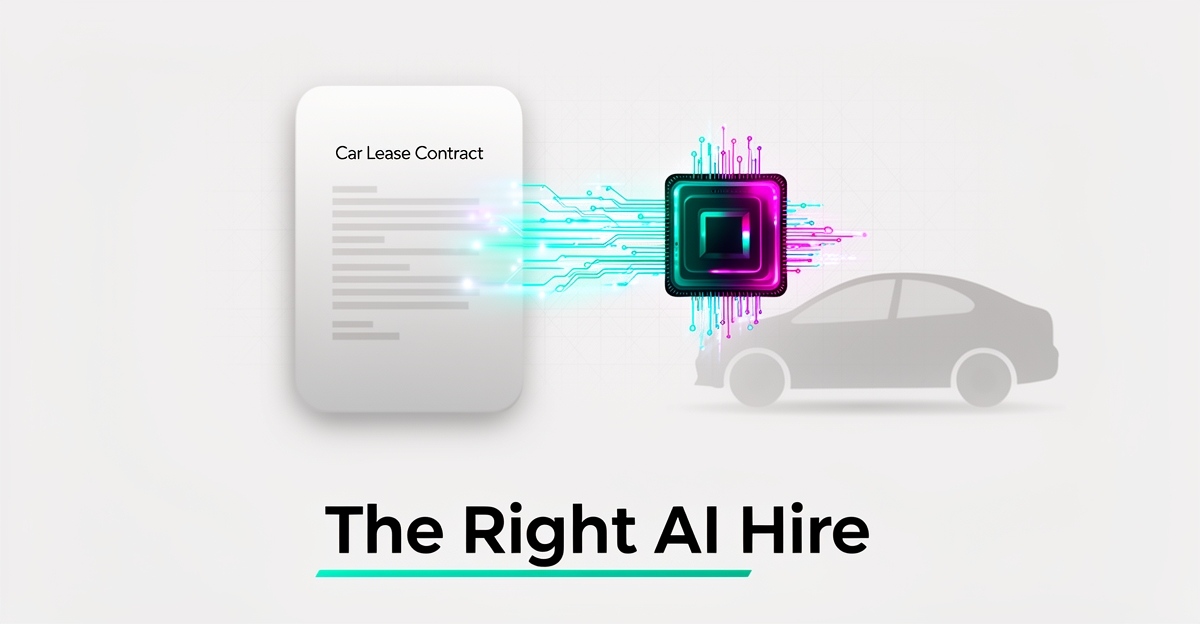
How to Choose the Right AI Employee for Your Car Leasing Business
Key Facts
- AI-powered lease extraction is typically far cheaper than manual abstraction, which industry analyses report at €200–500 per lease according to LeaseIQ
- Manual lease abstraction reportedly takes 4–8 hours per contract, while AI extraction processes a lease in roughly 2–5 minutes per LeaseIQ research
- AI extraction is reported to achieve 90–97% accuracy on standard terms, versus an 8–15% error rate for manual work per LeaseIQ's comparison
- AI operating systems are reported to outperform manual processes in fleet management once a fleet exceeds roughly 25 to 30 vehicles per AI Business OS
- AI lease analysis is reported to be dramatically faster and more accurate than manual review according to LeaseScan.ai
- AIQ Labs' managed AI employees run at roughly 80% less cost than an equivalent human hire
- AIQ Labs has deployed 200+ multi-agent systems and runs 4 live SaaS products daily
Hire a team member that works 24/7 — for less than a part-time wage.
AI receptionists, SDRs, dispatchers and 99+ roles. Trained on your business, fully managed.
Not sure where to start? Ask our AI planner
The Hidden Cost of Manual Lease Processing in Car Leasing
Every lease contract that crosses your desk carries a price tag most leasing businesses never calculate. Manual lease abstraction is reported to cost €200–500 per lease in-house and demand 4–8 hours of staff time per contract — and that's before the errors start compounding.
The accuracy problem is where the real damage hides. Manual abstraction reportedly carries an error rate of 8–15% on individual data points, meaning a single misread rate, term, or mileage clause can ripple through billing, compliance, and customer trust. AI-powered extraction, by contrast, is reported to achieve 90–97% accuracy on standard terms while processing a lease in 2–5 minutes at a fraction of the manual cost.
Then there are the costs that never appear on a P&L. When abstraction quality slips, the downstream consequences multiply quickly:
- Re-abstraction of amendments: a 200-lease portfolio averaging 2.5 amendments each generates 700 documents to process
- Missed critical dates that can cost a meaningful share of annual rent
- Compliance failures that erode portfolio value and customer trust
- Lost negotiating leverage — disciplined critical date management is reported to deliver 10–15% better terms at renegotiation
The scale threshold matters too. According to AI Business OS, AI operating systems outperform manual processes in fleet management once a fleet exceeds roughly 25 to 30 vehicles — meaning most established leasing businesses have already crossed the point where manual methods structurally hold them back.
The financial gap widens with volume. AI lease analysis is reported to run dramatically faster and more accurately than manual review, and AI-powered extraction typically costs a small fraction of manual abstraction. For leasing businesses, the more concrete number is this: AIQ Labs' managed AI employees run at roughly 80% less cost than an equivalent human hire, and the company has deployed 200+ multi-agent systems across industries.
This is why the question isn't whether to automate lease processing — it's which AI role fits your workflow. A readiness assessment, like the one behind AIQ Labs' 2-minute Fit Check, matches your specific lease volumes, document types, and error exposure to the right AI employee configuration, whether that's an AI lease counselor, inquiry handler, or compliance monitor. The hidden cost of manual processing is already on your books; the only real decision is how quickly you stop paying it.
Matching AI Employee Roles to Your Specific Leasing Workflows
The most expensive AI employee is the one doing a job you didn't need automated in the first place. Car leasing businesses that see real returns start by mapping specific AI roles to the workflows bleeding the most time and money.
Contract processing and lease abstraction represent the clearest starting point for most leasing operations. Manual abstraction is reported to cost €200–500 per lease, take 4–8 hours per contract, and carry an 8–15% error rate on individual data points, according to LeaseIQ's analysis of AI versus manual abstraction. An AI employee handling document processing cuts that to minutes per document with high accuracy — which is why AIQ Labs' AI Employees catalog includes roles like Data Entry Agents and Quality Assurance Agents that slot directly into this workflow.
Critical date tracking is where compliance-focused AI roles earn their keep. Missed critical dates can cost a meaningful share of annual rent, while companies with disciplined date management are reported to achieve 10–15% better terms at renegotiation, per the same LeaseIQ research. An AI compliance monitor or scheduler role — analogous to AIQ Labs' AI Scheduler or Calendar Manager — watches renewal windows, amendment deadlines, and payment dates around the clock.
For customer-facing work, the matching logic looks like this:
- Inquiry handling and intake: AI receptionists and intake specialists answer every call and email, qualifying prospects before your team ever picks up the phone
- Lease counseling: AI chat agents walk applicants through terms, documentation requirements, and application status using your actual lease data
- Billing and collections: AI accounts receivable clerks and collections agents chase overdue payments with compliant, documented outreach
- Fleet coordination: AI dispatchers and logistics agents track vehicle assignments, returns, and availability in real time
Fleet-heavy operations hit a tipping point worth noting: AI operating systems are reported to outperform manual processes once a fleet exceeds roughly 25 to 30 vehicles, according to AI Business OS research. If your leasing portfolio sits above that threshold, an operations-focused AI employee — or a fuller AI Operating System — likely delivers faster payback than a front-office one.
The practical takeaway: don't hire an AI employee for a generic title. Identify your highest-cost workflow — abstraction errors, missed dates, unanswered inquiries, or fleet coordination gaps — and match the role to that specific bottleneck. If one workflow is clearly the biggest drain, a fixed-price AI Workflow Build rebuilds just that piece; if the whole operation needs connecting, the phased AI Operating System approach fits better. A readiness assessment, like the discovery process AIQ Labs runs before any deployment, exists precisely to make that match before you spend a dollar on the wrong hire.
Implementing AI Employees: From Pilot to Full Integration
Starting with a focused pilot allows car leasing businesses to validate AI impact before scaling, reducing risk while capturing early wins. AIQ Labs' implementation begins with a discovery workflow fix or AI employee pilot targeting high-friction areas like lease abstraction or inquiry handling. Each phase ties directly to measurable outcomes such as reduced processing time, lower error rates, and cost savings.
For lease abstraction specifically, AI-powered extraction is reported to cost a small fraction of manual methods and process a lease in roughly 2–5 minutes at high accuracy, compared to manual abstraction's reported 4–8 hours per contract and 8–15% error rate. That efficiency gap is why extraction-focused AI employees typically pay for themselves quickly.
The implementation follows structured phases. Phase 1 focuses on discovery and architecture, analyzing current workflows and designing a solution aligned with business goals. Phase 2 covers development and integration, building the AI employee and connecting it to essential tools like CRM and document management systems. Phase 3 handles deployment and training, ensuring smooth go-live and team readiness. Phase 4 drives ongoing optimization and scale, continuously improving performance as the business grows.
Payment follows the same flexible logic: you can start monthly with a managed AI employee, build in milestones for a fixed-price workflow rebuild, or own the system outright if you want the asset on your balance sheet. To begin, take the 2-minute Fit Check and then book a free 30-minute strategy call to map your biggest bottleneck and identify a high-ROI automation opportunity — no obligation, just clarity on where AI fits.
Still paying for 10+ subscriptions that don’t talk to each other?
We build custom AI systems you own outright. No vendor lock-in. Full control.
Not sure where to start? Ask our AI planner
Frequently Asked Questions
Is my car leasing business too small to benefit from an AI employee?
How accurate is AI lease abstraction compared to doing it manually?
Which AI employee role should I start with for my leasing business?
How long does it take for an AI employee to pay for itself?
What hidden costs of manual lease processing should I be worried about?
What's the safest way to implement an AI employee without disrupting my operations?
Stop Paying for the Hidden Cost of Manual Processing
The math for car leasing is now clear: manual lease abstraction is expensive, slow, and error-prone, while the right AI employee processes leases in minutes instead of hours at a fraction of the cost — roughly 80% less than a human hire. The real win comes from matching the role to the bottleneck — whether that's abstraction and quality assurance, critical date compliance, inquiry handling, lease counseling, or fleet coordination once you cross the fleet-size threshold where AI operating systems consistently outperform manual processes. Start with a focused pilot on your highest-cost workflow, measure reduced processing time, lower error rates, and cost savings, then scale. AIQ Labs helps leasing businesses make that match through a readiness assessment that maps your specific volumes, document types, and error exposure to the right AI employee configuration. Take the 2-minute Fit Check, then book your free 30-minute strategy call to map your biggest bottleneck and identify a high-ROI automation opportunity with no obligation — if there isn't a clear win, we'll tell you. The question isn't whether AI lease processing beats manual review; it's how quickly you stop paying for the manual alternative.
Make AI your competitive advantage — not just another tool.
Strategy, implementation and ongoing optimization. One partner, end to end.
Not sure where to start? Ask our AI planner