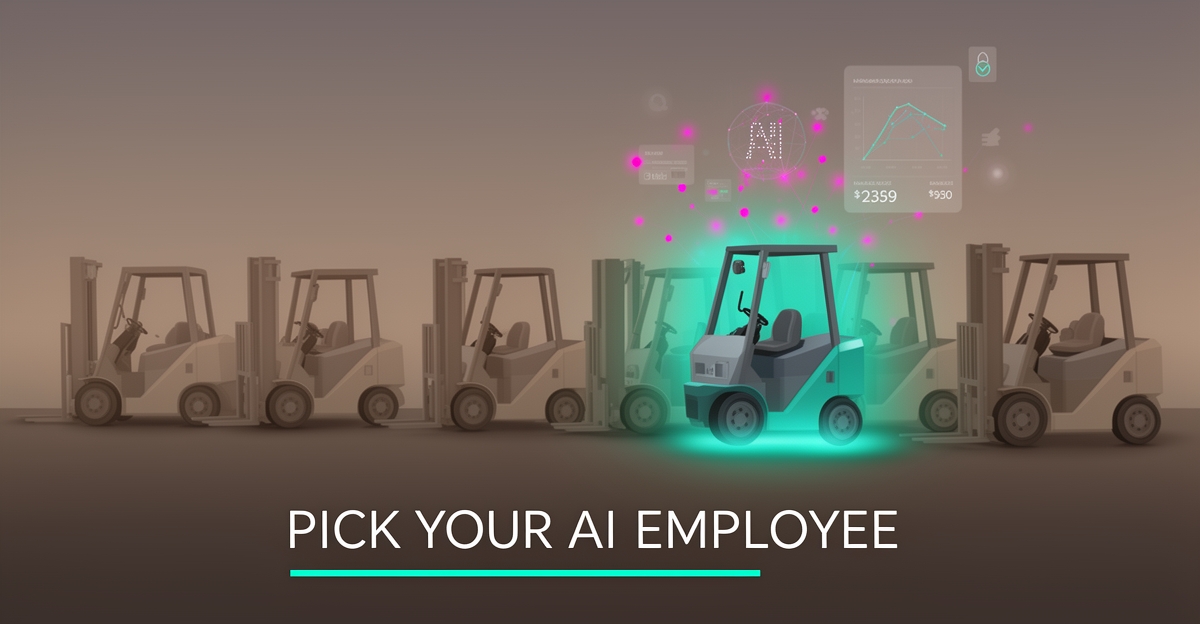
How to Choose the Right AI Employee for Your Forklift Rental Business
Key Facts
- AI-powered dynamic pricing has been reported to lift forklift rental revenue by double digits within the first season, according to equipment rental business guides
- Predictive maintenance using AI is credited with meaningfully fewer mid-rental equipment failures—commonly cited in the 30-45% range based on operator reports
- A single forklift operating 24/7 typically requires 4.5 human operators, driving annual labor costs well past $200,000 per cost analysis
- Autonomous forklifts can reduce annual operating costs from roughly $172,000-$263,000 to $22,500-$50,000 for three-shift operations based on total cost of ownership analysis
- Multi-shift operations commonly report payback on autonomous forklift investment in roughly 14-22 months per cost analysis
- Facilities have reported substantially fewer safety incidents—often cited as 70-90%—after deploying autonomous forklifts based on operational reports
- Product damage rates are reported to drop from 1-3% with human operators to under 0.5% with autonomous forklifts per operational data
Hire a team member that works 24/7 — for less than a part-time wage.
AI receptionists, SDRs, dispatchers and 99+ roles. Trained on your business, fully managed.
Not sure where to start? Ask our AI planner
Understanding Your Two AI Employee Options: Software vs. Hardware
When you decide to "hire" an AI employee for your forklift rental business, you're not just choosing a single product; you're making a strategic choice between two fundamentally different types of workers. One manages your data, the other moves your inventory. Understanding this distinction is the first step toward making a smart investment.
The first category is the AI software agent. Think of this as your digital back-office expert, a team member dedicated to handling the repetitive cognitive tasks that consume valuable time. This AI employee works behind the scenes to optimize your operations, from managing customer inquiries to adjusting pricing based on market demand. AIQ Labs delivers this kind of worker through its AI Employees service—managed AI staff covering 99+ roles, from receptionists and SDRs to dispatchers, at a fraction of the cost of a human hire.
These digital employees excel at specific operational challenges. According to a guide for equipment rental businesses, operators using AI-powered dynamic pricing have reported revenue increases in the 12-22% range in the first season. They can also serve as a 24/7 customer service representative, answering questions and capturing leads long after your human team has gone home.
Key roles for an AI software agent include:
- Dispatch Assistant: Optimizes delivery and pickup schedules.
- Lease Manager: Handles routine customer inquiries and booking confirmations.
- Equipment Analyst: Uses telematics data to predict maintenance needs, with some operators reporting 30-45% fewer mid-rental failures.
The second category is the autonomous forklift, a physical AI employee that performs material handling tasks. This is where AI moves from the back office to the warehouse floor, using advanced sensors and navigation to transport goods without a human operator. The AI displacement score for a forklift operator is a staggering 84%, according to an analysis by WhatAboutAI.com, highlighting the significant potential for automation in this role.
This physical AI worker directly addresses one of the biggest operational costs: labor. A single forklift running 24/7 typically requires about 4.5 human operators, driving annual labor costs over $200,000. An autonomous forklift eliminates this expense, which is why a cost analysis by Robotomated shows that businesses with multi-shift operations often see a full payback on their investment in roughly 14-22 months.
The choice isn't about which AI is better, but which one solves your most pressing problem. If you're losing leads after hours or struggling with inefficient pricing, a software agent is your answer. If high labor costs and operator shortages are limiting your growth, an autonomous forklift is the more logical hire. For many, a hybrid approach that combines human expertise with both types of AI offers the most flexible path forward.
When Labor Costs and Shift Structure Make Autonomous Forklifts the Right Choice
For forklift rental businesses running multiple shifts or operating around the clock, labor costs quickly become the dominant expense. A single forklift operating 24/7 typically requires 4.5 operators, driving annual labor expenses beyond $200,000 per unit when wages, benefits, and associated costs are included. This creates a clear financial tipping point where the higher upfront investment in autonomous forklifts is justified by substantial long-term savings.
The economics become compelling when comparing total cost of ownership. Traditional forklifts incur annual operating costs commonly estimated at $172,000 to $263,000 for three-shift operations, largely due to labor. In contrast, autonomous forklifts are reported to reduce this to roughly $22,500 to $50,000 annually, primarily covering maintenance, charging, and software updates. Over five years, this can translate to savings ranging from $530,000 to over $1 million per unit compared to manned operation, with most multi-shift deployments reportedly achieving payback in 14 to 22 months.
Beyond direct labor savings, autonomous forklifts deliver critical operational and safety advantages. Facilities have reported 70 to 90 percent fewer safety incidents after deployment, addressing the leading causes of accidents such as fatigue, blind spots, and human error. Product damage rates also drop significantly in reported deployments—from 1 to 3 percent with human operators to under 0.5 percent with autonomous systems—reducing replacement costs and improving customer satisfaction. These combined benefits make autonomous forklifts not just a cost-saving measure but a strategic upgrade for rental businesses facing labor shortages, high turnover, or the need for consistent, reliable performance across multiple shifts. For companies evaluating where to allocate AI investment, this analysis highlights when transitioning from human-operated to autonomous equipment delivers the clearest return—particularly when shift structure and labor economics align to eliminate recurring operator costs that commonly exceed $150,000 to $210,000 annually per unit. AIQ Labs helps rental businesses model these scenarios through data-driven assessments that clarify the optimal path forward based on real operational metrics.
How to Start with Software AI Agents for Immediate Operational Impact
Forklift rental businesses often overlook the fastest path to AI ROI: software agents that solve immediate operational pain points without requiring major capital investment or workflow disruption. Starting with targeted AI software agents delivers measurable gains in pricing accuracy, equipment uptime, and customer responsiveness—addressing three of the most common revenue leaks in the industry.
Dynamic pricing engines, for example, analyze real-time demand, seasonal trends, and competitor rates to automatically adjust rental fees, with shops reporting revenue increases in the 12-22% range in the first season after implementation. Predictive maintenance systems, meanwhile, shift from fixed-schedule servicing to usage-based alerts, reducing mid-rental equipment failures—operators commonly report reductions in the 30-45% range—and minimizing costly downtime that frustrates customers and erodes trust. For after-hours inquiries, AI-powered chatbots trained on your specific inventory and policies can handle booking questions, equipment recommendations, and policy clarifications 24/7, capturing leads that would otherwise go to competitors while freeing staff to focus on high-value interactions during business hours.
To begin, deploy one agent targeting your most pressing pain point—whether it's a dynamic pricing tool for seasonal demand swings, a predictive maintenance model for aging fleet reliability, or a customer service chatbot for after-hours lead capture. Measure impact through clear metrics like revenue per available unit, mean time between failures, or after-hours conversion rate, then scale based on proven results. This low-risk approach builds internal confidence in AI while delivering immediate operational improvements that fund larger transformations. Start with AIQ Labs' 2-minute Fit Check to identify which software AI agent will deliver the fastest ROI for your specific rental operation, then book a free 30-minute strategy call to map it out.
A Practical Framework for Evaluating, Piloting, and Scaling Your AI Employee
Choosing the right AI employee for your forklift rental business starts with understanding your operational reality. A clear, step-by-step framework helps you evaluate options without overextending resources or chasing technology for its own sake. The goal is to align AI adoption with your specific workflow challenges, whether they live in the back office or on the warehouse floor.
Begin by analyzing your operational profile. Consider your shift structure—single-shift operations may benefit more from software AI, while multi-shift or 24/7 facilities see stronger returns from autonomous forklifts due to labor savings. Assess labor availability; if recruiting and retaining qualified operators is a persistent challenge, automation becomes a strategic necessity. Evaluate seasonality and facility layout stability, as these directly impact the suitability of autonomous systems, which thrive in predictable environments. Finally, review your budget for upfront investment, recognizing that autonomous forklifts carry higher initial costs but lower long-term operating expenses.
Next, identify your most pressing pain points. If pricing optimization is a bottleneck, a dynamic pricing AI agent could deliver double-digit revenue gains in the first season. If equipment downtime is eroding profitability, a predictive maintenance agent can meaningfully reduce mid-rental failures. For after-hours inquiries or repetitive customer service tasks, an AI chatbot captures leads and improves responsiveness. When labor costs and safety incidents dominate concerns, an autonomous forklift eliminates operator expenses and can dramatically cut accidents. For inventory visibility, an AI-powered tracking agent enhances accuracy without adding headcount.
Evaluate the total cost of ownership over five years, not just sticker price. For software AI, weigh subscription costs against reclaimed staff time and revenue gains. For autonomous forklifts, compare the commonly cited $50,000-$90,000 upfront investment (plus $10,000-$40,000 for infrastructure and integration) against reported annual savings of $150,000-$210,000 in eliminated operator wages, reduced accident costs, and lower product damage rates (under 0.5% vs. 1-3% for human-operated units). This TCO approach reveals that multi-shift operations often achieve payback in roughly 14-22 months.
Start small to validate impact and build confidence. For software AI, deploy a single agent—such as a chatbot handling FAQs or a pricing tool tied to your rental calendar. For autonomous forklifts, pilot 3-5 units on your most repetitive, predictable routes, like moving pallets between staging areas and dock doors. This phased approach lets you refine processes, train staff, and measure results before scaling. Throughout, prioritize change management: communicate plans early, retrain operators for higher-value roles like fleet supervision, and involve your team in the pilot to foster trust and smooth adoption. AIQ Labs supports this journey through its three entry points: AI Employees for managed AI staff, Workflow Builds to rebuild the one workflow that costs you the most at a fixed price, and AI Operating Systems when you're ready for one connected operating layer you own outright—with payment models that let you start monthly, build in milestones, or own it outright.
Still paying for 10+ subscriptions that don’t talk to each other?
We build custom AI systems you own outright. No vendor lock-in. Full control.
Not sure where to start? Ask our AI planner
Frequently Asked Questions
Is AI software or an autonomous forklift better for my rental business?
How much revenue can dynamic pricing AI actually add?
Will AI maintenance software really reduce breakdowns?
How fast do autonomous forklifts pay for themselves?
Are autonomous forklifts actually safer than human operators?
What's the lowest-risk way to start with AI?
Your Next AI Hire Starts With One Clear Step
Choosing the right AI employee for your forklift rental business isn't about chasing technology—it's about solving your most pressing operational challenge, whether that's lost after-hours leads, unpredictable equipment downtime, or labor costs that can exceed $200,000 annually per unit running 24/7. This article outlined two distinct paths: AI software agents that optimize pricing, maintenance, and customer service with measurable ROI in weeks, and autonomous forklifts that eliminate operator expenses and are reported to reduce safety incidents by up to 90% in multi-shift environments. The key is to start small—pilot one agent targeting your biggest pain point, measure the impact through clear metrics like revenue per available unit or mean time between failures, then scale based on proven results. AIQ Labs helps rental businesses navigate this journey with managed AI employees, fixed-price workflow builds, and phased AI operating systems you own outright. To identify which AI employee will deliver the fastest ROI for your specific situation, take the 2-minute Fit Check and then book a free 30-minute strategy call to map your operational reality and uncover high-impact automation opportunities.
Make AI your competitive advantage — not just another tool.
Strategy, implementation and ongoing optimization. One partner, end to end.
Not sure where to start? Ask our AI planner