How to Choose the Right AI Employee for Your Refrigerated Trucking Operation
Key Facts
- 96% of transportation leaders currently use AI across planning and operations according to KriraAI research.
- AI in transportation market is projected to grow at 30.2% CAGR from 2024 to 2029 per WifiTalents forecast.
- 51% of logistics and supply-chain decision-makers report deploying AI/ML in some functions according to industry data.
- AI-based demand forecasting and dispatch optimization can cut last-mile costs up to 15% shows transportation analysis.
- Agentic AI is expected to dominate transportation operations workloads by 2028 per industry forecast.
- About 50% of employees will need reskilling by 2025 amid logistics AI adoption TMA Solutions reports.
Hire a team member that works 24/7 — for less than a part-time wage.
AI receptionists, SDRs, dispatchers and 99+ roles. Trained on your business, fully managed.
Not sure where to start? Ask our AI planner
The Hidden Cost of Missed Calls and Manual Dispatch in Refrigerated Trucking
Refrigerated loads don’t wait for business hours, and neither do the problems that pile up when calls go unanswered. After-hours booking requests sit on voicemail, dispatchers triangulate loads manually between shifts, and compliance paperwork for temperature logs and HOS accumulates while the clock runs on perishable freight.
That friction is expensive in a temperature-controlled, time-sensitive operation. Missed calls convert directly to lost loads, while manual dispatch creates bottlenecks that delay pickup windows and erode carrier reputation. Compliance gaps from delayed paperwork expose SMB carriers to audits and penalties at the worst possible moment.
The competitive pressure is intensifying. According to industry research, 96% of transportation leaders currently use AI across planning and operations. The market is accelerating, with a 30.2% projected CAGR for AI in transportation from 2024 to 2029. Small and medium-sized carriers can no longer treat AI as an experiment reserved for large fleets.
AI adoption is already mainstream in logistics functions. A recent study found 51% of logistics and supply-chain decision-makers report deploying AI/ML at least in some functions. The pressure is not theoretical; it shows up in dispatch queues, missed revenue calls, and manual compliance tracking that scales poorly.
The hidden cost compounds across three daily pressure points:
- After-hours call abandonment when owner-operators and brokers call outside dispatch hours
- Manual dispatch triage that delays load confirmations and driver assignments
- Compliance paperwork backlog for temperature logs, bills of lading, and HOS documentation
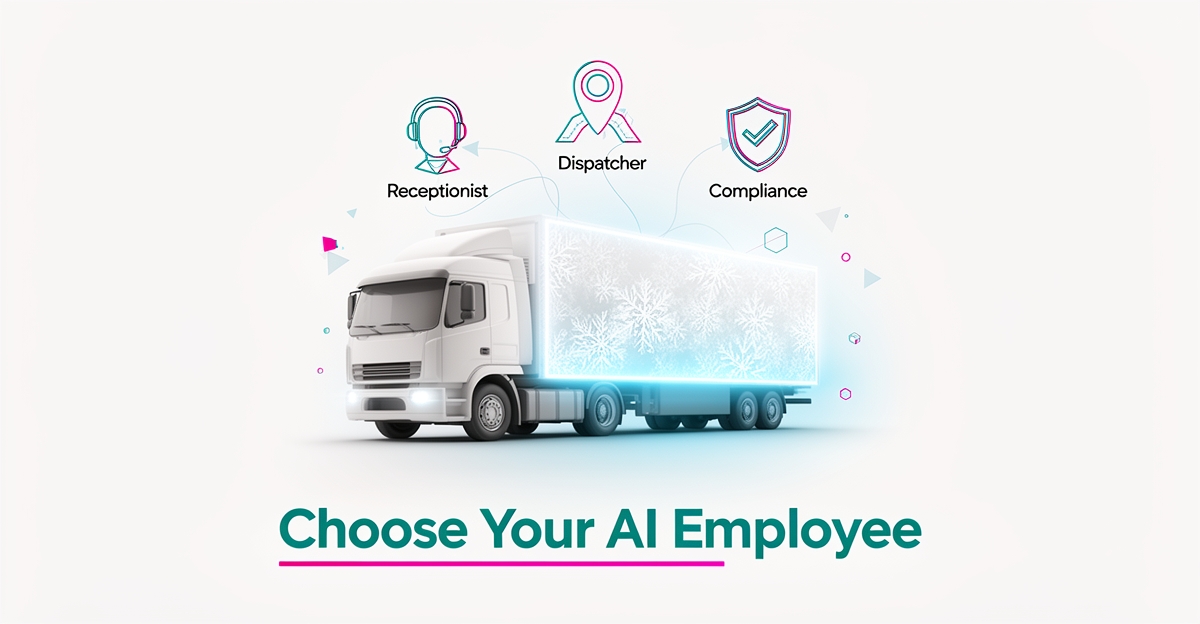
Each point represents a workflow gap that an AI employee can close. Trucking businesses must decide between an AI dispatcher, receptionist, or compliance monitor — each serving a distinct operational need. This guide walks readers through selecting the right AI employee role based on workflow gaps and business goals, with AIQ Labs providing end-to-end implementation support through AI Employees, AI Workflow Builds, or AI Operating Systems.
The financial upside is measurable. Transportation analysis shows up to 15% cost reduction in last-mile operations from AI-based demand forecasting and dispatch optimization. Efficiency gains from automation also reduce the manual rework that drives overtime and errors in refrigerated operations.
Choosing the right AI employee starts with mapping where time and revenue leak. For carriers facing missed calls and after-hours coverage gaps, an AI receptionist ensures 24/7 intake, intelligent routing, and appointment booking. For dispatch bottlenecks, an AI dispatcher can qualify loads, match capacity, and update drivers without human hand-offs. For compliance, an AI monitor can track documentation, flag missing logs, and prepare audit-ready records.
AIQ Labs helps SMB carriers move from pilot to production with managed AI employees that work alongside human teams, not replace them. The goal is to eliminate the manual friction that costs loads, delays service, and creates compliance risk in a business where temperature and time are non-negotiable.
AI Dispatcher, AI Receptionist, or AI Compliance Monitor: Matching the Role to Your Biggest Workflow Gap
Reefer operators face a constant tension between coverage, cost, and compliance, and the right AI employee changes which lever you pull first. Matching the role to the biggest workflow gap prevents wasted spend and delivers measurable operational lift fast.
An AI Dispatcher closes the load coverage and driver coordination gap. It continuously monitors inbound requests, trailer availability, and driver hours, then auto-assigns loads and re-routes in real time. For last-mile and regional reefer lanes, industry research shows up to 15% cost reduction from AI-based demand forecasting and dispatch optimization. The role also handles check calls, HOS updates, and exception alerts so dispatchers focus on exceptions, not data entry.
An AI Receptionist eliminates missed calls and scheduling friction 24/7. It answers phones, books dock appointments, confirms pickups, and routes urgent messages to humans. Reefer customers expect immediate confirmation for temperature-sensitive freight, and an always-on receptionist removes the bottleneck without adding headcount. This is the fastest win when inbound call volume or after-hours coverage is the constraint.
An AI Compliance Monitor builds audit trails and regulatory documentation automatically. It ingests ELD logs, temperature data, DVIRs, and bills of lading, then flags gaps, generates reports, and maintains a searchable record for audits. With transportation industry statistics forecasting agentic AI to account for a majority of AI workloads in transportation operations by 2028, compliance work is a prime candidate for autonomous agents.
The choice comes down to where leakage is highest today.
- Load coverage and driver utilization low → AI Dispatcher
- Missed calls, slow booking, after-hours gaps → AI Receptionist
- Audit prep, documentation errors, regulatory risk → AI Compliance Monitor
Adoption is already mainstream. Recent analysis finds 96% of transportation leaders currently use AI across planning and operations, and SMBs are adopting alongside larger carriers. The decision is not whether to use AI, but which workflow gap to close first.
AIQ Labs supports reefer carriers through AI Strategy & Transformation Consulting and AI Implementation Roadmaps, helping map the gap to the right AI employee role and integrate it with existing dispatch, TMS, and compliance tools via AI Workflow Builds.
A Decision Framework: Auditing Your Workflows Before You Hire Your First AI Employee
Refrigerated trucking runs on tight windows, perishable cargo, and constant communication. When a call goes unanswered or a dispatch stalls, the cost shows up as spoiled product, missed pickups, and compliance exposure. Auditing your workflows first prevents buying an AI employee for the wrong job.
Start by mapping where work actually breaks down, not where you assume it does. Track a week of inbound calls, dispatch requests, and compliance touchpoints. Note wait times, repeat questions, manual re-entry, and any shipment where temperature logs, hours-of-service, or delivery confirmations were late or missing.
Patterns reveal the right AI role. Unanswered calls and after-hours inquiries point to a receptionist gap. Stalled dispatch, driver check-ins, and load confirmations that sit in email signal a dispatcher need. Repeated paperwork errors, missed inspections, and audit prep stress indicate a compliance monitor opportunity.
Refrigerated carriers are already moving fast. According to industry research, 96% of transportation leaders currently use AI across planning and operations. The market is accelerating, with a recent forecast projecting 30.2% annual growth for AI in transportation through 2029.
A focused audit answers three questions:
- Where do calls go unanswered and who picks them up next?
- Where does dispatch stall between request, confirmation, and driver assignment?
- Where do compliance risks live in logs, temperature records, and reporting?
Quantify the impact of each gap. Measure missed call rate, average dispatch cycle time, and hours spent on compliance reporting each week. This creates a clear business case and avoids a scattered multi-tool approach. Starting with one well-defined role beats deploying three half-built tools.
For refrigerated operations, the highest-leverage first hire is often the role that touches customers and drivers 24/7. An AI receptionist can answer calls, route inquiries, and book appointments without adding headcount. An AI dispatcher can triage load requests, check driver availability, and push confirmations. An AI compliance monitor can track hours-of-service, temperature logs, and inspection due dates.
AIQ Labs works with trucking businesses to map these gaps and align them to a single AI employee role, then build and manage it end-to-end via AI Employees. The approach mirrors how 51% of logistics decision-makers are already deploying AI/ML in at least some functions, according to market data.
Once the first role proves value, you expand with confidence. Audit first, hire once, scale deliberately.
Deploying Your AI Employee: From Job Description to 24/7 Operation
Hiring an AI employee looks a lot like hiring a human one — and that's the point. The implementation path starts with a job description, moves through systems integration, and ends with a team member who works 24/7/365 without ever calling in sick.
Start with a job description, not a software demo. Whether you're bringing on an AI dispatcher, receptionist, or compliance monitor, write the role the same way you would for a human hire: define the tasks, the escalation rules, and what "a good day at work" looks like. AIQ Labs uses that job description to build and train the AI employee on your specific processes, voice, and tools before deployment.
Integration is where the role becomes real. Your AI employee connects to the systems it needs to do the job — your TMS, dispatch software, calendar, phone lines, and email — through API integrations. Once live, it answers calls, books appointments, qualifies leads, and documents everything in the tools your team already uses, communicating through normal channels rather than a separate dashboard.
Guardrails matter just as much as capability. Well-designed deployments include human-in-the-loop controls, so your dispatcher or office manager reviews anything outside the AI's authority before it happens. Validation layers and audit trails keep every action logged and reviewable — a practical necessity given that regulatory scrutiny of AI in transportation is growing, including high-risk use case classifications under the EU AI Act.
The economics explain why adoption is accelerating. With 96% of transportation leaders already using AI across planning and operations, the question has shifted from whether to deploy to how fast. AI employees in equivalent roles cost 75–85% less than human hires — no salary, benefits, or recruiting costs — while covering nights, weekends, and holidays that a 40-hour-per-week employee simply can't.
Plan for your human team, too. According to workforce research, about 50% of all employees will need reskilling by 2025, and the companies that handle this transition thoughtfully gain a competitive edge. As one analysis of the logistics workforce puts it, the consequences for workers are not predetermined — reskilling dispatchers and CSRs to manage AI-driven workflows turns displacement anxiety into career growth.
A practical rollout looks like this:
- Write the job description and define escalation boundaries
- Integrate with TMS, phone, calendar, and communication systems
- Set human-in-the-loop checkpoints for critical decisions
- Train your team on supervising and working alongside the AI
- Monitor performance and retrain continuously as patterns emerge
Deployment typically takes weeks, not months, with performance monitoring and optimization built into the ongoing management. If you want a realistic picture of what a dispatcher or receptionist role would look like in your operation, AIQ Labs offers a free 30-minute strategy call to map your biggest bottleneck — and if there isn't a clear win, they'll tell you that too. Learn more about how to get started.
Scaling Beyond the First Hire: Building an AI-Powered Trucking Operation You Own
The first AI employee rarely stays the only one. Once an AI dispatcher proves it can book loads, assign drivers, and update customers without dropping a call, the natural next question is: what else can we connect?
That is where most refrigerated trucking operations either build a system or buy a tangle. The difference comes down to architecture. A dispatcher handling load assignments, a receptionist answering shipper calls around the clock, and a compliance monitor tracking driver hours and reefer temperature logs only deliver full value when they share the same data. When your dispatcher assigns a load, the receptionist should already know the ETA. When compliance flags an hours-of-service issue, dispatch should see it before booking the next run.
The industry is moving this direction fast. According to transportation industry research, 96% of transportation leaders already use AI across planning and operations, and agentic AI is expected to account for the majority of AI workloads in transportation by 2028. The operators building connected systems now are the ones who will own that advantage.
Here is what scaling beyond the first hire typically looks like:
- Start with one role — dispatcher, receptionist, or compliance — and let it prove ROI on your real workflows
- Add the second AI employee against a shared data layer so both roles see the same loads, drivers, and customer records
- Connect every role to your TMS, ELD, and communication tools through deep API integrations
- Expand to a full operating system where dispatch, intake, compliance, and invoicing run as one coordinated system
The ownership question matters more than most operators realize. Subscription tools rent you capability. A custom-built system makes you the owner — your code, your agents, your data, no vendor lock-in. AIQ Labs structures this three ways: Start Monthly for a single AI employee at less than a part-time hire, Build in Milestones to add workflows phase by phase, or Own It Outright for a complete AI operating system with full IP transfer.
The stakes are real. Industry data shows AI-driven dispatch and demand forecasting can cut last-mile operating costs by up to 15%, and AI-optimized routing reduces fuel spend and emissions by up to 20%. Those gains compound when every role in your operation works from the same intelligence.
If you are ready to move from one AI hire to a connected system you own, start the two-minute Fit Check. It leads to a free 30-minute strategy call with an AI engineer who will map your biggest bottleneck and tell you honestly whether there is a clear win. No pitch — just a working session.
Still paying for 10+ subscriptions that don’t talk to each other?
We build custom AI systems you own outright. No vendor lock-in. Full control.
Not sure where to start? Ask our AI planner
Frequently Asked Questions
What is an AI employee and how does it differ from a chatbot?
How much can an AI employee save compared to hiring a human for the same role?
What workflow gaps indicate I need an AI receptionist versus an AI dispatcher?
Is AI adoption in transportation really mainstream for small carriers?
How does AIQ Labs ensure compliance and control when deploying an AI employee?
What’s the first step to see if an AI employee is right for my trucking operation?
Audit First, Hire the Right AI Employee, Then Scale With Confidence
Refrigerated trucking wins or loses on speed, coverage, and compliance, and the leaks are predictable: after-hours calls that go unanswered, dispatch that stalls between request and driver assignment, and paperwork that piles up until audit season. The article shows how mapping those three pressure points points to a clear first hire — an AI receptionist for 24/7 intake and booking, an AI dispatcher for load qualification and real-time coordination, or an AI compliance monitor for ELD, temperature logs and audit-ready records. Start with one well-defined role, integrate it with your TMS and phone systems, and add human-in-the-loop guardrails so your team supervises rather than replaces. Once the first AI employee proves ROI on real workflows, you can connect roles on a shared data layer and build toward an owned operating system instead of renting subscriptions. AIQ Labs helps SMB carriers move from audit to deployment with AI Strategy & Transformation Consulting and managed AI employees that work alongside your team. Start the Fit Check at https://aiqlabs.ai/apply for a free 30-minute strategy call to map your biggest bottleneck and get an honest assessment of whether there is a clear win.
Make AI your competitive advantage — not just another tool.
Strategy, implementation and ongoing optimization. One partner, end to end.
Not sure where to start? Ask our AI planner