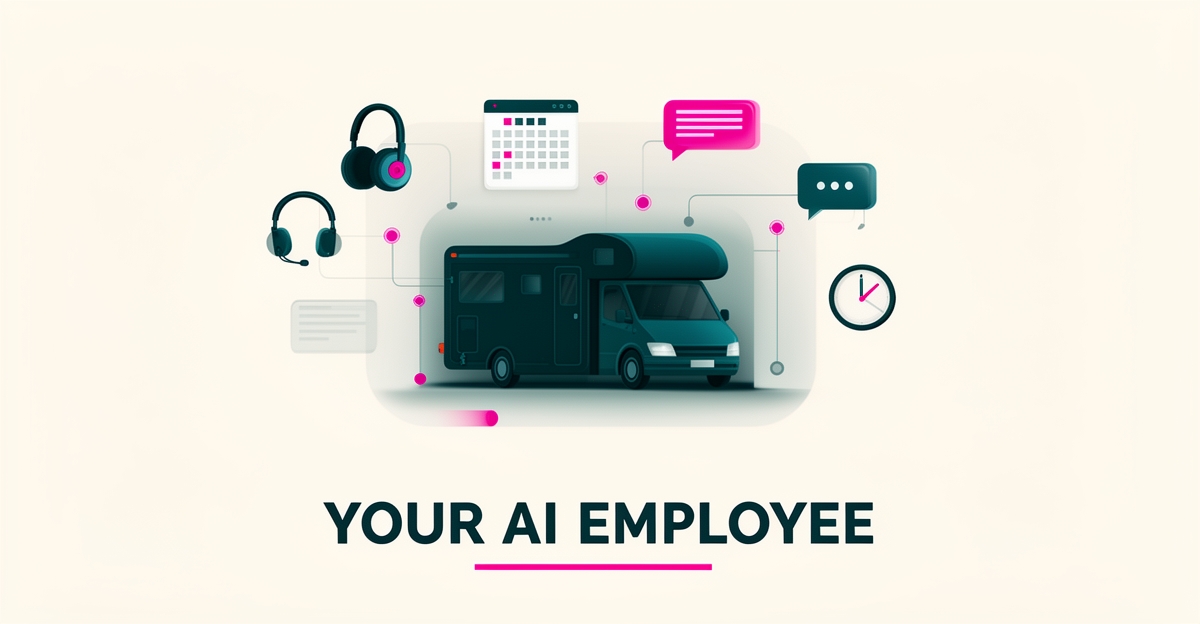
How to Choose the Right AI Employee for Your RV Service Team
Key Facts
- Most large organizations now use AI in at least one business function, and adoption has kept climbing through 2026
- A meaningful share of service inquiries—often estimated at a quarter or more—arrive after regular business hours
- Customers consistently rank having to repeat themselves among their top frustrations with service interactions
- AIQ Labs has deployed 200+ multi-agent systems and runs 4 live SaaS products daily
- A managed AI employee typically costs roughly 80% less than an equivalent human hire
Hire a team member that works 24/7 — for less than a part-time wage.
AI receptionists, SDRs, dispatchers and 99+ roles. Trained on your business, fully managed.
Not sure where to start? Ask our AI planner
The Hidden Cost of Missed Calls and Manual Workflows in RV Service Centers
RV service centers face mounting pressure from missed calls and manual workflows that drain resources and frustrate customers. After-hours calls often go unanswered, leading to lost service opportunities and dissatisfied clients who turn to competitors. Scheduling bottlenecks slow down operations, while administrative overload pulls technicians away from revenue-generating work. These inefficiencies are no longer sustainable as customer expectations for instant, 24/7 service continue to rise.
By late 2026, automation has moved from a competitive edge to table stakes across service industries. Most large organizations have automated at least one business function, and the workflow automation market has grown steadily for years. For RV service centers still relying on manual call handling and paper-based scheduling, the cost of inaction is concrete: missed appointments, delayed repairs, and eroded customer trust.
Missed after-hours calls directly impact revenue—industry estimates commonly put after-hours inquiries at a quarter or more of total customer contact. When these calls go to voicemail or are missed entirely, RV centers lose immediate booking opportunities and risk damaging their reputation for responsiveness. Meanwhile, manual scheduling creates bottlenecks that ripple through the entire service workflow—technicians wait for dispatch, parts orders are delayed, and service bays sit idle. Administrative staff spend excessive time on data entry, phone tag, and appointment rescheduling, tasks that could be automated to free up capacity for higher-value activities.
- After-hours service inquiries represent a significant portion of total customer contact
- Manual scheduling increases technician downtime and reduces bay utilization
- Administrative overload diverts skilled staff from customer-facing and technical work
- Delayed communication leads to longer repair cycles and lower customer satisfaction
- Inconsistent follow-up results in missed upsell opportunities and forgotten maintenance
AIQ Labs addresses these challenges through AI Employees designed for RV service workflows—AI receptionists that handle 24/7 call routing and appointment booking, dispatchers that optimize technician allocation in real time, and follow-up agents that keep customers coming back. Each managed AI employee typically costs around 80% less than an equivalent human hire, and AIQ Labs has deployed 200+ multi-agent systems across businesses like yours. If your bottleneck is a single broken workflow rather than headcount, Workflow Builds rebuild that one process at a fixed price. Either way, continuing with manual workflows is a losing bet for competitive RV service operations.
Matching AI Employee Roles to Your RV Service Workflow: Receptionist, Dispatcher, or Follow-Up Agent?
RV service centers juggle phone calls, scheduling, and follow-ups across a busy shop floor, and the right AI employee changes which bottleneck disappears first. Matching the role to the workflow gap prevents overlap and maximizes adoption.
An AI Receptionist owns the front door. It answers calls 24/7, routes inquiries, takes messages, and books appointments without tying up a human. This role fits centers with high call volume, missed calls during peak hours, or limited front-desk coverage. Modern AI receptionists can answer questions, solve routine problems, and remember past conversations, which reduces friction in every interaction.
An AI Dispatcher is built for field coordination. It triages service requests, matches technicians to jobs, updates ETAs, and syncs with calendars and work order systems. Centers with mobile service, multiple bays, or seasonal spikes benefit most when dispatch is the constraint. The underlying principle is workflow automation: standardizing the flow of tasks, information, and documents so they execute independently, following predefined rules and logic.
An AI Customer Follow-Up Agent handles the post-service loop. It sends service reminders, checks satisfaction, collects reviews, and nudges pending invoices or warranty work. This role solves retention and revenue leakage when teams lack capacity for consistent outreach.
Choose by mapping pain to role:
- Call volume and missed opportunities → AI Receptionist for 24/7 coverage and intelligent routing
- Technician utilization and scheduling complexity → AI Dispatcher for real-time triage and dispatch
- Low follow-through on service reminders and reviews → AI Customer Follow-Up Agent for automated, personalized outreach
Customer expectations tighten the decision. Surveys of customer experience consistently show that having to repeat information is one of the biggest frustrations in service interactions, and most customers prefer brands that personalize the experience. An AI employee that remembers past conversations and provides seamless continuity directly addresses that friction.
AIQ Labs offers 99+ managed AI employee roles—including Receptionist, Dispatcher, and Follow-Up Agent—within its AI Employees service. The Start Monthly payment model lets centers pilot one role, train it on their business processes, and integrate with existing tools without a long-term commitment. When you're ready to connect everything into one operating layer, AI Operating Systems builds that out in phases, owned outright.
Adoption rises when teams see the role as elevation, not replacement. AI workers can handle routine Tier 0 through 2 issues autonomously and provide consistent customer experience across channels while integrating directly into business systems—so technicians and advisors focus on the work that actually needs a human.
From Selection to Deployment: How to Pilot Your AI Employee with Zero Risk
Starting an AI employee pilot doesn't require a full-scale transformation—it begins with a clear, focused step. Defining the agent's purpose is the foundation of any successful deployment. For RV service teams, this means identifying whether the AI will handle appointment scheduling, customer follow-ups, dispatch coordination, or after-hours call routing—each role solving a specific workflow bottleneck.
Once the purpose is defined, the next step is selecting the right input sources and integrating with existing tools. AIQ Labs' Start Monthly model ensures seamless connections to platforms like Calendly for booking, QuickBooks for invoicing, or CRM systems for customer history—all configured during the build and training phase. This eliminates manual data entry and reduces operational errors, the same efficiency gain driving most organizations to automate at least one business function.
Deployment follows a structured path: the AI employee is trained on your specific processes, voice, and tools, then goes live with a dedicated phone number, email, or chat presence. Throughout the pilot, performance is monitored in real time—tracking accuracy, response times, and customer satisfaction—with the ability to pause, adjust, or retrain as needed. This low-risk approach mirrors what makes AI-powered customer service work in practice: reducing repetition and enabling personalized experiences—critical for RV centers managing high-volume seasonal demand.
The pilot phase isn't about perfection—it's about proof. With the ability to pause or adjust anytime, RV service teams can validate results before scaling, ensuring the AI employee delivers value without disruption. This phased, managed approach turns experimentation into confident adoption, one workflow at a time.
Still paying for 10+ subscriptions that don’t talk to each other?
We build custom AI systems you own outright. No vendor lock-in. Full control.
Not sure where to start? Ask our AI planner
Frequently Asked Questions
What is the main benefit of using an AI receptionist for an RV service center?
How does an AI dispatcher improve technician utilization in an RV service shop?
Can an AI follow-up agent help increase customer retention and revenue for RV service centers?
How much does an AI employee cost compared to a human hire?
Is it risky to pilot an AI employee in my RV service center before committing long-term?
Do AI employees replace human staff in RV service centers, or do they work alongside them?
Turn Your Service Bottlenecks into Competitive Advantages
Choosing the right AI employee for your RV service team starts with pinpointing where missed calls, scheduling delays, or inconsistent follow-ups are costing you the most. Whether it's an AI Receptionist capturing after-hours inquiries, a Dispatcher optimizing technician allocation, or a Follow-Up Agent nurturing customer relationships, each role targets a specific workflow gap to free up your team for higher-value work. With AIQ Labs' Start Monthly model—managed AI employees that integrate with your tools, learn your processes, and work 24/7 at roughly 80% less cost than a human hire—you can pilot a solution with minimal risk and scale only when you see the impact. Take the first step by identifying your biggest bottleneck: start the 2-minute Fit Check to map your opportunity, then book a free 30-minute strategy call to see how an AI employee can elevate your service operations.
Make AI your competitive advantage — not just another tool.
Strategy, implementation and ongoing optimization. One partner, end to end.
Not sure where to start? Ask our AI planner