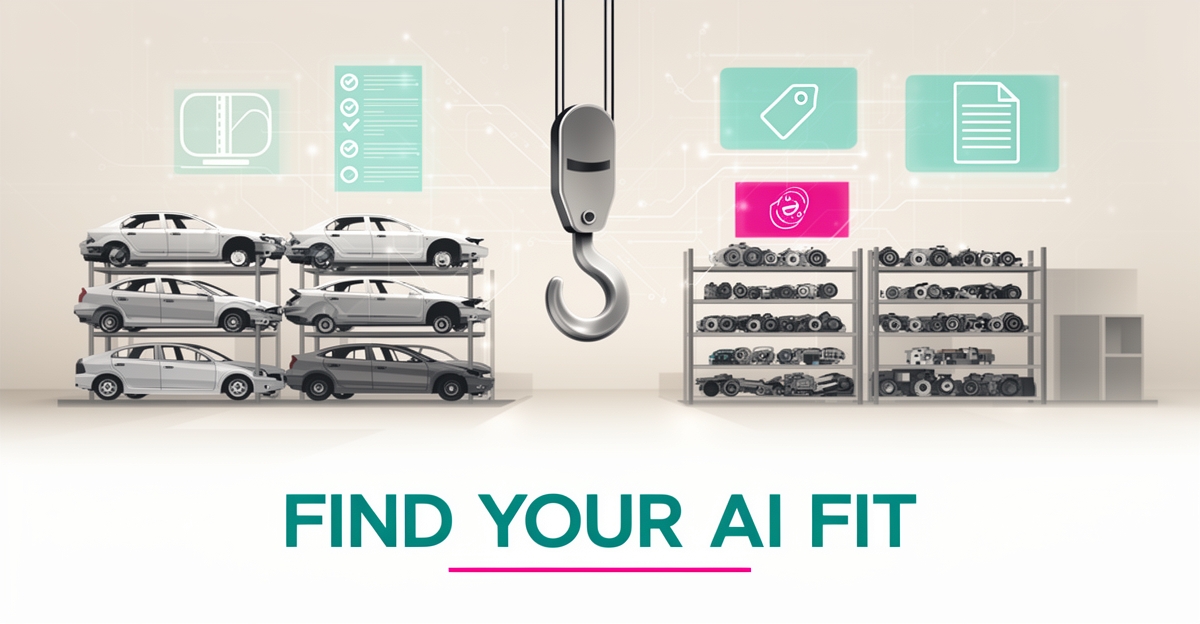
How to Choose the Right AI Employee for Your Salvage Yard Operations
Key Facts
- AIQ Labs has deployed 200+ multi-agent systems across live business operations
- AI employees typically cost roughly 80% less than an equivalent human hire while running 24/7
- AIQ Labs offers 99+ managed AI roles, including dispatchers, pricing agents, and documentation assistants
- Every engagement starts with a 2-minute Fit Check at aiqlabs.ai/apply, followed by a free 30-minute strategy call
Hire a team member that works 24/7 — for less than a part-time wage.
AI receptionists, SDRs, dispatchers and 99+ roles. Trained on your business, fully managed.
Not sure where to start? Ask our AI planner
Assessing Your Salvage Yard's Operational Bottlenecks
Salvage yards run on speed, accuracy, and paperwork that never seems to end. The first step to choosing the right AI employee is mapping where those three forces break down every day.
Start by tracking delays in dispatch and inbound processing. Yards that move parts quickly still lose hours to manual call-backs, work-order re-entry, and driver wait time. When dispatch is reactive instead of proactive, those delays compound across the yard floor — missed pick-up windows, wrong parts loaded, and rework that eats into the day.
Pricing accuracy is another high-leverage bottleneck. Manual look-ups, inconsistent condition grading, and lagging market data create quote errors and lost sales. A slow or inconsistent quote doesn't just cost margin — it sends buyers to the yard down the road.
Documentation backlogs compound both problems. Photos, titles, inventory updates, and compliance records pile up when staff juggle phones and systems. Data handling is a known weak point in field operations, and yards are no exception: title paperwork, VIN verification, and environmental logs all require consistent handling, and inconsistent handling creates risk.
A practical bottleneck audit focuses on measurable moments, not general complaints:
- Dispatch delays: average time from inbound call to truck assignment, missed pick-up windows, and rework due to wrong parts loaded
- Pricing inaccuracies: quote-to-sale variance, time spent verifying part condition, and lost deals from slow responses
- Documentation backlogs: hours per day spent on photos, titles, and inventory entry, plus error rates on compliance records
- Customer follow-up gaps: callbacks missed, duplicate inquiries, and manual status updates
Mapping these points creates a clear fit for an AI employee role. A yard with chronic dispatch lag benefits from an AI dispatcher that books, routes, and confirms loads 24/7. Pricing-heavy operations gain from an AI pricing agent that reconciles market data and condition notes in real time. Documentation-heavy sites use an AI documentation assistant to capture, tag, and file records automatically. You can browse the full range of managed roles on the AI Employees page.
AIQ Labs uses a structured Fit Check to translate these bottlenecks into a role-specific deployment plan, matching the workflow pain to the right managed AI employee or custom workflow build. The goal is not automation for its own sake, but measurable relief on the tasks that cost time, money, and customer trust every day.
Matching AI Employee Roles to Core Salvage Yard Functions
Salvage yard operations run on speed, accuracy, and coordination across the yard, the counter, and the back office. Matching the right AI employee to each pressure point turns fragmented manual work into measurable throughput.
A dispatcher AI employee mirrors the role of a field coordinator, routing inbound inventory, scheduling teardown crews, and prioritizing outbound pickups. By applying predictive signals to yard assets and equipment, dispatchers reduce unplanned downtime and keep lanes moving — the same principle that has made AI-driven planning standard in manufacturing and logistics.
A pricing agent AI employee handles the high-volume, rules-driven work of valuation. Salvage pricing depends on real-time market data, condition notes, and parts demand. The same automation principles that transformed manufacturing quality control apply to dynamic pricing, margin protection, and inventory turnover. The agent continuously updates listings and flags underpriced stock.
A documentation assistant AI employee addresses compliance and record keeping where human error is costly. In a salvage yard, title paperwork, VIN verification, and environmental logs require consistent handling. An AI assistant automates capture, classification, and audit trails, so nothing depends on someone remembering to file it at the end of a long shift.
Role selection should follow core operations and measurable outcomes:
- Yard logistics and dispatch → proactive routing and downtime reduction
- Inventory valuation and sales → automated condition checks and pricing accuracy
- Compliance and documentation → process automation with accountability and transparency
AIQ Labs maps these functions during the Fit Check, identifying which AI employee role — dispatcher, pricing agent, or documentation assistant — fits daily workflows and where automation delivers the clearest return. If the bottleneck lives in one specific workflow rather than a role, a fixed-price AI Workflow Build may be the faster path. Accountability and transparency remain essential for AI-driven decision-making, and a clear governance layer ensures yard teams trust the outputs.
When AI is aligned to data, people, and process, it creates measurable operational impact rather than technology for its own sake.
Evaluating AI Employee Fit Using AIQ Labs' Readiness Framework
Choosing the right AI employee starts with understanding your salvage yard's current readiness for AI integration. AIQ Labs' Fit Check evaluates your technology stack, data quality, and team capacity to ensure any AI employee — whether a dispatcher, pricing agent, or documentation assistant — can deliver measurable ROI without requiring an enterprise-scale overhaul. This structured approach identifies gaps early, so you deploy AI that works with your existing tools and workflows, not against them.
The framework begins with a technology stack assessment, examining how well your current systems — such as inventory management, CRM, or scheduling software — can integrate with AI agents through APIs or middleware. Many salvage yards operate with legacy or disconnected tools, which can hinder automation if not addressed upfront. Data practices are a common readiness gap in field operations, and that gap directly impacts AI reliability. AIQ Labs evaluates your data infrastructure for consistency, accessibility, and compliance to prevent bottlenecks in AI performance.
Next, the assessment reviews data quality and governance, focusing on whether your operational data — like part inventories, pricing histories, or supplier contacts — is clean, structured, and regularly updated. Poor data quality is a leading cause of AI underperformance, especially in dynamic environments like salvage yards where item conditions and market values fluctuate. Where gaps exist, AIQ Labs recommends targeted data cleanup or enrichment steps as part of the readiness plan.
Finally, the framework gauges team capacity and change readiness, assessing whether your staff has the time, skills, and willingness to collaborate with AI employees. Successful integration depends not just on the AI's capabilities but on human-AI collaboration — such as supervisors reviewing AI-generated pricing suggestions or dispatchers validating AI-routed tow requests. AIQ Labs provides change management support to build confidence and competence, ensuring your team sees the AI employee as a force multiplier, not a replacement. By aligning AI roles with your actual operational bottlenecks — like slow quote generation or missed call follow-ups — you ensure the technology drives efficiency where it matters most.
Start the Fit Check — a two-minute assessment at aiqlabs.ai/apply — to evaluate your salvage yard's AI readiness and identify which AI employee role will deliver the fastest impact. Follow it with a free 30-minute strategy call at aiqlabs.ai/book to map your highest-ROI automation opportunities and build a phased adoption plan that scales with your business.
Deploying and Optimizing Your AI Employee for Long-Term Impact
Deploying an AI employee effectively requires more than just installation — it demands a structured approach that evolves from pilot to full integration while measuring real operational impact. At AIQ Labs, implementation follows clear phases designed to minimize risk and maximize value for salvage yard operations. The journey begins with Discovery & Architecture, where we analyze your current workflows — such as parts intake, pricing, or dispatch — to identify where an AI dispatcher, pricing agent, or documentation assistant can eliminate bottlenecks. This phase includes a technology assessment and ROI projection, ensuring the solution aligns with your business goals before any development starts.
Next, Development & Integration spans roughly 4–12 weeks, during which we build and customize the AI employee to your specific processes, integrate it with tools like your inventory management or CRM systems, and rigorously test for accuracy and reliability. Once validated, Deployment & Training ensures a smooth go-live, complete with role-specific training for your team and setup of performance monitoring. Finally, Optimization & Scale becomes an ongoing commitment: we continuously monitor performance, refine the AI employee's capabilities, and scale its use across additional workflows as your yard grows. Payment follows the same logic — start monthly, build in milestones, or own the system outright — so you're never locked into a model that doesn't fit. Details are on the pricing page.
To ensure long-term success, tie monitoring directly to operational KPIs. Track improvements in response time for customer inquiries, reduction in pricing or documentation errors, and gains in throughput — such as faster parts listing or quicker dispatch cycles. Establishing clear accountability protocols for AI-driven decisions supports transparency, especially when AI handles customer-facing tasks like quoting or scheduling. By continuously evaluating effectiveness against these metrics, you transform your AI employee from a trial into a core driver of efficiency and competitive advantage. And if the AI employee proves itself across multiple workflows, an AI Operating System can connect those workflows into one layer your yard owns outright.
Still paying for 10+ subscriptions that don’t talk to each other?
We build custom AI systems you own outright. No vendor lock-in. Full control.
Not sure where to start? Ask our AI planner
Frequently Asked Questions
How do I know which AI employee role — dispatcher, pricing agent, or documentation assistant — my salvage yard actually needs?
What if my team doesn't know how to handle data properly for AI systems?
Can AI really help with unpredictable salvage yard operations like equipment breakdowns?
How long does it take to deploy an AI employee for my salvage yard?
Will an AI employee replace my existing staff or work with them?
How do I ensure accountability when AI is making pricing or dispatch decisions?
Turn Bottlenecks into Breakthroughs with the Right AI Employee
By now, you've seen how mapping dispatch delays, pricing inaccuracies, and documentation backlogs reveals exactly where an AI dispatcher, pricing agent, or documentation assistant can deliver measurable relief — without overhauling your existing systems. The right AI employee isn't about chasing technology for its own sake; it's about aligning automation with your yard's daily rhythms to free up time, reduce errors, and strengthen customer trust. Start with AIQ Labs' two-minute Fit Check at aiqlabs.ai/apply, then book a free 30-minute strategy call at aiqlabs.ai/book to map your highest-impact automation opportunity. This practical first step ensures any AI investment targets the bottlenecks that cost you time and money every day — so you can focus on moving more parts, not more paperwork.
Make AI your competitive advantage — not just another tool.
Strategy, implementation and ongoing optimization. One partner, end to end.
Not sure where to start? Ask our AI planner