Back to Blog

How to Choose the Right AI Employee Role for Your AV Rental Business

AI Strategy & Transformation Consulting > AI Readiness Assessment16 min read

How to Choose the Right AI Employee Role for Your AV Rental Business

Key Facts

  • AI investments will yield $22.3 trillion globally by 2030.
  • Every dollar spent on AI generates $4.9 in global economy.
  • Hiscox reduced claim processing time from one hour to ten minutes.
  • Markerstudy Group saved 56,000 hours annually through call summarization.
  • 82% reduction in report writing time achieved by Axon Enterprise.
  • 66% of CEOs report measurable business benefits from generative AI.
  • 85% of Fortune 500 companies use Microsoft AI solutions.
AI Employees

What if you could hire a team member that works 24/7 for $599/month?

AI Receptionists, SDRs, Dispatchers, and 99+ roles. Fully trained. Fully managed. Zero sick days.

The Digital Gap in AV Rental Operations

Most AV rental companies excel at delivering flawless physical experiences but struggle with chaotic digital workflows. This disconnect between physical excellence and digital inefficiency creates operational bottlenecks that stifle growth and frustrate clients.

While on-site technical support remains a critical differentiator, the back-office reality often involves manual scheduling, lost emails, and disjointed communication. AI adoption bridges this gap by automating the repetitive tasks that consume valuable human hours.

The industry lacks specific AI data for AV rentals, but adjacent service sectors reveal the severity of the problem. Without automation, teams spend excessive time on administrative duties rather than client relations.

Consider the time lost in traditional dispatch and support models. Efficiency gains in similar industries are substantial:

  • Hiscox reduced claim processing time from one hour to just 10 minutes using AI agents.
  • Markerstudy Group saved 56,000 hours annually through automated call summarization.
  • EchoStar Hughes projected a 25% productivity boost by automating field service workflows.

These statistics highlight a massive opportunity for AV businesses to reclaim time. By automating routine administrative tasks, staff can focus on complex event logistics and high-value client interactions.

Not all AI roles offer equal value. Research suggests starting with low-risk, high-volume tasks before attempting complex automation. MIT Sloan describes this as "extensive experimentation" focused on small-scale transformations.

For AV rental operations, prioritize roles that handle data synthesis and internal coordination rather than fully autonomous customer-facing chatbots.

Recommended Entry-Point AI Roles:

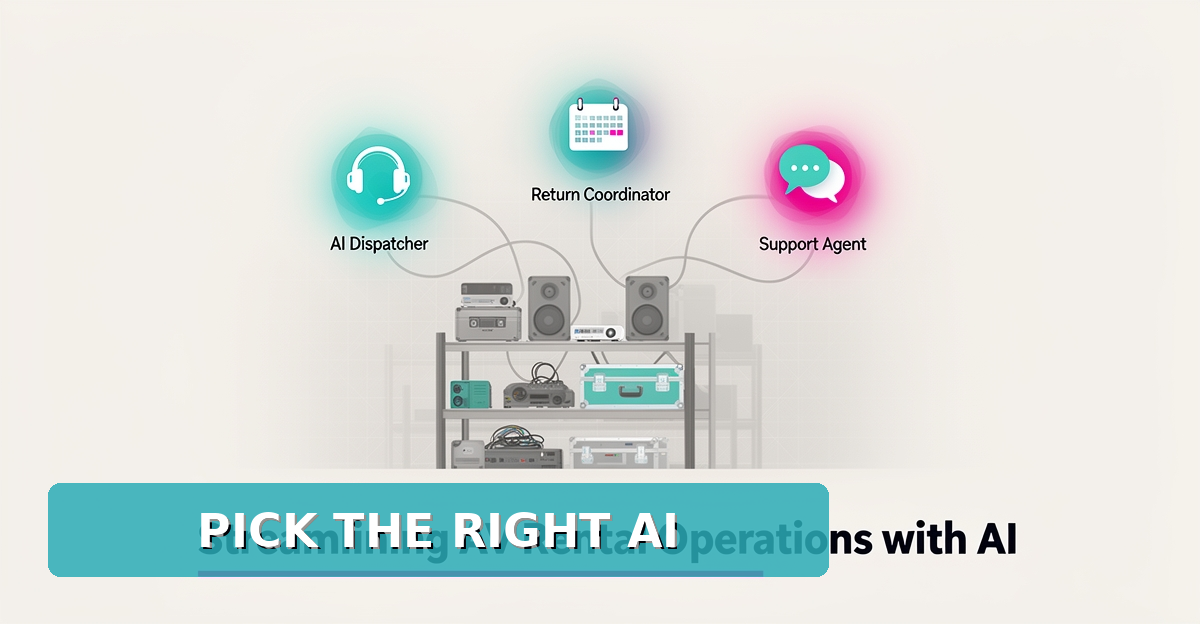
  • AI Return Coordinators: Handle scheduling, inventory updates, and client notifications.
  • AI Dispatchers: Optimize vehicle routes and equipment assignments based on historical data.
  • AI Customer Support Agents: Manage routine inquiries, booking confirmations, and initial intake.

Starting with these roles allows you to build an "intelligent choice architecture" that supports human decision-making. This approach minimizes risk while proving the value of AI integration.

Implementing AI is not about replacing humans; it is about empowering your workforce with better tools. As Microsoft notes, generative AI frees employees to dive into more complex and creative work by automating mundane tasks.

To succeed, establish clear governance frameworks for AI decision rights. For example, AI can suggest optimal dispatch routes, but human managers should retain final approval for high-value events. This balance ensures quality control while maximizing efficiency.

With a solid foundation in place, you can begin to scale these capabilities across your entire operation.

The Risk-Based Approach to AI Role Selection

Many AV rental owners rush to automate their front line, but this high-risk strategy often backfires. Consumer-facing automation is widely considered the riskiest transformation because it removes the human-in-the-loop during critical customer interactions.

Instead, successful operators categorize AI roles by risk tolerance. By starting with internal support functions, you can prove value and build confidence before touching client communication. This phased approach minimizes disruption while maximizing operational efficiency.

According to MIT Sloan Management Review, AI implementation should be segmented into three distinct risk tiers. This framework helps leaders decide where AI fits best within their specific operational context.

  • Common Tasks: Low-risk activities like synthesizing information, documenting meetings, and internal data entry.
  • Specialized Uses: Moderate-risk roles such as internal customer service support and creative guidance.
  • Consumer-Facing Applications: High-risk transformations like autonomous chatbots that handle complex troubleshooting without human oversight.

For AV rental businesses, the "Common Tasks" and "Specialized Uses" tiers offer the safest entry point. These roles handle the heavy lifting of logistics without exposing your brand reputation to potential AI errors in client communication.

Start your AI journey with roles that optimize your backend operations. Internal support functions like dispatching and inventory management are high-volume, low-risk candidates for automation.

Research indicates that AI significantly reduces time spent on repetitive administrative tasks. For example, Hiscox reduced claim processing time from one hour to just ten minutes using AI agents for routine queries. This level of efficiency is directly applicable to AV rental workflows.

Consider deploying AI Return Coordinators and Dispatchers first. These agents can handle data synthesis, scheduling, and internal coordination seamlessly. This allows your human staff to focus on complex event logistics and on-site technical support, which remain critical differentiators in the industry.

The most effective early-stage approach is "extensive experimentation" focused on small-scale transformations. This strategy creates immediate value while minimizing risk.

MIT Sloan experts note that enterprises should take a targeted approach that lays the foundation for larger efforts. Do not attempt to automate your entire AV rental workflow overnight.

Begin with a single high-volume role, such as an AI Dispatcher. Use this pilot to build an "intelligent choice architecture" that supports human decision-makers rather than replacing them. This method ensures you can test integration with existing CRM and scheduling tools before scaling.

As you integrate AI, you must define clear boundaries for decision-making authority. Leaders must balance responsible use with oversight to maintain quality control.

Define specific limits for your AI Dispatchers. For instance, AI can suggest optimal vehicle routes or equipment assignments based on historical data. However, human managers should retain final approval for high-value or complex event logistics.

This governance framework ensures compliance and protects your business from automated errors. By keeping humans in the loop for critical decisions, you maintain the high-touch service quality that AV rental clients expect. Once these internal systems are stable, you can confidently explore more advanced customer-facing applications.

Optimal AI Roles for AV Rental Workflows

Selecting the right AI employee role for your AV rental business requires balancing operational efficiency with risk management. Rather than attempting to automate your entire operation at once, start with roles that handle high-volume, low-risk administrative tasks.

This phased approach allows you to prove value while minimizing disruption to your critical event logistics.

MIT Sloan research identifies "consumer-facing applications" as the riskiest AI transformations because they often remove the human in the loop entirely. For AV rental companies, this means fully autonomous chatbots for complex technical troubleshooting are premature.

Instead, focus on "Common Tasks" and "Specialized Uses" that support human decision-makers. These roles synthesize information and manage schedules without the high stakes of direct customer resolution.

  • AI Dispatchers: Handle data synthesis and initial equipment routing.
  • Return Coordinators: Manage inventory tracking and schedule confirmations.
  • Intake Specialists: Process initial client inquiries and basic qualification.

By starting with these internal support roles, you build an "intelligent choice architecture" that enhances human capabilities rather than replacing them. This ensures your team retains control over complex event logistics while offloading repetitive administrative burdens.

While specific data for AV rental AI adoption is emerging, adjacent service industries demonstrate significant efficiency gains. Field services and insurance sectors show that AI can drastically reduce time spent on routine documentation and coordination.

Key statistics from these sectors highlight the potential ROI for AV businesses:

  • EchoStar Hughes projects saving 35,000 work hours by automating field service tasks.
  • Hiscox reduced claim processing time from 1 hour to 10 minutes using AI agents.
  • Axon Enterprise achieved an 82% reduction in time spent on report writing.

These figures suggest that AV rental businesses can similarly reduce administrative bottlenecks by deploying AI for routine inquiries and booking confirmations.

Microsoft Cloud data confirms that automating mundane tasks frees employees to focus on complex, value-added work.

The most effective early-stage approach to generative AI is "extensive experimentation" focused on small-scale transformations. This strategy creates immediate value while laying the foundation for larger-scale efforts.

For AV rental operators, this means beginning with a single high-volume role rather than a comprehensive system overhaul.

  1. Start Small: Deploy an AI Receptionist or Appointment Setter to test integration with your CRM and scheduling tools.
  2. Measure Impact: Analyze reduction in missed calls and administrative time spent.
  3. Scale Gradually: Expand to Dispatcher or Return Coordinator roles as confidence grows.

MIT Sloan experts note that this targeted approach minimizes risk while demonstrating tangible benefits to stakeholders.

As you integrate AI employees, you must define clear boundaries for their authority. The hierarchy of decision rights must shift so that AI shapes the decision environment rather than making final operational decisions alone.

For example, an AI Dispatcher can suggest optimal vehicle routes based on historical data. However, human managers should retain final approval for high-value or complex event logistics.

This governance framework ensures compliance and maintains quality control. It allows you to harness AI’s speed while preserving the human judgment essential for successful event execution.

By focusing on internal coordination and adopting a phased strategy, your AV rental business can achieve significant efficiency gains without compromising service quality.

Implementation Strategy: Small-Scale Transformation

Most AV rental businesses get stuck in the "pilot purgatory" phase, where isolated AI experiments fail to scale into operational reality. The secret to avoiding this trap isn't a massive, risky overhaul of your entire tech stack. Instead, successful organizations are shifting toward extensive experimentation focused on small-scale transformations. This targeted approach allows you to create immediate value while minimizing operational risk, laying a sturdy foundation for future large-scale efforts.

According to MIT Sloan Management Review, the most effective early-stage approach to generative AI is strict risk management. By categorizing tasks based on risk tolerance, you can prioritize roles that deliver high ROI without exposing your brand to unnecessary error.

For an AV rental business, this means starting with common tasks like data synthesis and scheduling, rather than jumping straight to autonomous, consumer-facing applications. This phased strategy ensures that your team builds trust in the technology before it handles complex customer interactions.

When selecting your initial AI employee roles, focus on positions that handle high-volume, low-risk administrative workflows. These roles serve as the perfect testing ground for integration with your existing CRM and dispatch systems. By starting small, you can refine your processes without disrupting live event logistics.

Consider these high-priority roles for your initial pilot:

  • AI Return Coordinator: Automates the verification of returned gear against inventory lists, reducing human error in lost/damaged item claims.
  • AI Dispatcher Assistant: Suggests optimal vehicle routes and equipment assignments based on historical data, leaving final approval to human managers.
  • AI Customer Support Agent: Handles routine inquiries, booking confirmations, and initial intake, freeing up staff for complex event needs.

Research from Microsoft shows that automating such routine tasks yields massive efficiency gains. For example, Hisxo reduced claim processing time from up to one hour to just ten minutes using AI agents for routine queries. Similarly, Axon Enterprise saw an 82% reduction in time spent on reports after implementing similar automation.

As you integrate AI into these roles, you must establish clear governance frameworks. AI should not replace human judgment in critical decision-making; instead, it should support it. This concept is known as an intelligent choice architecture, where AI presents options and trade-offs to human decision-makers.

Leaders must balance responsible AI use with oversight, shifting the hierarchy of decision rights. For instance, an AI Dispatcher might suggest the best truck for a wedding based on traffic and distance, but a human manager should retain final approval for high-value or complex logistics. This ensures compliance and maintains quality control while leveraging AI speed.

Microsoft’s research indicates that 66% of CEOs report measurable business benefits from generative AI initiatives. However, these benefits only materialize when AI is deployed to automate mundane tasks, freeing employees to focus on creative and complex problem-solving.

Once you have validated the efficacy of your initial AI roles, you can begin expanding into more complex workflows. The goal is to move from isolated tasks to a unified operational system that enhances your competitive advantage. This evolution requires continuous monitoring and optimization to ensure the AI remains aligned with your business goals.

By starting with small-scale transformations, you create a culture of innovation that is both safe and scalable. This methodical approach prevents the common pitfall of over-automating too soon, ensuring that every AI employee adds tangible value to your AV rental operation. With a solid foundation in place, your business is ready to leverage AI for strategic, long-term growth.

Next Steps: From Assessment to Automation

Moving from theoretical AI potential to tangible operational efficiency requires a structured path. Most businesses stall at the experimentation phase because they lack a clear roadmap for scaling.

According to MIT Sloan, successful organizations prioritize small-scale transformations to minimize risk while proving value. This phased approach allows AV rental operators to test AI roles like dispatchers or return coordinators before committing to enterprise-wide changes.

By starting with high-volume, low-risk tasks, you build the foundation for a mature AI strategy. AIQ Labs provides the AI Readiness Assessment needed to identify these specific opportunities within your unique workflow.

Attempting to automate complex workflows without understanding your current data infrastructure leads to failure. An assessment identifies whether your team is ready for managed AI employees or if deeper custom development is required.

Key benefits of starting with an assessment include:

  • Risk Mitigation: Identifies low-risk "common tasks" suitable for initial AI deployment
  • ROI Clarity: Establishes baseline metrics to measure future efficiency gains
  • Workflow Mapping: Reveals bottlenecks in dispatch, intake, or coordination processes
  • Technology Alignment: Ensures AI solutions integrate seamlessly with existing CRM tools

As noted by Microsoft, automating routine tasks can reduce processing times by up to 90%. However, realizing these gains requires knowing exactly which tasks to automate first.

Once your readiness is established, the next step is deploying a targeted AI solution. This typically begins with a single role, such as an AI Dispatcher or Customer Support Agent.

This pilot phase serves as a proof of concept, demonstrating how AI handles real-world scenarios like:

  • Automated Scheduling: Handling booking inquiries and calendar updates 24/7
  • Intelligent Dispatch: Routing technicians based on inventory and location data
  • Return Coordination: Managing equipment check-ins and damage assessment notes
  • Customer Follow-up: Automating post-event satisfaction surveys and feedback loops

For example, similar field service businesses have seen 25% productivity boosts by automating routine administrative tasks. Your AV rental business can achieve comparable results by focusing on these high-impact areas first.

AI transformation is not a one-time project; it is an ongoing process of optimization and scaling. AIQ Labs acts as your AI Transformation Partner, guiding you through every stage of this journey.

Our partnership model includes:

  • Strategic Roadmap Design: Customized plans aligned with your growth objectives
  • Ongoing Optimization: Continuous monitoring and refinement of AI performance
  • Governance Frameworks: Ensuring compliance and responsible AI usage
  • Scalability Support: Expanding AI roles as your business volume increases

Research from MIT Sloan highlights that leaders must shift their focus to shaping the decision environment rather than just making individual decisions. This means building systems that empower your team to make better choices faster.

By choosing AIQ Labs, you gain a partner invested in your long-term success. We combine strategic consulting with hands-on implementation to ensure your AI investments deliver measurable ROI.

Ready to begin your journey? Schedule a Free AI Audit to discover your first high-impact automation opportunity.

AI Development

Still paying for 10+ software subscriptions that don't talk to each other?

We build custom AI systems you own. No vendor lock-in. Full control. Starting at $2,000.

Frequently Asked Questions

Should I start with an AI dispatcher or a customer-facing chatbot for my AV rental business?
Start with internal roles like Dispatchers or Return Coordinators rather than consumer-facing chatbots. MIT Sloan research identifies autonomous customer applications as the riskiest transformation because they remove the human in the loop. Beginning with internal coordination allows you to prove value and build trust before handling complex client interactions.
How much time can AI actually save for my dispatch and support teams?
While specific AV rental data is emerging, adjacent industries show massive efficiency gains. For example, Hiscox reduced claim processing time from one hour to just 10 minutes, and Axon Enterprise saw an 82% reduction in report-writing time. These figures suggest AI can drastically cut the administrative bottlenecks common in AV rental operations.
Is it safe to let AI handle my customer inquiries without human oversight?
It is safer to start with 'Common Tasks' and 'Specialized Uses' like intake and scheduling, which are low-risk. MIT Sloan notes that 'Consumer-Facing Applications' are the riskiest because they remove human oversight during critical interactions. You should keep humans in the loop for complex troubleshooting to protect your brand reputation.
Can AI help me reduce lost or damaged equipment claims?
Yes, by deploying AI Return Coordinators to automate inventory verification and scheduling confirmations. This reduces human error in tracking returns and ensures accurate documentation of gear condition. It is part of a 'small-scale transformation' strategy that minimizes risk while improving operational accuracy.
How do I know if my business is ready to implement AI employees?
You need an AI Readiness Assessment to evaluate your current technology stack, data infrastructure, and team capabilities. This process identifies high-value automation targets and establishes baseline metrics to measure future efficiency gains. It ensures your AI solutions integrate seamlessly with existing CRM and scheduling tools.
What is the best way to implement AI without disrupting my current events?
Adopt a 'small-scale transformation' strategy by starting with one high-volume, low-risk role like an AI Receptionist or Appointment Setter. This phased approach allows you to test integration with your existing tools without disrupting live event logistics. Once you see results, you can gradually scale to more complex roles like Dispatchers.

From Back-Office Chaos to Front-Line Excellence

The disconnect between physical excellence and digital inefficiency is a critical bottleneck for AV rental businesses, but strategic AI adoption offers a clear path forward. By prioritizing low-risk, high-volume roles like AI Return Coordinators and AI Dispatchers, you can automate routine administrative tasks and reclaim valuable human hours. This shift allows your team to focus on complex event logistics and high-value client interactions, driving growth without the complexity or risk of massive investment. AIQ Labs serves as your complete AI transformation partner, helping you bridge this gap through tailored readiness assessments and the deployment of managed AI employees. We don’t just provide recommendations; we architect custom systems you own, ensuring sustainable competitive advantage. Whether you start with a targeted workflow fix or an AI employee pilot, the goal is the same: eliminate manual bottlenecks and empower your workforce. Contact AIQ Labs today to discover how we can architect your competitive advantage and transform your AV rental operations.

AI Transformation Partner

Ready to make AI your competitive advantage—not just another tool?

Strategic consulting + implementation + ongoing optimization. One partner. Complete AI transformation.

Join The Newsletter

Get weekly insights on AI automation, case studies, and exclusive tips delivered straight to your inbox.

Ready to Increase Your ROI & Save Time?

Book a free 15-minute AI strategy call. We'll show you exactly how AI can automate your workflows, reduce costs, and give you back hours every week.

P.S. Still skeptical? Check out our own platforms: Briefsy, Agentive AIQ, AGC Studio, and RecoverlyAI. We build what we preach.