How to Choose the Right AI Employee Role for Your Moving Business
Key Facts
- Industry analyses, including Project Management Institute research, consistently find that a large majority of AI projects fail to meet expectations when tools are picked before problems are defined
- Status reporting and routine updates can consume many hours weekly for managers—time automated tracking can reclaim
- Boston Consulting Group research attributes roughly 80% of AI adoption impact to people factors and 20% to technology
- AIQ Labs AI Employees typically cost around 80% less than an equivalent human hire while working 24/7/365
- AIQ Labs has deployed 200+ multi-agent systems and runs four live SaaS products daily
Hire a team member that works 24/7 — for less than a part-time wage.
AI receptionists, SDRs, dispatchers and 99+ roles. Trained on your business, fully managed.
Not sure where to start? Ask our AI planner
The Hidden Cost of Manual Tasks in Moving Operations
Every missed call during a move is a potential customer booking with your competitor. Yet most moving companies still rely on manual processes for phone inquiries, quote generation, and delivery tracking—creating a steady drain on resources and a frustrating experience for customers.
The problem isn't a lack of technology. Industry analyses, including Project Management Institute research, consistently find that a large majority of AI projects fail to meet expectations, primarily because businesses implement solutions without clearly identifying the underlying problems. For moving operations, this often means deploying generic chatbots that can't handle the complexity of coordinating schedules, calculating variable pricing, or managing multi-day moves.
The manual burden is real. Managers can spend many hours each week on status reporting and routine updates alone—time that could be redirected toward customer service or business development. In moving businesses, this translates to hours spent answering repetitive questions, manually generating quotes, and making confirmation calls that could be automated.
Consider the typical manual workflow in a moving company:
- Phone inquiries interrupt crews mid-move, forcing someone to stop and answer basic questions
- Quote generation requires gathering details, calculating costs, and following up—often taking hours or days
- Delivery tracking involves multiple phone calls and manual updates to customers
- Scheduling coordination happens through back-and-forth emails and calls, creating opportunities for errors
The challenge isn't finding AI tools—it's choosing the right ones. The sales technology landscape has grown crowded, making it easy to select solutions that don't align with your actual operational needs. Many moving companies fall into this trap, implementing AI for the sake of appearing modern rather than solving specific bottlenecks.
As IT project management commentators have warned, everyone is rushing to add AI, but most will end up with the same mess they had with previous software rollouts—because tech doesn't equal transformation. This insight applies directly to moving operations: simply adding AI without addressing root causes creates more complexity, not less.
Successful AI implementation starts with a different question: What problems do we keep solving manually? This problem-first approach, emphasized by AIQ Labs in their work with service businesses, ensures that AI roles are purpose-built to address genuine operational challenges rather than creating new layers of technology to manage.
The most effective moving companies identify specific pain points—missed calls after hours, delayed quote responses, or inconsistent delivery updates—then match those needs to targeted AI solutions. This strategic alignment transforms AI from a novelty into a functional team member that handles routine tasks while human staff focus on complex problem-solving and relationship-building.
Matching AI Roles to Moving Business Pain Points
Moving businesses face constant pressure to manage high volumes of customer inquiries, quote requests, and delivery logistics while maintaining service quality. AI employees offer a targeted solution by handling repetitive tasks that consume staff time without adding strategic value. Because a large majority of AI projects fail to meet expectations, matching AI roles to specific pain points matters more than adopting technology broadly.
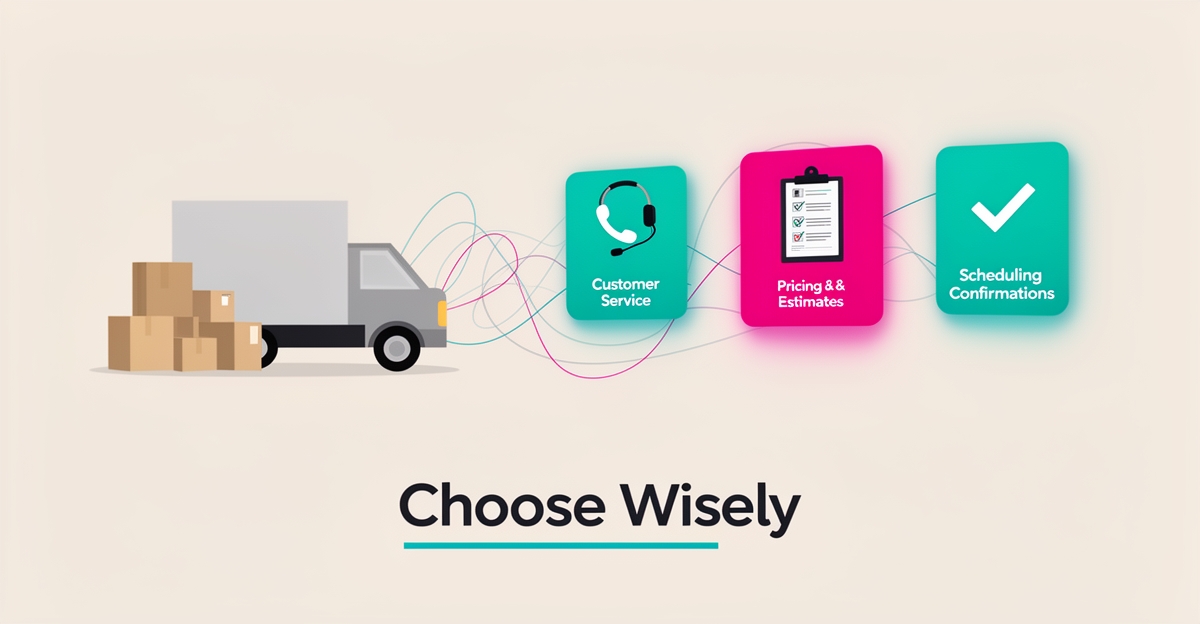
A receptionist AI directly addresses missed calls and delayed responses by providing 24/7 phone coverage, intelligent call routing, and appointment scheduling—ensuring no customer inquiry goes unanswered. This role reduces the burden on human staff while improving response times and caller experience. For moving companies, where initial contact often determines conversion, consistent availability can significantly impact lead capture and customer trust.
The quote assistant AI streamlines the estimate process by gathering move details, applying predefined pricing parameters, and generating preliminary quotes faster than manual methods. This accelerates the sales cycle and improves lead conversion by reducing the time between inquiry and response. Meanwhile, a delivery confirmator AI manages scheduling, sends automated confirmations, tracks completion status, and handles post-delivery follow-ups—enhancing communication and reducing no-shows or confusion.
Success with AI depends more on people than technology, as Boston Consulting Group research attributes roughly 80% of adoption impact to human factors like training, change management, and workflow integration. Moving businesses should start by identifying their most time-consuming manual tasks—such as phone handling, quote generation, or delivery tracking—and define clear AI role requirements that align with existing systems. Piloting one role at a time allows for feedback, refinement, and measurable results before scaling.
- Audit current operations to pinpoint repetitive, high-volume tasks
- Map the customer journey to find touchpoints where AI can provide immediate value
- Prioritize roles that directly impact customer satisfaction and operational efficiency
By focusing on problem-first implementation—asking "What problems do we keep solving manually?"—moving companies can deploy AI employees that genuinely support their teams rather than disrupt them. This approach ensures AI enhances human capabilities, allowing staff to focus on complex problem-solving, relationship-building, and strategic growth while routine tasks are handled consistently and efficiently. AIQ Labs helps moving businesses navigate this process by building and managing AI employees tailored to specific operational needs, ensuring seamless integration and ongoing optimization.
A Practical Framework for Selecting and Deploying Your AI Employee
Choosing the wrong AI role first is why moving companies stall. A problem-first framework prevents wasted spend and builds an AI employee that actually works alongside your crew.
Start by auditing the manual work that repeats daily. Map every customer touchpoint from first call to post-delivery follow-up and flag tasks that are high-volume, rule-based, and time-consuming. This audit reveals where an AI receptionist, quote assistant, or delivery confirmator will deliver immediate relief.
Define the role by outcomes, not technology. Clarify what the AI employee will do, how it hands off to humans, and what success looks like in moving company terms: faster quotes, fewer missed calls, cleaner scheduling. Problem identification comes before role selection, because industry research consistently shows most AI projects fail to meet expectations when technology is chosen first.
Prioritize high-impact, low-risk workflows for a pilot. Moving businesses typically see the fastest wins with:
- Receptionist AI that answers initial inquiries and books estimates 24/7
- Quote Assistant AI that collects move details and generates preliminary pricing
- Delivery Confirmator AI that sends updates, tracks completion, and handles follow-ups
Integration planning is critical. The AI role must connect to your existing CRM, calendar, dispatch system, and phone lines so data flows without duplicate entry. AIQ Labs designs these connections as part of its AI Employees service, which bundles build, training, tool integrations, monitoring, and improvements into a managed monthly plan that typically costs around 80% less than an equivalent human hire.
Adoption determines ROI. Boston Consulting Group research shows roughly 80% of AI adoption impact comes from people and 20% from technology. Train staff on escalation paths, create clear guidance on when the AI handles a task versus a human, and use pilot team members as champions who share real results.
Pilot with limits, then measure. Run the AI employee in a defined window with clear metrics: response time, quote-to-book rate, missed call reduction, and staff hours saved. Routine status reporting and updates can consume many hours weekly for managers—time that automated tracking can reclaim.
Optimize continuously. Review performance data weekly, refine the AI's knowledge and workflows, and expand only after the role proves reliable. This staged approach lets moving companies scale AI employees with confidence while keeping service quality and human oversight at the center.
Still paying for 10+ subscriptions that don’t talk to each other?
We build custom AI systems you own outright. No vendor lock-in. Full control.
Not sure where to start? Ask our AI planner
Frequently Asked Questions
What are the most common AI employee roles recommended for moving businesses?
Why do so many AI projects fail to meet expectations in moving companies?
What percentage of AI adoption impact comes from people versus technology?
How much do AIQ Labs' AI Employees cost compared to a human hire?
What is the first step in choosing the right AI employee role for a moving business?
Turning Manual Tasks Into Strategic Advantage
Choosing the right AI employee role isn't about adopting the latest technology—it's about solving the specific bottlenecks that drain your moving business every day. By starting with the question 'What problems do we keep solving manually?' you can pinpoint whether a receptionist AI to capture after-hours leads, a quote assistant to speed up estimates, or a delivery confirmator to reduce scheduling errors will deliver the fastest impact. This problem-first approach ensures AI enhances your team rather than complicates it, freeing staff to focus on relationships and growth while routine tasks run consistently in the background. The businesses seeing real results aren't those with the most AI—they're the ones who matched the role to the pain point. Ready to see where your biggest opportunity lies? Start with the two-minute Fit Check, then book a free 30-minute strategy call to map your highest-ROI automation opportunity. Industry research consistently shows most AI projects fail when technology leads the process—make sure yours doesn't become part of that statistic.
Make AI your competitive advantage — not just another tool.
Strategy, implementation and ongoing optimization. One partner, end to end.
Not sure where to start? Ask our AI planner