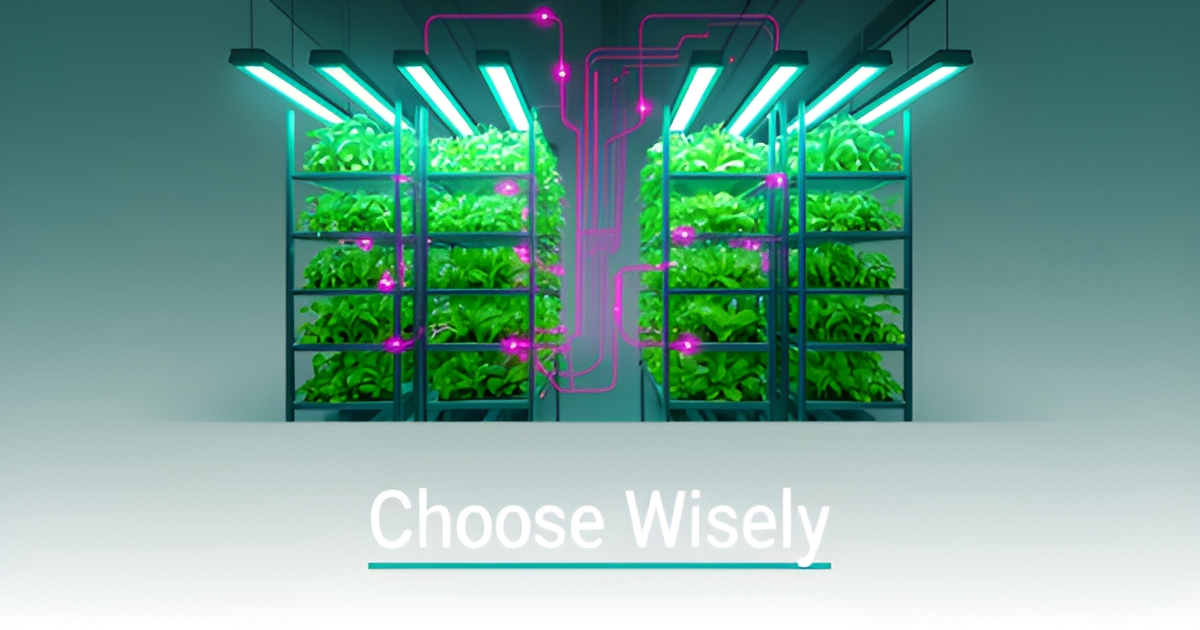
How to Choose the Right AI Partner for Your Vertical Farm
Key Facts
- Labor can exceed 50% of operational costs in vertical farming according to sustainability research
- The core challenge shifted from production control to decision control in 2026 vertical farming analysis
- Sensor data forms the base layer for every AI decision in vertical farms industry research shows
- AI systems forecast energy demand and adjust lighting and climate based on price patterns according to operational economics research
- Global population is projected to reach 10 billion by 2050 driving food security pressure in AI vertical farming analysis
- Edge-cloud infrastructure complexity slows decision speed and erodes operational trust technical assessment notes
Hire a team member that works 24/7 — for less than a part-time wage.
AI receptionists, SDRs, dispatchers and 99+ roles. Trained on your business, fully managed.
Not sure where to start? Ask our AI planner
Why Vertical Farm AI Partnerships Fail
Most vertical farm AI pilots don't fail because the technology is bad. They fail because the farm itself is a uniquely hostile environment for generic AI — and most vendors never see it coming.
The economics alone set vertical farms apart. Labor can exceed 50% of total operational costs in vertical farming, particularly in regions with higher minimum wages, while energy dominates the remaining cost structure through lighting, climate control, and HVAC loads. An AI partner who treats your operation like a standard manufacturing floor will optimize the wrong variables first — and burn your pilot budget proving it.
Then there's the decision density problem. Vertical farms don't run on fixed schedules the way traditional agriculture does. As recent industry analysis notes, the core challenge has shifted from production control to decision control — lighting, climate, energy, and crop conditions must adjust continuously, in real time, as small inefficiencies compound quickly at scale. Generic AI vendors typically deliver dashboards and alerts. What vertical farms actually need is a control layer that acts.
The labor transition makes this worse. The workforce is shifting from manual roles — transplanting, harvesting, cleaning — toward technical positions managing robotics, data analytics, and automated systems, a transition that sustainability researchers describe as a fundamental restructuring of farm labor. Your AI partner must design for a team that's mid-transition, not one that already employs data scientists.
The pattern of failure is remarkably consistent. Vendors without agriculture-specific depth stumble on the same pressure points:
- Climate control integration — they can't reconcile HVAC, LED lighting schedules, and CO2 systems into unified decision logic
- Crop monitoring nuance — computer vision trained on generic plant imagery misses the early stress signals that research shows appear before human-visible symptoms
- Energy optimization blindness — they treat energy as a fixed cost rather than a dynamic variable that AI should actively schedule around price and load patterns
- Data infrastructure fragility — sensor networks in grow environments generate noisy, inconsistent data that breaks models built on clean assumptions
The result is predictable: pilots that stall at Stage 2 of the AI maturity curve, never scaling beyond a single grow room or proof-of-concept. The vendor delivered something technically functional but operationally irrelevant — a model that works in the demo environment but can't handle the messy, interconnected reality of a working vertical farm.
This is exactly why domain context matters more than algorithmic sophistication. At AIQ Labs, our approach to AI transformation starts with understanding the operational workflow before writing a single line of code — because an AI system that doesn't respect the physics of your grow environment and the economics of your energy bill isn't a solution. It's an expensive science project.
Four Non-Negotiable Criteria for Evaluating AI Partners
Choosing the right AI partner for vertical farming requires more than evaluating generic technology—it demands alignment with the sector’s unique operational realities. The most effective partners demonstrate deep integration capabilities, proven domain expertise, scalable architecture, and a commitment to long-term ownership and evolution.
Data integration depth is foundational, as AI must unify disparate streams from IoT sensors, computer vision feeds, and energy management systems into a cohesive decision layer. Without this unification, insights remain siloed and actions fragmented. Research shows that AI-driven vertical farms achieve greater operational consistency by continuously processing real-time data to adjust lighting, climate, and nutrient delivery—turning controlled environments into stable, scalable operationsindustry research. This requires more than dashboard aggregation; it demands a decision engine that acts on correlated inputs across domains.
Domain expertise proof separates vendors who understand agriculture from those who merely apply generic AI models. Partners must demonstrate experience with hydroponic and aeroponic workflows, yield prediction models, and nutrient/irrigation automation. Studies confirm that AI systems optimizing these variables improve resource efficiency, reduce waste, and enable proactive interventions—such as detecting plant stress before visible symptoms appearrecent analysis. True expertise means the AI speaks the language of crop cycles, not just algorithms.
Scalability architecture ensures the system performs under real-world facility demands. Edge-cloud infrastructure must support low-latency climate decisions at scale, avoiding bottlenecks that undermine responsiveness. As noted in technical assessments, scalability depends on reliable edge-cloud coordination—when infrastructure grows overly complex, decision speed slows and operational trust erodestechnical evaluation. The AI must keep pace with the farm’s physical rhythm, not lag behind it.
Finally, post-implementation ownership determines long-term value. Partners should provide full IP transfer, avoid vendor lock-in, and offer managed optimization that evolves with crop cycles and market shifts. This aligns with the principle that sustainable AI transformation requires clients to own, control, and adapt their systems—free from platform dependencies or recurring vendor tolls. AIQ Labs embodies this approach through its true ownership model, ensuring clients retain complete control over custom-built AI assetsAI transformation partner. Without this, even the most advanced system becomes a liability rather than an advantage.
The Hidden Cost of Generic AI in Controlled Environment Agriculture
The wrong AI partner doesn't just waste your budget—it actively erodes the operational foundation your vertical farm depends on. While generic AI vendors promise quick wins, they often deliver systems that create more problems than they solve, leaving farm operators with expensive technical debt and workflows more fragmented than before automation began.
The stakes are particularly high in controlled environment agriculture, where labor can consume over 50% of operational expenses and energy volatility directly impacts margins. When horizontal AI providers—those serving every industry from retail to real estate—apply generic algorithms to your grow operations, they miss the biological nuances that determine whether your lettuce thrives or fails. These systems typically optimize for isolated metrics rather than the interconnected variables that define successful vertical farming.
The result is technical debt that compounds daily. Generic platforms often require extensive customization to handle basic agricultural workflows like nutrient film technique monitoring or photoperiod adjustments. As your farm scales, these patches create brittle integrations that break during critical growth phases. Instead of the continuous adjustment loops that enable real-time responses to plant stress or energy price fluctuations, you're left with rigid automation that requires constant manual overrides.
Perhaps most damaging is how misaligned automation widens the skills gap already challenging the industry. Vertical farming requires a workforce capable of managing AI-driven environmental controls and robotic systems, yet generic platforms often demand specialized IT knowledge that your horticulturalists don't possess. This creates a dangerous dependency on external consultants while your existing team—already stretched thin across planting, harvesting, and monitoring—struggles to interpret dashboards designed for data scientists rather than growers.
The hidden costs manifest in several ways:
- Integration fragility: Generic APIs that fail during critical climate transitions, requiring emergency manual overrides that negate automation benefits
- Data silos: Systems that can't communicate with your existing HVAC, irrigation, or lighting infrastructure, forcing duplicate data entry and increasing error rates
- Workflow mismatch: Automation designed for manufacturing lines rather than biological systems, ignoring the living variability of crops
- Skills displacement: Platforms that require coding knowledge to adjust basic parameters, pushing unskilled labor further from advancement opportunities
When AI doesn't understand the difference between a nutrient deficiency and a lighting malfunction, or can't adjust VPD (vapor pressure deficit) based on crop stage, it doesn't just underperform—it actively misleads. Farms stuck with these systems often find themselves trapped in what industry observers call the "pilot purgatory," where promising demos never translate to profitable, scalable operations.
AIQ Labs approaches this differently by building agriculture-specific systems that respect both the biological and economic realities of controlled environment agriculture. Rather than forcing your farm to adapt to generic software, true vertical farming AI adapts to your crops, your climate, and your existing infrastructure—creating the continuous adjustment loops that separate thriving operations from stalled experiments.
How to Structure a Partnership That Delivers ROI in 90 Days
Vertical farms win on control, but they lose on compounding inefficiencies when decisions stay manual. A 90-day ROI partnership starts by replacing guesswork with a targeted workflow fix, not a full rebuild.
The first step is a Discovery Workshop to audit sensor infrastructure and map decision bottlenecks. Teams review temperature, humidity, nutrients, CO2 levels, and energy use across the facility, because sensor data forms the base layer for every AI decision. Poor data quality limits model value, so the workshop validates consistency before any build begins.
From that audit, you select one high-impact workflow: climate, energy, or yield. AI in vertical farming is used to manage and optimize key operations such as climate control, crop monitoring, energy use, and production planning by processing real-time data continuously rather than relying on fixed schedules. The Build in Milestones model then delivers a targeted AI Workflow Fix in phases you approve and pay for.
A practical 90-day structure looks like this:
- Discovery Workshop, 2–3 days to audit sensors and prioritize climate, energy, or yield
- Phase 1 build of the chosen workflow with immediate integration to existing controls
- Proven value metrics before scaling to Department Automation or a Complete Business AI System
Energy is a dominant cost in indoor production, and AI systems forecast demand and adjust lighting and climate based on price and load patterns. That dynamic scheduling stabilizes margins where electricity dominates operating costs.
Labor pressure makes the case urgent. Labor can constitute a significant portion of operational expenses in vertical farming, sometimes exceeding 50% of total costs, especially in regions with higher minimum wages. Automation reallocates human capital to higher-value tasks while improving consistency.
The demand context is clear. The global community is confronted with mounting challenges to food security, with a projected population of 10 billion by 2050 and growing constraints of traditional agriculture. Vertical farms address land scarcity and water depletion, and AI enhances precision through monitoring environmental factors and early disease detection.
AIQ Labs structures these engagements with True Ownership and milestone-based payment, so clients keep all code and can stop anytime. The model proves value fast, then scales.
Why AIQ Labs Is Built Different for Vertical Farming
AIQ Labs was built from the ground up to solve the exact challenges vertical farms face when scaling AI—complex decision-making, high operational costs, and the need for true ownership. Unlike generic AI vendors, we combine custom multi-agent development, managed AI employees for roles like dispatch and QA, and strategic transformation consulting under one accountable partnership.
Our approach starts with deep integration into your existing systems—sensors, climate controls, inventory tools—using LangGraph workflows to orchestrate 70+ agents daily in production environments, just as we do in our own regulated AI platforms. This isn’t theoretical: our live SaaS portfolio proves we can handle the real-time data streams and compliance demands vertical farming requires, from energy optimization to predictive yield modeling.
What truly sets us apart is our SMB-accessible pricing model. With Start Monthly plans costing less than a part-time hire, vertical farms can deploy AI Employees for dispatching, monitoring, or quality assurance without the risk or complexity of traditional AI projects. You own what we build—no vendor lock-in—and we guide you through every stage of AI maturity, from pilot to transformation, ensuring your system evolves with your farm.
- AI-driven climate control reduces sharp energy cost swings, improving margin stability in electricity-intensive operations
- Computer vision enables early disease detection, shifting intervention from reaction to prevention and reducing yield loss
- Predictive analytics optimize lighting and nutrient delivery based on real-time data, improving resource efficiency and planning accuracy
By combining engineering excellence with true ownership and practical innovation, AIQ Labs delivers AI that doesn’t just automate tasks—it transforms how vertical farms operate, scale, and compete. We don’t just recommend AI; we build, manage, and partner with you to make it work—starting with a free strategy call to identify your highest-impact opportunity.
Still paying for 10+ subscriptions that don’t talk to each other?
We build custom AI systems you own outright. No vendor lock-in. Full control.
Not sure where to start? Ask our AI planner
Frequently Asked Questions
Why do AI pilots often fail in vertical farms?
What should I look for when evaluating an AI partner for my vertical farm?
How much does labor really cost in vertical farming, and can AI help?
What's the difference between generic AI tools and agriculture-specific AI?
How quickly can AI deliver ROI in a vertical farming operation?
Do I need to hire data scientists to run AI systems in my vertical farm?
Your Vertical Farm’s AI Advantage Starts Here
Choosing the right AI partner for your vertical farm isn’t about chasing the latest algorithm—it’s about finding a team that understands the unique pressures of your operation: soaring labor costs, energy volatility, and the need for real-time decision control across climate, crop, and resource systems. Generic AI fails here because it treats your farm like a factory, missing the biological nuance and economic reality that define success in controlled environment agriculture. The path forward begins with a targeted fix—auditing your sensor infrastructure, identifying one high-impact workflow, and building a solution that integrates with your existing controls, not against them. AIQ Labs helps vertical farms move beyond pilot purgatory by delivering owned, agriculture-specific AI systems that scale with your business, starting with a free strategy call to uncover your highest-impact opportunity. Take the first step toward AI that works as hard as your grow room does—schedule your free 30-minute strategy call today.
Make AI your competitive advantage — not just another tool.
Strategy, implementation and ongoing optimization. One partner, end to end.
Not sure where to start? Ask our AI planner