How to Scale Your Animal Damage Repair Business with AI-Driven Field Operations
Key Facts
- Half of frontline field technicians report burnout at work according to Microsoft's Work Trend Index
- Two-thirds of frontline employees say they lack sufficient time to complete daily tasks per Microsoft's Work Trend Index
- AI-driven scheduling optimizes technician assignments by analyzing proximity, experience, and availability in real time
- Integrated AI provides step-by-step guidance and visual aids directly to technicians on-site
- Automated work order generation reduces delays and improves first-time fix rates
- AI integration with existing field software enables faster scaling without costly retooling
- AI agents connect dispatch systems, customer portals, and work order platforms into a unified workflow
Hire a team member that works 24/7 — for less than a part-time wage.
AI receptionists, SDRs, dispatchers and 99+ roles. Trained on your business, fully managed.
Not sure where to start? Ask our AI planner
The Burnout Bottleneck: Why Field Teams Can't Keep Up with Demand
Animal damage repair teams face mounting pressure as seasonal demand spikes, yet many struggle to keep pace with workloads. Frontline employees are hitting their limits, with half reporting burnout at work and two-thirds saying they lack sufficient time to complete tasks. This operational strain directly impacts response times, job quality, and the ability to scale during peak seasons.
- Technicians overwhelmed by manual dispatch and paperwork miss critical service windows
- Inconsistent job documentation leads to rework and customer dissatisfaction
- Limited visibility into real-time job status creates bottlenecks in workflow
- Ad-hoc communication between field and office increases errors and delays
- Inability to prioritize urgent repairs during high-volume periods strains resources
These challenges are especially acute in animal damage repair, where timely response prevents further property degradation and health risks. When field teams operate under chronic time pressure and burnout, the quality of repairs suffers and customer trust erodes. AIQ Labs addresses this bottleneck by connecting AI agents with your existing field tools, linking dispatch systems, customer portals, and work order platforms into a unified workflow that reduces manual overhead and lets teams focus on skilled repair work rather than administrative tasks.
AI Integration as a Force Multiplier: Connecting Tools Without Retooling
Many field service businesses hesitate to adopt AI, fearing costly system overhauls and disruptive retooling. Yet the pressure to scale efficiently is mounting, with half of frontline technicians reporting burnout and two-thirds saying they lack sufficient time to complete daily tasks, challenges that AI can directly alleviate by streamlining workflows and reducing manual burden.
AIQ Labs integrates AI agents with your existing field software, dispatch, CRM, and scheduling systems, using Model Context Protocol and multi-agent architectures. This approach connects legacy tools into a unified workflow without requiring replacement, allowing you to scale operations rapidly while preserving prior investments. By acting as a force multiplier, AI handles routine coordination, data synchronization, and task orchestration, freeing human teams to focus on high-value field work. Depending on where the pain is sharpest, you can start with AI Employees handling intake and dispatch, a single Workflow Build targeting your costliest workflow, or a full AI Operating System that ties everything together.
- AI-driven scheduling optimizes technician assignments by analyzing proximity, experience, and availability in real time.
- Integrated AI provides step-by-step guidance, visual aids, and remote collaboration tools directly to technicians on-site.
- Automated work order generation and alert response reduce delays and improve first-time fix rates.
These capabilities are grounded in proven frameworks like LangGraph and ReAct, which allow specialized AI agents to collaborate on complex field service workflows, from intelligent dispatch to post-job follow-up, while maintaining audit trails and human-in-the-loop controls for critical decisions. The result is a scalable, intelligent operations layer that enhances efficiency without disrupting existing systems.
By connecting AI to current infrastructure through secure, validated integrations, including calendars, payment processors, and industry-specific platforms, AIQ Labs helps animal damage repair businesses transform fragmented tools into a cohesive, AI-powered field operations engine. This enables faster response times, better resource allocation, and improved customer satisfaction, all while avoiding the downtime and cost of full system replacements. As AI handles repetitive coordination, teams gain capacity to take on more jobs, improve service quality, and grow sustainably, proving that scaling doesn't require starting over, but rather building smarter on what already works.
From Dispatch to Done: AI-Powered Workflow Automation in Action
AI-powered field operations transform the chaos of dispatch into a seamless journey from alert to resolution. With intelligent scheduling and real-time guidance, technicians spend less time on logistics and more time fixing problems, directly addressing the burnout and time pressure reported by frontline employees. Microsoft's Work Trend Index highlights these pain points as critical barriers to efficiency in field service.
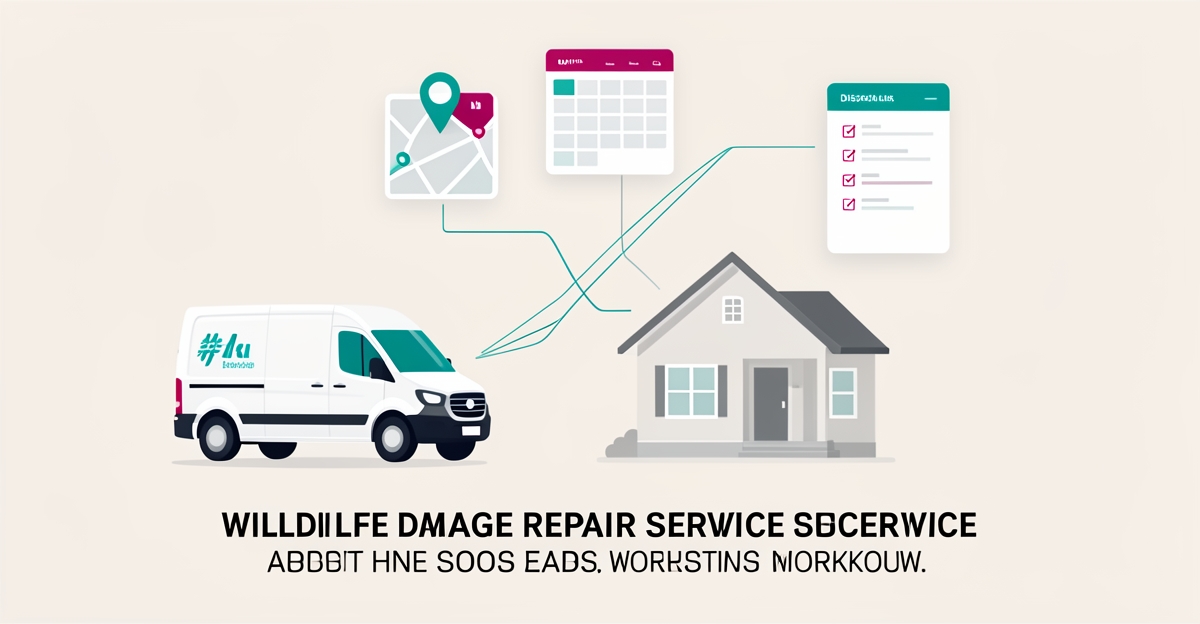
Resource Scheduling Optimization automatically matches the right technician to each job based on proximity, skill set, and availability, reducing manual dispatch effort and improving first-time fix rates. When an animal damage alert triggers, whether from a customer portal or sensor system, AI agents instantly generate optimized work orders and push them to mobile devices, eliminating delays caused by manual triage. This intelligent routing ensures teams are deployed where they're needed most, maximizing coverage without adding headcount.
Once en route, technicians receive step-by-step, AI-guided instructions directly in their field service app, complete with visuals and contextual tips for common repair scenarios. These guided workflows standardize troubleshooting, reduce errors, and enable less experienced staff to handle complex jobs confidently. By embedding AI into existing field tools, without requiring a full system overhaul, businesses achieve around-the-clock service capacity through smarter automation, not more staff. AIQ Labs enables this integration seamlessly, connecting dispatch, customer portals, and field software into a unified workflow where AI handles the routine, and humans focus on what they do best.
Your Path to Scaling: Assessment, Integration, and Optimization
Scaling animal damage repair operations requires more than adding technicians, it demands smarter workflows that reduce burnout and reclaim lost time. Half of frontline field workers report being burned out at work, while two-thirds say they lack sufficient time to complete daily tasks, creating a critical bottleneck for growth. AIQ Labs addresses this through a phased process designed for low-risk, measurable progress.
The journey begins with discovery and architecture, where we analyze your current dispatch, customer intake, and field tool integrations to identify automation opportunities. This phase includes technology assessments, ROI projections, and a clear roadmap tailored to your business maturity, whether you're starting with a single workflow fix through Workflow Builds or building toward a complete AI Operating System you own outright. Development and integration follows, during which we build custom AI agents that connect your existing field software, customer portals, and scheduling systems into a unified workflow, ensuring seamless data synchronization across CRM, accounting, and field service platforms without requiring costly retooling.
Deployment and training focuses on user readiness and system validation. We deploy the AI solution into production, provide role-specific training for your team, and establish performance monitoring to track improvements in real time. Finally, ongoing optimization ensures continuous improvement through feature enhancements, scaling support as your business grows, and regular ROI reporting. Throughout this process, the Start Monthly, Build in Milestones, and Own It Outright payment models let you scale responsibly, paying only for approved phases or adjusting your AI workforce as needed, with full ownership of everything built. This approach transforms field operations from a source of strain into a scalable competitive advantage.
Still paying for 10+ subscriptions that don’t talk to each other?
We build custom AI systems you own outright. No vendor lock-in. Full control.
Not sure where to start? Ask our AI planner
Frequently Asked Questions
Do I need to replace my existing dispatch or scheduling software to use AI in my animal damage repair business?
How can AI actually reduce burnout for my field technicians?
What does AI-driven dispatch look like in practice for animal damage repair jobs?
Can less experienced technicians handle complex repair jobs with AI support?
How long does it take to implement AI field operations, and what's the process?
Do I keep control over critical decisions if AI is running my workflows?
Build Smarter, Not Harder: Your Next Step Toward Scalable Field Operations
Scaling an animal damage repair business doesn't require ripping out your existing systems or hiring an army of new technicians. As we've explored, AI-driven field operations can transform your dispatch, scheduling, and on-site workflows by connecting the tools you already use into one unified system. From intelligent job matching to guided repairs and automated work orders, AI acts as a force multiplier, reducing burnout, improving first-time fix rates, and freeing your team to focus on skilled work. With half of frontline technicians reporting burnout and two-thirds saying they lack time to complete daily tasks, the need for smarter operations has never been clearer. AIQ Labs has deployed 200+ multi-agent systems and runs four live SaaS products daily, we know what works in the field. Ready to see what's possible? Take the two-minute Fit Check at https://aiqlabs.ai/apply, then book a free 30-minute strategy call to map your biggest bottleneck and identify high-ROI automation opportunities.
Make AI your competitive advantage — not just another tool.
Strategy, implementation and ongoing optimization. One partner, end to end.
Not sure where to start? Ask our AI planner