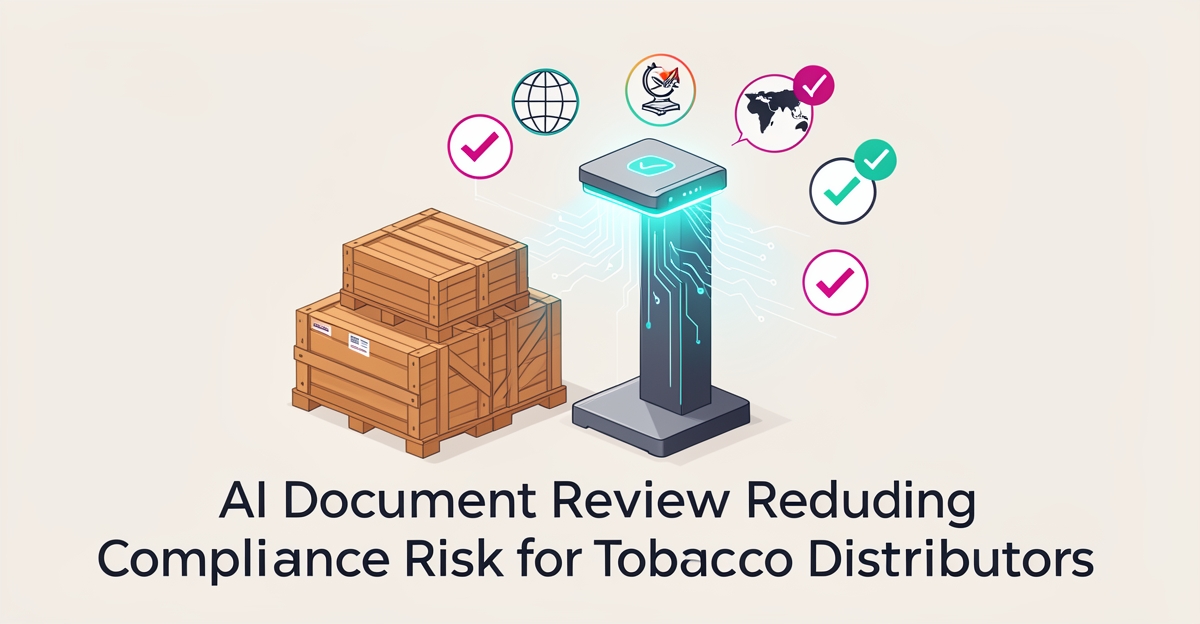
How Tobacco Distributors Can Reduce Compliance Risks with AI Document Review
Key Facts
- Tobacco distributors face a high volume of regulatory updates annually across many jurisdictions — industry analyses commonly cite hundreds of changes per year
- Regulatory affairs teams often spend the majority of their time on documentation management rather than analysis
- AI document review can substantially reduce compliance processing time while improving consistency, according to analyses of AI applications in regulated wholesale
- AI enables real-time regulatory change tracking with automatic impact assessment across active contracts and label templates
- Manual review creates exposure that compounds every quarter as regulatory activity continues
- Governance is the foundation — agentic AI adoption continues to expand in regulated industries, sometimes faster than oversight mechanisms mature
- AI-powered document review shifts compliance from reactive firefighting to proactive risk control
Hire a team member that works 24/7 — for less than a part-time wage.
AI receptionists, SDRs, dispatchers and 99+ roles. Trained on your business, fully managed.
Not sure where to start? Ask our AI planner
The Compliance Burden: Hundreds of Updates Across Many Jurisdictions
For a single tobacco distributor, staying compliant means tracking a moving target: regulatory changes arrive continuously across federal, state, provincial, and local jurisdictions. Industry analyses of tobacco regulatory compliance commonly describe hundreds of updates per year, and that volume of change has turned documentation into the dominant workload for regulatory affairs teams — often consuming the majority of their working hours.
That imbalance has real consequences. When highly trained compliance professionals spend most of their week on paperwork rather than analysis, the risk profile of the entire operation shifts. Agreements go unreviewed, updated clauses sit in queues, and labeling requirements change faster than manual processes can track.
The structural problem comes down to three compounding pressures:
- Jurisdictional fragmentation — each state, province, and locality layers its own rules on top of federal requirements, multiplying the documents that must be reviewed and maintained
- Constant regulatory churn — a steady stream of annual updates means a contract or label that was compliant last quarter may be exposed today
- Manual review bottlenecks — human reviewers can only process documents sequentially, so backlogs grow precisely when regulatory activity spikes
Manual document review was never designed for this pace. A distributor managing dozens of supplier agreements, retail contracts, and labeling submissions across many jurisdictions faces a simple math problem: the volume of compliance-critical documents grows every year, while the capacity of a human review team does not. Every unread amendment and every unchecked clause represents potential legal exposure — fines, license risk, or worse.
The cost dimension matters too. When most of a regulatory team's capacity goes to documentation management, distributors are effectively paying senior-level salaries for data-entry-adjacent work. Analyses of AI applications in tobacco wholesale suggest that AI-powered document review can substantially reduce compliance processing time while improving consistency — a direct answer to both the cost and the risk side of the equation.
This is where AI document review changes the equation. Rather than replacing compliance judgment, AI systems scan distributor agreements, flag non-compliant clauses against current jurisdictional requirements, and surface labeling risks before they reach a regulator's desk. At AIQ Labs, we build these kinds of compliance-first AI systems for regulated industries — with audit trails and human-in-the-loop controls designed in from the start, so automation strengthens oversight rather than bypassing it. You can explore how this fits your operation through our AI Workflow Builds, which rebuild the one workflow that costs you the most at a fixed price.
The distributors that recognize this shift early gain a structural advantage: compliance becomes a proactive, continuously monitored function instead of a reactive scramble. Those that continue relying on manual review carry a growing, largely invisible liability — one regulatory update at a time.
How AI Document Review Flags Risk Before It Becomes Liability
Tobacco distributors are drowning in paperwork while regulators move faster than ever. With regulatory updates arriving continuously across many jurisdictions, manual review creates exposure that compounds every quarter.
AI document review shifts compliance from reactive firefighting to proactive risk control. Systems scan distributor agreements, purchase orders, and labeling documents continuously, comparing language against current requirements and flagging deviations before execution. This automated validation reduces legal exposure where human review misses subtle clause changes.
Processing efficiency improves dramatically at scale. AI document review can substantially reduce compliance processing time and improve consistency, freeing regulatory affairs teams from repetitive checks. Today, regulatory affairs teams often spend the majority of their time on documentation management — a burden that automation directly reallocates to strategic oversight.
Real-time regulatory change tracking is built into production-grade solutions. Instead of quarterly manual updates, AI monitors rule changes across jurisdictions and maps impacts to active contracts and label templates. Multi-jurisdiction reporting consolidates evidence for audits without rebuilding reports from scattered files.
A compliant AI document review system typically delivers:
- Automated scanning and validation of distributor agreements against current regulations
- Risk flagging for non-compliant clauses, labeling errors, and tax stamp requirements
- Real-time regulatory change tracking with automatic impact assessment
- Multi-jurisdiction reporting and audit trails for governance
Beyond speed, the value is governance at speed. Agentic systems move sequentially and resolve ambiguity quickly, which means human oversight must be designed in from the start. AIQ Labs builds secure, compliant AI systems tailored to regulated industries, embedding validation layers and audit trails for document review workflows — whether as a single rebuilt workflow or as part of a broader AI Operating System that connects compliance into one operating layer you own outright.
When AI handles first-pass review, legal and compliance teams focus on exceptions, negotiations, and risk decisions rather than manual comparison. That shift reduces liability and creates a defensible compliance posture as requirements continue to evolve.
Governance First: Why AI Adoption Outpaces Oversight in Regulated Industries
Agentic AI adoption is accelerating in regulated industries, but governance frameworks are lagging behind, creating significant risk for tobacco distributors scaling AI document review. Industry analyses indicate that many organizations focus on what AI can do without evaluating whether they have the operating models, governance frameworks, and human oversight capacity to control its outputs. This imbalance means ambiguity in complex distributor agreements may be silently resolved by AI rather than surfaced for human review, potentially embedding compliance errors at scale.
Tobacco distributors face a continuous stream of regulatory updates across many jurisdictions, with regulatory affairs teams often spending the majority of their time on documentation management. Without proper governance, AI-powered contract analysis — while capable of substantially reducing compliance processing time — can automate risks instead of mitigating them. Audit workflows designed around human judgment are ill-suited for agentic AI's speed, which moves sequentially and at scale, often masking inconsistencies that would have been caught in slower, manual reviews.
To prevent premature deployment from masking foundational weaknesses, distributors must establish governance infrastructure before scaling AI use cases. This includes implementing human-in-the-loop controls for high-risk clause evaluations, maintaining immutable audit trails for every AI-driven decision, and defining clear escalation paths when ambiguity arises. Governance is the foundation — agentic AI will continue expanding into audit and finance regardless of whether oversight mechanisms are in place. Building this foundation ensures AI surfaces risks rather than silently resolving them, turning automation into a compliant advantage rather than a hidden liability. For distributors aiming to scale AI responsibly, working with a partner who embeds governance into every build — as AIQ Labs does across all of its service lines — helps align innovation with oversight from the outset.
A Practical Roadmap: From Assessment to Automated Compliance
Manual reviews can't keep pace with the regulatory load facing tobacco distribution. Distributors navigate a continuous stream of regulatory updates across many jurisdictions, while regulatory affairs teams spend much of their time on documentation management. A compliance-first roadmap turns that burden into a controlled, auditable system.
Assessment starts with governance, not models. Most organizations ask what AI can do, but neglect to evaluate whether they have operating models, governance frameworks, and human oversight capacity in place to control what AI does. Mapping current document workflows, data ownership, and audit trails reveals where ambiguity is silently resolved rather than surfaced. This baseline prevents premature deployment that looks successful until the foundation erodes.
High-risk workflows are identified by volume, variability, and consequence. Distributor agreements, labeling packs, tax stamp documentation, and customer verification records carry the highest exposure. AI can scan and validate distributor agreements, flag labeling risks, and surface non-compliant clauses, reducing legal exposure. Prioritizing these flows ensures early wins without expanding scope before controls are ready.
Deployment follows a compliance-first architecture with ownership built in. Systems are built to validate every action before execution, maintain complete audit trails, and enforce human-in-the-loop escalation for critical decisions. AIQ Labs builds custom systems that businesses own outright, with payment models that fit your stage — start monthly, build in milestones, or own it outright. That ownership model matters in regulated industries where vendor lock-in creates compliance risk. See the full breakdown on our pricing page.
Effectiveness is monitored through operational metrics and governance health. Processing time, accuracy rates, and exception handling are tracked against baseline. Continuous monitoring ensures agentic AI moves at speed without bypassing judgment.
A practical roadmap looks like this:
- Assess current governance infrastructure and document workflows for gaps in oversight and data lineage
- Identify high-risk document types such as distributor agreements and labeling where non-compliant clauses create legal exposure
- Deploy AI document review with compliance-first architecture, validation layers, and audit trails
- Monitor effectiveness with accuracy, processing time, and human-in-the-loop escalation metrics
When implemented deliberately, AI document review delivers faster market access with sustainable compliance control rather than hidden risk.
Still paying for 10+ subscriptions that don’t talk to each other?
We build custom AI systems you own outright. No vendor lock-in. Full control.
Not sure where to start? Ask our AI planner
Frequently Asked Questions
How much time do regulatory affairs teams typically spend on documentation management?
How many regulatory updates do tobacco distributors need to track each year?
Can AI-powered document review actually reduce compliance processing time?
What are the risks of deploying AI for document review without proper governance?
What types of documents should tobacco distributors prioritize for AI review?
How does AI document review help with real-time regulatory changes?
Turning Compliance Burden into Strategic Advantage
The challenge for tobacco distributors is clear: a continuous stream of regulatory updates across many jurisdictions, combined with regulatory teams spending most of their time on documentation, creates a compliance burden that scales with risk. AI document review offers a path forward — automating first-pass review, flagging non-compliant clauses, and improving consistency — when built with governance first, human-in-the-loop controls, and audit trails. The real value isn't just speed, but shifting teams from reactive paperwork to proactive risk oversight. For distributors ready to assess their current workflows and explore how AI can strengthen compliance without compromising control, the next step is a focused conversation. Start with the two-minute Fit Check, then book a free 30-minute strategy call to map your biggest bottlenecks and see where AI delivers measurable, auditable value — no obligation, just clarity.
Make AI your competitive advantage — not just another tool.
Strategy, implementation and ongoing optimization. One partner, end to end.
Not sure where to start? Ask our AI planner