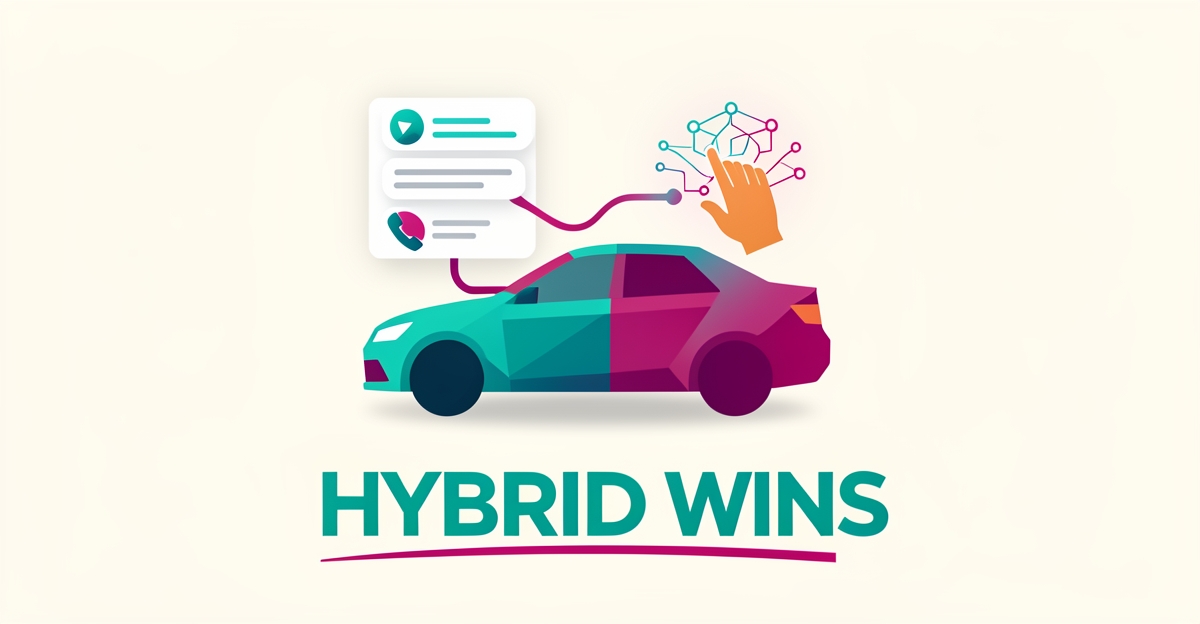
In-House vs. AI: Which Is Better for Managing Customer Inquiries in Auto Sales?
Key Facts
- A strong majority of consumers still prefer interacting with a human over an AI agent for important matters according to SurveyMonkey research.
- A meaningful share of consumers say they would cancel a service if it were solely AI-driven in customer service statistics.
- Most customers report higher satisfaction when AI handles simple, routine queries from AI customer service analysis.
- Seamless AI-to-human handoffs remain rare—only a small fraction of consumers report experiencing one in SurveyMonkey findings.
- AI can meaningfully reduce customer service costs, with some analyses citing savings of roughly 30% annually according to WorldMetrics.
- A significant share of customers appreciate a combination of AI and human support per Hiver HQ analysis.
Hire a team member that works 24/7 — for less than a part-time wage.
AI receptionists, SDRs, dispatchers and 99+ roles. Trained on your business, fully managed.
Not sure where to start? Ask our AI planner
The Consumer Trust Gap in Auto Sales Support
As of late 2026, AI adoption in customer service keeps accelerating across industries—yet consumer sentiment tells a more complicated story. A strong majority of Americans still prefer interacting with a human over an AI agent, and most still favor speaking to a real person for support. This deep-seated preference creates a critical tension for auto dealerships, where trust and personal connection are paramount in high-stakes transactions like vehicle purchases and trade-ins.
Consumers aren't just indifferent to AI—they're often actively skeptical. Many report negative feelings about companies using AI in customer experience, and a majority believe it's deployed primarily to cut costs rather than improve service. This perception fuels distrust, especially for sensitive matters like financing terms or warranty disputes. The risk is tangible: a meaningful share of consumers say they would cancel a service entirely if they discovered it was solely AI-driven, and many would even pay extra for guaranteed access to a human representative.
This skepticism doesn't mean AI has no role; rather, it highlights where it fits best. Data shows most customers report higher satisfaction when AI handles simple, routine queries like checking vehicle specs or service hours, and many prefer chatbots for quick answers over waiting in a queue. Yet when it comes to nuanced, relationship-driven conversations—such as scheduling a test drive or discussing trade-in valuation—human agents remain irreplaceable. Most people feel human agents better understand their needs and handle complex issues more accurately than AI.
For auto sales businesses, the challenge lies in bridging this gap without sacrificing efficiency or eroding trust. A hybrid approach—where AI manages the roughly 80% of routine inquiries and humans focus on the 20% of high-value, personalized interactions—aligns with the customers who appreciate a blend of both. However, success hinges on seamless handoffs: only a small fraction of consumers currently experience a smooth transition from AI to human support, a gap that can frustrate users and undermine the entire experience. Dealerships must design systems that preserve context and empower customers to escalate effortlessly when needed, ensuring AI enhances—not replaces—the human connection that drives loyalty in automotive retail.
Why Hybrid Beats Human-Only or AI-Only
The debate between human-only and AI-powered customer support misses the point. In the high-stakes world of auto sales, the most effective strategy isn't choosing one over the other; it's building a hybrid model that leverages the strengths of both. This approach directly addresses the core tension between consumer skepticism and business efficiency.
Consumers are wary of fully automated systems. According to a SurveyMonkey report, a strong majority of Americans prefer interacting with a human, and roughly half would cancel a service if it were solely AI-driven. For a dealership, this means automating sensitive conversations about financing or trade-in values could actively drive customers away.
However, ignoring AI's operational benefits is equally unwise. Businesses are adopting AI for good reason. One industry analysis found AI can cut customer service costs by around 30% annually, while other reports note it can save agents significant time each day on repetitive work. This efficiency is crucial for handling the high volume of routine inquiries dealerships receive.
The solution is a hybrid model that aligns with the customers who appreciate a combination of AI and human support. This "human-led, AI-assisted" approach uses technology to enhance, not replace, the human connection. AIQ Labs builds this model around an 80/20 split.
AI handles the 80% of routine, repetitive inquiries that don't require emotional intelligence. This frees up human agents to focus on the 20% of high-value interactions where trust and empathy are paramount.
- AI-Powered Tasks (The 80%): Answering basic questions about vehicle specs, checking inventory, booking service appointments, and providing business hours.
- Human-Led Tasks (The 20%): Scheduling test drives, discussing trade-in valuations, navigating complex financing options, and resolving customer complaints.
This division of labor allows AI to provide instant, 24/7 responses for simple queries—something most users prefer over waiting in a queue. Meanwhile, sales staff can dedicate their time to building relationships and closing deals. The biggest operational risk in this model is a clumsy handoff: only a small fraction of consumers report experiencing a seamless transition from AI to a human agent.
A successful hybrid system must ensure context is passed along, so the customer never has to repeat themselves. By strategically blending AI's efficiency with human empathy, dealerships can meet modern customer expectations, optimize their operations, and build the lasting loyalty that drives revenue.
What AI Should Handle vs What Humans Must Own
The dividing line between AI efficiency and human trust isn't theoretical—it's visible in the data. Most customers report higher satisfaction with AI-handled simple queries, yet a majority believe AI is used primarily to save money, not to improve service, and many distrust AI for sensitive issues entirely. The winning strategy isn't choosing one over the other; it's mapping every inquiry to the channel best equipped to resolve it.
- AI owns the routine: Vehicle specifications, real-time inventory checks, dealership hours, service appointment booking, and initial lead qualification. These are high-volume, data-driven interactions where speed and 24/7 availability win.
- Humans own the relationship: Test drive coordination, trade-in valuations, financing structuring, complaint resolution, and closing deals. These moments require empathy, negotiation, and the nuanced judgment that most consumers say only humans provide.
The risk lives in the handoff. Because so few consumers experience a seamless transition from AI to a human agent, a clunky escalation erodes the trust the AI just built. At AIQ Labs, we architect hybrid systems where the AI captures context—vehicle interest, trade details, financing pre-qualification—and passes a complete conversation summary to the sales consultant before the phone rings. That "digital twin" of the customer journey ensures the human picks up exactly where the AI left off, turning a potential friction point into a competitive advantage.
Building a Seamless Hybrid Support System
A hybrid support system only works when the technology disappears and the customer feels helped, not handed off. In auto sales, that means designing for routine speed and human trust at the same time.
Data readiness comes first. An AI agent needs a dynamic digital twin of day-to-day operations to answer accurately. Industry analysis warns you cannot run an agent on fragmented data, and clean, integrated inventory, pricing, and service records are non-negotiable. Without that foundation, hallucinations rise and trust erodes.
Context-aware handoff design protects the relationship. Because seamless AI-to-human handoffs remain rare, the transfer must carry full context. Capture name, vehicle interest, trade-in notes, and prior questions, then route to the right specialist with a summary, not a blank slate. A visible “talk to a person” option gives customers control and prevents frustration.
Training and governance keep the hybrid model human-led. Staff need clear escalation rules for financing, trade-in valuations, test drives, and complaints. AI handles high-volume, repeatable inquiries while people own empathy and closing. This mirrors the broader pattern: customers report higher satisfaction with AI-handled simple queries, yet strongly prefer a human for meaningful, high-stakes issues.
Measurement closes the loop. Track volume deflection, first-contact resolution, handoff time, and post-interaction sentiment. Use those signals to refine prompts, knowledge bases, and escalation thresholds.
Practical implementation steps dealerships can follow:
- Audit data sources and build a unified digital twin for inventory, service, and CRM
- Map inquiry types to AI vs human, reserving sales conversations for staff
- Design context-preserving handoffs with prefilled notes and warm transfers
- Train teams on AI-assisted workflows and define governance for sensitive data
- Measure deflection, satisfaction, and seamless handoff rates weekly
When the hybrid is built right, AI handles roughly 80% of routine inquiries and frees staff for personalized conversations that drive loyalty. AIQ Labs delivers this through managed AI staff—receptionists, SDRs, and dispatchers that cover the routine layer at a fraction of a hire's cost—or a fixed-price workflow rebuild targeting the single costliest inquiry process first. The result is 24/7 coverage for specs and scheduling with human expertise for the high-stakes moments customers remember.
Still paying for 10+ subscriptions that don’t talk to each other?
We build custom AI systems you own outright. No vendor lock-in. Full control.
Not sure where to start? Ask our AI planner
Frequently Asked Questions
Is AI a bad move for auto dealerships if customers prefer talking to humans?
What kinds of customer inquiries should AI handle versus a human sales team?
Will customers leave if we automate too much?
How do we make handoffs from AI to human not frustrating?
Can AI actually save money for a dealership?
Is a hybrid AI plus human model actually wanted by customers?
The Road Ahead: Blending Efficiency with Empathy
The debate between in-house and AI isn't about choosing sides—it's about strategic integration. While AI offers undeniable efficiency for routine tasks, the data is clear: most buyers still crave human connection, especially for high-stakes auto sales conversations. The winning formula is a hybrid model where AI handles the 80% of repetitive inquiries—like inventory checks and service scheduling—freeing your team to focus on the 20% that drive revenue: test drives, trade-ins, and financing. The key to success lies in seamless handoffs; ensuring context travels with the customer is critical, as a clunky transition erodes the trust you've built. By adopting a human-led, AI-assisted approach, dealerships can reduce costs while deepening customer loyalty. At AIQ Labs, we've deployed 200+ multi-agent systems and architect these exact hybrid setups, ensuring your AI enhances rather than replaces the human touch. Ready to bridge the gap? Start with a 2-minute Fit Check, then book a free 30-minute strategy call to map your dealership's hybrid support system.
Make AI your competitive advantage — not just another tool.
Strategy, implementation and ongoing optimization. One partner, end to end.
Not sure where to start? Ask our AI planner