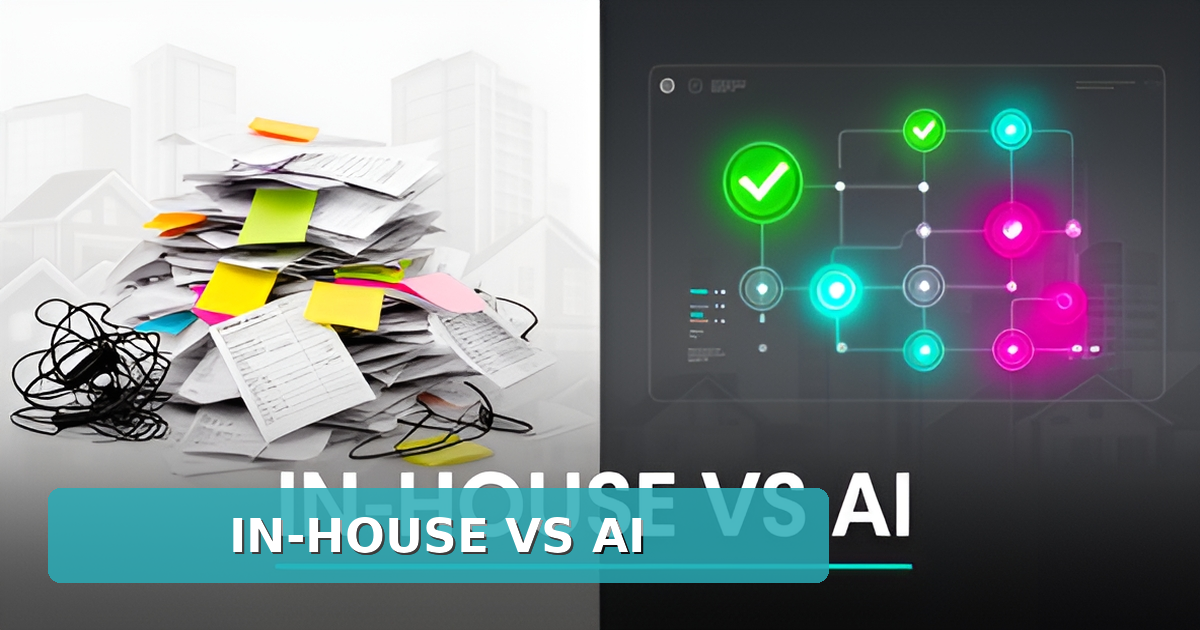
In-House vs. AI: Which Is Better for Managing Property Maintenance Workflows?
Key Facts
- Manual repair coordination commonly takes 30-40 hours monthly for active portfolios; AI-assisted triage and dispatch typically reduces that to a handful of hours
- AI-powered intake and dispatch typically responds in hours, not the 12-24 hours common with manual inbox-based workflows
- Delayed repairs are consistently linked to lower renewal rates and higher vacancy costs
- Predictive maintenance typically reduces emergency repair calls by roughly a third in well-implemented deployments
- AI-powered property management commonly cuts administrative workload significantly and reduces operational costs in the 40-60% range for coordination-heavy tasks
- Time-to-resolution for maintenance typically improves substantially after AI chatbots and automated scheduling are deployed
Hire a team member that works 24/7 — for less than a part-time wage.
AI receptionists, SDRs, dispatchers and 99+ roles. Trained on your business, fully managed.
Not sure where to start? Ask our AI planner
The True Cost of Manual Maintenance Coordination
Manual maintenance coordination looks manageable on paper until the hours pile up and tenants start leaving.
In-house teams are drowning in fragmented workflows that create invisible drag on operations and revenue. The cost is not just salary; it is the friction of reactive processes that compound every month.
Property managers running manual processes typically spend 30-40 hours monthly on administrative tasks for repair coordination alone, compared with a fraction of that once AI-assisted triage and dispatch are in place. That reduction in administrative burden never shows up in a headcount report, but it shows up in payroll, overtime, and missed follow-ups.
Response delays are built into the model. Manual workflows commonly average 12-24 hour response times, while AI-powered triage and dispatch typically respond within hours. Phone, email, and text requests sit in inboxes, get logged inconsistently, and wait for a coordinator to manually route them to the right vendor.
The tenant impact is real. Properties with delayed repairs tend to see lower renewal rates, directly eroding rental income and increasing vacancy costs. Slow follow-ups also drive after-hours calls, and landlords who implement AI alerts commonly report a meaningful drop in after-hours interruptions.
Hidden inefficiencies that accumulate in manual coordination include:
- Manual logging and ad-hoc vendor dispatch with no real-time visibility
- Reactive firefighting instead of proactive scheduling and risk scoring
- Fragmented communication across phone, email, and text with no unified work order trail
- Inconsistent accountability and missed follow-ups that extend resolution time
These patterns show why reactive workflows cost more than they save. Without automated triage, work orders stall, contractors are contacted late, and tenants experience repeated delays.
AI shifts the model from coordination to execution. Instead of a human chasing updates, an AI system can manage work orders, timelines, and contractor follow-ups end-to-end, reducing administrative burden and improving accountability. AIQ Labs builds this as a managed capability through its AI Employees—AI maintenance coordinators and dispatchers that handle intake, routing, and follow-up around the clock—or as a targeted AI Workflow Build that rebuilds the one workflow costing you the most.
The result is fewer missed updates, faster resolution, and a maintenance operation that scales with portfolio growth without proportional headcount increases.
How AI Transforms Maintenance from Reactive to Predictive
AI transforms maintenance workflows from reactive to predictive by leveraging IoT sensors, machine learning, and automated triage systems. These technologies analyze real-time equipment data and historical failure patterns to identify potential issues before they escalate into emergencies. As a result, property managers can shift from scrambling to fix broken systems to scheduling repairs during optimal windows, reducing disruption and cost. Industry reporting as of late 2026 consistently shows AI-powered predictive maintenance reducing emergency repair calls by roughly 30% in mature deployments.
This proactive approach extends beyond simple alerts—AI systems can flag likely equipment failures days or even weeks in advance by monitoring vibration, temperature, pressure, and usage trends. When failure probability exceeds a set threshold, the platform automatically generates preventive work orders and notifies the appropriate vendor. AI-driven vendor selection further optimizes outcomes by analyzing response times, labor rates, and quality scores, which typically produces lower labor costs than static vendor lists. These capabilities turn maintenance from a cost center into a strategically managed function.
- IoT sensors provide continuous monitoring of critical building systems like HVAC, plumbing, and electrical
- Predictive analytics models forecast failure likelihood using historical and real-time data streams
- Automated triage routes issues to the right vendor based on skill, location, and urgency
- Preventive work orders are triggered before tenants even notice a problem
- Performance tracking improves vendor accountability and service consistency over time
By integrating these functions, AI reduces the administrative burden on maintenance coordinators—often cutting manual coordination work by more than half—while improving first-time fix rates and tenant satisfaction. Mature property management platforms demonstrate how AI streamlines maintenance coordination, especially for portfolios of 50+ units, by reducing after-hours emergency calls and enabling data-driven scheduling. This shift not only lowers operational costs but also extends equipment lifespan and protects net operating income through fewer emergency premiums and better budget predictability. AIQ Labs supports this transformation through AI Workflow Builds that integrate with existing property management systems to deliver measurable efficiency gains.
The Financial Case: AI vs. Human Coordinators by the Numbers
Property maintenance coordination looks cheap on paper until you add the hours spent chasing work orders, following up with contractors, and covering after-hours calls. The math shifts quickly when human coordinators are measured against automated workflows.
Human-led maintenance teams carry a heavy administrative load. Manual repair workflows commonly consume 30-40 hours monthly in administrative tasks, while AI-assisted systems typically reduce that to a handful of hours—a reduction on the order of 70%. Properties relying on manual processes also tend to experience lower tenant renewal rates due to delayed repairs.
AI changes the cost structure by automating routine coordination without adding headcount. Industry data as of 2026 reports that AI-powered property management commonly cuts administrative workload in half and reduces operational costs by 40-60% for coordination-heavy functions. The savings come from fewer emergency dispatches and less overtime, not just software fees.
Availability is another cost driver that rarely appears on a budget. Human coordinators work business hours and miss calls. Case studies note that AI chatbots can handle common tenant queries 24/7, freeing managers to focus on complex tasks. Continuous coverage reduces after-hours escalation and protects tenant satisfaction.
Speed compounds the financial impact. Documented implementations show time-to-resolution for maintenance issues improving substantially—often by around 50%—after deploying AI-powered chatbots and scheduling systems. Faster resolution means fewer repeat visits and lower labor cost premiums.
AI also improves accountability across vendors. Research on property management AI highlights that AI tracking systems enhance vendor accountability and maintenance workflow oversight. Automated follow-ups and performance scoring replace manual chasing.
The financial case breaks down into measurable shifts:
- Administrative hours typically drop from 30-40 per month manually to a fraction of that with AI
- Operational costs commonly fall 40-60% for coordination-heavy workflows with AI-powered automation
- Time-to-resolution often improves by around 50% with chatbot and scheduling automation
- 24/7 intake eliminates missed calls and after-hours penalties
For SMB portfolios, the comparison is not AI versus a coordinator, it is owned automation versus recurring payroll. An AI maintenance coordinator from AIQ Labs runs at roughly 80% less than the cost of a comparable human hire, managing work orders, timelines, and contractor follow-ups as a managed capability rather than a headcount line item. The result is predictable cost with continuous coverage.
When coordinators are measured by cost per work order closed and hours spent on follow-up, AI delivers lower total cost of ownership with higher throughput.
Implementing AI Maintenance Management: A Practical Roadmap
Moving from spreadsheets and phone tags to AI-driven maintenance is less about replacing people and more about removing the friction that slows work orders down.
A practical roadmap starts with data. Clean work order history, vendor performance records, and asset information form the foundation for triage and predictive routing. Without this, AI cannot prioritize urgency or learn patterns. Integration with existing property management systems ensures the AI works inside current workflows rather than alongside them.
Pilot with a single workflow to prove impact before scaling. A focused test on maintenance intake to dispatch lets teams measure response time and completion rates with minimal risk. Case studies show time-to-resolution for maintenance issues often improving by around 50% after deploying AI-powered chatbots and scheduling systems. Pilots also surface data gaps and build staff confidence.
Human-in-the-loop safeguards keep accountability and compliance intact. AI can categorize requests by urgency and nature, but property managers review escalations and final vendor assignments. This approach mirrors best practices where human oversight spots and resolves errors quickly. Clear escalation rules for safety-critical issues protect tenants and limit liability.
Success is measured with operational KPIs, not just automation. Teams track metrics that tie directly to tenant experience and cost control:
- Response time from request to first contractor contact
- Average time-to-resolution for maintenance issues
- Administrative hours spent per month on work order coordination
- Tenant satisfaction scores related to repairs
Across implementations, AI-assisted intake and dispatch typically achieves response times measured in hours rather than the 12-24 hours common with manual processes, and predictive maintenance programs commonly reduce unplanned incidents by roughly a third, improving budget predictability.
AIQ Labs supports this transition through AI Workflow Builds that unify CRM, accounting, and property management tools, and through managed AI Employees that handle intake, dispatch follow-ups, and completion tracking 24/7. For portfolios ready to connect maintenance into a single operating layer across leasing, accounting, and vendor management, an AI Operating System ties it all together—built in phases and owned outright. The goal is operational leverage: teams handle more volume with fewer coordination bottlenecks while keeping human judgment where it matters most.
Still paying for 10+ subscriptions that don’t talk to each other?
We build custom AI systems you own outright. No vendor lock-in. Full control.
Not sure where to start? Ask our AI planner
Frequently Asked Questions
How much admin time can I actually save by switching from manual maintenance coordination to AI?
Will faster repairs really help me keep tenants longer?
Can AI predict maintenance issues before my tenants even notice them?
Is AI maintenance management cheaper than hiring another coordinator?
How fast can AI respond to a maintenance request compared to a human team?
Do I have to replace my maintenance staff with AI?
From Reactive Repairs to Proactive Performance: The Real ROI of AI in Maintenance
The pattern is clear: manual maintenance coordination drains time, money, and tenant trust. Properties using AI for maintenance workflows typically see administrative hours drop dramatically, response times cut in half, and emergency repairs reduced by roughly a third. These aren't just efficiency gains—they translate directly to higher renewal rates, lower operational costs, and a maintenance operation that scales without proportional headcount increases. For property managers ready to move beyond reactive firefighting, the next step is identifying where AI can deliver the fastest impact. Start with the 2-minute Fit Check and a free 30-minute strategy call to map your biggest bottleneck and see how owned automation can replace recurring payroll with predictable, 24/7 performance.
Make AI your competitive advantage — not just another tool.
Strategy, implementation and ongoing optimization. One partner, end to end.
Not sure where to start? Ask our AI planner