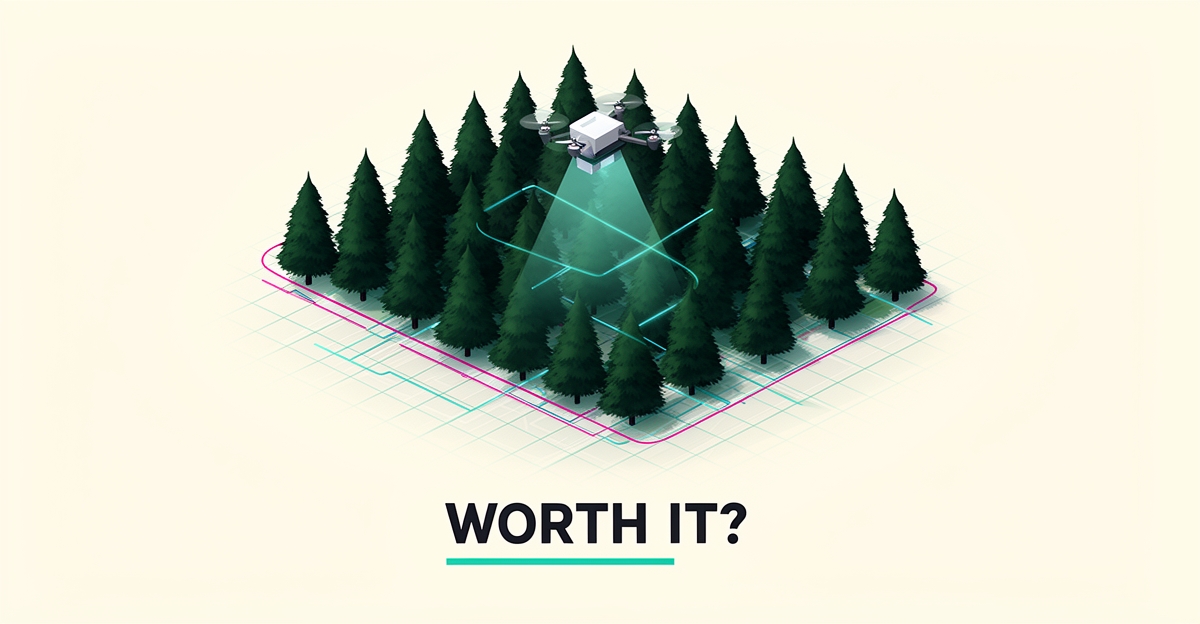
Is AI Worth It for Christmas Tree Farms? A Real-World Cost-Benefit Analysis
Key Facts
- Christmas trees need 8-10 years from planting to harvest maturity according to farm experts.
- Annual labor costs for Christmas tree farms range from $8,000 to $15,000 per farm management data.
- AI drones can map 100 hectares in approximately 30 minutes per industry analysis.
- Tree counting accuracy with AI drones reaches up to 98% in Agremo case studies.
- A single drone unit costs approximately €25,600 excluding software and training per recent drone adoption research.
- Drones can replace 5 to 10 manual workers per farm for counting and monitoring according to North Carolina State University.
- A single acre of Douglas fir can generate over $10,000 in profit when properly managed per Penn State Cooperative Extension.
Hire a team member that works 24/7 — for less than a part-time wage.
AI receptionists, SDRs, dispatchers and 99+ roles. Trained on your business, fully managed.
Not sure where to start? Ask our AI planner
The Long Game Problem Christmas Tree Farms Face
Christmas tree farming demands patience few businesses require. From planting to harvest, the growth cycle spans 8-10 years, locking capital into living inventory with no interim revenue. This long horizon means every season’s work—shearing, pest monitoring, and field maintenance—must be sustained without guaranteed returns until a decade later. Annual operating costs compound this challenge, with labor alone ranging from $8,000 to $15,000, equipment from $5,000 to $10,000, and marketing from $2,000 to $5,000, creating a fixed overhead burden year after year.
The operational rhythm intensifies these pressures. Counting thousands of trees manually consumes dozens of hours each season, while shearing and shaping require skilled labor after year three to ensure marketable form. Pest monitoring demands monthly walks through rows to spot needle cast or root rot early, and inventory tracking remains a labor-intensive, error-prone process relying on clipboards and memory. These tasks aren’t just time-consuming—they divert attention from strategic activities like customer engagement or sales planning during the critical holiday window. For small farms managing 5–25 acres, this labor intensity scales directly with acreage, making efficiency not just beneficial but essential to survival.
- Annual shearing begins at age 3 and repeats yearly until harvest
- Pest monitoring requires monthly inspections across all growing zones
- Manual inventory tracking is prone to human error in large plantations
- Equipment maintenance adds unpredictable costs to fixed annual budgets
- Marketing spend peaks seasonally but requires year-round planning
AIQ Labs understands these constraints through years of helping agricultural businesses model operational trade-offs. The core issue isn’t just cost—it’s the misalignment between year-round expenses and seasonal income, amplified by labor-intensive processes that scale poorly with farm size. When every hour spent counting trees is an hour not spent building customer relationships or refining harvest forecasts, the opportunity cost becomes structural. Efficiency gains here don’t just save money; they reclaim time for the strategic work that sustains long-term viability in a business where today’s labor determines next decade’s harvest. This is why rethinking foundational tasks like inventory and monitoring isn’t optional—it’s how farms bridge the gap between planting and profit.
What AI and Drones Actually Do on the Farm Today
On Christmas tree farms today, AI-powered drones are transforming core operations by mapping 100 hectares in approximately 30 minutes while achieving 98% accuracy in tree counting, as demonstrated by industry implementations. Each tree receives a unique digital identifier that enables precise tracking of growth patterns, health metrics, and sales history throughout its 8- to 10-year maturation cycle. This level of detail replaces labor-intensive manual processes that once required significant seasonal workforce deployment.
These capabilities directly address longstanding operational challenges, particularly on difficult terrain where traditional methods pose safety risks. LiDAR-guided systems now enable targeted spraying of fertilizers and herbicides, reducing chemical waste and environmental impact while improving application precision. Autonomous robotic mowers, designed for slopes between 60 and 70 degrees, are being deployed in areas where conventional machinery cannot operate safely, expanding usable farmland on previously inaccessible hillsides.
The integration of these technologies is reshaping labor requirements across the industry. Research indicates that AI drones and associated automation can replace the work of 5 to 10 manual laborers per farm for tasks such as inventory counting, field monitoring, and spraying operations. This shift not only reduces ongoing labor costs but also mitigates the physical strain and safety hazards associated with manual work on steep slopes and in dense plantations. For farms considering AI adoption, these practical capabilities represent measurable improvements in efficiency, accuracy, and worker safety—foundational elements for evaluating long-term return on investment in agricultural AI transformation.
Real Cost-Benefit Math for Small to Mid-Sized Operations
The economics of AI adoption for Christmas tree farms hinge on a straightforward calculation: whether the labor savings and operational efficiencies outweigh the initial investment. For small to mid-sized operations, this math requires careful scrutiny.
Deploying drone technology demands significant capital. According to industry analysis, a single drone unit costs approximately €25,600, excluding software subscriptions, training programs, and regulatory compliance measures. These additional expenses can add thousands to the total investment.
Scale dramatically influences ROI. Research from the Danish Christmas Tree Association indicates that large operations exceeding 500 hectares currently dominate drone usage for inventory management. For farms spanning just 5-10 hectares, the cost per acre becomes proportionally higher, extending the payback period considerably.
However, the operational savings present compelling arguments. North Carolina State University research demonstrates that drones replace 5-10 manual workers for counting, spraying, and monitoring tasks. Drone systems map 100-hectare plantations in approximately 30 minutes with 98% counting accuracy, according to Agremo case studies.
The Christmas tree business model intensifies these considerations. Agricultural experts note that trees require 8-10 years to reach harvest maturity, with revenue concentrated in a narrow seasonal window. This creates cash flow challenges that make large capital expenditures particularly sensitive.
Yet the profit potential justifies strategic investment. A Penn State Cooperative Extension budget analysis shows that a single acre of Douglas fir can generate over $10,000 in profit when properly managed. For a 10-hectare farm (approximately 25 acres), this translates to substantial revenue that AI-driven efficiency can help protect and enhance.
Key financial factors to evaluate include:
- Current labor costs for manual counting, spraying, and monitoring versus drone operation expenses
- Farm size and whether the fixed investment spreads across sufficient acreage
- Potential to reduce chemical waste through precision application
- Timeline to recoup costs given the 8-10 year crop cycle
- Regulatory compliance costs in your jurisdiction
At AIQ Labs, we help agricultural businesses model these scenarios with real operational data, ensuring technology investments align with actual cash flow patterns rather than theoretical benefits. The question isn't whether AI delivers value—it's whether your specific operation can capture that value within a reasonable timeframe.
Barriers, Risks, and When AI Pays Off
Adoption of AI-enabled drones on Christmas tree farms is accelerating, but the payoff is not automatic. Cost, compliance and scale shape whether the technology moves from curiosity to core operations.
High upfront investment remains the first hurdle. A drone system costs ~€25,600 excluding software, training and compliance, according to industry research on drone adoption. That figure does not include aviation regulation requirements or staff training, both cited as barriers for smaller operations. Coverage of AI takeover in tree farms notes cost, aviation rules and training remain barriers, especially for smaller farms.
Scale dependency is pronounced. The Danish Christmas Tree Association observes drones are used by big companies for inventory assessments only, while IndexBox analysis of drone technology shows farms range from 5-10 hectares small to 500+ hectares large. As of late 2026, drones are primarily used by large farms for inventory; smaller farms face higher relative costs per tree.
Regulatory and workforce friction adds risk. Strict aviation rules limit ease of deployment, and adoption requires growers to retrain staff who previously handled manual counting and field checks. North Carolina State University research cited in the same analysis estimates drones can replace 5–10 manual workers per farm for counting, spraying and monitoring, but that transition demands new skills and operational oversight.
When the numbers work, the benefits are clear. AI-powered drones and satellite imaging can map 100-hectare plantations in ~30 minutes and count trees with 98% accuracy within 24 hours, with each tree assigned a unique ID for growth and sales tracking. Accuracy up to 98 percent supports better harvest planning and reduces waste from mis-counts. LiDAR-enabled scans also improve precision in fertilizer and herbicide application, which matters on steep slopes where robotic mowers are being tested for 60–70° terrain.
Adoption is shifting from experimental to everyday. William H. Kohlway IV of NC State University notes drones have moved rapidly from experimental tools to everyday equipment over the past three to five years, particularly for larger growers. Experts increasingly view AI-enabled drones as standard agricultural equipment rather than experimental technology.
AIQ Labs evaluates these dynamics through ROI modeling and business cases for small to mid-sized farms, weighing labor savings, increased sales and reduced waste against upfront costs. Payoff is strongest where the workflow profile matches the technology.
- Large acreage >500 hectares with inventory and monitoring needs
- Steep or difficult terrain where manual labor is riskier and slower
- Operations with year-round data needs, not just seasonal harvest tracking
- Farms able to amortize ~€25,600 hardware over multiple seasons and workflows
For smaller farms, phased entry and shared services can reduce risk while building capability as costs decline and staff familiarity grows.
A Practical Path to AI Without Betting the Farm
Starting your AI journey doesn't require betting the farm on unproven technology. For Christmas tree operations, the highest immediate ROI often comes from targeting one labor-intensive workflow that directly impacts seasonal profitability—like inventory counting or pest monitoring—where AI delivers measurable savings without disrupting core operations. AIQ Labs helps farms identify these high-leverage entry points through a focused assessment that maps current pain points to AI-solvable outcomes. Our AI Workflow Builds service rebuilds the one workflow that costs you the most, at a fixed price and in phases.
Begin with a single workflow fix such as automating tree inventory using drone-collected imagery, which can map 100-hectare plantations in ~30 minutes with up to 98% accuracy, replacing 5–10 manual workers for counting tasks and reducing human error in growth tracking. This approach scales logically: start small, validate results, then expand into adjacent areas like pest monitoring or sales forecasting as confidence and capacity grow. AIQ Labs’ Build in Milestones model supports this phased approach—you approve and pay for each completed phase, keeping everything built so far if you pause or adjust.
Leverage managed AI Employees for 24/7 support in scheduling, lead qualification, or customer service during peak sales seasons, ensuring no inquiry goes unanswered while your team focuses on tree care and harvest logistics. These AI staff integrate with your existing tools, learn your processes, and operate continuously at roughly 80% less cost than a human hire—without the recruiting, training, or turnover risks. Throughout implementation, AIQ Labs provides ongoing monitoring and optimization, ensuring the system evolves with your farm’s needs.
To determine if this path delivers real value for your specific operation, start with a free strategy call after completing our two-minute Fit Check. We’ll assess your systems, identify your highest-ROI automation opportunity, and model the potential return—no obligation, just clarity on whether AI makes sense for your farm this season.
Still paying for 10+ subscriptions that don’t talk to each other?
We build custom AI systems you own outright. No vendor lock-in. Full control.
Not sure where to start? Ask our AI planner
Frequently Asked Questions
How much does it actually cost to get started with AI drones on a Christmas tree farm?
Is AI worth it for a small 10-acre Christmas tree farm, or is it just for big operations?
How much labor can drones actually replace on a tree farm?
How accurate is drone tree counting compared to manual methods?
What are the biggest hidden risks or barriers to adopting this technology?
How can I try AI without betting the farm on unproven tech?
Planting Seeds of Efficiency for Future Harvests
The economics of AI adoption ultimately depend on your acreage, labor costs, and patience for payback. While industry data shows drones can replace 5–10 workers and map 100 hectares in 30 minutes, the €25,600 entry cost demands careful modeling against your 8–10 year revenue cycle. For small to mid-sized farms, the smartest path often starts with a single workflow—like inventory counting—rather than a full technological overhaul. AIQ Labs specializes in this phased approach, helping agricultural businesses model ROI with real operational data before committing capital. Whether you start with a drone pilot or a targeted automation fix, the goal remains the same: ensuring today’s efficiency investments protect tomorrow’s harvest. Ready to see if the numbers work for your operation? Start with the two-minute Fit Check at https://aiqlabs.ai/apply, then book a free strategy call to map your highest-ROI opportunity—no obligation, just clarity on whether AI makes sense for your farm this season.
Make AI your competitive advantage — not just another tool.
Strategy, implementation and ongoing optimization. One partner, end to end.
Not sure where to start? Ask our AI planner