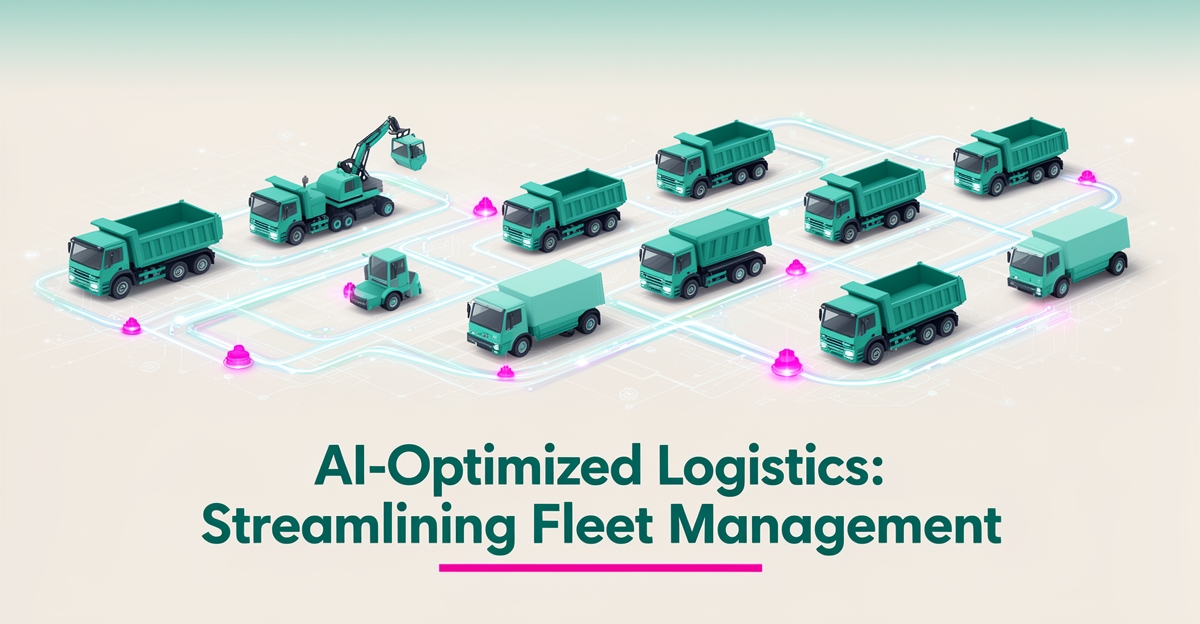
Is AI Worth It for Dispatch Services in the Construction and Transport Industry?
Key Facts
- AI dispatch typically cuts daily planning time by 80-95%, from 2-4 hours to under five minutes according to industry analysis.
- Comparative research suggests a 25-vehicle fleet can save tens of thousands of dollars annually with AI fleet management per comparative studies.
- Fleets of 20+ vehicles commonly reach break-even within 1-3 months, though exact ROI varies by operation per fleet management benchmarks.
- One dispatcher can typically oversee 35-50 vehicles with AI versus roughly 10-12 manually according to dispatch benchmarks.
- Manual HOS tracking risks significant per-violation fines — often in the tens of thousands of dollars per compliance research.
- Gartner has projected that a majority of AI projects stall or get abandoned when underlying data isn't AI-ready per industry research.
- Real-time tracking powered by AI can reduce customer support calls by an estimated 30-40% according to dispatch analysis.
Hire a team member that works 24/7 — for less than a part-time wage.
AI receptionists, SDRs, dispatchers and 99+ roles. Trained on your business, fully managed.
Not sure where to start? Ask our AI planner
The Hidden Cost of Manual Dispatch in Field Services
For construction and transport SMBs, manual dispatch isn't just a process—it's a drain on profitability that grows silently with every vehicle added to the fleet. What begins as a manageable task for a single dispatcher quickly becomes a source of operational friction, eroding margins through hidden costs that rarely appear on a balance sheet but are felt daily in fuel bills, overtime pay, and compliance risks.
The most immediate pain point is time waste. Manual dispatch commonly consumes 2 to 4 hours each morning just to build and adjust routes—a burden that scales with fleet size but offers no corresponding increase in output. For fleets over five vehicles, this daily planning window becomes a fixed overhead that limits how many jobs can be taken on, directly impacting revenue potential. AI-powered systems reduce this to minutes, freeing dispatchers to focus on exception handling and customer communication instead of spreadsheet juggling.
Fuel inefficiency compounds the problem. Manual routing, reliant on dispatcher intuition and outdated maps, tends to drive 15-30% higher fuel consumption compared to algorithmic optimization. For a 25-vehicle fleet, industry analyses estimate this inefficiency can contribute tens of thousands of dollars in annual losses from wasted fuel, unnecessary overtime, and administrative overhead—costs that AI-optimized dispatch can typically cut by 20-35% in total mileage and 10-15% in fuel spend. These aren't theoretical savings; they represent recoverable margin that manual processes leave on the table.
Compliance exposure adds another layer of risk. Manual Hours of Service (HOS) tracking increases the likelihood of violations, with fines that can reach five figures per incident—a single error can negate weeks of profit. While AI doesn't eliminate the need for oversight, it automates logging and reduces human error in tracking, turning a liability into a controlled process.
Perhaps most critically, manual dispatch hits a scalability wall. One dispatcher can effectively manage only 10-15 vehicles before delays, miscommunication, and errors become inevitable. Beyond that threshold, adding drivers requires adding dispatchers—a linear cost increase that undermines growth. AI systems, by contrast, enable one dispatcher to oversee 35-50 vehicles through automated routing and real-time adjustments, allowing SMBs to scale operations without proportional headcount growth.
These hidden costs aren't just inefficiencies—they're profit leaks that widen with every mile driven and every minute spent on manual planning. For SMBs aiming to grow beyond a handful of vehicles, continuing with manual dispatch means choosing to operate below capacity, pay more for less, and accept avoidable risks as the cost of doing business. The true cost of staying manual isn't in software fees—it's in what the business fails to earn, save, and avoid.
Where AI Dispatch Delivers Measurable Gains: Efficiency, Cost, and Scale
AI-powered dispatch turns daily routing from a manual bottleneck into a measurable profit lever for construction and transport fleets.
Planning time collapses immediately. What a human dispatcher spends 2 to 4 hours building each morning is completed by AI in under five minutes, an 80-95% reduction in daily planning time. Mid-day reroutes that take 15-45 minutes manually are recalculated in seconds, freeing dispatchers to focus on exceptions and customer service instead of rebuilding schedules.
Fuel and mileage gains compound quickly. AI-optimized routes commonly save 10-15% on fuel costs while fleets using AI-powered dispatch report 20-35% fewer total miles driven. For a 25-vehicle fleet, comparative research suggests savings of $54,000–$120,000 per year versus manual dispatch, with manual operations costing roughly 25% more in total operating expenses. Your exact numbers depend on routes, fuel prices, and labor costs—so model them against your own operation before committing.
The financial case is clearest at scale. Fleets of 20+ vehicles commonly see break-even within 1-3 months. One dispatcher can manage 35-50 vehicles with AI support versus the manual ratio of roughly 1:10-12, enabling growth without proportional headcount increase.
Measurable gains show up across the operation:
- Planning speed: 60-120 min/day manual vs under 5 min/day with AI
- Fuel efficiency: 15-30% higher consumption manually vs 10-15% savings with AI
- Scalability: AI handles 5 to 500+ drivers on the same workflow
- Customer experience: real-time tracking reduces support calls by an estimated 30-40%
These improvements matter most for small-scale owner-operator networks moving into regular routes. A data-driven evaluation of dispatch efficiency, cost control and driver utilization is the first step to realistic ROI projections. AIQ Labs offers three ways in: AI Employees (managed AI staff, including AI dispatchers, at a fraction of the cost of a human hire), AI Workflow Builds (rebuild the one workflow that costs you most, at a fixed price, in phases), and AI Operating Systems (one connected operating layer you own outright).
The impact is not just speed. It is what happens when something breaks — a cancellation, late crew, or emergency call — where AI recalculates the day in seconds while humans manage the nuance. That hybrid advantage is where efficiency, cost control and scale become sustainable.
The Hybrid Approach: Combining AI Optimization with Human Judgment
The most effective dispatch operations don't choose between AI and human expertise—they architect a partnership where each handles what it does best. This hybrid approach transforms dispatchers from manual route builders into strategic operations managers who focus on exceptions, relationships, and complex problem-solving.
A recent industry analysis confirms that successful operations run hybrid models where AI handles optimization and driver assignment while human dispatchers manage exceptions, customer escalations, and real-time problem solving. This division of labor addresses the core limitation of pure automation: algorithms excel at pattern recognition but falter when confronting the nuanced "tribal knowledge" that experienced dispatchers accumulate over years.
AI handles the predictable; humans handle the exceptional. The system manages route optimization, scheduling algorithms, compliance tracking, and real-time GPS monitoring—reducing daily planning time from hours to minutes. Meanwhile, human dispatchers navigate complex scenarios that require contextual judgment: a driver who prefers avoiding certain neighborhoods after dark, a construction site with unmarked access restrictions, or a last-minute customer requirement that demands creative rerouting.
This rebalancing delivers measurable operational improvements:
- One dispatcher can effectively oversee 35-50 vehicles instead of the manual ratio of 10-12
- Mid-day disruptions are recalculated in seconds rather than requiring 15-45 minutes of manual replanning
- Compliance monitoring runs automatically, reducing the risk of HOS violations that carry five-figure fines per incident
- Customer escalations receive immediate human attention rather than waiting in a queue behind routing calculations
However, process readiness determines success. According to industry research, the single biggest predictor of AI implementation failure is attempting to automate undocumented workflows. Before deploying hybrid systems, businesses must map the "it depends" logic that experienced dispatchers use instinctively—the unwritten rules about driver capabilities, customer preferences, and site-specific constraints.
This groundwork proves critical because Gartner has projected that a majority of AI projects stall or get abandoned when the underlying data isn't AI-ready. When underlying information contains wrong addresses, outdated skill tags, or missing inventory details, even the most sophisticated AI will optimize against flawed parameters and produce poor results.
For SMBs navigating this transition, AIQ Labs designs hybrid architectures where technology amplifies human expertise rather than replacing it—whether that's an AI dispatcher added to your existing team via AI Employees or a rebuilt dispatch workflow via AI Workflow Builds. By documenting tribal knowledge before automation, businesses create systems where AI handles the computational heavy lifting while dispatchers focus on relationship management and complex decision-making that drives customer satisfaction and driver retention.
How to Implement AI Dispatch Successfully: Avoiding the Common Failure Traps
Most AI dispatch projects fail before they ever save a mile of fuel. The breakdown is rarely the algorithm — it is the data and process underneath it.
Gartner has projected that organizations abandon a large share of AI projects for lack of AI-ready data. In construction and transport, that risk shows up as wrong addresses in the CRM, outdated skill tags, and undocumented “it depends” rules a dispatcher has carried for years. Without hygiene first, AI optimizes against bad data and produces worse results.
A low-risk path starts with data hygiene and process documentation, not software rollout. Clean the core fields the dispatcher actually uses daily — vehicle capacity, driver certifications, job sites, time windows, and equipment constraints. Map the unwritten logic for exceptions: who gets priority on a rain day, how overtime is avoided, which customers allow late arrivals. This mapping is the prerequisite for configuring AI to handle standard scenarios while humans keep the edge cases.
AIQ Labs approaches implementation through three payment models aligned with SMB realities. Start Monthly lets an owner-operator test one workflow with a flat monthly plan — including build, training, integrations, monitoring and improvements — with the ability to pause or adjust anytime. Build in Milestones splits a dispatch or department system into phases, approving and paying per phase and keeping everything built so far. Own It Outright gives you a system you own with no recurring fees. Full details are on the pricing page.
Change management determines adoption. Drivers and dispatchers typically need 1-2 weeks to adapt to new systems and workflows, and resistance drops when AI is framed as a tool that makes the job easier with better routes and less paperwork. A hybrid operating model works best: AI handles optimization, routing and compliance automation, while human dispatchers manage exceptions, customer escalations and driver coaching.
A practical implementation sequence looks like this:
- Audit and clean dispatch data: addresses, skills, assets, and historical routes
- Document process and “it depends” rules with the dispatcher before any automation
- Pilot AI on a single route type or depot with clear success metrics
- Train team on exception handling and real-time overrides
- Scale to full fleet after proving ROI and data quality
The payoff is measurable when the foundation is solid. AI typically reduces daily planning time by 80-95%, from 2-4 hours to under 5 minutes, and mid-day rerouting drops from 15-45 minutes manually to seconds with AI. For fleets of 20+ vehicles, break-even is commonly 1-3 months.
Process before automation is the single biggest reason projects succeed.
Still paying for 10+ subscriptions that don’t talk to each other?
We build custom AI systems you own outright. No vendor lock-in. Full control.
Not sure where to start? Ask our AI planner
Frequently Asked Questions
Is AI dispatch actually worth it for a small construction or transport fleet?
How much time will AI really save my dispatcher each day?
Will AI dispatch help with fuel costs and mileage?
Can one dispatcher really manage more vehicles with AI?
Will AI replace my dispatchers or just change their role?
What makes AI dispatch projects fail?
Your Dispatch Decision: Profit Leak or Growth Lever?
The evidence is clear: manual dispatch silently erodes profitability through wasted time, excessive fuel consumption, and avoidable compliance risks—costs that compound with every vehicle added to your fleet. AI-powered dispatch doesn’t just optimize routes; it transforms planning from a 2-4 hour daily burden into a minutes-long process, enabling one dispatcher to manage 35-50 vehicles instead of 10-15, while typically reducing fuel spend by 10-15% and total mileage by 20-35%. For fleets of 20+ vehicles, break-even commonly lands within the first few months. But success hinges on preparation: cleaning data, documenting tribal knowledge, and adopting a hybrid model where AI handles optimization and humans manage exceptions. If you’re ready to stop leaving margin on the table and start scaling efficiently, the first step is understanding your specific opportunity. Start the 2-minute Fit Check, then book a free 30-minute strategy call to map your biggest bottleneck and see whether AI dispatch delivers a clear win for your operation.
Make AI your competitive advantage — not just another tool.
Strategy, implementation and ongoing optimization. One partner, end to end.
Not sure where to start? Ask our AI planner