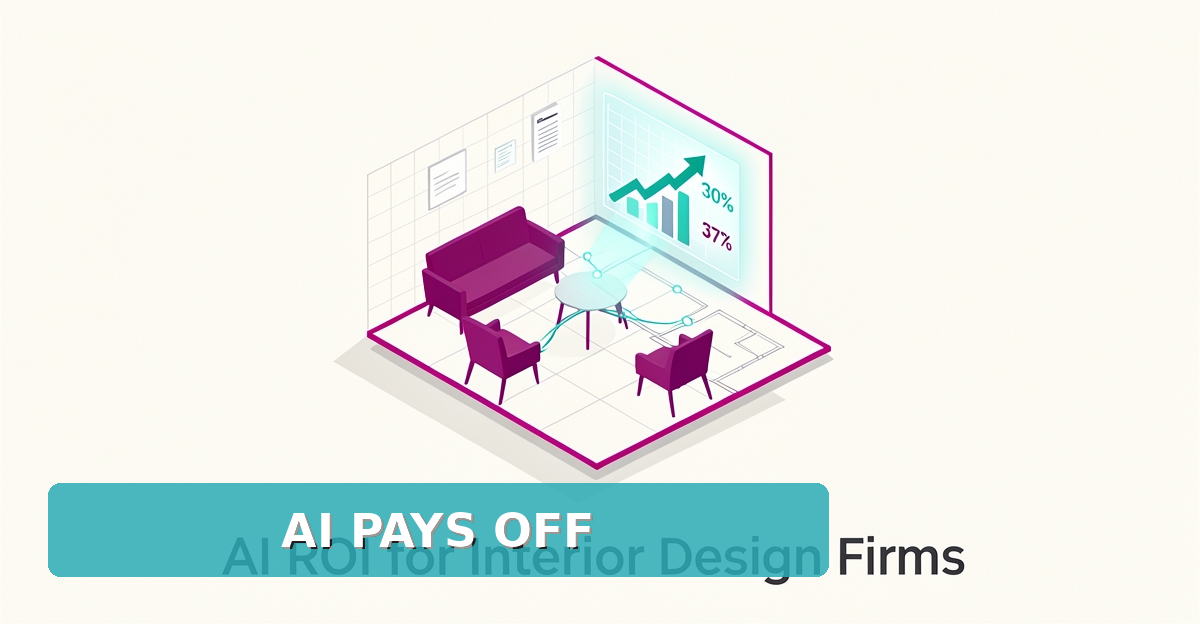
Is AI Worth It for Interior Design Firms? A Cost-Effective ROI Analysis
Key Facts
- As of late 2026, a majority of design professionals report using AI tools somewhere in their workflow, making automation a competitive baseline rather than an experiment
- Market analysts project the AI interior design market to grow at a strong double-digit rate through the 2030s, driven by firms competing on speed and personalization
- Most clients now expect some form of visual walkthrough or virtual preview before committing—firms that provide one typically convert more proposals than those relying on static presentations
- Manual admin commonly consumes up to roughly a third of a designer's week—time that cannot be billed to clients
- AI workflow automation can eliminate many hours of manual data entry weekly and sharply reduce operational errors like double-entry and missed follow-ups
- Slow or inconsistent follow-up is one of the most common reasons design leads go cold after first contact
- Entry-level AI design subscriptions typically run in the tens of dollars per month, making software cost trivial compared to recovered labor hours
Hire a team member that works 24/7 — for less than a part-time wage.
AI receptionists, SDRs, dispatchers and 99+ roles. Trained on your business, fully managed.
Not sure where to start? Ask our AI planner
The Admin Bottleneck Slowing Interior Design Profit
The administrative burden in interior design is no longer just an inconvenience—it's a direct threat to profitability and growth. Designers spend countless hours on manual tasks like scheduling, invoicing, and client follow-ups, pulling them away from the creative work that drives revenue and client satisfaction. As client expectations rise for faster turnarounds and personalized experiences, firms relying on manual processes risk falling behind competitors who have embraced efficiency as a necessity.
As of late 2026, most design professionals report using AI tools somewhere in their workflow, signaling a clear shift toward automation as a competitive baseline. That adoption is accelerating alongside broader market trends, with analysts projecting strong double-digit growth in the AI interior design market through the 2030s. Firms that delay automation aren't just missing out on efficiency gains—they're operating at a structural disadvantage in a market where speed is increasingly priced in.
The pressure is intensified by client demand for speed and personalization. Most clients now expect some form of visual walkthrough or virtual preview before committing to a design, and firms that provide one typically convert more proposals than those relying on static mood boards. Delivering these expectations manually creates bottlenecks: design revisions take longer, approvals stall, and project timelines stretch. These delays don't just frustrate clients—they erode margins, increase overhead, and limit how many projects a firm can realistically handle.
- Manual admin commonly consumes up to roughly a third of a designer's week
- Invoicing and scheduling errors routinely delay payments by days
- Clients expect initial concepts within days—manual processes often stretch much longer
- Slow or inconsistent follow-up is one of the most common reasons leads go cold after first contact
- Design teams frequently report spending more time on coordination than actual design work
For interior design firms, the admin bottleneck isn't a back-office issue—it's a profit leak that undermines creativity, delays revenue, and weakens client relationships. In an industry where speed, personalization, and reliability are now table stakes, continuing to rely on manual processes isn't sustainable. The question isn't whether to act—it's how quickly firms can close the efficiency gap before competitors do. AIQ Labs helps interior design businesses eliminate these operational drains through targeted AI Workflow Builds, turning administrative overload into a streamlined, scalable advantage.
How AI Cuts Costs and Speeds Projects in Real Firms
For interior design firms, the ROI question isn't theoretical anymore—it shows up in billable hours, project timelines, and conversion rates. The firms seeing the biggest gains aren't replacing designers; they're targeting the three cost centers where AI demonstrably moves the needle: admin time, turnaround speed, and client conversion.
Lever 1: Reclaiming Admin Hours
Repetitive administrative work—data entry, scheduling, document handling—quietly consumes designer capacity that could be billed to clients. AI workflow automation directly attacks this: integrated systems connecting CRM, project management, and accounting can eliminate many hours of manual data entry weekly and sharply reduce operational errors. For a small studio, that's the equivalent of a part-time coordinator without the salary—or an AI Employee handling intake, scheduling, and follow-up at a fraction of the cost of a human hire.
Lever 2: Faster Project Turnaround
Manual concept development and revision cycles stretch timelines and delay invoicing. AI-assisted design generation compresses that cycle, producing refined first drafts in hours rather than days. The broader market reflects this shift: analysts project strong double-digit growth in the AI interior design market through the 2030s—growth driven largely by firms competing on speed and personalization.
Lever 3: Client Satisfaction and Conversion
This is where AI often pays for itself fastest. Most clients now expect a visual walkthrough or virtual preview before committing, and firms that offer one typically convert more proposals than those relying on static presentations. Meanwhile, with most design professionals already using AI tools in their daily workflow, personalization-driven client experience is quickly becoming table stakes rather than differentiator.
Manual vs. AI-Assisted: The Cost Picture
Compare the two workflows side by side:
- Manual process: hours of data entry, days of concept iteration, and static presentations that leave clients guessing—costing billable time and losing prospects who can't visualize the result.
- AI-assisted process: automated data sync, rapid first-draft generation, and immersive walkthroughs that help more prospects sign.
- Tool costs: entry-level AI design subscriptions typically run in the tens of dollars per month, making the software side of the equation trivial compared to recovered labor hours.
The implementation challenge—data quality, workflow integration, adoption—is real, which is why firms often start with a structured assessment rather than ad-hoc tool purchases. At AIQ Labs, that's the first step in any engagement: model the ROI against your actual workflows before anything gets built, so the investment case rests on your numbers, not industry averages.
The firms capturing that augmentation today are the ones converting admin hours into billable creative work—and prospects into clients.
Choosing and Implementing AI Without Disrupting Your Workflow
Choosing and implementing AI without disrupting your workflow starts with understanding your specific pain points and data readiness. Many interior design firms struggle with scattered client files, inconsistent measurement logs, or outdated mood boards that slow down concept development. Before selecting a tool, audit where your team spends the most time on repetitive tasks—such as sourcing materials, generating client presentations, or tracking revisions—since AI excels at automating these predictable steps. With most design professionals already using AI tools in some form as of late 2026, adoption is standard practice rather than experimental.
The next step is evaluating whether a subscription-based tool or a custom-owned system better fits your operational scale and long-term goals. Off-the-shelf platforms for virtual staging or quick layout generation offer low entry barriers, typically at tens of dollars per month, making them ideal for testing AI's impact on renders and staging. However, these tools often require manual data input and may not integrate deeply with your existing project management or invoicing systems. For firms aiming to eliminate hours of weekly manual data entry or sharply reduce operational errors, a custom AI workflow built around your unique processes—client intake, material tracking, design approval loops—can create a unified system that you own outright and that evolves with your business. This approach avoids subscription chaos and builds true ownership, aligning with AIQ Labs' philosophy of delivering production-ready systems that clients control outright.
Finally, implement the chosen solution in phases to minimize disruption. Begin by inputting clean, structured data—standardized room dimensions, client preference tags, approved material libraries—into the AI tool, since poor data quality directly undermines output accuracy. Use the tool to generate initial concepts or renderings, then refine outputs through iterative feedback loops with your design team. Treat the AI as a junior designer handling first drafts, freeing your senior staff to focus on creative direction and client relationships. Over time, monitor time saved on admin tasks, project turnaround speed, and client satisfaction scores to measure ROI. This gradual, controlled rollout ensures your team adapts without overwhelm, turning AI from a potential disruption into a seamless extension of your workflow. Ready to assess where AI can deliver the fastest win for your firm? Start the 2-minute Fit Check, then book a free 30-minute strategy call to map your biggest bottleneck and identify high-ROI automation opportunities with an AI engineer. If there isn't a clear win, we'll say so—no obligation, just clarity.
When Custom AI Beats Off-the-Shelf Subscriptions for Design Studios
Off-the-shelf design tools look cheap until subscription creep and workflow limits eat the savings. Entry-level platforms for virtual staging and layout generation promise faster renders, but they remain rented features that do not integrate with your project management, CRM, or client approval process.
For SMB studios, the real cost is not the monthly plan. It is the manual handoffs between a SaaS generator and the rest of the business. AI-powered design tools can reduce admin time and accelerate turnaround, yet with most design professionals already using AI tools in their workflow as of late 2026, the pressure is on to move beyond generic subscriptions.
Custom-owned workflows change the equation from per-seat rent to owned asset. Instead of paying forever for a basic plan, a studio can build a system that ingests briefs, generates concepts, pushes them to client portals, and logs approvals automatically. That ownership model eliminates vendor lock-in and subscription dependency over time.
The market is rewarding ownership. Analysts project strong double-digit growth in the AI interior design market through the 2030s, driven by firms that want personalized, efficient solutions rather than one-size-fits-all templates.
A readiness-first approach prevents wasted spend. A structured assessment maps your current tech stack, data quality, and team capabilities before any build, so investment targets high-ROI automation rather than shiny features. AIQ Labs uses this as the starting point for AI Operating Systems and Workflow Builds, aligning custom systems with real operational bottlenecks—built in phases, paid in milestones, and owned outright.
When custom beats subscription, studios typically see:
- Reduced subscription dependency as owned systems replace multiple SaaS tools
- Seamless integration with CRM, accounting, and project management for a single source of truth
- Long-term savings through outright ownership of code, agents, and data
- Scalable workflows that grow with the firm without per-user price increases
Client experience also improves. Most clients now expect a visual walkthrough or virtual preview before committing, and firms that provide one typically convert more proposals. A custom system can automate those walkthroughs, track feedback, and trigger next steps without manual admin.
The decision is not AI versus no AI. It is rented AI versus owned AI. For studios ready to compete on speed and satisfaction, a built-and-owned workflow delivers a sustainable advantage that a monthly subscription cannot.
Still paying for 10+ subscriptions that don’t talk to each other?
We build custom AI systems you own outright. No vendor lock-in. Full control.
Not sure where to start? Ask our AI planner
Frequently Asked Questions
How much does it actually cost to start using AI in my design firm?
Will AI replace my interior designers?
What kind of ROI can I realistically expect from AI automation?
Should I use off-the-shelf AI tools or invest in a custom system?
How does AI actually improve client satisfaction and conversions?
How do I implement AI without disrupting my current projects?
The Verdict: AI Isn't Just Worth It—It's Table Stakes for Growth
The evidence is clear: AI delivers measurable ROI for interior design firms through reclaimed billable hours, accelerated project timelines, and stronger conversion. With most design professionals already using these tools as of late 2026, the question has shifted from whether to adopt AI to how quickly you can implement it without disrupting your creative workflow. Whether you start with an affordable subscription to test the waters or invest in a custom-owned system that eliminates subscription dependency, the key is beginning with a clear assessment of your specific bottlenecks—admin overload, slow revisions, or inconsistent client follow-up. AIQ Labs helps firms navigate this transition through structured assessments that identify your highest-ROI opportunities before you spend a dollar on tools. Ready to see where AI fits your practice? Start the 2-minute Fit Check, then book a free 30-minute strategy call to map your biggest bottleneck with an AI engineer—no obligation, just clarity on your next competitive advantage.
Make AI your competitive advantage — not just another tool.
Strategy, implementation and ongoing optimization. One partner, end to end.
Not sure where to start? Ask our AI planner