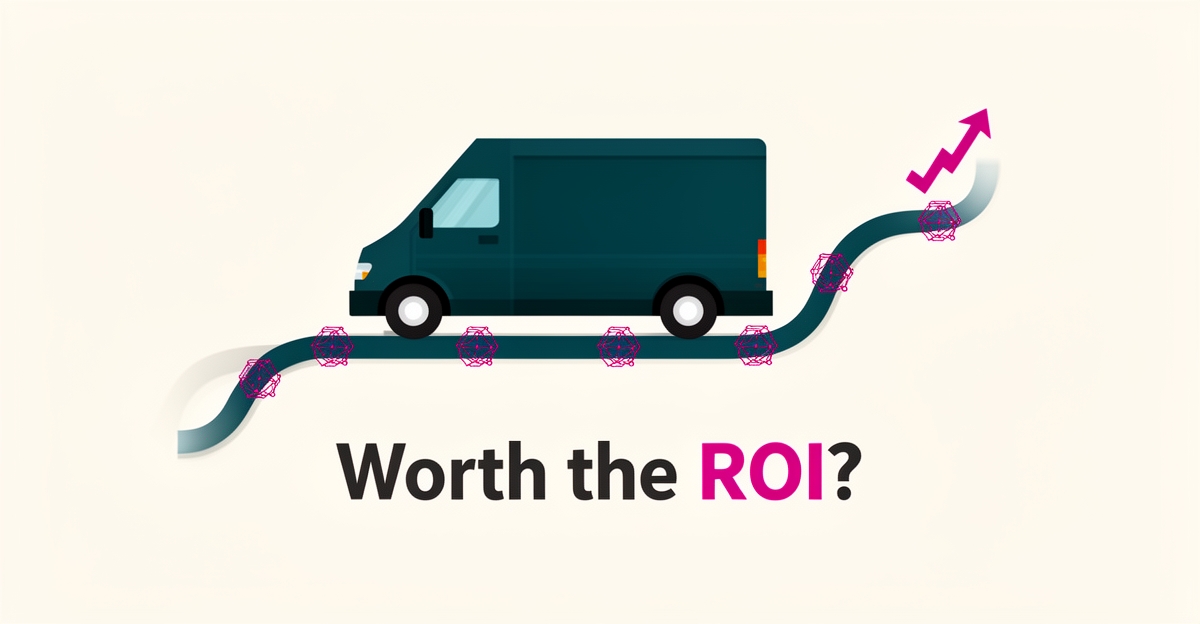
Is AI Worth It for Last-Mile Delivery? A Cost-Benefit Breakdown for SMBs
Key Facts
- AI-powered last-mile delivery solutions typically reduce costs by 15-30% and improve delivery speed by around 25% according to industry research
- Last-mile delivery is commonly cited as accounting for roughly half of total supply chain costs as noted in industry analyses
- The last-mile delivery market has been projected to grow from $1.56 billion in 2025 to $1.80 billion in 2026, a 15.4% CAGR per market projections
- AI-driven route optimization lowers emissions by minimizing unnecessary mileage and idling in urban corridors as noted by Sustainableatlas.org
- Autonomous delivery solutions can achieve up to 94% emissions reduction compared to diesel vans in optimal deployment scenarios per the European Transport Research Review
- Wing achieved 400,000 deliveries with an average delivery time of just 3 minutes and 43 seconds according to Sustainableatlas.org
- Zipline completed over 2 million commercial drone deliveries covering 125 million autonomous miles across seven countries as reported by Sustainableatlas.org
Hire a team member that works 24/7 — for less than a part-time wage.
AI receptionists, SDRs, dispatchers and 99+ roles. Trained on your business, fully managed.
Not sure where to start? Ask our AI planner
The Hidden Cost of Last-Mile Delivery: Why SMBs Are Losing Money
The last-mile delivery problem isn't just expensive—it's a silent profit killer for small and medium businesses. Commonly cited as accounting for half of total supply chain costs, this final leg drains resources that could otherwise fund growth or innovation. For SMBs operating on thin margins, the financial strain is immediate and severe, turning what should be a customer touchpoint into a persistent liability.
Urban delivery patterns make the situation worse. Stop-and-go driving in congested areas burns fuel unnecessarily and increases vehicle wear, while generating emissions that contradict sustainability goals many SMBs now prioritize. Research confirms that last-mile delivery generates disproportionate emissions due to these inefficient urban driving patterns, creating both an economic and environmental burden that scales with every delivery attempt.
The operational toll compounds the financial pain. Drivers waste time circling for parking, navigating one-way streets, and handling failed delivery attempts—all while dispatch teams scramble to reschedule and customers grow frustrated. These inefficiencies aren't just inconvenient; they directly erode delivery reliability and increase labor costs per successful drop-off. Without intervention, SMBs remain trapped in a cycle where higher delivery volume means higher losses, not higher revenue.
This is where AI transformation becomes less about advantage and more about necessity. By optimizing routes in real time, predicting demand fluctuations, and minimizing idle time, AI-powered systems directly attack the root causes of last-mile inefficiency. For SMBs questioning whether AI is worth the investment, the answer lies in the math: continuing with manual processes guarantees ongoing losses, while intelligent automation offers a path to break even—and eventually, to profit. AIQ Labs helps SMBs navigate this shift with practical, ownership-focused solutions—like a fixed-price workflow rebuild—designed for real-world logistics challenges.
AI-Powered Last-Mile Solutions: Measurable ROI in Cost, Speed, and Reliability
AI-powered last-mile delivery solutions are delivering measurable ROI for SMBs through tangible improvements in cost, speed, and reliability. By leveraging machine learning to optimize routes, predict demand, and automate dispatch decisions, businesses can typically reduce delivery costs by 15-30% while improving delivery speed by around 25%. Locus.sh attributes these gains to smarter resource allocation and reduced idle time, directly impacting the bottom line without requiring fleets of autonomous vehicles.
These efficiency gains also translate into environmental benefits, with AI-driven route optimization cutting fuel consumption and emissions through fewer miles driven and less stop-and-go urban driving. While autonomous delivery modalities like drones and sidewalk robots can achieve up to 94% emissions reductions in ideal conditions, as noted by Sustainableatlas.org, their scalability remains constrained by regulatory hurdles, infrastructure needs, and public acceptance—making AI-powered software solutions a more immediately viable path for most SMBs.
- Reduces last-mile delivery costs by 15-30% through dynamic routing and load optimization
- Improves delivery speed by roughly 25% with real-time traffic and demand forecasting
- Lowers emissions by minimizing unnecessary mileage and idling in urban corridors
- Enhances reliability via predictive ETAs and automated exception handling
- Scales with existing fleets and workflows, avoiding major capital expenditure
For SMBs evaluating AI adoption, the focus should be on solutions that integrate with current operations—such as AI-powered dispatch and route optimization—rather than waiting for autonomous fleets to become mainstream. AIQ Labs helps businesses assess these opportunities through strategic planning that models ROI based on actual delivery volumes, fuel costs, and labor savings, ensuring investments align with scale and operational readiness. The result is a clear, data-backed path to modernization that delivers efficiency gains today while building toward future automation.
From Pilot to Profit: How SMBs Can Implement AI Without Overinvesting
SMBs don’t need a full AI operating system on day one. They need a controlled path from assessment to measurable profit, with the option to pause or scale without sunk costs.
Start with a workflow assessment that maps where time, fuel and errors leak. Last-mile delivery is commonly cited as roughly half of total supply chain costs, driven by stop-and-go urban driving patterns. Identifying the single broken workflow first avoids over-engineering and keeps investment proportional to scale.
Select fit-for-purpose AI tools rather than a platform suite. Route optimization and dispatch AI deliver the fastest payback for SMBs because they attach to existing drivers, vehicles and customer promises. According to industry research, AI-powered last-mile delivery solutions can typically reduce delivery costs by 15-30% and improve delivery speed by around 25%. That range gives a realistic ROI window for pilots with limited routes.
Integration comes before expansion. AI works as the decision layer that connects orders, inventory, capacity, drivers, vehicles, customer promises, and real-time execution. A phased integration with CRM, accounting and dispatch systems prevents data silos and manual re-entry. AIQ Labs structures this through milestone-based builds—starting with discovery and architecture, then development and integration—so you pay as each phase proves itself. When you're ready to connect everything into one operating layer, an AI Operating System built in phases and owned outright is the end state, not the starting point.
Scale based on measurable KPIs, not hype. Track cost per stop, on-time rate, fuel use and error rate weekly. When the pilot holds for 4–6 weeks, expand to adjacent workflows like automated dispatch or customer notifications.
A practical phased roadmap looks like this:
- Assess & prioritize: map current last-mile operations, cost drivers and data readiness
- Pilot one workflow: deploy route optimization or dispatch AI on a contained route set
- Integrate & train: connect to existing tools, train team on handoffs and exceptions
- Measure & scale: validate KPIs, then expand to additional routes or departments
The last-mile delivery market has been projected to grow from $1.56 billion in 2025 to $1.80 billion in 2026, a 15.4% CAGR, signaling rising competitive pressure for SMBs to improve efficiency without adding headcount. Keeping the first build narrow, owned and measurable lets SMBs capture profit before complexity, and avoid the pilot stall that traps most organizations.
Still paying for 10+ subscriptions that don’t talk to each other?
We build custom AI systems you own outright. No vendor lock-in. Full control.
Not sure where to start? Ask our AI planner
Frequently Asked Questions
Is AI actually worth the investment for small delivery businesses?
How much does last-mile delivery really cost my business?
What's the difference between AI route optimization and autonomous delivery vehicles?
How do I implement AI without overhauling my entire operation?
What kind of ROI can I realistically expect from AI delivery software?
Do I need to buy new vehicles or equipment to use AI for deliveries?
Profit Before Complexity: Your Next Move in Last-Mile
Last-mile delivery is eating profit because manual processes can’t keep up with urban congestion, failed attempts, and rising labor costs. AI changes that equation by attacking the root inefficiencies — dynamic routing, demand forecasting, and automated dispatch can typically cut delivery costs by 15-30% and improve speed by around 25%, while reducing emissions and scaling with fleets you already own. The smartest SMBs aren’t chasing autonomous fleets; they’re piloting one contained workflow, measuring cost per stop, on-time rate, and fuel use for 4-6 weeks, then expanding. With the last-mile delivery market projected to grow from $1.56 billion in 2025 to $1.80 billion in 2026, a 15.4% CAGR according to market data, efficiency is becoming a competitive necessity, not a luxury. AIQ Labs helps SMBs map the highest-ROI workflow first and build owned solutions that integrate with existing operations. Take the 2-minute Fit Check at https://aiqlabs.ai/apply, then book a free 30-minute strategy call at https://aiqlabs.ai/book to map your bottleneck and validate ROI before you invest. Prefer email? Reach the team at [email protected].
Make AI your competitive advantage — not just another tool.
Strategy, implementation and ongoing optimization. One partner, end to end.
Not sure where to start? Ask our AI planner