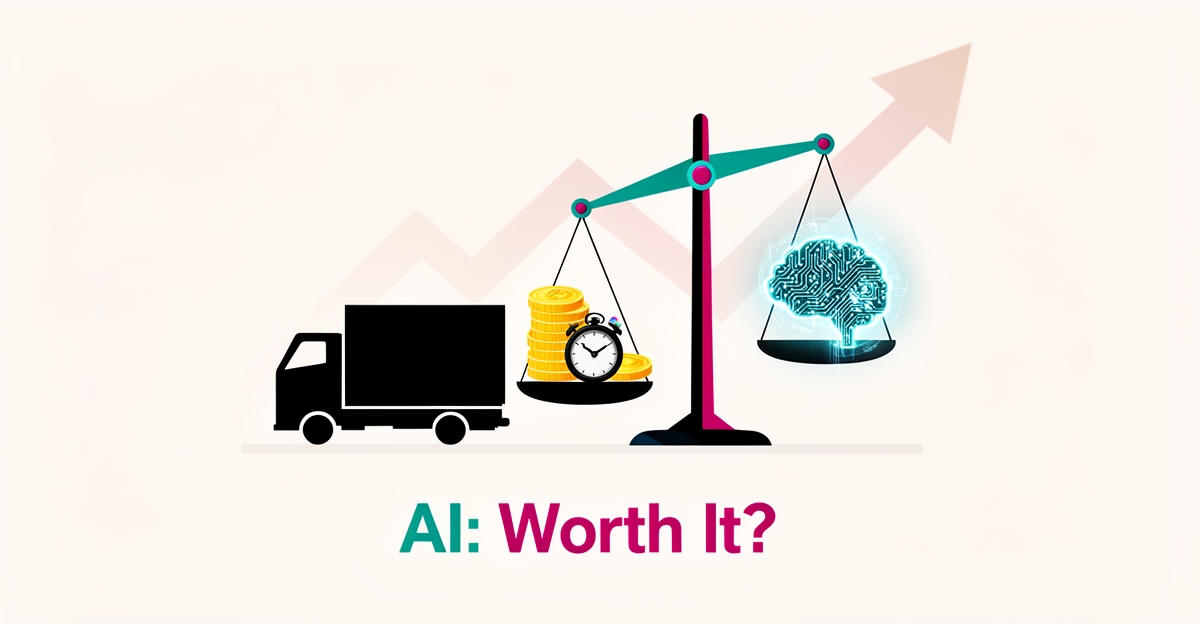
Is AI Worth It for Moving Companies? A Cost-Benefit Analysis
Key Facts
- Transportation and logistics AI adoption grew roughly 47.5% in 2024 according to adoption statistics, and momentum has continued into 2026
- More than 70% of global organizations use AI for at least one business function according to industry data
- Amazon has committed to massive AI capital spending—reported in the hundreds of billions per TechRadar reporting
- Very few enterprises can confidently forecast AI costs six months out says FinOps Foundation's Jay Litkey
- Model usage metrics describe activity without explaining value according to FinOps guidance
Hire a team member that works 24/7 — for less than a part-time wage.
AI receptionists, SDRs, dispatchers and 99+ roles. Trained on your business, fully managed.
Not sure where to start? Ask our AI planner
The AI Adoption Surge in Moving and Logistics: Opportunity Meets Uncertainty
The transportation and logistics sector has seen rapid AI adoption—growth reached roughly 47.5% in 2024 per industry research—and the shift has only accelerated since. Major players like Amazon and FedEx already use AI for route optimization, analyzing real-time traffic and weather to cut fuel costs and delivery times, while inventory tracking systems using IoT sensors provide real-time visibility into goods movement, reducing loss and damage claims. Demand forecasting tools let companies anticipate seasonal spikes, optimizing staffing and truck allocation ahead of peak moving seasons.
These applications directly address pain points familiar to any moving business: inefficient routes wasting driver hours, inventory errors leading to customer disputes, and reactive staffing that inflates labor costs. The opportunity lies in translating these enterprise-level use cases into affordable solutions for smaller movers. However, the excitement around AI is tempered by a real uncertainty—many organizations struggle to forecast AI costs accurately because of consumption-based pricing. Unlike traditional software, AI expenses can balloon unpredictably as usage expands across departments, especially when teams adopt tools without thinking about token economics or usage governance. That creates a risk of cost exposure outpacing oversight, turning a strategic investment into an unmanaged expense.
For moving companies, the path to AI being "worth it" hinges on disciplined financial oversight from the outset. Drawing from FinOps principles originally designed for cloud cost management, businesses must govern AI spend before scaling, ensuring every dollar tied to AI is measured against incremental business outcomes—reduced labor hours per move, faster quote-to-booking times, or fewer customer service escalations. Without this framework, even high-potential use cases like AI-powered dispatch or inventory tracking can become cost centers rather than profit drivers. AIQ Labs helps moving companies navigate this with a fixed-price Workflow Build that targets the one workflow costing you the most, so the investment is strategic, measurable, and phased.
Why AI Costs Are Hard to Predict and What That Means for Your Moving Business
AI adoption is surging, but predicting its true cost remains a moving target, especially in industries like moving where operations span multiple departments and legacy systems. Unlike traditional software subscriptions, AI often operates on consumption-based pricing—charging per API call, token, or compute hour—making expenses highly variable and difficult to forecast without disciplined oversight. A moving company might start with an AI tool for route optimization, only to see usage creep as sales, customer service, and dispatch teams begin experimenting with the same platform for lead scoring, chat support, and inventory tracking. Each expansion seems reasonable in isolation, but collectively these small increases can create a demand curve that outpaces budget projections before anyone notices. As one FinOps leader noted, very few enterprises can confidently forecast what AI will cost them in six months, largely because teams across legal, HR, and customer operations aren’t thinking about token economics—they’re focused on whether the tool works per TechRadar reporting. This unpredictable consumption, combined with legacy system friction in companies not built "AI-first," makes retrofitting AI into existing workflows complex and costly, further obscuring true spend. Without governance from the outset, AI adoption risks becoming uncontrolled and expensive, especially for small and medium-sized moving companies that lack the infrastructure to monitor usage across departments. The solution is to apply FinOps practices early—treating AI spend like cloud costs with real-time tracking, allocation, and optimization—so governance shapes how AI scales rather than requiring a scramble to restore control after spend has outpaced oversight. For moving companies, this means measuring not just AI activity like model usage or inference volume, but the incremental business outcome per dollar spent: Did AI reduce driver hours per move? Shorten quote-to-booking time? Lower claims for damaged goods? Only by tying cost to tangible outcomes can a moving company determine whether AI is truly worth the investment. AIQ Labs structures every engagement around this outcome-driven approach—whether a monthly AI Employee, a milestone-based Workflow Build, or a phased AI Operating System—so AI adoption is measurable, governed, and aligned with operational goals from the start.
Measuring AI’s Real Value: From Activity Metrics to Business Outcomes for Movers
When a moving company owner asks whether their AI investment is "working," the answer rarely comes from usage dashboards. Counting API calls or tracking how many times the dispatch team opened an AI tool tells you nothing about profitability. The real question is simpler and harder: what did each dollar of AI spend actually return to the business?
This distinction matters more for AI than for any previous technology investment. According to Jay Litkey of the FinOps Foundation, metrics like model usage, inference volumes, and compute consumed "describe activity without explaining value." His recommended alternative is the incremental business outcome per dollar of AI spend — a measure that forces clarity on what AI is actually delivering.
For moving companies, this framework translates into three concrete outcome categories:
- Labor hours per move. AI route optimization — already deployed at scale by Amazon and FedEx — should measurably reduce driver hours and fuel consumption per job, according to industry adoption research.
- Quote-to-booking velocity. If an AI-powered intake or CRM system doesn't shorten the time between a customer's first inquiry and a signed booking, it isn't generating value — it's generating cost.
- Damage and loss claims. AI-driven inventory tracking, which companies like DHL use with IoT sensors and RFID tags, should directly reduce the frequency and cost of customer claims for lost or damaged goods.
The urgency behind this measurement discipline is real. With logistics AI adoption growing rapidly since 2024, moving companies face competitive pressure to adopt quickly. But Litkey warns that very few enterprises can confidently forecast what AI will cost them in six months, because usage expands across departments in small, individually reasonable increments that collectively outpace oversight.
This is where governance before scale becomes the operative principle. Applying financial operations discipline early — before AI spend fragments across dispatch, sales, and customer service — ensures that growth in usage tracks growth in measurable outcomes rather than drifting into uncontrolled cost exposure.
For SMB movers without an internal FinOps team, this kind of ROI modeling is precisely where structured guidance pays for itself. AIQ Labs builds cost-benefit models around a company's actual operations — mapping AI spend to specific outcomes like reduced labor hours and faster booking cycles — so that every dollar invested has a defined, trackable return before the first system goes live. With 200+ multi-agent systems deployed, that modeling is grounded in real deployments, not theory.
Practical Steps to Make AI Work for Your Moving Company: Start Small, Govern Early, Scale Smart
For moving companies, the promise of AI is real—but so is the risk of uncontrolled costs. Industry data shows AI adoption in transportation and logistics has grown rapidly since 2024, driven by proven use cases like route optimization and demand forecasting that directly impact moving operations per industry research. Yet without early governance, even well-intentioned pilots can spiral into unpredictable expenses as usage scales across teams unaware of token consumption or API costs, FinOps observers warn.
The solution is to start small, govern early, and scale smart—applying FinOps principles from day one. Begin by piloting AI in a high-impact, contained workflow such as dispatch automation or customer service intake, where outcomes like reduced response times or fewer missed calls are easy to measure. Use the Start Monthly model to deploy a single AI Employee—like an AI Dispatcher or AI Receptionist—with setup, training, integrations, and ongoing improvements included, at roughly 80% less than the cost of a human hire. This approach lets you validate ROI in weeks, not months, while pausing or adjusting anytime if goals aren’t met. When one workflow proves out, a fixed-price Workflow Build rebuilds the single costliest workflow in your operation, milestone by milestone—and when you're ready to connect everything, an AI Operating System gives you one connected layer you own outright.
Track success against clear business outcomes: Did AI reduce labor hours per move? Did faster quote booking increase conversion rates? Did better inventory tracking cut damage claims? By anchoring AI spend to incremental value per dollar—not just activity metrics—you build a governance framework that shapes scaling rather than chasing it. Once proven, expand to adjacent workflows using the same disciplined, phase-by-phase approach, ensuring every new application delivers measurable efficiency before the next investment. This is how moving companies turn AI from a cost center into a competitive advantage—without the risk of runaway spending.
Still paying for 10+ subscriptions that don’t talk to each other?
We build custom AI systems you own outright. No vendor lock-in. Full control.
Not sure where to start? Ask our AI planner
Frequently Asked Questions
Is AI worth the investment for a small moving company?
How do I avoid unpredictable AI costs as usage grows across teams?
What specific business outcomes should I track to know if AI is working for my moving company?
Can I start using AI without a big upfront investment or technical team?
Why can’t most companies forecast AI costs six months out?
What’s the first step to make AI work for my moving business without risk?
The Verdict: AI Pays Off When You Govern First, Scale Second
The pattern is clear: AI adoption in transportation and logistics surged because the use cases—route optimization, inventory tracking, demand forecasting—directly solve the daily pain points of moving companies. But the difference between a profitable investment and an uncontrolled expense comes down to one discipline: measuring incremental business outcome per dollar of AI spend from day one. When you tie AI costs to reduced driver hours, faster quote-to-booking times, and fewer damage claims, you transform consumption-based pricing from a risk into a lever you control. AIQ Labs helps moving companies build that governance framework before the first pilot launches—starting with a single AI Employee, scaling to a fixed-price Workflow Build, and eventually a connected AI Operating System you own outright. The companies pulling ahead aren't guessing—they're governing. Take the 2-minute Fit Check at aiqlabs.ai/apply, then book a free 30-minute strategy call to map your highest-ROI automation opportunity—no obligation, just clarity on where AI actually pays off.
Make AI your competitive advantage — not just another tool.
Strategy, implementation and ongoing optimization. One partner, end to end.
Not sure where to start? Ask our AI planner