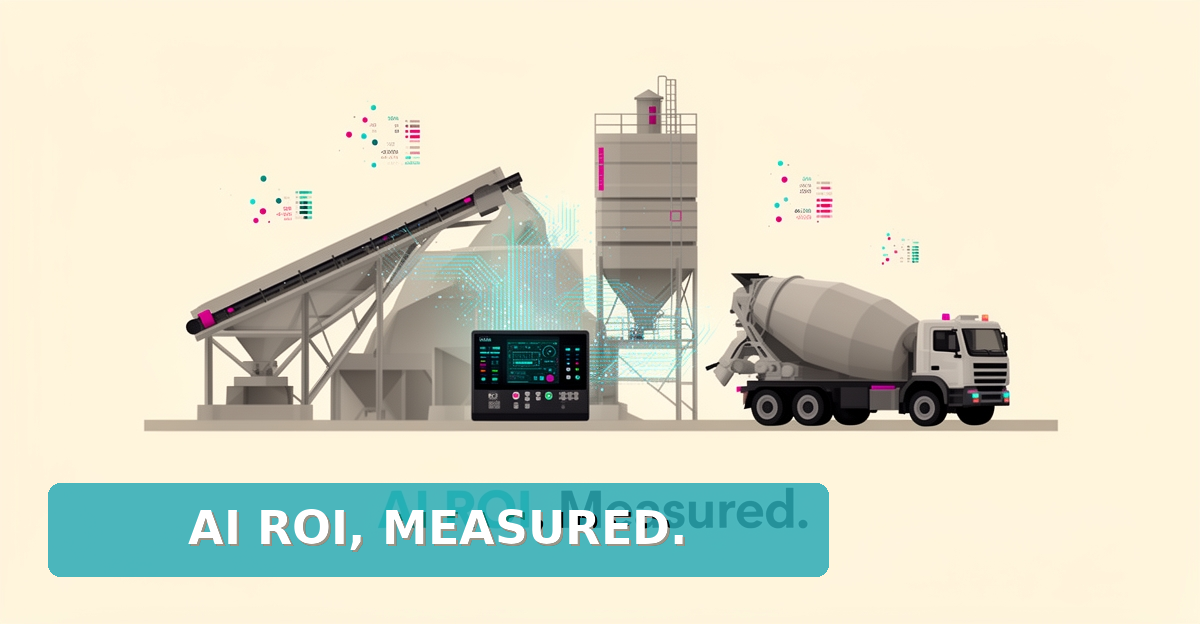
Is AI Worth It for Ready-Mix Concrete Suppliers? A Real-World ROI Breakdown
Key Facts
- Traditional batching can see a significant share of loads go over tolerance according to Sysdyne Technologies research
- AI-assisted batching can reduce over-tolerance loads to a small fraction of production per Sysdyne analysis
- Sysdyne estimates roughly $25,000 per plant per year in material savings from AI-assisted batching — verify against your own plant data
- AI-driven scheduling produced documented single-day savings of about $1,300 in cases reported by Sysdyne
- AI-powered ready-mix software vendors report up to 90% reduction in manual work per Mazenet Tech
- The same vendor reports up to 60% operational cost savings — treat vendor figures as directional, not guaranteed
Hire a team member that works 24/7 — for less than a part-time wage.
AI receptionists, SDRs, dispatchers and 99+ roles. Trained on your business, fully managed.
Not sure where to start? Ask our AI planner
The Hidden Cost of Inconsistent Batching and Manual Back Office Work
Inconsistent batching and manual back-office work quietly erode margin on every ready-mix plant. When tolerances slip and paperwork piles up, the cost shows up as wasted material, overtime, and missed deliveries.
Traditional batching can see 20-30% of loads going over tolerance, according to Sysdyne Technologies. That variability forces rework, customer complaints, and higher cement and admixture usage. With AI-assisted batching, Sysdyne reports only 4-5% of loads going over tolerance, which it estimates translates to roughly $25,000 per plant per year in material costs saved. Your actual numbers depend on your volumes and mix designs.
Back-office work compounds the problem. Most operations run disconnected systems that do not communicate, with duplicate customer records, inconsistent mix cataloging, and outdated pricing sheets. According to industry analysis, poor data quality and legacy software lock workflows in place, making manual reconciliation the norm.
The labor impact is measurable. Vendors like Mazenet Tech report that AI-powered ready-mix concrete management software can deliver up to a 90% reduction in manual work and up to 60% operational cost savings. Without automation, teams spend hours on invoicing, collections visibility, and order entry that could be handled by intelligent workflows.
Scheduling inefficiencies add a daily hit. Sysdyne has documented AI-driven scheduling saving $1,300 in a single day by tightening dispatch and reducing idle truck time. Manual planning struggles to react to traffic, site delays, and last-minute mix changes.
Common pain points that show up across plants include:
- High batching tolerance rates driving material waste and rejected loads
- Excessive manual data entry and reconciliation across disconnected systems
- Reactive scheduling that leaves trucks waiting and customers waiting longer
- Back-office tasks like invoicing and collections that delay cash flow
These issues are not just operational nuisances. They create inconsistent quality and erode trust with contractors who rely on on-time, spec-compliant deliveries. AIQ Labs works with suppliers to model ROI against their own plant data, focusing on batching consistency, labor reduction, and faster response times.
When batching variability and manual processes persist, the hidden cost compounds plant by plant. Quantifying those losses is the first step to building a financially sound AI case.
How AI Delivers Measurable ROI in Ready-Mix Operations
When concrete suppliers ask whether AI actually pays for itself, the answer lives in the numbers coming out of plants that have already made the switch. The savings aren't abstract—they show up in material costs, batch accuracy, and daily scheduling decisions.
The clearest example is batching tolerance. In traditional batching operations, research from Sysdyne Technologies indicates that 20-30% of loads can go over tolerance, meaning producers consistently mix more material than specifications require. With AI-assisted batching, that figure drops to roughly 4-5% of loads—a dramatic improvement in consistency that translates directly into recovered material costs.
That improvement compounds into real money. The same research estimates about $25,000 per plant per year in material costs saved through AI-assisted batching alone. For a supplier operating multiple plants, those annual savings stack quickly, often covering a meaningful share of the technology investment before counting any other benefits.
Scheduling delivers another measurable win. AI-driven scheduling saved $1,300 in a single day in cases documented by Sysdyne. Optimized dispatch means fewer wasted truck hours, better load sequencing, and less overtime—savings that recur every working day rather than once a year.
The back office is where the labor savings concentrate. According to Mazenet Tech, AI-powered ready-mix concrete management software can deliver up to a 90% reduction in manual work, alongside up to 60% operational cost savings. Tasks like invoicing workflows, collections visibility, and analytics reporting that once consumed staff hours become automated processes, freeing teams to focus on customers and production.
Where exactly does the money come from? The documented savings cluster in four areas:
- Reduced material waste from fewer over-tolerance loads in batching
- Lower labor costs from automating invoicing, analytics, and collections workflows
- Daily scheduling gains from optimized dispatch and truck utilization
- Faster response times to customer inquiries and changing market conditions
These benefits also reinforce each other. As Erica Flukinger, Digital Director of Heidelberg Materials North America, has explained, "AI can help us see and predict patterns that drive improved and proactive decision-making." Better data quality and real-time monitoring allow AI to recommend adjustments faster than manual processes alone, improving batching consistency across the board.
The key is modeling these gains against your own operation's numbers rather than relying on industry averages. That's where ROI modeling grounded in your real plant data—like the approach AIQ Labs uses with suppliers—turns scattered statistics into a concrete business case, showing which savings apply to your plants and what payback timeline to expect.
Overcoming Adoption Barriers: From Legacy Systems to AI Integration
Many ready-mix concrete suppliers recognize AI's potential but struggle to move beyond pilot projects due to fragmented technology landscapes and operational realities. The industry often runs on a patchwork of legacy systems—batch plant controllers, dispatch boards, accounting software—that don't share data, forcing teams into manual workarounds and creating blind spots in decision-making. This disconnect isn't just inconvenient; it directly undermines AI's ability to deliver consistent value, as models require clean, integrated data to function effectively. According to industry analysis, disconnected systems and poor data quality—including duplicate customer records and inconsistent mix cataloging—are among the top barriers slowing AI adoption across ready-mix operations.
Legacy software compounds these challenges, as many plants still rely on older platforms deeply embedded in daily workflows. Operators have built routines around these tools over years, making replacement feel risky even when newer, AI-capable solutions exist. The fear of disruption—downtime during transition, retraining staff, or losing tacit knowledge—often outweighs perceived long-term gains. Yet, as noted by Heidelberg Materials' Digital Director, AI's real power lies in capturing and applying institutional knowledge consistently, reducing reliance on individual expertise and enabling more predictable outcomes across shifts and locations.
A phased, milestone-based approach addresses these concerns by minimizing risk while building confidence through early wins. Instead of attempting a full-system overhaul, suppliers can start with a single, high-impact workflow—such as automating dispatch notifications or improving batching tolerance monitoring—where AI demonstrably reduces errors or saves time. For example, AI-assisted batching has been shown to cut over-tolerance loads from 20-30% down to roughly 4-5%, translating to an estimated $25,000 in annual material savings per plant. By validating ROI in one area first, teams gain tangible proof of value, making subsequent phases easier to fund and adopt. This incremental strategy aligns with AIQ Labs' AI Workflow Builds, where you pick the one workflow that costs you the most, we rebuild it at a fixed price in phases, and you own the result outright—letting suppliers evolve toward fuller AI adoption without halting operations or overextending resources.
Your Path Forward: Assess, Pilot, and Scale with Confidence
Ready-mix concrete suppliers looking to adopt AI don't need to overhaul everything at once. A clear, phased approach minimizes risk while building confidence in measurable outcomes. Starting with a focused assessment helps pinpoint where automation delivers the fastest return—whether in dispatch, invoicing, or batching consistency.
Begin with the 2-minute Fit Check to map your biggest operational bottlenecks, then book a free 30-minute strategy call to identify high-ROI opportunities. AIQ Labs uses this session to evaluate your current systems, data quality, and workflow pain points—no obligation, just clarity on where AI can save time and reduce errors. From there, pilot a single workflow, such as AI-powered dispatch or automated invoicing. Industry cases show AI-driven scheduling saving $1,300 in a single day, while AI-assisted batching reduces over-tolerance loads from 20-30% to roughly 4-5%—an estimated $25,000 per plant per year in material savings.
- Assess: Fit Check plus a free 30-minute strategy call to identify automation-ready workflows
- Pilot: Rebuild one high-cost workflow with an AI Workflow Build at a fixed price, with measurable KPIs
- Scale: Expand into a connected AI Operating System once ROI is validated, built in phases and owned outright
This step-by-step path means each phase builds on proven results, with payment models that match your stage—Start Monthly, Build in Milestones, or Own It Outright. By anchoring decisions in real data and incremental wins, suppliers scale AI adoption with confidence, turning automation into a sustainable competitive advantage. Start your Fit Check at aiqlabs.ai/apply to begin.
Still paying for 10+ subscriptions that don’t talk to each other?
We build custom AI systems you own outright. No vendor lock-in. Full control.
Not sure where to start? Ask our AI planner
Frequently Asked Questions
How much material waste can AI really save in ready-mix concrete batching?
What kind of labor savings can AI deliver in the back office for concrete suppliers?
Is AI-driven scheduling actually worth the investment for daily operations?
What are the main barriers to adopting AI in ready-mix concrete operations?
How should a ready-mix supplier start using AI without overhauling everything at once?
Can AI help improve response times to customer inquiries and market changes?
Turning AI Potential into Ready-Mix Profit
The pattern is clear: inconsistent batching, manual back-office work, and reactive scheduling quietly drain margins at ready-mix plants every day. Industry research suggests AI-assisted batching can save roughly $25,000 per plant annually by cutting over-tolerance loads from 20-30% to about 4-5%, while documented cases show $1,300 in single-day scheduling savings through optimized dispatch. Add in the up-to-90% reduction in manual back-office tasks reported by software vendors, and the operational case for AI becomes hard to ignore. The honest next step is to test these numbers against your own operation. Start with the free Fit Check at aiqlabs.ai/apply to map your biggest bottlenecks and see where AI can deliver measurable ROI for your plants—no obligation, just clarity on your path forward.
Make AI your competitive advantage — not just another tool.
Strategy, implementation and ongoing optimization. One partner, end to end.
Not sure where to start? Ask our AI planner