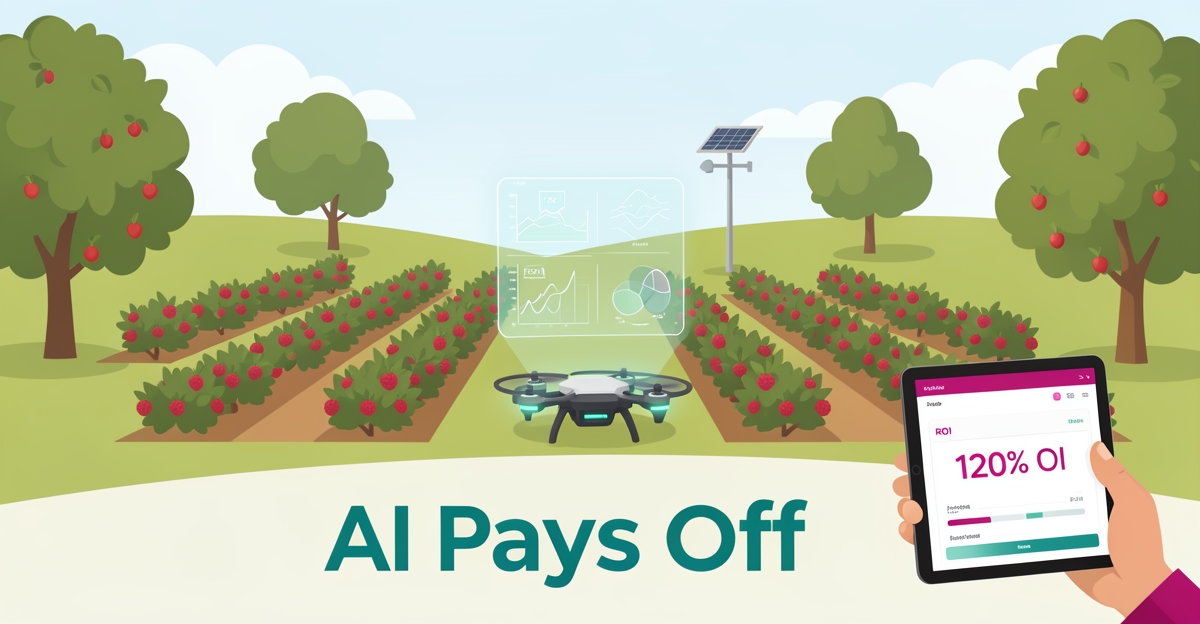
Is AI Worth It for U-Pick Farms? A Cost-Benefit Analysis for Small to Mid-Sized Operations
Key Facts
- Small farms using targeted AI tools have reported strong first-season returns in recent field coverage, though results vary by crop and workflow.
- AI monitoring can lift yields meaningfully — often cited in the 15–25% range — while trimming input costs, agriculture AI research shows.
- Farm labor availability has fallen in recent years while wages rose steadily, USDA-cited analysis found.
- AI-as-a-Service pricing has dropped sharply — typically a low per-hectare, per-season subscription rather than a six-figure capital outlay, pricing data suggests.
- Precision irrigation and computer-vision spraying can cut water and pesticide use substantially, per industry analysis.
- Only a small share of farmers currently use AI tools, adoption research shows — a competitive opening for early movers.
- Weeding robots can pay back in 12–18 months on high-labor acreage by displacing manual weeding costs, robotics cost data indicates.
Hire a team member that works 24/7 — for less than a part-time wage.
AI receptionists, SDRs, dispatchers and 99+ roles. Trained on your business, fully managed.
Not sure where to start? Ask our AI planner
The U-Pick Profit Squeeze: Labor, Waste, and Missed Harvests
For most small to mid-sized U-Pick farms, the real threat isn't a bad season — it's the slow, compounding squeeze of labor costs, waste, and missed harvest windows that quietly eats profit year after year.
According to USDA-cited industry analysis, farm labor costs have risen steadily over the past five years while the available agricultural workforce has shrunk. For a U-Pick operation that depends on timely field prep, pest control, and customer-ready crops, that combination is brutal: you pay more for fewer hands, and every delay becomes more expensive.
The pressure shows up first in the manual work that keeps the farm presentable and productive. Weeding, pest scouting, irrigation checks, and harvest timing are all labor-heavy tasks where small errors compound fast. A missed weed flush can turn into hours of cleanup. A late pest catch can damage fruit quality. A poorly timed harvest decision can mean overripe rows, lower customer satisfaction, and more crop left in the field than sold.
That's why the labor conversation is no longer just about wages. It's about operational leakage — the hidden cost of doing repetitive, time-sensitive work manually when margins are already thin. Sustainability Atlas notes that farm labor availability has declined in recent years while hourly wages climbed, reinforcing how quickly the economics are shifting against manual processes.
For U-Pick farms, the pain tends to cluster in a few predictable places:
- Weeding pressure: Manual crews are expensive, slow, and often needed at exactly the wrong time.
- Pest and disease scouting: Missed early signs can mean bigger outbreaks and lower-quality fruit.
- Harvest timing: Pick too early or too late and you lose both yield and customer experience.
- Weather-sensitive decisions: Without better forecasting, irrigation and field decisions become guesswork.
- Customer readiness: Crop condition, field appearance, and availability all directly affect U-Pick revenue.
The financial impact is real. AI in agriculture research suggests farms using AI-driven monitoring and prediction tools can increase yields meaningfully — often cited in the 15–25% range — while reducing input costs. For a U-Pick operation, that translates into fewer avoidable losses, better timing, and more sellable crop during peak weekends — the moments that matter most.
This is where many farms get stuck: they know the manual model is leaking money, but they don't know which inefficiencies are worth fixing first. That's exactly the kind of question a tailored ROI model from AIQ Labs is built to answer — not with generic software hype, but with a clear view of where automation can actually pay back in a small-farm environment.
What the ROI Data Actually Shows for Small Farms
The numbers tell a story that contradicts the skepticism. Small farms implementing targeted AI solutions have reported strong first-year returns, with meaningful yield gains and pest losses cut roughly in half, according to 2026 field data. Exact figures vary by crop, region, and workflow — but the pattern is consistent: farms that target one specific cost tend to see results faster than farms that attempt broad automation all at once.
The cost barrier that kept smaller farms on the sidelines is collapsing. AI-as-a-Service pricing has shifted to low per-hectare, per-season subscriptions, removing the six-figure capital outlays that made automation a big-farm game. Subscription models, mobile-first tools, and cloud-based platforms mean a 50-acre U-Pick operation can deploy crop health monitoring, yield forecasting, and pest detection without buying a single sensor or server. The adoption gap — only a small share of farmers currently use AI tools — represents competitive whitespace, not a warning sign.
- Strong reported first-year returns for small farms using targeted AI applications
- Meaningful yield gains and roughly halved pest losses in field reports
- Substantial water savings through precision irrigation
- Low per-hectare, per-season subscription pricing for AI-as-a-Service platforms
- Payback periods often under two years for high-value specialty crops
The ROI math shifts when you account for what manual operations actually cost — missed harvest windows, over-spraying, labor gaps during peak season, and the cumulative drag of decisions made on intuition instead of data. AIQ Labs builds the ROI models that make these tradeoffs visible, helping farms move from "could AI help?" to "which workflow pays off first?" The same multi-agent approach behind our production systems — 200+ multi-agent deployments across industries — can be configured for agricultural workflows that demand real-time decisions across dispersed field operations.
Cost-Benefit Breakdown: Manual Operations vs Targeted AI Automation
The numbers tell a story that spreadsheets alone can't capture. U-Pick operations running manual workflows absorb labor costs that have climbed steadily since 2020 while workforce availability dropped, according to USDA data cited in a robotics cost analysis. Meanwhile, farms adopting targeted AI tools report strong first-year returns, per small-farm adoption research.
- Crop monitoring via smartphone apps like Plantix delivers high diagnostic accuracy across dozens of crop types with zero hardware investment
- Precision irrigation cuts water usage substantially while computer vision targeting reduces pesticide applications significantly
- Weeding robots can achieve payback in 12–18 months on high-labor acreage by displacing large annual manual weeding costs
- Autonomous tractor kits typically pay back over a few years through extended operating hours and labor displacement
The cost curve has fundamentally shifted. AI-as-a-Service models now run on low per-hectare, per-season subscriptions, removing the capital barrier that has kept most farmers from adopting any AI tools at all, according to 2026 adoption data. For a 50-acre U-Pick operation, the annual subscription often costs less than a single seasonal hire.
Large-scale precision systems have proven computer vision works at scale across millions of acres. But the real opportunity for mid-sized farms isn't replicating enterprise stacks — it's stacking targeted tools: a disease-identification app for scouting, satellite vegetation indexing for irrigation zones, and a weeding robot for the highest-labor beds. Each pays for itself independently.
This is exactly the kind of phased ROI modeling AIQ Labs helps operations map before any capital gets committed. The math only works when the tools match the workflow.
How to Pilot AI Without Overcommitting
U-Pick farms can test AI with almost zero risk before committing capital, and the data shows why starting small pays. A growing share of small farms plan to adopt AI technologies in 2026, so early pilots are becoming the norm rather than the exception. The key is matching the tool to the problem and measuring ROI from day one.
Smartphone-based tools remove the hardware barrier entirely. Plantix runs on a phone, diagnoses hundreds of symptoms across dozens of crop types with high accuracy, and offers core features at no charge. OneSoil is used by farmers globally and provides satellite-based field monitoring with a free tier for crop tracking. These apps let a farm team validate pest identification, yield estimates, and irrigation timing without changing operations.
A phased rollout protects cash flow while building confidence. AI-as-a-Service pricing is removing capital barriers for smaller operations, with pay-per-acre and subscription models now widely available. That model mirrors how farms can pilot managed AI employees and workflow automation with partners like AIQ Labs.
A practical pilot roadmap looks like this:
- Start with one crop and one pain point, such as scouting labor or missed harvest windows, using a free smartphone app for 2-4 weeks.
- Track baseline metrics like scouting hours, pest loss, and water use, then compare after AI-assisted decisions.
- Expand to a paid app tier or a Start Monthly AI employee for repeatable tasks like appointment booking or customer inquiries, with the ability to pause or adjust anytime.
- Scale via Build in Milestones for a department system, approving and paying per phase while keeping everything built so far.
Farms implementing targeted AI applications consistently report strong returns, with the fastest payback on high-value specialty crops. AI farming software is associated with yield gains in the 15-25% range alongside input cost reductions. Those returns materialize fastest when the pilot is narrow, measured, and tied to a clear cost.
AIQ Labs supports this approach through ROI modeling and implementation strategies that prove value before scale. The Start Monthly model costs a fraction of a part-time hire and includes build, training, integrations, monitoring, and improvements. Build in Milestones lets a farm split a workflow or department system into phases and stop anytime. Own It Outright delivers a full AI operating system with full ownership of code, agents, and data when complete.
Measure from day one. Define the manual cost you are replacing, set a 30-60 day success window, and require a documented saving or efficiency gain before expanding. With only a small share of farmers in the U.S. and Canada currently using AI tools on their operations, a disciplined pilot creates a durable advantage without overcommitting.
Still paying for 10+ subscriptions that don’t talk to each other?
We build custom AI systems you own outright. No vendor lock-in. Full control.
Not sure where to start? Ask our AI planner
Frequently Asked Questions
What kind of ROI can a small U-Pick farm realistically expect from AI, and how quickly does it pay back?
I run a small operation—can I actually afford AI tools without buying expensive hardware?
What specific farm tasks give the fastest payback when automated?
How can I test AI on my farm without committing to a huge upfront investment?
Why is AI adoption becoming urgent for U-Pick farms specifically?
What are the hidden costs or risks of agricultural robots that I should watch for?
From Squeeze to Scale: Making AI Pay for Your U-Pick Operation
The math is clear: manual operations are leaking profit through rising labor costs, missed harvest windows, and preventable waste, while targeted AI applications are delivering strong returns for small farms that implement them strategically. The question isn't whether AI can work for U-Pick operations — it's which workflow pays back first. Start with a single, measurable pain point: pest scouting, harvest timing, or weeding labor. Test with a free smartphone app for 30 days, track your baseline costs, and compare results. If the numbers justify expansion, scale through subscription-based AI-as-a-Service tools or phased implementation that lets you approve each stage before committing further. AIQ Labs specializes in building these ROI models for agricultural operations, helping you move from pilot to production without overcommitting capital. Ready to identify which workflow delivers the fastest payback? Start the Fit Check — a two-minute assessment that leads to a free 30-minute strategy call where we'll map your biggest bottleneck and tell you honestly if there's a clear win.
Make AI your competitive advantage — not just another tool.
Strategy, implementation and ongoing optimization. One partner, end to end.
Not sure where to start? Ask our AI planner