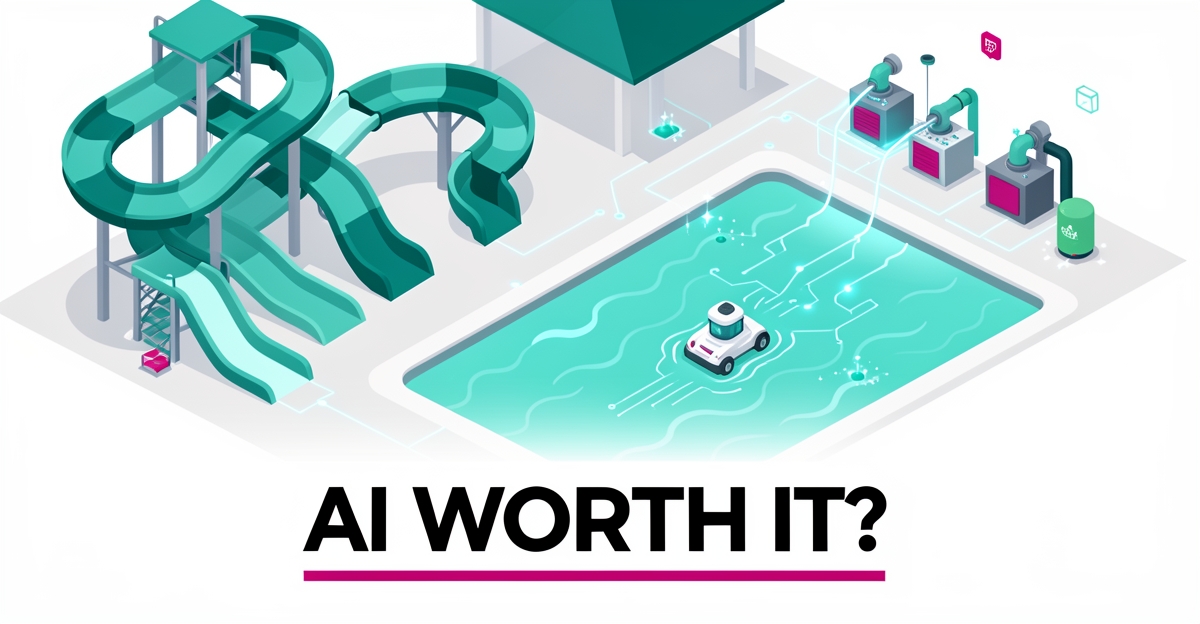
Is AI Worth It for Water Parks? A Cost-Benefit Analysis of Automation
Key Facts
- Robotic pool cleaners typically use 60-80% less energy than running the main pump for manual cleaning cycles, per comparative industry analyses
- AI-driven monitoring systems can typically flag equipment failures 2-6 weeks in advance, converting emergency shutdowns into planned maintenance
- Dynamic pricing engines integrated with online booking channels have been reported to lift RevPAR by double-digit percentages in hospitality-adjacent venues
- Robotic cleaners typically achieve around 95% pool coverage versus 60-75% for manual methods, based on comparative cleaning efficiency studies
- Manual water treatment adjusts dosing every 2-4 hours; AI systems respond to sensor data within minutes
- Most water park AI deployments require roughly 3-6 months for full implementation, including data migration and staff training
Hire a team member that works 24/7 — for less than a part-time wage.
AI receptionists, SDRs, dispatchers and 99+ roles. Trained on your business, fully managed.
Not sure where to start? Ask our AI planner
The Hidden Costs of Manual Water Park Operations
Water parks face mounting pressure from operational inefficiencies that silently drain profitability, even as attendance numbers remain steady. Manual processes in areas like booking, maintenance, and water treatment create avoidable costs that compound over time, eroding margins without obvious warning signs.
One of the most significant hidden costs stems from energy waste in pool cleaning cycles. Manual cleaning relies on the main pool pump running for 6-8 hours to achieve effective cleaning, consuming 1.5-2.5 kWh of electricity per hour during operation. In contrast, automated robotic cleaners typically complete the same task in 2-3 hours while using only 0.1-0.2 kWh per hour—a 60-80% reduction in energy use. That inefficiency lands directly on your utility bill: manual systems commonly run $30-$50 monthly in electricity for a single pool versus $5-$10 for robotic alternatives, and the gap multiplies across every pool and attraction in the park.
Beyond energy, fragmented data systems create cascading inefficiencies that delay critical responses. Manual water treatment processes adjust chemical dosing only every 2 to 4 hours based on periodic testing, leaving water quality vulnerable to fluctuations between checks. AI-driven systems respond to sensor data within minutes, enabling real-time optimization that prevents both over-treatment and under-treatment. The delay in manual systems increases the risk of compliance issues and forces reactive maintenance—often resulting in emergency repairs that cost significantly more than planned interventions.
These inefficiencies are exacerbated by operational silos where reservations, maintenance schedules, and guest tracking exist in disconnected spreadsheets or legacy systems. Staff spend excessive time reconciling data across platforms, increasing the likelihood of double bookings or missed maintenance windows. The resulting guest dissatisfaction and operational disruptions lead to lost revenue opportunities and increased labor costs as teams scramble to correct preventable errors.
For water park owners evaluating transformation, understanding these hidden costs is essential to building a realistic business case. AIQ Labs specializes in modeling these specific inefficiencies through [AI Workflow Builds](/workflow-builds)—rebuilding the one workflow that costs the most, at a fixed price, in phases—so you get clarity on whether automation delivers measurable value for your unique operation. To explore how these insights apply to your park, start with the [2-minute Fit Check](/apply) and a free 30-minute strategy call.
How AI Delivers Measurable ROI in Water Parks
For water park operators, the return on investment from AI is not a vague promise but a series of measurable gains that appear across maintenance logs, utility bills, and revenue reports. The strongest returns materialize where manual guesswork currently costs the most: equipment failure, energy waste, and static pricing.
Predictive maintenance delivers the most immediate operational savings. While manual water treatment relies on scheduled rounds and reactive repairs, an [AI Operating System](/ai-operating-systems) analyzes continuous sensor data to identify equipment failures typically 2 to 6 weeks before they occur. This early warning window transforms emergency shutdowns into planned maintenance, extending asset life and preventing the revenue loss of unexpected closures. Instead of adjusting chemical dosing every 2 to 4 hours based on manual testing, these systems optimize treatment in real-time, reducing both chemical waste and energy consumption.
Revenue management represents the second major ROI driver. By analyzing demand patterns, weather forecasts, and historical attendance, AI enables dynamic pricing strategies that static models miss. Operators in hospitality-adjacent venues have reported double-digit RevPAR gains after integrating intelligent pricing engines with online booking channels. The technology identifies micro-trends—such as a projected weekend occupancy spike—and adjusts rates automatically, ensuring the park captures maximum value during peak demand without manual spreadsheet analysis.
Facility operations offer a third area of rapid payback. Traditional pool maintenance relies on energy-intensive systems that run 6 to 8 hours daily, whereas robotic cleaning technology completes the same coverage in 2 to 3 hours using 0.1–0.2 kWh per hour. This shift typically cuts monthly energy costs from $30–$50 down to $5–$10 per pool while achieving roughly 95% coverage rates compared to the 60–75% typical of manual methods.
These technologies function as a force multiplier for existing staff, not a replacement. By automating data collection and routine adjustments, AI eliminates the administrative bottlenecks that lead to double bookings and missed maintenance windows. Staff shift from updating spreadsheets to managing guest experiences, while managers gain consolidated dashboards that replace information silos with actionable intelligence. Where the gap is a front-desk or booking workload, managed [AI Employees](/ai-employees) can absorb receptionist and scheduling tasks at roughly 80% less cost than an equivalent human hire.
The financial case rests on data-driven decision-making rather than labor reduction. As AIQ Labs emphasizes in ROI modeling engagements, the transition requires viewing AI as an operational intelligence layer that compounds value over time. When parks integrate these systems to handle the heavy lifting of analysis and prediction, they convert operational complexity into measurable margin improvement.
Implementing AI Without Disruption: A Phased Approach for Water Parks
Adopting AI in a water park environment does not require a "big bang" overhaul; a phased, modular approach minimizes risk and allows operations to stabilize between stages. Based on comparable deployments in marina and aquatic facility management, most systems require 3 to 6 months for full implementation, including data migration and staff training.
The first step is a rigorous assessment of current pain points. Operators should identify specific inefficiencies such as double bookings, missed maintenance windows, or high energy costs. AIQ Labs recommends starting with high-impact areas like water treatment or booking systems, where the ROI is most immediate. For example, AI monitoring in water treatment can predict equipment failures 2 to 6 weeks in advance, shifting maintenance from reactive repairs to predictive planning.
Once pain points are identified, select modular solutions that integrate with existing infrastructure. Rather than locking into a large vendor contract, a fixed-price [Workflow Build](/workflow-builds) lets a park rebuild its single most expensive workflow first, prove the savings, and scale from there. Key considerations for selection include:
- Compatibility with existing SCADA and POS systems
- Ability to handle dynamic pricing and booking-channel integration
- Predictive maintenance capabilities for critical infrastructure
- Real-time analytics for guest flow and safety
Integration and data migration follow selection. Historical data from spreadsheets or legacy systems must be transferred to the new platform to train the AI models effectively. This phase is critical; the AI relies on this data to identify patterns—such as recurring weekend occupancy spikes—that can inform staffing and pricing decisions.
Training staff to work alongside AI is essential for adoption. The goal is augmentation, not replacement. Staff should learn to interpret AI dashboards and override automated decisions when necessary. For instance, while AI can optimize chemical dosing in real-time, human oversight ensures safety protocols are met during peak load times.
Finally, continuous optimization ensures long-term value. Operators should monitor KPIs such as energy consumption, maintenance costs, and guest satisfaction scores. Robotic cleaners, for example, demonstrate the efficiency gains possible: they typically use 60-80% less energy than manual systems and achieve around 95% coverage rates. By tracking these metrics, water parks can refine their AI systems, ensuring the technology evolves alongside operational needs and delivers sustained ROI. Flexible payment models—start monthly, build in milestones, or own it outright—keep the investment matched to the value each phase proves.
Still paying for 10+ subscriptions that don’t talk to each other?
We build custom AI systems you own outright. No vendor lock-in. Full control.
Not sure where to start? Ask our AI planner
Frequently Asked Questions
How much can AI actually save on water park energy costs?
Will AI replace my lifeguards and guest services staff?
How long does it take to implement AI systems in a water park?
Can AI really increase water park revenue, or is it just about cutting costs?
How does AI improve water treatment compared to manual testing?
What's the typical upfront investment for water park AI?
Turning Operational Leaks into Profit Streams
The evidence is clear: manual water park operations silently drain profitability through energy waste, fragmented data, and reactive maintenance—costs that compound daily even when attendance holds steady. AI adoption targets these exact pain points, delivering measurable ROI via predictive maintenance that prevents emergency repairs, dynamic pricing that captures peak-demand revenue, and robotic cleaning that typically slashes energy use by 60-80%. This isn't about replacing staff but augmenting them—freeing teams from spreadsheets to focus on guest experiences while AI handles the heavy lifting of data analysis and prediction. For water park owners ready to stop guessing and start optimizing, the path forward begins with clarity. AIQ Labs has deployed 200+ multi-agent systems and runs four live SaaS products daily, and we model these specific inefficiencies through ROI assessments that quantify savings from reduced energy use, faster response times, and eliminated manual reconciliation. Take the first step today: complete the [2-minute Fit Check](/apply), book your free 30-minute strategy call, and pinpoint where automation delivers the highest impact for your park. Questions first? Email [email protected].
Make AI your competitive advantage — not just another tool.
Strategy, implementation and ongoing optimization. One partner, end to end.
Not sure where to start? Ask our AI planner