Is AI Worth It for Wheel Alignment Shops? A Cost-Benefit Analysis
Key Facts
- Computerized 3D alignment systems deliver precision around ±0.1°, reducing variability from technician skill according to industry research
- AI tools are typically reported to reduce administrative time by 30-40% in automotive shops through automation of scheduling and customer communication per shop performance studies
- AI scheduling tools are commonly credited with cutting no-show rates from 12-15% to under 5% via automated reminders and predictive booking based on shop management data
- Modern alignment machines can process 15-30 vehicles daily at $80-$150 per service, with equipment payback often cited in the 12-18 month range per equipment benchmarks
- AI diagnostics are reported to reduce diagnostic time by 60%+ with 90%+ accuracy in identifying vehicle issues per diagnostic accuracy research
- Industry projections suggest over 60% of auto repair shops may use AI technology by late 2026, up from roughly 25% in early 2025 according to industry projections
Hire a team member that works 24/7 — for less than a part-time wage.
AI receptionists, SDRs, dispatchers and 99+ roles. Trained on your business, fully managed.
Not sure where to start? Ask our AI planner
The Profit Pressure Facing Alignment Shops Today
Profit margins in wheel alignment are shrinking even as demand rises. Shops are caught between rising vehicle complexity and a workforce that can't keep pace, forcing owners to choose between turning away work or burning out the team they have.
Technician shortages are the most visible pressure point. Experienced alignment techs are retiring faster than replacements are trained, and the work now requires fluency in electronics as well as mechanics. That skills gap shows up in longer cycle times, inconsistent results, and higher comeback rates.
Vehicle complexity compounds the problem. Modern cars arrive with advanced driver assistance systems that demand precision beyond traditional specs. Industry research suggests roughly half of vehicle owners have experienced problems with their ADAS after repairs to those systems, turning a routine alignment into a liability risk when measurements drift.
Customer expectations add another layer. Drivers expect same-day service, digital before-and-after reports, and transparent pricing. Manual processes struggle to deliver speed and accuracy at the same time, especially during peak hours.
Administrative drag quietly erodes profitability. Automotive shop analysis indicates AI tools can reduce administrative time by 30-40%, a range that reflects the hours lost to scheduling, invoicing, and follow-up calls that could be automated. That time is time not spent on the rack.
No-shows and rescheduling amplify the cost of staying manual. Shop management data notes AI scheduling tools can reduce no-show rates from 12-15% to under 5%, freeing bays for paying work instead of empty appointments.
The cost of staying manual shows up in three compounding areas:
- Labor inefficiency from repetitive data entry and phone chasing
- Revenue loss from no-shows and underutilized bays
- Comebacks and customer disputes driven by measurement variability
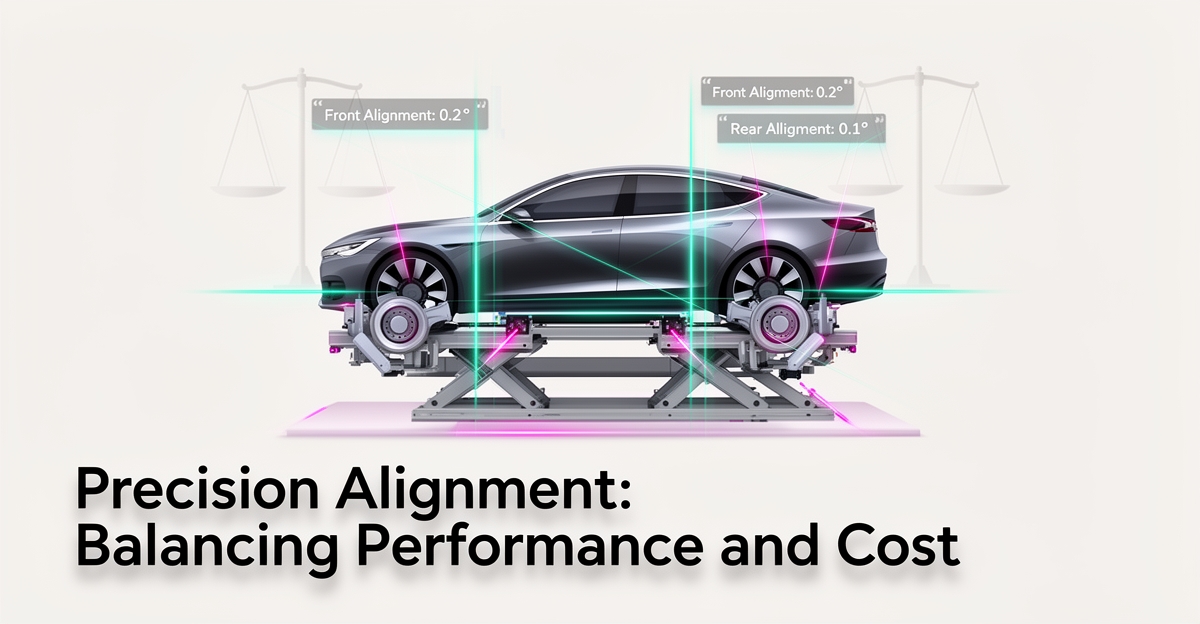
Traditional alignment methods introduce variability even with skilled technicians. Precision around ±0.1° is now the baseline customers expect, and manual setups rarely deliver it consistently across shifts.
For SMB owners evaluating total cost of ownership versus gains in efficiency, accuracy, and satisfaction, these pressures create a clear business case. AIQ Labs approaches this through data-driven ROI modeling that maps shop size and volume to realistic savings — starting with a focused rebuild of the one workflow that costs you the most — rather than generic promises.
Shops that remain manual are paying for inefficiency in overtime, lost appointments, and reputational risk. The profit pressure is not theoretical; it is measured in wasted admin hours, missed bookings, and ADAS-related comebacks that could be prevented with consistent, guided workflows.
What AI Actually Delivers for Alignment Operations
AI-powered 3D alignment systems deliver precision around ±0.1°, reducing the variability introduced by technician skill in manual methods and supporting consistent results across every vehicle. This level of accuracy supports faster turnaround, with diagnostic time reported reduced by 60%+ and diagnostic accuracy exceeding 90%, allowing shops to identify issues more quickly and reliably. As a result, alignment shops can process 15-30 vehicles per day, significantly increasing throughput without sacrificing quality.
Beyond measurement precision, AI integration improves operational flow through smarter scheduling and customer engagement. Shops using AI-powered management systems commonly report reducing administrative time by 30-40% while cutting no-show rates from 12-15% to under 5% through automated reminders and predictive booking. These efficiencies free up staff to focus on higher-value tasks and improve bay utilization. AI tools also enhance diagnostic capabilities by cross-referencing symptoms with OEM databases and repair histories, surfacing issues that might be missed in manual assessments.
- ±0.1° precision vs skill-dependent manual methods
- 60%+ reported reduction in diagnostic time
- 90%+ reported diagnostic accuracy
- No-show rates dropping to under 5%
- 15-30 vehicles processed per day
For shops investing in AI-enabled alignment equipment priced between $4,275 and $6,000+, these combined gains are typically cited as yielding ROI within 12-18 months. AIQ Labs helps alignment businesses model these outcomes based on their specific volume and workflows — whether that means AI employees handling phones and booking or a deeper operational build — ensuring the technology investment aligns with measurable operational improvements. By anchoring decisions in data rather than assumptions, shops can adopt AI as a driver of efficiency, accuracy, and long-term competitiveness.
Total Cost of Ownership vs Real-World Returns
AIQ Labs helps wheel alignment shops evaluate whether AI investments deliver real returns by comparing total cost of ownership against measurable gains in efficiency and accuracy. Equipment tiers range from $4,275 for budget-friendly 3D systems to over $6,000 for professional-grade models, while AI tools for scheduling, diagnostics, or shop management typically cost $50-500/month depending on scope and features according to industry analysis. With alignment services priced at $80-$150 per job and machines capable of processing 15-30 vehicles daily per equipment benchmarks, even modest volume creates clear paths to payback.
Administrative time typically drops by 30-40% with AI-assisted scheduling and customer communication tools, directly freeing up technician hours for billable work as documented in shop performance studies. Estimating errors are reported to fall by 40% when AI diagnostics cross-reference symptoms with OEM databases, reducing costly comebacks and improving first-time fix rates per diagnostic accuracy research. Vendors have also published accounts-payable recovery examples — one single-location shop reportedly recovered $36,000 annually, and a three-location franchise uncovered over $14,000 in missing credits in four hours per vendor case studies. Treat these as illustrative, not guaranteed — your numbers depend on your books. These savings compound quickly, especially when paired with reduced no-show rates (from 12-15% to under 5%) and faster diagnostic throughput as AI scheduling and diagnostic tools demonstrate.
Payback timelines shift based on shop size and daily volume. A high-volume shop doing 20 alignments daily at $100 average revenue generates $2,000/day, meaning a $5,500 AI-enabled system covers its equipment cost in under three days of gross revenue — excluding operational gains. For smaller shops doing 5 alignments daily, the same investment requires ~11 days of gross revenue for equipment payback, but the 30-40% administrative time reduction effectively adds 1.5-2 billable hours per technician each day. When AI tools prevent even one misdiagnosis or scheduling gap per week, a monthly $100-300 diagnostic assistant cost is often recovered in a single corrected job. AIQ Labs models these variables — with transparent pricing under Start Monthly, Build in Milestones, or Own It Outright — so shops of any scale can align AI spending with realistic, volume-driven returns. See current payment models for details.
How to Implement AI Without Disruption
Implementing AI in a wheel alignment shop doesn't require a full-scale overhaul. Start by assessing current workflow pain points — most shops find scheduling inefficiencies and customer communication gaps consume a large share of administrative time. Addressing these areas first delivers quick wins with minimal disruption.
Begin with AI-powered scheduling or customer communication tools, which typically cost $50-150/month per location and can reduce no-show rates from 12-15% to under 5% through automated reminders and smart booking. These tools integrate easily with existing shop management platforms and require little technical setup. An AI receptionist or dispatcher can take bookings, answer calls, and chase confirmations around the clock at a fraction of the cost of a human hire.
Before expanding, validate that any AI system includes comprehensive vehicle database coverage — top alignment machines feature 50K+ to 60K+ vehicle databases — and confirms OEM compliance for repair specifications, especially critical for ADAS-equipped vehicles. Ensure bay space accommodates equipment needs (12-14 feet for 3D systems) and establish a regular calibration schedule every 6-12 months.
Train staff using on-screen guidance features built into modern AI systems, which shorten learning curves and improve consistency across technicians. Once scheduling and communication show measurable gains, expand incrementally to diagnostics (reducing diagnostic time by 60%+), inventory management (cutting excess stock by up to 40%), and advanced reporting — tying each phase to AIQ Labs' milestone-based build approach so growth stays predictable and scalable. When you're ready to see which workflow to rebuild first, the 2-minute Fit Check is the fastest starting point.
Still paying for 10+ subscriptions that don’t talk to each other?
We build custom AI systems you own outright. No vendor lock-in. Full control.
Not sure where to start? Ask our AI planner
Frequently Asked Questions
What is the typical ROI timeline for AI-powered alignment equipment?
How much can AI reduce administrative time in an alignment shop?
Will AI alignment systems improve accuracy compared to manual methods?
Can AI really reduce no-show rates for alignment appointments?
Is AI worth the investment for a small alignment shop doing only 5 jobs per day?
How does AI help with ADAS-related alignment risks?
The Precision Payoff: Turning Alignment Challenges into Competitive Advantage
Wheel alignment shops today face a convergence of pressures: technician shortages, ADAS-equipped vehicles demanding ±0.1° precision, and customer expectations for speed and transparency that manual processes struggle to meet. The reported data shows AI integration directly addresses these pain points — cutting administrative time by 30-40%, reducing no-show rates from 12-15% to under 5%, and delivering diagnostic accuracy exceeding 90% while processing 15-30 vehicles daily. For shops evaluating the investment, AIQ Labs provides data-driven ROI modeling that aligns technology spending with measurable gains in efficiency, accuracy, and customer satisfaction — with 200+ multi-agent systems deployed behind that work. To see how these returns apply to your specific volume and workflows, take the 2-minute Fit Check and book a free 30-minute strategy call — no obligation, just clarity on where AI delivers real value for your shop.
Make AI your competitive advantage — not just another tool.
Strategy, implementation and ongoing optimization. One partner, end to end.
Not sure where to start? Ask our AI planner