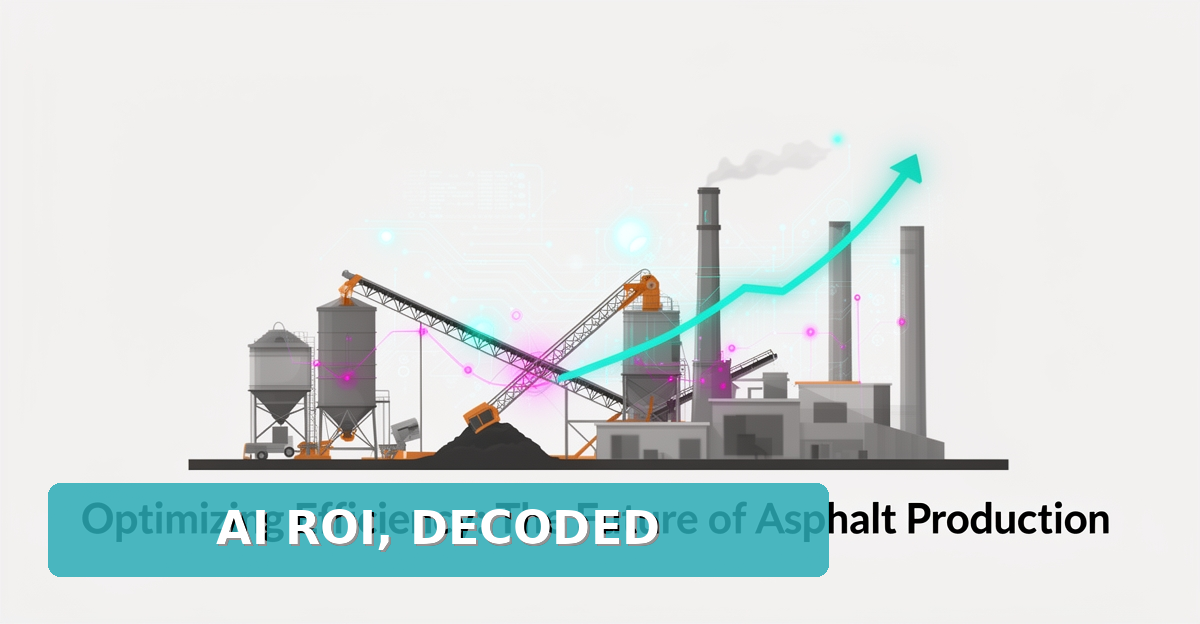
Is AI Worth It for Your Asphalt Plant? A Breakdown of ROI and Real Costs
Key Facts
- A large share of global infrastructure assets are decades old, contributing to a multi-trillion-dollar US investment gap, according to infrastructure asset management data.
- Data-driven capital planning is reported to deliver lower lifecycle costs and extend asset life, infrastructure analysis shows.
- AI agents excel at routine tasks like checking schedules and summarizing production, but require high-quality data and proper permission models, PlantDemand research indicates.
- The biggest near-term AI wins are time savings on routine information tasks, not replacing plant managers, industry analysis confirms.
- AI-powered predictive maintenance typically requires scarce labeled failure data, while process control needs consistent operational data, automation research reveals.
- A missed mix can cost an entire day of production in asphalt's short paving season, making operational tempo unique, asphalt operations analysis notes.
Hire a team member that works 24/7 — for less than a part-time wage.
AI receptionists, SDRs, dispatchers and 99+ roles. Trained on your business, fully managed.
Not sure where to start? Ask our AI planner
The Asphalt Plant Pressure Cooker: Short Season, High Stakes
The pressure of asphalt operations is unique. The paving season is brutally short, weather is a constant threat, and a single missed mix can erase an entire day's profit. This is the high-stakes environment where every decision carries significant financial weight.
This operational tempo is what separates asphalt from other heavy industries. As industry analysis from PlantDemand notes, "What is unique is the operational tempo: paving season is short, weather is unpredictable, and a missed mix can cost a day of production." This reality creates a pressure cooker for plant managers.
The core challenges converging on asphalt plants include:
- A compressed revenue window, where a few months of good weather must generate the entire year's profit.
- Constant operational risk from unforeseen equipment failures or supply chain disruptions.
- The high cost of error, where one bad batch can impact a project and your reputation.
- Managing aging infrastructure that demands more predictive oversight.
This isn't just an operational headache; it's a national-scale issue. According to data on infrastructure asset management, a large share of global infrastructure assets are more than 40 years old, contributing to a multi-trillion-dollar investment gap in the US alone. Your plant is a critical node in a system already under immense strain.
The financial consequences of inefficiency are severe. A reactive approach to maintenance and capital planning is no longer viable. The same data suggests a data-driven strategy can lead to significantly lower lifecycle costs. For a plant operator, this isn't an abstract number; it's the difference between leading the market and falling behind.
This is precisely the problem AI is designed to help solve. It's not about replacing your experienced team, but augmenting them with tools that can predict failures, optimize schedules, and turn operational data into a financial asset. Understanding if your plant is ready for this shift is the first step, which is why a thorough AI readiness assessment is critical before any investment is made.
Where AI Actually Pays Off in Asphalt Operations
AI is transforming asphalt operations by delivering measurable returns in four key areas: scheduling and dispatch, predictive maintenance, process control, and emissions monitoring. AI agents streamline routine information tasks — such as checking schedules, summarizing production, or pulling material usage — freeing up plant managers for higher-value decisions. PlantDemand notes that these time-saving wins represent the biggest near-term opportunities, especially given the short paving season and weather-dependent workflows where delays are costly.
Predictive maintenance powered by AI reduces unplanned downtime by identifying equipment wear before failure occurs. When combined with data-driven capital planning, this approach can extend asset life and lower lifecycle costs meaningfully. iFactory reports that infrastructure assets over 40 years old make up a large share of global systems, underscoring the urgency of proactive maintenance to avoid expensive reactive repairs.
AI-enhanced process control minimizes material waste by detecting production anomalies in real time, allowing operators to adjust mix designs or feed rates before quality issues arise. Similarly, AI-driven emissions monitoring helps plants stay compliant with environmental regulations by flagging deviations early, preventing fines and production halts. Together, these capabilities support smoother operations during tight scheduling windows.
- AI agents for scheduling and dispatch reduce manual coordination time
- Predictive maintenance cuts downtime and extends equipment life
- Process control lowers waste and improves mix consistency
- Emissions monitoring avoids regulatory penalties and shutdowns
AIQ Labs supports asphalt operations through AI readiness assessments that identify which of these technologies will deliver the strongest return based on a plant's size, data maturity, and operational rhythms. By focusing on high-impact, low-risk entry points — like automating dispatch logs or enabling predictive alerts on critical crushers — plants can build confidence in AI while capturing immediate efficiency gains. The result is a more resilient operation that maximizes uptime, reduces waste, and protects margins across the paving season.
Real Costs, Real Limitations, and What Drives ROI
AI can deliver real returns in an asphalt plant, but only when the investment matches the quality of your data and the realities of your operation. The gap between a profitable deployment and an expensive disappointment usually comes down to preparation, not the technology itself.
The upfront costs are real. Industry analysis of asphalt plant automation shows that AI-powered predictive maintenance, process control, and emissions monitoring all require significant investment in hardware and software, plus the training and expertise to keep them running. There is no meaningful "plug and play" tier here.
The bigger constraint is data. According to PlantDemand's white paper on AI agents in asphalt operations, AI capabilities are limited by the quality of the data they are trained on and the permission model in place. The Model Context Protocol (MCP) standard is emerging as a critical piece, giving AI systems controlled, auditable access to plant tools and data rather than unchecked freedom.
Each major AI application carries its own data dependency:
- Predictive maintenance detects equipment failures before they happen, but requires high-quality labeled failure data, which is scarce in industrial settings.
- Process control optimizes production and reduces waste, but depends on process data that is often difficult to capture consistently.
- Emissions monitoring flags anomalies before they become costly fines, but only works with reliable, continuous emissions data — the kind specialized measurement solutions are built to provide.
When the data foundation is solid, the payoff compounds. Infrastructure asset management data suggests data-driven capital planning can deliver lower lifecycle costs, with AI-powered deterioration modeling extending asset life. One infrastructure operations center reported millions saved year-to-date with asset health above 94%.
One thing the research is unambiguous about: AI augments your team, it does not replace it. As PlantDemand puts it, AI agents are excellent assistants for the people who already run your plant — not replacements — and pretending otherwise is how good technology gets a bad reputation. The biggest near-term wins are time savings on routine information tasks: checking a plant's schedule, summarizing a week of production, or pulling material usage for a customer.
This is why a structured readiness assessment matters before any dollars move. At AIQ Labs, our AI readiness assessments evaluate your data infrastructure, permission models, and workflows to determine which applications — predictive maintenance, process control, or AI-assisted operations — will actually pay back for a plant of your size and tempo. In an industry where paving season is short and a missed mix can cost a day of production, the right first move is knowing where AI fits before you buy it.
From Readiness to Results: A Practical AI Adoption Path
Adopting AI in asphalt is less about chasing hype and more about sequencing the right work at the right time. Plants that move from readiness to results start with operations, not technology, and build confidence through small, measurable wins.
Start with a thorough analysis of asphalt operations to identify where AI can be applied. Plant managers and operations leaders benefit most when AI agents assist with scheduling, dispatch, and reporting, but capabilities are limited by data quality and the permission model in place. According to PlantDemand research, the biggest near-term wins are time savings on routine information tasks like answering schedule questions or summarizing production.
A formal readiness assessment maps current technology stack, data infrastructure, and team capabilities against high-value automation targets. This step surfaces gaps in labeled failure data, process data, and emissions data that often constrain predictive maintenance, process control, and emissions monitoring. The Model Context Protocol standard is a crucial component in enabling safe and controlled AI adoption in industrial operations.
From assessment, plants define a pilot that matches size and risk tolerance. Pilot AI operators for information workflows first, then expand to workflow automation in production control. Pilots should target routine questions, weekly production summaries, and material usage pulls for customers, where AI agents act as excellent assistants for the people who already run the plant.
A practical adoption path follows:
- Conduct operations analysis to pinpoint scheduling, dispatch, reporting, and maintenance pain points
- Validate data quality and access controls, with MCP for safe tool integration
- Run a contained pilot with an AI operator on information tasks, measure time saved
- Scale to workflow automation for predictive maintenance and process control
- Institutionalize with an infrastructure operations center for real-time asset visibility
Context matters for asphalt. Infrastructure data shows a large share of global infrastructure assets are 40+ years old and the US faces a multi-trillion-dollar infrastructure investment gap. Data-driven capital planning can deliver lower lifecycle costs, reinforcing why plants need efficient decision making now.
AIQ Labs supports this path through tailored AI readiness assessments that determine which solutions offer the best return for each plant's size and operations. Engagement can be structured to match risk appetite: [Start Monthly](/ai-employees) for a managed AI employee — a receptionist, dispatcher, or SDR that handles routine coordination at a fraction of a human hire's cost — [Build in Milestones](/workflow-builds) for a phased rebuild of the one workflow that costs you the most, with pay-per-phase approval, or [Own It Outright](/ai-operating-systems) for a connected AI operating system built in phases, with full code and data ownership. Start with a 2-minute [Fit Check](/apply) to see where your plant fits.
Results compound when pilots prove value before scale. Plants that begin with readiness, pilot information workflows, and expand deliberately avoid the pilot stall and move toward sustained efficiency gains.
Still paying for 10+ subscriptions that don’t talk to each other?
We build custom AI systems you own outright. No vendor lock-in. Full control.
Not sure where to start? Ask our AI planner
Frequently Asked Questions
Is AI worth the investment for my asphalt plant given our short paving season?
What kind of ROI can I expect from AI in predictive maintenance for my asphalt plant?
Do I need perfect data to use AI in my asphalt plant?
Will AI replace my plant operators or maintenance team?
What's the first step to adopting AI in my asphalt operations without wasting money?
How does the Model Context Protocol (MCP) help with AI adoption in asphalt plants?
Key Takeaways
The math is straightforward: a short paving season, aging equipment, and zero margin for error mean every hour of unplanned downtime or wasted mix cuts directly into the year's profit. AI can shift that equation — predictive maintenance, process control, and AI-assisted scheduling all pay off — but only when your data and permissions are ready first.
Start with a readiness assessment, pilot AI on routine information tasks, and scale deliberately. Whether that means a managed AI employee, a phased workflow rebuild, or a full AI operating system you own outright, the right structure depends on your plant's size, data maturity, and risk appetite. The season doesn't wait — neither should your data.
Make AI your competitive advantage — not just another tool.
Strategy, implementation and ongoing optimization. One partner, end to end.
Not sure where to start? Ask our AI planner