Is AI Worth It for Your Log Home Business? A ROI Breakdown for Small Builders
Hire a team member that works 24/7 — for less than a part-time wage.
AI receptionists, SDRs, dispatchers and 99+ roles. Trained on your business, fully managed.
Not sure where to start? Ask our AI planner
The Hidden Cost of Manual Processes in Log Home Building
Log home builders often underestimate how much time and money manual processes quietly drain from their operations. In lead qualification, inventory tracking, and customer onboarding, repetitive tasks consume hours that could be spent on design, craftsmanship, or client relationships.
Manual lead qualification typically involves sorting inquiries by hand, logging details into spreadsheets, and following up based on memory or scattered notes. This approach leads to inconsistent follow-up, missed opportunities, and delayed responses—especially during peak seasons. Businesses relying on manual data entry and task routing commonly see meaningful error rates, which directly impacts conversion rates and customer trust. These inefficiencies compound when builders try to scale, as each new lead or project adds linear workload without systemic efficiency gains.
Inventory management presents similar challenges. Without automated tracking, builders frequently face stockouts of key materials like specialized logs, sealants, or hardware, delaying projects and frustrating clients. Conversely, overstocking ties up capital in unused materials that degrade over time. Manual systems lack predictive capabilities, making it difficult to anticipate seasonal demand shifts or supplier lead times accurately. As a result, builders often operate in a reactive mode, adjusting orders only after shortages or surpluses become critical.
Customer onboarding suffers from the same fragmentation. Welcome packets, contract signing, scheduling, and initial walkthroughs are often handled through disjointed emails, phone calls, and paper forms. This increases the likelihood of miscommunication, missed documents, and scheduling conflicts—each requiring manual correction. The cumulative effect is a slower start to projects, higher administrative burden, and a less professional first impression.
These manual workflows not only waste time but also create hard scalability limits. Unlike AI-driven systems that can handle hundreds of leads or inventory updates simultaneously, manual processes scale only by adding headcount—each new employee bringing training costs, management overhead, and potential for human error. For small log home businesses operating with tight margins, this model becomes unsustainable as demand grows.
The hidden cost isn't just in lost time—it's in missed revenue, avoidable mistakes, and the gradual erosion of operational agility. When every hour spent on manual data entry or error correction is an hour not spent building, designing, or engaging clients, the true price of manual processes becomes clear. Addressing these inefficiencies isn't about adopting technology for its own sake—it's about reclaiming capacity to focus on what log home builders do best: creating enduring, high-quality homes.
How AI Delivers Measurable ROI in Log Home Operations
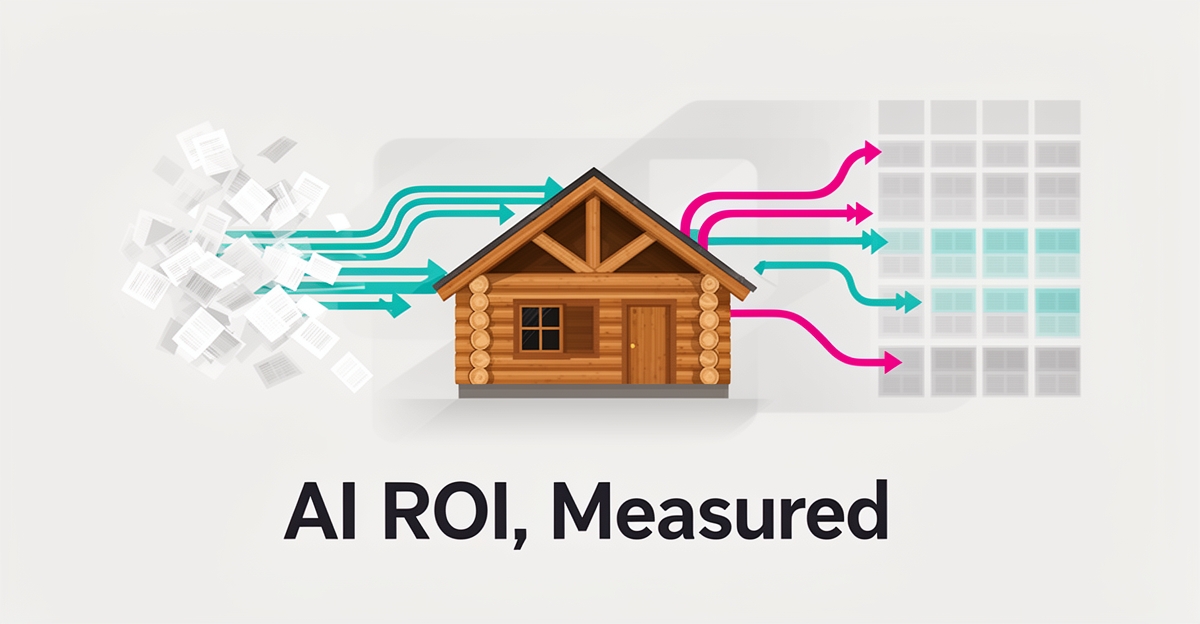
Small log home builders feel every hour of delay — from first inquiry to first delivery. AI compresses that timeline without adding headcount, turning operational friction into measurable margin.
Lead response time is the first financial leak. Manual follow-up stretches hours to days, while AI systems process inquiries in minutes to hours. Industry comparisons of AI versus manual processes typically show dramatically faster processing with AI, which directly protects high-intent leads before competitors respond. Faster qualification also lifts throughput, with home services operators commonly reporting meaningful increases in daily job completions after implementing AI systems.
Material ordering is where cost savings compound. Log home builds rely on precise timber, millwork, and hardware ordering. AI-powered forecasting analyzes historical sales patterns, seasonality, and trend detection to optimize reorder points. The result is reduced stockouts and excess inventory—a pattern reflected in widely reported cost savings from AI adoption across operations. For small builders, that margin protects cash flow on long-cycle projects.
Client onboarding benefits from the same automation logic. AI can ingest inquiry forms, verify requirements, schedule site visits, and prep proposal packets without repetitive manual entry. Error rates drop sharply compared to manual handling, while scalability becomes workforce-independent rather than headcount-limited.
Where financial value materializes for small builders:
- Lead response and qualification: AI agents qualify and route inquiries 24/7, shortening sales cycles and increasing qualified appointments.
- Material and inventory optimization: Predictive models reduce over-ordering and stockouts, improving cash flow and build schedules.
- Automated onboarding: Intake, documentation, and scheduling are handled end-to-end, cutting admin hours and accelerating project start.
These gains align with the revenue model of small builders, where labor cost and project velocity drive profitability. AIQ Labs validates ROI before investment through a structured Workflow Build that targets the one workflow costing you the most—often lead qualification, inventory management, or customer onboarding—at a fixed price, delivered in phases.
The financial case is not theoretical. AI adoption delivers measurable cost reduction and throughput gains when applied to repetitive, data-driven workflows. For builders ready to validate impact at their scale, a focused readiness assessment clarifies which use cases deliver the fastest payback.
Practical Steps to Validate AI ROI Before Investing
You don't need a massive budget or a leap of faith to test AI in your log home operation — you need a structured, low-risk validation path. Here's how smart builders are proving ROI before committing serious capital.
Before spending a dollar on AI tools, audit your current operations. Conducting an AI readiness assessment is the essential first step — evaluating your data quality, existing infrastructure, and team capabilities.
Ask yourself: Are your lead sources tracked consistently? Do you have clean records of past builds, material costs, and customer interactions? Poor data quality undermines even the best AI systems, so identifying gaps now prevents expensive failures later.
Resist the urge to automate everything at once. Focus on a single workflow where AI can deliver measurable results quickly. For most log home builders, lead qualification offers the fastest payback — especially if your team spends hours chasing tire-kickers instead of serious buyers.
Other strong candidates include:
- Responding to after-hours inquiries that would otherwise go cold
- Automating follow-ups with prospects who requested quotes but haven't committed
- Scheduling site visits and consultations without phone tag
- Routing qualified leads to the right salesperson based on project scope
The goal is choosing one bottleneck where automation frees up your team for higher-value work — like closing deals and managing builds.
This is where many small builders stall: they assume AI requires enterprise-level investment. It doesn't. AIQ Labs' Start Monthly model lets you deploy a single AI employee — such as a lead qualifier or receptionist — for a flat monthly fee that typically costs far less than a human hire. The plan includes the build, training on your specific business, tool integrations, monitoring, and ongoing improvements, with the flexibility to pause or adjust anytime.
This approach eliminates the risk of a large upfront commitment while giving you real performance data. Businesses adopting AI commonly report meaningful cost savings and much faster processing speeds — but those numbers only matter if they materialize in your operation. A pilot lets you verify results before scaling.
Track concrete metrics during your pilot: response times, qualified lead volume, hours saved, and conversion rates. Operators implementing AI in home services often report gains in daily job completions within the first 90 days — but your mileage depends on starting with the right use case and clean data.
Once you've validated ROI in one area, expand systematically. Add AI-powered inventory forecasting if material waste eats your margins, or customer onboarding automation if post-sale communication falls through cracks. Builders who need everything connected — leads, scheduling, materials, and client communication in one layer — can graduate to an AI Operating System built in phases and owned outright. Each new application should build on proven wins, not hopeful guesses.
The builders winning with AI aren't the ones spending the most — they're the ones testing smart, measuring ruthlessly, and scaling only what works.
Still paying for 10+ subscriptions that don’t talk to each other?
We build custom AI systems you own outright. No vendor lock-in. Full control.
Not sure where to start? Ask our AI planner
Frequently Asked Questions
Is AI actually worth it for a small log home business, or is it only for big companies?
How much time and money are manual processes really costing my log home business?
What's the fastest way to see ROI from AI in my building business?
How do I test AI without making a huge upfront investment?
Can AI help with inventory and material ordering for log home builds?
How long does it take to see results after implementing AI?
Build Smarter, Not Harder: Your Next Step Toward AI-Powered Growth
Manual processes in lead qualification, inventory tracking, and customer onboarding quietly drain time, increase error rates, and limit scalability for log home builders—turning operational friction into missed revenue and frustrated clients. AI delivers measurable ROI by compressing response times, reducing stockouts and overstocking, and automating repetitive workflows, with adopters commonly reporting meaningful cost savings and much faster processing speeds. The path forward doesn't require a massive investment: start with a focused pilot in one high-impact area like lead qualification, track concrete metrics, and scale only what proves effective in your operation. AIQ Labs helps builders validate ROI before committing, with a Start Monthly model that deploys a single AI employee for far less than a human hire—complete with build, training, integrations, and ongoing support. To see where AI can make the biggest impact in your business, take the two-minute Fit Check and schedule a free 30-minute strategy call to map your biggest bottleneck and identify high-ROI opportunities—no obligation, just clarity.
Make AI your competitive advantage — not just another tool.
Strategy, implementation and ongoing optimization. One partner, end to end.
Not sure where to start? Ask our AI planner