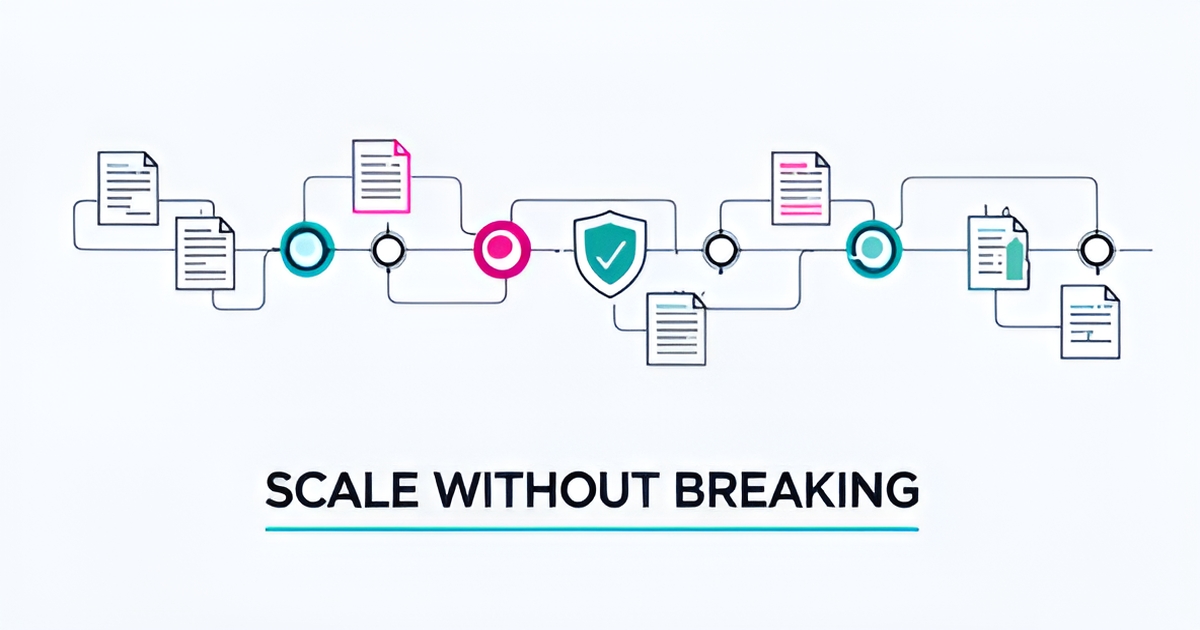
Scalability Considerations for Legal AI Document Workflows
Key Facts
- The global legal AI market is projected to grow from $1.4 billion in 2024 to $3.9 billion by 2030, according to Grand View Research.
- 59% of legal professionals cite handling large volumes of legal data as AI's single biggest value area, Thomson Reuters finds.
- 77% of legal professionals now use generative AI for document review, making it the industry's dominant AI use case, per Thomson Reuters.
- While 61% of legal professionals have adopted AI-assisted review, fewer than one-third have formal documentation protocols, Logikcull reports.
- An AmLaw100 firm's AI complaint response system cut associate time from 16 hours to 3-4 minutes, Harvard Law School interviews reveal.
- 96% of legal professionals demand confidential data safeguards and 90% demand explainable AI reasoning, Thomson Reuters research shows.
- 78% of corporate clients say AI-enabled quality improvements are essential, but only 6% believe most providers deliver them, according to Thomson Reuters.
Hire a team member that works 24/7 — for less than a part-time wage.
AI receptionists, SDRs, dispatchers and 99+ roles. Trained on your business, fully managed.
Not sure where to start? Ask our AI planner
The Document-Volume Problem: Why Legal Workflows Break at Scale
Every growing law firm eventually hits the same wall: the cases keep coming, but the documents multiply faster than the hours to review them. What worked at fifty cases a year collapses at five hundred — and the industry data shows firms know it.
When Thomson Reuters surveyed legal professionals, 59% cited handling large volumes of legal data more effectively as AI's single biggest value area. It's not a niche concern; it's the defining pressure of modern practice.
The market reflects it. Grand View Research identifies the challenge of managing large volumes of data and documents as a core driver of legal AI adoption, projecting the global market to grow from USD 1.4 billion in 2024 to USD 3.9 billion by 2030 — a 17.3% annual growth rate built substantially on document volume.
The problem isn't just quantity. Manual review degrades in three predictable ways as caseloads climb:
- Consistency erodes. A single workplace collaboration platform can generate millions of messages, files, and metadata records within months — a volume where human reviewers inevitably classify similar documents differently.
- Fatigue sets in. Reviewers working through document sets of that size make errors not from incompetence but from exhaustion, and those errors compound across a case.
- Costs become unsustainable. Linear staffing — hiring more reviewers for more documents — eats margins and still can't keep pace.
Yet most firms that adopt AI get stuck at the pilot stage. Harvard Law School interviews with AmLaw100 firms found that even elite practices run multiple pilots, iterate with vendors, and abandon use cases that fail — and the investment required to scale is "difficult for many mid-sized firms." The firms with the deepest pockets pull ahead while second-tier practices stall.
This is the gap AIQ Labs builds against: phased, milestone-based implementations that let a firm prove a single document workflow before expanding, rather than betting the practice on an enterprise rollout it can't fund. The scaling problem is real — but it's solvable when the pipeline is designed to grow with case volume from day one, not retrofitted after the pilot succeeds.
What Courts and Clients Actually Require from a Scaled Pipeline
A scaled legal document pipeline isn't judged by throughput alone. Courts, clients, and bar regulators now impose a set of non-negotiable requirements — and the gap between firms that meet them and firms that don't is widening fast.
The first requirement is human-in-the-loop oversight. ABA guidance makes human review of AI outputs mandatory, and as WashU School of Law puts it, the duty to review, correct, and approve final documents remains with the lawyer, not the algorithm. Any pipeline that scales without a human checkpoint on privilege calls and final filings fails this test by design.
The second requirement is a documented audit trail. Courts have affirmed AI-assisted review, but they scrutinize how the model was configured, what validation steps were taken, who approved classifications, and what the documented error rates were. As one analysis of court expectations notes, judges don't penalize teams for using AI — they penalize teams that can't account for what their AI did. Yet here lies the governance gap: while 61% of legal professionals report adopting AI-assisted review, fewer than one-third have formal documentation protocols. Audit trails must be built into the pipeline from day one, not retrofitted after a discovery dispute.
The third requirement is integration with existing case management systems. Tools that operate in isolation create data silos and duplication, undermining the very efficiency they promise. Both Clio's guidance and the ABA's evaluation criteria flag ease of integration as a core selection standard.
This is where pipeline architecture matters. AIQ Labs designs its legal document workflows with configurable human-in-the-loop escalation, complete audit logging, and validation layers built into the system itself — so governance scales with case volume rather than competing against it. Deep integration with existing case management platforms keeps document data flowing through one connected system instead of fragmenting across tools.
Trust expectations reinforce all three requirements. According to Thomson Reuters research, 96% of legal professionals demand confidential data safeguards, 94% demand grounding in authoritative content, and 90% demand explainable, defensible reasoning. Meanwhile, 78% of corporate clients say AI-enabled quality improvements are essential — but only 6% believe most providers deliver them, and 32% are reconsidering relationships with firms falling behind.
A scalable pipeline, then, must satisfy three audiences at once: courts that want explainability, clients that want quality, and regulators that want human accountability. Firms that architect these requirements into their workflows from the start scale with confidence; firms that treat them as afterthoughts scale their risk instead.
Ready to assess your document workflow against these requirements? Start the two-minute Fit Check at aiqlabs.ai/apply, then book a free 30-minute strategy call at aiqlabs.ai/book to map your pipeline's governance and scaling gaps with an AI engineer.
How Phased, Multi-Agent Pipeline Design Scales with Case Volume
Scaling a document workflow isn't just about processing more files faster — it's about doing so in a way courts, clients, and ethics boards can audit. Harvard Law School's interviews with AmLaw100 firms found that these firms scale AI by running multiple pilots, iterating on accuracy, and treating each pilot as a business process reengineering effort — with some use cases failing and being abandoned along the way (Harvard Law School CLP). That iterative reality matters for any firm designing pipelines.
AIQ Labs' company-stated approach mirrors this model. Its "Build in Milestones" structure splits each workflow into phases the firm approves and pays for as it ships — meaning a document pipeline can start with one high-volume task, prove its accuracy, then expand. This matters because Harvard's research shows AI investment tends to advantage financially strong firms while remaining "difficult for many mid-sized firms" (Harvard Law School CLP). Phased, pay-as-you-go deployment lowers that barrier.
On the architecture side, AIQ Labs states its pipelines use multi-agent LangGraph workflows — specialized agents handling extraction, summarization, and classification — wrapped in validation layers, guardrails, and audit trails, with MCP integration connecting to existing legal CRM and case management tools. These map directly against industry-validated requirements:
- Human oversight: ABA guidance mandates lawyer supervision of AI outputs, keeping the duty to review and approve final documents with the lawyer, not the algorithm.
- Defensibility: Courts accept AI-assisted review but scrutinize training, validation steps, and whether humans made privilege calls — fewer than one-third of adopters have formal documentation protocols despite 61% adoption.
- Integration: Tools must connect with existing case management systems to avoid data silos and unlock further time savings.
Honesty about constraints strengthens the case. GPT systems can only process a finite amount of text at a time — usually a few thousand words — so long contracts and multi-page filings may require piece-by-piece review (Washington University School of Law). Multi-agent pipelines help here by chunking documents across specialized agents, but the constraint is real, not solved. Similarly, TAR's scalability depends heavily on training-set quality and works best on structured, text-heavy documents, while generative AI handles greater data variety but is newer, less court-accepted, and prone to hallucinations (Clio).
The result is a pragmatic picture: phased deployment, built-in audit trails, and human-in-the-loop controls are what let a pipeline grow from a single document workflow to firm-wide volume — the same pilot-to-scale discipline AmLaw100 firms already practice, made accessible to firms that can't fund a seven-figure platform build.
Closing the Mid-Sized Firm Gap: A Practical Scaling Roadmap
Harvard Law School's Center on the Legal Profession found that AI investment "advantages those firms with the financial strength to make these investments" and will be difficult for many mid-sized firms — a direct competitive threat to second-tier practices. But the same research shows how large firms actually scale: pilot by pilot, one workflow at a time. Mid-sized firms can copy that playbook without the AmLaw100 budget.
The roadmap starts with a single high-volume workflow. Client intake and document review are the natural candidates — document review is already the dominant AI use case, with 77% of legal professionals using generative AI for it, and 59% citing the ability to handle large volumes of legal data as AI's top value area (Thomson Reuters). Pick the workflow that consumes the most billable hours today.
Then define success before you build. Harvard's interviews with AmLaw100 firms found pilots doubling as business process reengineering efforts, with firms iterating to improve accuracy and abandoning use cases that failed. Set concrete metrics upfront: hours saved per matter, error rates, time from intake to engagement letter. If the pilot doesn't clear them, stop — that's the model working, not failing.
From there, expand in phases. The firms that scale successfully treat AI as a sequence of proven wins, not a firm-wide rollout. A practical sequence looks like:
- Phase 1: Automate the single highest-volume workflow (intake or document review) with defined success metrics.
- Phase 2: Integrate the proven system with existing case management software to avoid data silos and duplication.
- Phase 3: Extend to adjacent workflows — summarization, contract data extraction, client communication.
- Phase 4: Establish governance, audit trails, and human-in-the-loop review as firm-wide standards.
That last phase matters more than most firms realize. Courts don't penalize teams for using AI; they penalize teams that can't account for what their AI did — yet fewer than one-third of legal professionals have formal documentation protocols despite 61% reporting AI-assisted review adoption (Logikcull). Building audit trails and validation steps in from the first pilot keeps scaling defensible.
The barrier, of course, is money and risk — which is where the payment structure changes the math. AIQ Labs structures engagements three ways: Start Monthly (one AI employee on a flat monthly plan you can pause or adjust), Build in Milestones (pay per phase, stop anytime, keep everything built so far), and Own It Outright (full ownership of code, agents, and data). The milestone model mirrors the pilot-then-expand approach the research validates: each phase ships, gets measured against your metrics, and only then does the next one get funded.
For a mid-sized firm, that converts a capital-intensive bet into a sequence of small, reversible decisions — closing the gap Harvard identified, one workflow at a time.
If you want to see where your firm's document workflow bottleneck actually is, start the two-minute Fit Check at aiqlabs.ai/apply and book a free 30-minute strategy call at aiqlabs.ai/book. It's a working session with an engineer, not a sales pitch — and if there isn't a clear win, you'll hear that too.
Still paying for 10+ subscriptions that don’t talk to each other?
We build custom AI systems you own outright. No vendor lock-in. Full control.
Not sure where to start? Ask our AI planner
Frequently Asked Questions
Why do legal document workflows break down as a law firm grows?
Do courts allow AI-assisted document review?
Is human review still required if we use AI for document processing?
How can a mid-sized firm afford to scale AI without an AmLaw100 budget?
What should we automate first when scaling a legal document workflow?
Can AI actually handle long contracts and multi-page filings?
Scale Isn't a Bet — It's a Sequence
Document volume is the defining pressure on modern legal practice, and the firms that survive it will be the ones whose pipelines grow with caseloads — not against them. The path forward isn't a firm-wide rollout or a seven-figure platform build; it's the pilot-then-expand discipline AmLaw100 firms already practice: automate one high-volume workflow, measure it against defined success metrics, integrate it with your case management systems, and extend from there with audit trails and human oversight built in from day one. With 32% of corporate clients reconsidering relationships with firms falling behind on AI-enabled quality, per Thomson Reuters, waiting is its own risk. That's where AIQ Labs' Build in Milestones model changes the math: each phase ships, gets measured, and only then gets funded — a sequence of small, reversible decisions instead of one capital-intensive bet. Want to know where your document workflow bottleneck actually is? Start the two-minute Fit Check at aiqlabs.ai/apply and book a free 30-minute strategy call at aiqlabs.ai/book. It's a working session with an engineer, not a sales pitch — and if there isn't a clear win, you'll hear that too.
Make AI your competitive advantage — not just another tool.
Strategy, implementation and ongoing optimization. One partner, end to end.
Not sure where to start? Ask our AI planner