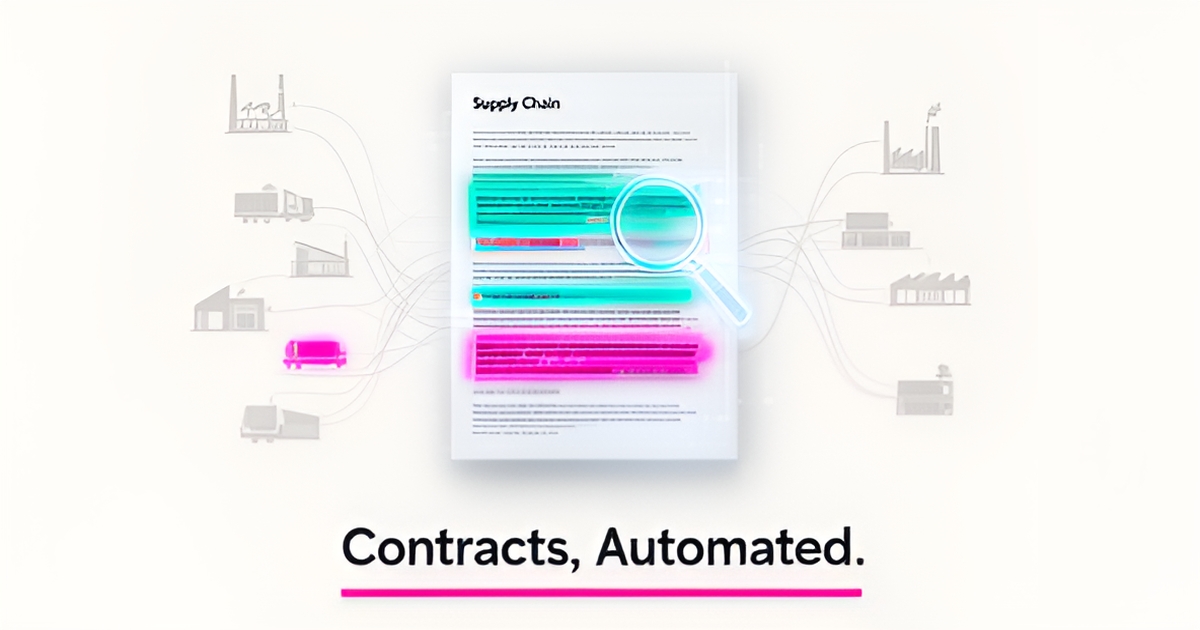
Legal Document Automation Using AI For Supply Chain Contracts
Key Facts
- Lawyers spend 40–60% of their time drafting and reviewing contracts, with legal teams averaging 3 hours per contract, per Thomson Reuters research.
- The AI contract management market is projected to nearly triple from $1.51B in 2025 to $4.25B by 2030, with procurement named a core adoption driver.
- A financial services firm cut document review time by 50–75%, saving up to $200,000 annually, according to documented case results.
- Benchmark testing of 3,282 contracts found general-purpose LLMs failed on precise language, numeric thresholds, and absence checks, per LegalOn's contract review analysis.
- A semiconductor supplier cut NDA reviews from 2 hours to 30 minutes, and a hospital system reduced contract review time by 75%, reported customer outcomes show.
- Miller & Martin attorneys warn that pasting confidential contracts into public AI models is 'the digital equivalent of publishing it,' risking trade secret and privilege loss.
- Enterprise contract platforms run $30,000 to $100,000 per year with multi-month implementations, pricing benchmarks indicate.
Hire a team member that works 24/7 — for less than a part-time wage.
AI receptionists, SDRs, dispatchers and 99+ roles. Trained on your business, fully managed.
Not sure where to start? Ask our AI planner
The Contract Review Bottleneck Costing Supply Chain Teams
Every supply chain contract sitting in the review queue is costing money twice: once in the hours it takes to read it, and once in the risk of what slips through unread. For procurement teams managing hundreds of supplier agreements, that double cost compounds fast.
The scale of the problem is well documented. According to Thomson Reuters research, lawyers spend 40–60% of their time drafting documents and reviewing contracts, and legal teams average roughly 3 hours reviewing a single contract. Multiply that across a procurement portfolio of supplier MSAs, logistics agreements, and service contracts, and the math becomes uncomfortable.
When in-house capacity runs out, the work goes to outside counsel — and costs balloon accordingly. Enterprise contract platforms can run $30,000 to $100,000 per year with multi-month implementations, pushing mid-sized supply chain teams back to hourly billing. As one contracts paralegal manager put it, reducing reliance on outside counsel alone realized "thousands of dollars in savings" for her team.
The documented upside of fixing this is substantial:
- A financial services firm cut document review time by 50–75%, saving up to $200,000 annually
- A Cincinnati hospital system reduced contract review time by 75%
- A semiconductor supplier cut NDA reviews from 2 hours to 30 minutes
These aren't projections — they're reported outcomes from teams that stopped treating manual review as a fixed cost.
The risk side is just as expensive as the labor side. As contract review analysis bluntly puts it, "One missed liability cap or overlooked auto-renewal clause can cost an organization much more than a year of software fees." A liability cap that silently deviates from your playbook on a high-volume supplier agreement, or an auto-renewal that locks you into unfavorable freight rates for another term, can erase a year of procurement savings overnight.
Human reviewers miss these because volume forces triage: experienced contract managers skim for the clauses they know matter most, and everything else gets a lighter pass. AI-assisted review flips that dynamic by flagging risks, deadlines, and deviations from approved language at machine speed — with humans making the final call on what matters commercially.
That's the model AIQ Labs builds toward: automated first-pass review that surfaces the liability caps, renewal dates, and non-standard terms, paired with human-in-the-loop controls so nothing ships without a qualified decision behind it. For supply chain teams, the question isn't whether contract review can be automated — it's how much the current bottleneck is already costing them.
Why Purpose-Built AI Beats Pasting Contracts into ChatGPT
Pasting a supplier agreement into ChatGPT feels like a shortcut — until the model misses a liability cap or invents a renewal clause. That's not a hypothetical risk: benchmark testing of 3,282 contracts across 21 precision-critical guidelines found that general-purpose LLMs "reliably found clauses, but failed on precise language, numeric thresholds, multi-part requirements, cross-references, and absence checks."
The problem isn't intelligence — it's design. General-purpose models are built for open-ended conversation, not deterministic contract analysis. Docusign notes that these tools "lack determinism, leading to inconsistent interpretations of the same clause across different runs." For a supply chain team reviewing thousands of supplier agreements, that inconsistency is a liability, not a convenience.
Purpose-built contract AI works differently. Instead of free-form interpretation, it performs structured, constrained analysis against your own standards. According to Thomson Reuters' buyer's guide, these systems extract clauses, obligations, deadlines, and risks; identify problematic terms like force majeure, indemnification, and termination by meaning and context; and enable bulk review of thousands of agreements in minutes.
In procurement specifically, AI contract tools go further than review alone. They can:
- Compare contract language against approved templates and negotiation playbooks, flagging deviations automatically
- Structure contract, invoice, and purchase order data to detect non-compliance issues across documents
- Compare payment terms and detect duplicates across the full supplier portfolio
- Automate creation, review, and approval workflows to cut cycle times
The market is moving fast in this direction. The AI in contract management market is projected to grow from $1.51B in 2025 to $4.25B by 2030, at roughly 23% CAGR, with procurement named as a core adoption driver. DocuSign launched the industry's first purpose-built AI contract agent in April 2025, initially targeting procurement and sales workflows — a clear signal that specialized, grounded AI is where contract automation is heading.
This is exactly the gap custom-built systems fill. AIQ Labs approaches contract review the way the research says it should be built: AI trained on the client's own playbooks and templates, constrained to structured analysis, with human-in-the-loop escalation and full audit trails — not a chatbot asked to summarize a 40-page MSA. The result combines the speed of automation with the determinism that general-purpose tools structurally can't provide.
The stakes justify the rigor. As one analysis bluntly put it, "one missed liability cap or overlooked auto-renewal clause can cost an organization much more than a year of software fees." For supply chain teams, that's the real argument: precision beats convenience when the documents govern millions in spend.
Human-in-the-Loop, Security, and Audit Trails: The Non-Negotiables
Every credible source on AI contract review converges on one point: the technology supports legal professionals, it does not replace them. Attorneys at Miller & Martin put it bluntly — current AI platforms are "not a viable replacement for competent legal counsel (yet)" — and note that AI has no understanding of a business's risk tolerance, no strategic insight into negotiating position, and zero accountability for the outcome.
That caution is well-founded. AI models can hallucinate, citing non-existent laws or inventing regulatory standards, and models trained on stale data may produce legally incorrect answers given how frequently regulations change across jurisdictions. This is why human-in-the-loop review isn't a nice-to-have; it's a legal risk requirement for any supply chain contract automation deployment.
Security is the second non-negotiable. Miller & Martin warns that inputting confidential information into a public AI model is "the digital equivalent of publishing it," causing irreversible loss of trade secret protection and a potential waiver of legal privilege. Buyers should verify vendors hold SOC 2 Type II or ISO 27001 certifications and confirm that models never share or train on confidential client data. Maintaining documentation of how and when AI was used in drafting also demonstrates quality control and helps resolve disputes — which is why market research cites increasing compliance requirements and the need for audit trails as deployment drivers in regulated industries.
In practice, these requirements translate into concrete architecture. A purpose-built system — like those AIQ Labs constructs for legal and supply chain workflows — should include:
- Validation layers that check every AI action before execution, with hard guardrails customized per role
- Configurable human escalation when a situation exceeds the AI's authority, so attorneys review flagged clauses rather than raw drafts
- Complete audit logging of every analysis, edit, and approval for compliance review and dispute resolution
- Verified security certifications and an explicit guarantee that client data is never used to train models
The distinction matters because general-purpose AI tools "lack determinism, leading to inconsistent interpretations of the same clause across different runs," according to Docusign. Purpose-built, constrained systems grounded in a client's own playbooks and templates deliver the consistency and auditability that precision-critical contract review demands.
The right mental model for supply chain teams: AI handles the volume — extracting obligations, deadlines, and risk clauses across thousands of agreements — while legal professionals handle judgment. Speed without oversight is a liability, not an advantage.
How to Implement AI Contract Review You Actually Own
The biggest reason AI contract review projects fail isn't the technology — it's buying a generic tool that doesn't know how your business reviews contracts. Purpose-built systems exist for a reason: in one 2026 benchmark of 3,282 contracts, general-purpose LLMs reliably found clauses but failed on precise language, numeric thresholds, multi-part requirements, and absence checks. The fix is to build the system around your own legal operation, not around a vendor's assumptions.
That starts with grounding. A contract review system you actually own is trained on your playbooks, your templates, and your historical contract corpus — so when it flags a limitation-of-liability cap or an auto-renewal clause, it's comparing against standards your legal team already approved. This grounding is what delivers the determinism that off-the-shelf tools lack; as Docusign notes, general-purpose AI tools "often lack determinism, leading to inconsistent interpretations of the same clause across different runs". A system anchored to your corpus produces consistent output run after run, which is exactly what auditability requires.
Next, integration. The review system should connect directly to your procurement, CRM, and document management platforms so contracts flow in and results flow out without manual re-entry. This mirrors how AIQ Labs builds systems generally — deep two-way integrations with tools like HubSpot, Salesforce, and document systems, so the AI acts inside your existing workflow rather than alongside it.
Then phase the rollout deliberately:
- Start with one high-volume, lower-risk contract type — NDAs or standard MSAs — where volume makes the ROI obvious and risk is contained.
- Configure the review rules against your playbook for that contract type, with human-in-the-loop review on every flagged issue before anything is finalized.
- Measure cycle-time reduction against your baseline — legal teams spend an average of 3 hours reviewing a single contract, so even partial automation shows up fast.
- Expand to more complex agreement types only after the first phase proves out accuracy and adoption.
Ownership matters as much as architecture. When you license a platform like Harvey at roughly $30,000+ per month or Ironclad at $30,000–$100,000 per year, the playbook logic lives in the vendor's system. Under a Build in Milestones or Own It Outright model — the approach AIQ Labs uses for client systems — the code, agents, and data transfer to you, so the system evolves with your contracts instead of your contracts conforming to it.
Finally, insist on the compliance layer from day one: complete audit trails logging how and when AI was used, human escalation on every material decision, and no training on your confidential data. Practitioners warn that feeding confidential contracts into a public model is "the digital equivalent of publishing it" — an irreversible loss of trade secret protection and potential waiver of legal privilege. A system built this way, informed by AIQ Labs' compliance-first work on its collections platform and legal CRM integrations, is one your legal team will actually trust.
If you want to see whether this path fits your contract volumes and systems, start with the two-minute Fit Check at aiqlabs.ai/apply, then a free 30-minute strategy call at aiqlabs.ai/book — a working session with an AI engineer, not a sales pitch.
Still paying for 10+ subscriptions that don’t talk to each other?
We build custom AI systems you own outright. No vendor lock-in. Full control.
Not sure where to start? Ask our AI planner
Frequently Asked Questions
Can AI actually review supply chain contracts, or does a human still need to check everything?
Why can't I just paste contracts into ChatGPT instead of using a specialized tool?
How much time and money can AI contract review actually save?
Is it safe to upload confidential supplier contracts to an AI tool?
What does enterprise contract review software cost?
How should we roll out AI contract review without disrupting procurement operations?
Your Contract Queue Is Already Costing You — Here's What to Do About It
The evidence points one direction: manual contract review is a bottleneck with a measurable price tag, and general-purpose AI isn't the fix — purpose-built systems grounded in your own playbooks, with human-in-the-loop controls, security certifications, and audit trails, are. Teams that made the switch cut review times by 50–75% and saved up to $200,000 annually, per Thomson Reuters — while protecting themselves from the missed liability caps and auto-renewals that quietly erode procurement savings. The practical path forward is phased: start with one high-volume, lower-risk contract type, measure cycle-time gains against your baseline, and expand only after accuracy proves out. AIQ Labs builds these systems the way the research says they should be built — constrained analysis trained on your standards, human escalation on every material decision, and full ownership of the code and data. If you want to know whether this fits your contract volumes, start with the two-minute Fit Check at aiqlabs.ai/apply, then book a free 30-minute strategy call at aiqlabs.ai/book — a working session with an AI engineer, not a sales pitch.
Make AI your competitive advantage — not just another tool.
Strategy, implementation and ongoing optimization. One partner, end to end.
Not sure where to start? Ask our AI planner