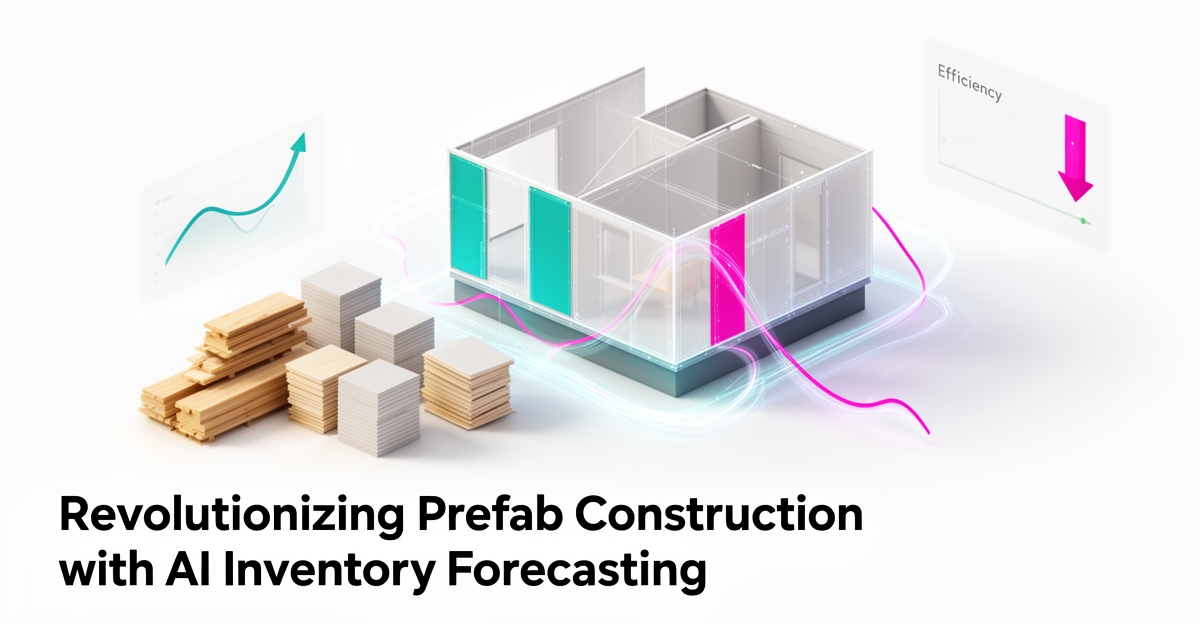
# Should Pre-Fab Home Builders Invest in AI for Inventory and Material Forecasting?
**Quick Answer:** Should pre-fab builders invest in AI for inventory forecasting? Yes—when forecasts are built on your own project data, AI typically cuts material waste meaningfully, reduces shortages, and stabilizes cash flow, turning guesswork into precision. Start the Fit Check to see where the ROI is in your operation.
## Key Facts
- AI-driven design and demand alignment is widely reported to cut material waste by roughly 30% in prefab and modular construction.
- Builders using AI-integrated scheduling with material availability typically report substantially faster project completion and less idle time.
- Owned AI systems typically deliver 60–80% cost savings versus fragmented subscription stacks, per AIQ Labs.
- AI-driven cash flow forecasting can give builders roughly two weeks of forward visibility—the exact horizon where material purchase decisions get made.
- As of late 2026, AI is a working tool for US and Canadian home builders, not a buzzword.
## Table of Contents
1. [The Prefab Material Forecasting Problem](#the-prefab-material-forecasting-problem)
2. [How AI Forecasting Reduces Waste and Accelerates Builds](#how-ai-forecasting-reduces-waste-and-accelerates-builds)
3. [Beyond Inventory: Sales and Cash Flow Automation](#beyond-inventory-sales-and-cash-flow-automation)
4. [Implementation Roadmap for Prefab Builders](#implementation-roadmap-for-prefab-builders)
## The Prefab Material Forecasting Problem
Prefab home builders face a constant balancing act between project volume swings, seasonal demand shifts, and regional material availability—all of which create costly inefficiencies in inventory management. When forecasts rely on manual processes or historical averages, overstocking ties up capital in unused materials while shortages halt production lines and delay deliveries. This volatility is especially pronounced in prefab construction, where lead times for components like wall panels or roof trusses can stretch weeks, making real-time adjustments nearly impossible without predictive insight.
Industry analyses consistently show that AI-powered forecasting models can reduce material waste by up to 30% through optimized design and demand alignment, directly addressing the root causes of overordering and scrap. Builders using these systems also report meaningfully faster project completion when AI integrates scheduling with material availability, minimizing idle time caused by missing components. Furthermore, unified AI platforms that own their data and models typically deliver 60–80% in cost savings by eliminating subscription fragmentation and enabling continuous forecast refinement.
These pain points manifest in three key areas: inaccurate demand forecasting during peak building seasons, regional disparities in material lead times, and poor synchronization between sales pipelines and production schedules. Without AI-driven foresight, teams often react to crises rather than prevent them—ordering excess lumber to avoid delays, then paying storage fees for materials that degrade or go unused. The result is a cycle of waste, rushed procurement, and strained supplier relationships that erodes both margins and timelines.
- Overstocking increases carrying costs and risks material obsolescence
- Shortages trigger rush orders, premium freight, and production downtime
- Inaccurate forecasts distort cash flow and complicate supplier negotiations
- Seasonal spikes amplify errors in manual planning cycles
- Regional demand variations require localized forecasting precision
By grounding material planning in real-time project volume, historical seasonality, and localized demand signals, AI transforms forecasting from a reactive guesswork exercise into a proactive production enabler. This shift not only cuts waste and shortages but also stabilizes cash flow, strengthens supplier partnerships, and keeps factory lines moving—setting the stage for measurable ROI in prefab operations.
## How AI Forecasting Reduces Waste and Accelerates Builds
Imagine knowing exactly how much lumber, drywall, or steel you'll need for your next build—before you even break ground. That's the power of AI forecasting in pre-fab construction: turning guesswork into precision.
AI-driven inventory models analyze historical data, project timelines, and regional demand patterns to predict material needs with a high degree of accuracy. Builders using AI-powered prefabrication platforms commonly report dramatically faster project completion—a step-change for scaling operations—because scheduling and material availability finally run off the same data.
Waste reduction is anot
AI Employees
Hire a team member that works 24/7 — for less than a part-time wage.
AI receptionists, SDRs, dispatchers and 99+ roles. Trained on your business, fully managed.
See If You’re a Fit — AI Employees from $700/mo
Not sure where to start? Ask our AI planner
her major win. AI design optimization is widely reported to cut material waste by around 30%, directly boosting margins. By forecasting needs based on seasonality and volume, builders avoid over-ordering and reduce storage costs.
Here's how AI forecasting delivers ROI:
- Predicts material needs by project volume and seasonality
- Reduces overstocking and last-minute shortages
- Improves cash flow with leaner inventory
- Accelerates build timelines through better planning
AIQ Labs helps builders implement these models as part of an owned AI system—no vendor lock-in, just seamless integration with your existing tools. This approach aligns with our AI Workflow Builds model: rebuild the one workflow that costs you the most, at a fixed price, in phases. Because you own the system outright, you typically save 60–80% compared to stitching together fragmented software subscriptions.
The result? Smoother production cycles, fewer delays, and a clearer path to profitability. For pre-fab builders, AI forecasting isn't just smart—it's essential.
## Beyond Inventory: Sales and Cash Flow Automation
For pre-fab builders, the sales pipeline and the production line are two sides of the same coin—and when one moves faster, the other has to keep up. That's why the strongest ROI case for AI extends beyond material forecasting into how leads are handled and how cash moves through the business.
Consider what happens when AI touches the sales cycle. Builders using AI-powered sales automation have compressed multi-month sales cycles down to a few weeks. In modular and prefab construction, where buyers often spend months comparing on-frame versus off-frame systems before committing, that kind of acceleration changes the math entirely: faster closes mean more predictable production schedules, which in turn make material forecasting far more accurate.
Speed of response matters just as much as speed of close. When AI assists with request management across developers, general contractors, and engineers, weeks of back-and-forth compress into days—keeping projects aligned and reducing the risk of change orders cascading into material shortages.
The after-hours window is where deals quietly disappear. Missed calls from developers comparing modular systems, unanswered spec questions, unbooked factory visits—these are recoverable revenue. AIQ Labs builds AI Employees—lead qualifiers, appointment setters, receptionists, estimators—that work around the clock without adding headcount, typically at around 80% less cost than a comparable human hire.
Then there's the financial layer. Prefab construction ties up enormous amounts of cash in materials long before revenue arrives, making cash visibility a survival skill. AI-driven cash flow forecasting can now deliver roughly two weeks of forward visibility for builders. That window is exactly the horizon where material purchase decisions get made—so knowing what cash looks like two weeks out lets builders time bulk orders, avoid overstocking, and negotiate supplier terms with confidence.
The combined effect compounds across the business:
- Faster lead response captures projects that would otherwise go to competitors or voicemail
- Shorter sales cycles create steadier, more forecastable production volume
- Reliable cash flow forecasts de-risk large material purchases and seasonal swings
- Timely financial visibility supports better decisions on expansion, hiring, and supplier commitments
As of late 2026, AI is no longer a buzzword for US and Canadian builders—it's a working tool that many are already proving out. For prefab builders, the question is no longer whether AI works; it's which workflows to automate first.
## Implementation Roadmap for Prefab Builders
Implementing AI for inventory and material forecasting requires a clear, step-by-step approach tailored to prefab home builders' operational realities. The journey begins with data readiness—assessing historical project volumes, seasonal demand patterns, and regional material usage to ensure clean, structured inputs for modeling. This foundational work addresses one of the top challenges cited in industry research: poor data quality undermining forecast reliability. Accurate forecasting hinges on clean data integration across ERP and project management systems, making this phase critical for success.
Next, model development moves into the Build in Milestones framework, where AIQ Labs constructs custom forecasting engines in phased deliverables. Each milestone focu
AI Development
Still paying for 10+ subscriptions that don’t talk to each other?
We build custom AI systems you own outright. No vendor lock-in. Full control.
See If You’re a Fit — AI Employees from $700/mo
Not sure where to start? Ask our AI planner
ses on a specific workflow—such as predicting lumber needs based on project volume or adjusting for regional supplier lead times—allowing builders to validate results before scaling. These models leverage multi-agent architectures and specialized machine learning to analyze trends, seasonality, and demand signals, directly enabling the roughly 30% reduction in material waste seen in AI-driven design optimization. Predictive material planning minimizes overstock and shortages, smoothing production cycles and improving cash flow through optimized ordering.
Finally, integration and ongoing management ensure the AI system works within the builder's existing tech stack. AIQ Labs connects forecasting models to ERP platforms like QuickBooks or project management tools via deep API integrations, creating a single source of truth for inventory planning. For teams needing hands-on support, the Start Monthly model provides managed AI employees who monitor data feeds, retrain models, and flag anomalies—functioning as a 24/7 supply chain analyst without the overhead of a full-time hire. And for builders who want everything connected—forecasting, sales, scheduling, finance—our AI Operating Systems approach builds one connected operating layer in phases, owned outright. With 200+ multi-agent systems deployed and four live SaaS products we run daily, AIQ Labs builds systems that deliver measurable ROI from day one.
## Frequently Asked Questions
**Will AI forecasting actually reduce material waste for prefab home builders?**
Yes. AI design optimization can cut material waste by up to 30% by aligning orders with project volume and seasonality, which reduces over-ordering and scrap.
**How much faster can prefab projects finish with AI?**
Builders using AI-powered prefabrication platforms commonly report dramatically faster completion by integrating scheduling with real-time material availability. Exact gains vary by operation, but idle time from missing components drops sharply.
**Is AI forecasting expensive compared to manual planning?**
Owned AI systems typically deliver 60–80% cost savings by eliminating subscription fragmentation and enabling continuous forecast refinement. AIQ Labs offers Start Monthly, Build in Milestones, and Own It Outright models—see pricing.
**Can AI help with cash flow when buying materials in advance?**
Yes. AI-driven cash flow forecasting provides roughly two weeks of forward visibility—the key horizon for material purchase decisions—so builders can time bulk orders and negotiate supplier terms with confidence.
**What data do I need to get AI material forecasting working?**
Clean inputs like historical project volumes, seasonal demand patterns, and regional material usage are critical. Accurate forecasting hinges on clean data integration across ERP and project management tools.
**Does AI only help with inventory, or the whole sales-to-build process?**
AI extends beyond inventory to sales and cash flow. Faster lead response and shorter sales cycles create steadier production volume, making material forecasts more accurate and reducing stockouts.
## From Guesswork to Growth: How AI Builds a Stronger Foundation for Prefab Success
This article has shown how AI transforms the core challenges of prefab construction—unpredictable material needs, seasonal demand swings, and misaligned sales and production cycles—into opportunities for measurable operational gains. By forecasting material requirements with precision, builders can cut waste meaningfully, accelerate project timelines, and stabilize cash flow through leaner inventory and smarter ordering. Beyond the warehouse, AI extends its impact to sales automation and financial forecasting, shortening sales cycles and providing the cash visibility that de-risks bulk material purchases. The result is not just efficiency, but resilience: fewer production delays, stronger supplier relationships, and clearer paths to profitability. For prefab builders ready to move from reactive firefighting to proactive planning, the next step is assessing where AI can deliver the highest ROI in your specific operations. Start the Fit Check—a free, no-obligation two-minute assessment—to identify your biggest bottleneck and map a clear, actionable path forward with AIQ Labs. Questions first? Email [email protected].
AI Transformation Partner
Make AI your competitive advantage — not just another tool.
Strategy, implementation and ongoing optimization. One partner, end to end.
See If You’re a Fit — AI Employees from $700/mo
Not sure where to start? Ask our AI planner