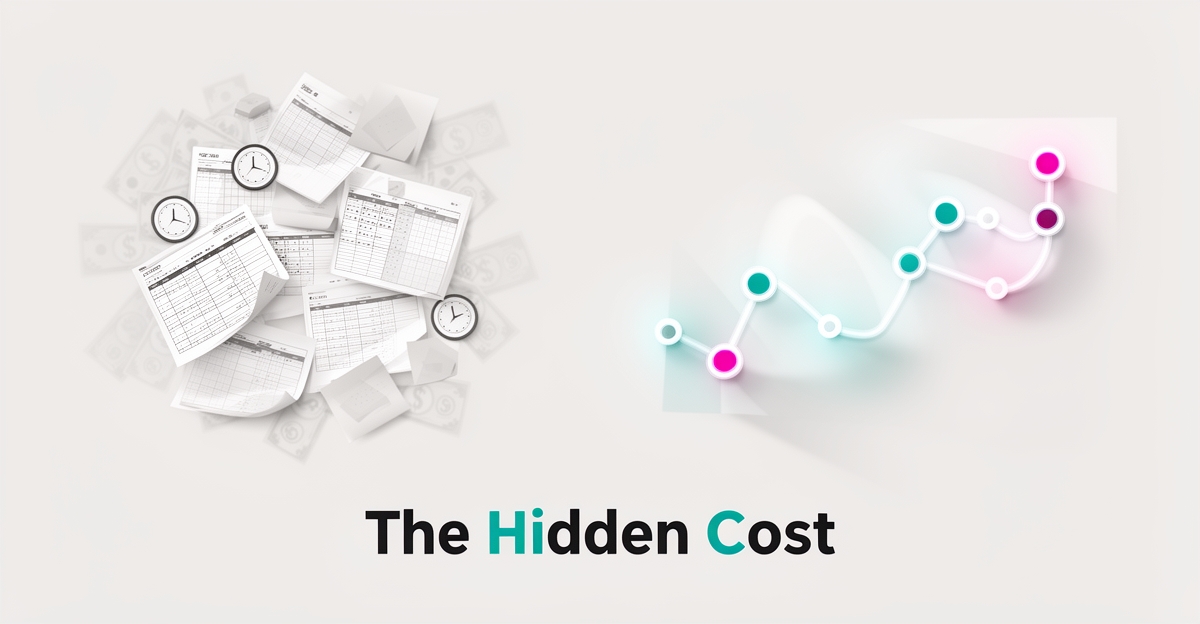
The Hidden Cost of Manual Move Coordination — And How AI Can Fix It
Key Facts
- Businesses relying on manual processes can lose tens of thousands of dollars annually to inefficiencies according to industry research
- Manual data entry errors typically occur at roughly a 1% rate, with each fix carrying real cost based on operational analysis
- Staff spending 90 minutes daily on manual tasks can incur $13,125 in yearly labor costs at a $35/hour rate
- AI can typically automate 65% or more of repetitive data and decision workflows per workflow automation studies
- AI implementation has been associated with meaningful gains in customer satisfaction in deployed solutions
- Manual quoting by sales reps can cost companies tens of thousands annually in labor at roughly 2 hours per quote
Hire a team member that works 24/7 — for less than a part-time wage.
AI receptionists, SDRs, dispatchers and 99+ roles. Trained on your business, fully managed.
Not sure where to start? Ask our AI planner
The Hidden Financial Drain of Manual Dispatch Coordination
Manual move coordination drains more than just time—it silently erodes profitability through cascading inefficiencies that rarely show up on balance sheets. Dispatch teams spend countless hours reconciling schedules, chasing confirmations, and correcting avoidable mistakes, all while managing the pressure of real-time customer expectations. This constant firefighting masks the true financial toll: businesses relying on manual processes can lose tens of thousands of dollars annually—industry estimates often land in the $50,000 to $120,000 range—according to industry research. These losses stem not from dramatic failures, but from the accumulation of small delays, miscommunications, and rework that compound daily.
The hidden costs manifest in tangible ways: misrouted trucks, missed pickup windows, and frustrated clients who may not return. Each data entry error—occurring at an estimated 1% rate—carries a real cost to fix, turning routine administrative tasks into expensive liability. When staff spend 90 minutes daily on manual coordination, the direct labor cost alone can reach $13,125 per employee yearly, based on a $35/hour rate. Over time, this repetitive burden contributes to burnout, turnover, and diminished morale, further increasing hidden expenses through recruitment and training cycles.
- Delayed pickups disrupt downstream scheduling and erode customer trust
- Miscommunication between drivers, dispatchers, and clients creates avoidable rework
- Manual data entry errors trigger invoicing disputes and payment delays
- Staff fatigue from repetitive tasks reduces responsiveness during peak demand
- Workarounds and shadow systems emerge, fragmenting operational visibility
AIQ Labs addresses these challenges by transforming dispatch coordination from a reactive, error-prone function into a streamlined, intelligent workflow. Through AI Employees and integrated automation, businesses gain real-time visibility, predictive scheduling, and error reduction—turning a chronic cost center into a source of operational resilience. The shift isn't just about saving time; it's about reclaiming the margin lost to preventable friction.
Why Systems Alone Fail and Manual Workarounds Persist
Despite investments in ERP, WMS, and TMS platforms, many organizations still grapple with manual coordination because these systems operate in silos without shared interpretation. As noted in industry analysis, the architectural gap leaves dispatch teams interpreting fragmented data from multiple sources, forcing human intervention to reconcile discrepancies. This disconnect persists even when software is present, as systems reflect only slices of reality while dispatch lives in between, creating a reliance on workarounds that undermine technological investments. Research highlights this structural flaw, explaining why automation alone fails to eliminate manual burden when data isn't unified or actionable across platforms.
Email-based approvals exacerbate these inefficiencies, introducing delays that ripple through operations. Purchase order approvals can stall for 2-3 days due to reliance on threaded email chains that lack real-time visibility or automated routing. This lag directly impacts pickup scheduling and resource allocation, turning what should be a streamlined handoff into a bottleneck. Meanwhile, sales representatives often spend roughly 2 hours per quote on manual preparation, a task that consumes significant time without guaranteeing accuracy or speed. When scaled across teams, this effort can translate to tens of thousands of dollars in annual labor costs per company, according to the same analysis. These figures reveal how manual quoting, though seemingly routine, becomes a substantial drain on productivity.
The cumulative effect of these limitations is a cycle of reactive fixes rather than proactive optimization. Teams develop informal processes — spreadsheets, sticky notes, and ad-hoc check-ins — to fill the gaps between systems, but these workarounds are error-prone and difficult to scale. Manual data entry, for instance, carries an estimated 1% error rate, with each mistake adding cost to correct, further inflating operational expenses. Such hidden costs accumulate quietly, eroding profitability despite the presence of digital tools. Without a layer of intelligence that interprets, connects, and acts on data across platforms, organizations remain trapped in a cycle where technology enables partial automation but human labor continues to bear the coordination burden. AIQ Labs addresses this gap by building systems that unify data flow and enable real-time decision-making, reducing dependence on manual interpretation.
How AI Performance Monitoring Eliminates Coordination Waste
Every delayed pickup and miscommunicated job lives in the gap between systems that don't talk to each other. The problem is architectural: each tool reflects only a slice of reality, dispatch lives in between, and no shared interpretation exists, as one analysis of manual dispatch coordination puts it. AI performance monitoring closes that gap by continuously reconciling data across disparate platforms instead of waiting for a human to notice the discrepancy.
This matters because manual oversight is expensive and error-prone. Manual data entry carries an estimated 1% error rate, and each mistake costs real money to fix — a quiet drain that compounds across thousands of records. Businesses relying on manual processes can lose tens of thousands of dollars annually to inefficiencies, errors, and missed opportunities, according to research on hidden process costs.
AI systems attack this waste on three fronts:
- Reconciling data from CRM, scheduling, dispatch, and billing systems into a single, real-time view of operations.
- Flagging anomalies proactively — a delayed pickup, a stalled invoice, a double-booked crew — before customers feel the impact.
- Automating the repetitive data and decision workflows that consume staff hours, with AI capable of handling 65% or more of these tasks.
- Tracking KPIs continuously, so performance trends surface in dashboards rather than in end-of-month surprises.
The throughput difference is fundamental. Manual work is limited by human capacity and time, while AI delivers high throughput and continuous operation, processing vast datasets with consistency that improves through feedback loops. Where a human coordinator can only watch so many jobs at once, an AI monitoring layer never stops watching.
The customer-facing results are measurable. Companies that implemented AI-powered solutions have reported meaningful improvements in customer satisfaction scores and repeat business rates after system implementation. Faster, more accurate coordination translates directly into customers who trust the operation enough to come back.
This is where real-time visibility becomes the deciding factor. Custom KPI dashboards that consolidate every business system into one view — like the dashboards AIQ Labs builds for clients — turn monitoring from a periodic chore into an always-on capability. When performance data flows continuously, errors get caught at the source, and the hidden costs of manual coordination stop accumulating silently.
The outcome is a shift in human effort, not its elimination. Staff stop reconciling conflicting systems and start handling the judgment calls that actually require a person — while the AI layer keeps the operational picture accurate around the clock.
Building an AI-Powered Move Operation With AIQ Labs
Building an AI-powered move operation starts with a clear audit of where manual coordination is draining resources. Businesses relying on manual processes lose real money every year to miscommunication, delayed pickups, and staff burnout from repetitive tasks like data entry and quote preparation. AIQ Labs begins this transformation with a discovery phase that maps current workflows, identifies high-impact automation targets, and projects ROI—laying the foundation for a production-ready system. For many moving companies, the fastest win is a focused AI Workflow Build: rebuild the one workflow that costs the most, at a fixed price, delivered in phases.
The implementation follows AIQ Labs' three entry points: AI Employees (managed AI staff across 99+ roles, at roughly 80% less cost than a human hire), AI Workflow Builds, and AI Operating Systems — one connected operating layer, built in phases and owned outright. Through the Start Monthly, Build in Milestones, or Own It Outright models, clients receive a tailored fix—such as automating dispatch coordination, integrating CRM and scheduling tools, or enabling real-time load tracking—delivered in phases with approval at each stage. This approach eliminates siloed systems by creating a single source of truth across operations, reducing the need for manual intervention when tools disagree or lag behind real-time events. Clients own the code, agents, and data outright, avoiding vendor lock-in while gaining full control over future development and customization.
Once deployed, AI Employees take on roles like Dispatcher or Service Coordinator, working 24/7 to manage communications, optimize routing, and update statuses across channels—reducing the errors that make manual data entry so expensive. Real-time KPI dashboards provide visibility into performance metrics like on-time pickup rates and response latency, enabling continuous optimization. With monitoring, retraining, and improvements included in the Start Monthly model, businesses gain an AI workforce that scales with demand—proving that AI isn't just about replacing manual work, but augmenting human teams to focus on higher-value decisions while the system handles execution with consistency and speed. To explore how this applies to your move operation, start the 2-minute Fit Check and book a free 30-minute strategy call to map your biggest bottleneck and identify high-ROI automation opportunities.
Still paying for 10+ subscriptions that don’t talk to each other?
We build custom AI systems you own outright. No vendor lock-in. Full control.
Not sure where to start? Ask our AI planner
Frequently Asked Questions
How much does manual dispatch coordination actually cost my business?
Are data entry mistakes really that expensive?
Why do we still have manual workarounds even with ERP, WMS, and TMS?
Can AI really handle most of the repetitive dispatch work?
What customer impact do companies see after switching to AI coordination?
How do I start fixing manual coordination without a huge upfront commitment?
Stop Paying for the Gaps Between Your Systems
Manual move coordination doesn't fail loudly — it leaks profit daily through misrouted trucks, missed pickups, rework from data entry errors, and staff burning hours reconciling siloed systems. With businesses potentially losing tens of thousands of dollars annually to these inefficiencies according to industry research, the cost is real even when the problems look routine. AI performance monitoring closes the architectural gap by reconciling CRM, scheduling, dispatch and billing into one real-time view, flagging anomalies before customers feel them and automating the repetitive workflows that consume staff time. The result is fewer errors, faster decisions, and teams focused on judgment instead of firefighting. AIQ Labs helps SMBs turn that visibility into a manageable system with custom dashboards and AI Employees that work 24/7 across your existing tools. Start with a clear audit of your highest-friction workflow, map the data handoffs where delays occur, and test one automated coordination loop. Ready for a no-obligation working session? Start the 2-minute Fit Check at https://aiqlabs.ai/apply for a free 30-minute strategy call at https://aiqlabs.ai/book to map your biggest bottleneck and identify high-ROI automation opportunities.
Make AI your competitive advantage — not just another tool.
Strategy, implementation and ongoing optimization. One partner, end to end.
Not sure where to start? Ask our AI planner