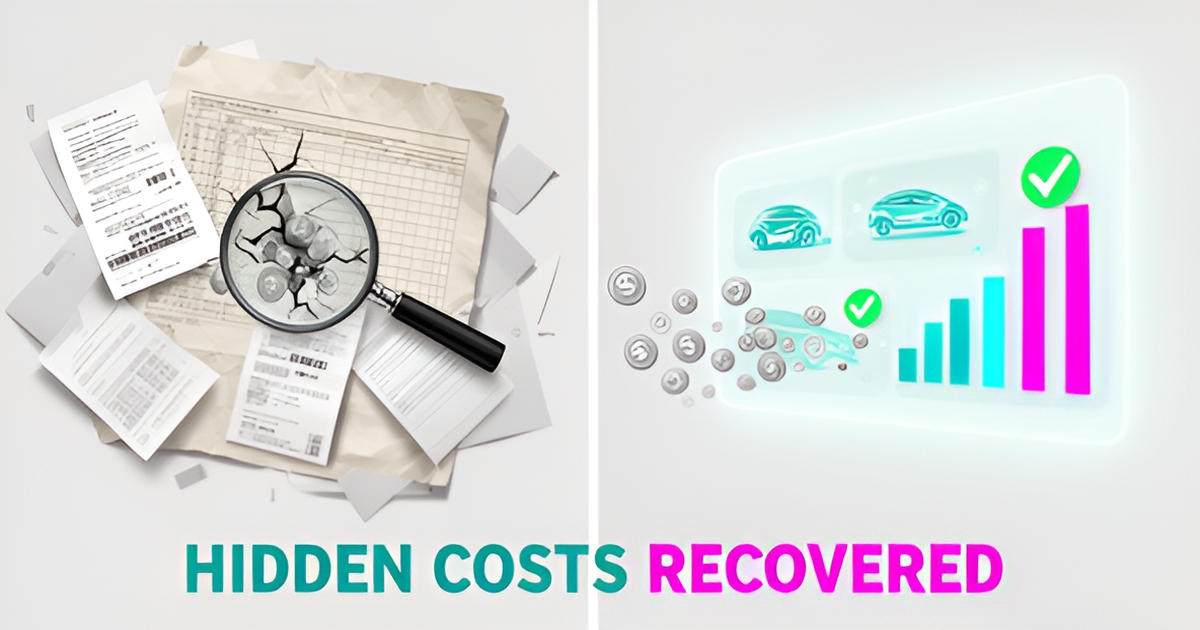
The Hidden Cost of Manual Repair Tracking in PDR: How AI Fixes It
Key Facts
- Hail storms can trigger a sudden, extreme spike in inbound calls overnight—far more than a front desk can answer manually.
- Carrier estimates routinely miss billable operations like R&I, blend and calibrations; shops using manual scrub spreadsheets typically leave this money on the table on a large share of insurance jobs.
- Manual tech pay calculation commonly consumes the better part of a day each week; automated reporting can reduce it to roughly 20 minutes.
- AI voice agents answer calls near-instantly and operate 24/7 to capture every lead during surge events.
- AI-powered inspection systems can process a vehicle in under a minute, compared to several minutes for manual inspection.
Hire a team member that works 24/7 — for less than a part-time wage.
AI receptionists, SDRs, dispatchers and 99+ roles. Trained on your business, fully managed.
Not sure where to start? Ask our AI planner
Fragmented Manual Tracking Is Leaking Revenue Every Day
Manual repair tracking in PDR shops isn't just inconvenient—it's actively bleeding revenue every day. When scheduling lives on a whiteboard, estimates in a spreadsheet, and technician pay in a disconnected document, critical details fall through the cracks. This fragmentation creates silent profit leaks that compound during peak demand.
Carrier estimates routinely miss billable operations like R&I, blend, and calibrations, and manual scrub spreadsheets fail to catch them all. Shops that run a disciplined line-by-line audit of every carrier estimate typically find supplement revenue they were previously leaving on the table—often on a meaningful percentage of insurance jobs. Over a season of hail work, those missed line items add up to real money.
Administrative drag further erodes profitability. Manually calculating technician pay can turn a Friday afternoon into an accounting project, while front desk staff waste hours typing vehicle info and claim numbers from calls. Automating tech pay reporting can shrink that task to roughly 20 minutes, freeing staff for customer-facing work. Meanwhile, when the whiteboard is the system, customers constantly call for status updates, pulling the office away from revenue-generating tasks.
During hail surges, these gaps become catastrophic. Inbound call volume can spike dramatically overnight, and a single drop can generate dozens of simultaneous calls. Shops relying on manual intake miss calls that go straight to competitors—lost opportunities that vanish before the storm even passes. AIQ Labs helps PDR shops replace these brittle, disconnected systems with unified AI-driven platforms that capture every detail, automate reporting, and ensure no revenue slips through the cracks.
How AI Automates Intake, Estimates and Shop Floor Visibility
Manual intake, handwritten estimates and a whiteboard on the shop floor cost PDR shops time, revenue and visibility every single day.
AI replaces that fragmented workflow with connected data capture that starts the moment a customer calls. Voice agents answer near-instantly, provide 24/7 inbound coverage, and keep answering even when hail drives call volume through the roof. The agent is trained on your business with a private knowledge base, extracts vehicle info, claim numbers and carrier details in real time, and builds a complete job record while the caller is still on the line. If you want to see what this looks like in practice, AIQ Labs' AI Employees include managed AI receptionists and dispatchers built for exactly this kind of surge coverage.
Damage classification moves from subjective notes to vision-based, OEM-grounded decisions. Modern AI systems read customer photos to identify panels, count dents per panel and grade severity to build a structured estimate. AI body scanning systems use high-resolution cameras and structured lighting to detect imperfections and create a digital model that can be compared against a reference model. Live OEM lookup per vehicle for year/make/model construction makes repair decisions defensible, and AI-powered inspection systems can process a vehicle in under a minute.
Estimate auditing closes the revenue leak that manual scrubbing misses. The AI parses every line of carrier estimates from CCC, Mitchell, Audatex or PDF and audits against OEM-mandated operations and the shop's matrix. Missing R&I, blend, pre/post scans and calibrations are surfaced with cited reasons, so supplement requests are backed by documentation rather than guesswork.
Shop floor visibility replaces the whiteboard with live kanban. Every vehicle is visible from intake through completion, color-coded by account type with hail vs. ding flags, crew chips and hold indicators showing why a car isn't moving. Overdue alerts fire when vehicles should have moved but haven't, and multi-tech crew view tracks complex jobs correctly.
AIQ Labs builds AI systems that capture every repair detail and turn it into actionable insights for pricing, performance and growth, with data enrichment and augmentation that connects intake, estimating and execution.
Automated capture and visibility deliver:
- 24/7 voice intake that captures leads, books appointments and syncs to calendar
- Vision-based damage classification with OEM-grounded repair decisions
- Automated estimate auditing that recovers missed supplement revenue
- Live kanban shop floor visibility replacing manual tracking
The result is faster throughput, higher revenue capture and operational visibility manual systems cannot provide.
From Hail Surge to Tech Pay: Real PDR Workflows AI Replaces
When a hail storm hits, PDR shops face a sudden surge in inbound calls that can overwhelm manual systems overnight. During these events, a single drop can trigger dozens of simultaneous phone calls, and missing even a few means competitors capture those jobs while your team scrambles to keep up. An AI-powered intake system answers every call near-instantly, operates 24/7, and automatically builds complete job records while the caller speaks—eliminating manual data entry and ensuring no lead slips through the cracks.
Once the estimate arrives, AI audits every line against OEM requirements to recover missed supplement revenue that manual processes routinely overlook. This line-by-line audit surfaces overlooked items like R&I, blend, hazwaste, and pre/post scans with cited reasons, turning estimate scrubbing into a reliable revenue stream rather than a guessing game.
On the back end, AI transforms technician pay reporting from a weekly ordeal into a roughly 20-minute task. Instead of manually tallying who worked on what across disconnected spreadsheets and whiteboards, the system automatically breaks every released estimate into per-technician line items, correctly splitting multi-tech jobs and applying variable rates by account type. Pulling billed/earned/paid/balance reports now takes seconds, not hours, giving shops back valuable time while ensuring techs trust the accuracy of their pay. AIQ Labs builds this kind of end-to-end automation through AI Workflow Builds—rebuilding the one workflow that costs you the most, at a fixed price and in phases—so every repair detail turns into actionable insight for pricing, performance, and growth.
Implementation Path for PDR Shops Moving to AI
Moving from manual repair tracking to AI-powered systems requires a clear path that prioritizes data discipline and process standardization before scaling. AIQ Labs helps PDR shops build custom solutions with no subscription lock-in, ensuring every repair detail is captured accurately from the start.
The first step is establishing consistent data entry practices at intake, since AI systems depend on structured inputs to avoid noisy reporting signals and weak quantification. Shops should standardize how they capture vehicle info, claim numbers, and carrier details during every customer interaction—whether by phone, text, or web chat—to create a reliable foundation for automation. Without this discipline, even the most advanced AI cannot deliver accurate estimates or tech pay reports.
Next, map existing workflows to identify fragmentation points where scheduling, estimates, and technician tracking operate in disconnected silos. AIQ Labs designs custom systems that unify these functions into a single source of truth, replacing whiteboards and spreadsheets with live kanban boards that show real-time job status, overdue alerts, and multi-tech crew assignments. This integration ensures carrier estimates are audited line-by-line against OEM requirements, surfacing missed operations like R&I and calibrations that drive supplement revenue.
Finally, scale the system incrementally using a build-in-milestones approach, starting with AI-powered intake and estimate auditing before expanding to shop floor management and automated tech pay reporting. This phased rollout lets shops verify ROI early—such as reducing tech pay calculation from an entire afternoon to minutes—while maintaining full ownership of the AI system and avoiding vendor lock-in. Each phase builds on the last, creating a scalable, owned asset that grows with the business. For shops ready to connect everything into one operating layer, AIQ Labs' AI Operating Systems are built in phases and owned outright.
Still paying for 10+ subscriptions that don’t talk to each other?
We build custom AI systems you own outright. No vendor lock-in. Full control.
Not sure where to start? Ask our AI planner
Frequently Asked Questions
How much revenue are PDR shops really losing with manual repair tracking?
Can AI really handle a hail-storm call surge without missing leads?
How much time does AI save on technician pay reporting compared to manual methods?
Is AI inspection faster than manual dent assessment, and does it improve accuracy?
What's the first step for a PDR shop moving from whiteboards and spreadsheets to AI?
Do I need to give up ownership of my data or systems if I use AI from AIQ Labs?
Turn Your PDR Shop's Hidden Revenue Into Real Growth
Manual repair tracking in PDR shops isn't just inefficient—it's actively draining revenue through missed supplement income, lost calls during hail surges, and hours wasted on administrative tasks. AI-powered systems fix these leaks by capturing every repair detail, auditing estimates for missed R&I and calibration work, and replacing whiteboards with live shop floor visibility. Tech pay reporting drops from an entire afternoon to minutes, freeing staff for customer-facing work. The result is faster throughput, higher revenue capture, and operational clarity that manual systems simply can't match. If you're ready to stop leaving money on the table, start with the two-minute Fit Check at aiqlabs.ai/apply, then book a free 30-minute strategy call to map your biggest bottleneck and uncover high-ROI automation opportunities.
Make AI your competitive advantage — not just another tool.
Strategy, implementation and ongoing optimization. One partner, end to end.
Not sure where to start? Ask our AI planner