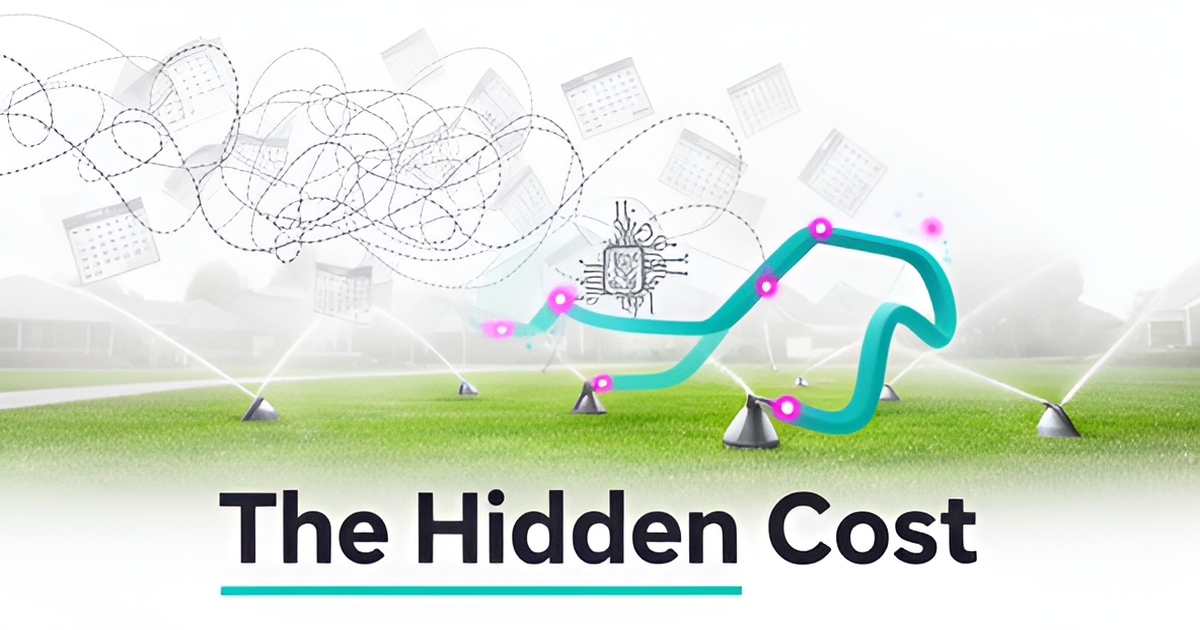
The Hidden Cost of Manual Service Scheduling in Irrigation Dealing — And How AI Fixes It
Key Facts
- Manual scheduling lacks the logic to predict job times, automate sequencing, or adapt to real-time field changes
- Field service teams that automate scheduling typically shift managers from reactive firefighting to proactive capacity forecasting
- AI route optimization reduces fuel consumption and drive time by sequencing jobs around live traffic, weather, and demand data
- Predictive maintenance AI has been shown in industry studies to cut unplanned downtime by up to half and maintenance costs meaningfully
- AIQ Labs has deployed 200+ multi-agent systems and runs 4 live SaaS products daily — scheduling automation is a proven, not experimental, category
- AI Employees typically cost around 80% less than an equivalent human hire while working 24/7
Hire a team member that works 24/7 — for less than a part-time wage.
AI receptionists, SDRs, dispatchers and 99+ roles. Trained on your business, fully managed.
Not sure where to start? Ask our AI planner
The True Cost of Manual Scheduling: Lost Revenue and Customer Trust
Manual scheduling feels organized until the field proves otherwise. Coordinators sort requests, estimate durations, and assign technicians by hand, then spend the day chasing changes.
Manual scheduling is reactive by design. The process relies on coordinators manually sorting requests, estimating job durations, and assigning technicians. This system breaks down in the field due to shifting priorities, unexpected delays, and urgent requests, leading to constant hands-on oversight and schedule adjustments.
Assignments rely entirely on human judgment, and even small shifts in technician availability can ripple through the rest of the day. Coordinators spend hours recalculating and adjusting plans, while managers react to issues instead of proactively managing them.
The cost shows up as idle time, missed appointments, and eroding trust. Without predictive tools, forecasting capacity, spotting SLA risks early, or anticipating workload pressure is difficult. Teams can see open tasks, but they cannot build the most efficient day.
Automation across industries shows the financial impact of fixing these gaps. Customer service and dispatch automation consistently delivers measurable savings — large enterprises have reported multi-million-dollar reductions in coordination costs after replacing manual routing and phone handling with AI agents. While exact figures vary by operation, the pattern holds: removing manual coordination removes waste.
- Enterprises replacing manual phone coordination with AI agents typically cut cost per contact by more than half
- AI-driven route optimization reduces fuel consumption and drive time by sequencing jobs around live conditions
- Automated scheduling frees coordinators from hours of daily recalculating
These gains mirror what irrigation dealing teams experience when scheduling stays manual. Missed windows create rescheduling loops, technicians drive extra miles between jobs, and customers receive late updates.
AI shifts the manager's role from reactive to proactive. AI scheduling software strengthens maintenance workflows by automating the parts of scheduling that change most during the day. Instead of relying on continuous manual coordination, teams gain a system that keeps schedules accurate and adaptive as field conditions shift.
The core problem is not organization, but optimization. Manual tools organize work but lack logic to build the most efficient day. They cannot predict job times, automate sequencing, or rearrange schedules based on real-time data.
AIQ Labs addresses this through AI Workflow Builds — rebuilding the one workflow that costs you the most, at a fixed price and in phases. For scheduling, that means automatically booking service visits, sending reminders, and optimizing technician routes based on weather and demand, without replacing the tools teams already use.
The result is fewer missed appointments, less idle time, and stronger customer trust.
How AI Scheduling Transforms Field Service Operations
Manual scheduling breaks down the moment field conditions shift — a delayed job, a weather event, or a technician calling out sick forces coordinators into hours of recalculating. AI scheduling replaces that reactive cycle with a proactive system that predicts job durations, sequences appointments by location, and adapts in real time without human intervention. Manual tools simply lack the logic to build the most efficient day, leaving managers reacting to SLA risks instead of preventing them.
- Automated appointment booking that syncs with technician calendars and customer preferences
- Route optimization using live traffic, weather, and demand data to cut drive time
- Real-time schedule adjustments when jobs run long or urgent requests arrive
- Proactive capacity forecasting that spots workload pressure before it causes delays
The impact compounds across operations. Field service and logistics teams using AI route optimization consistently report lower fuel costs and more billable hours per technician. The same patterns translate directly to irrigation dealing: fewer missed appointments, tighter routes, and technicians spending more time repairing systems than driving between them.
AIQ Labs builds custom scheduling agents that integrate with existing calendar and dispatch tools — Google Calendar, Calendly, industry-specific platforms — so the transition preserves current workflows while adding predictive intelligence. The system learns each business's job-time patterns, technician strengths, and seasonal demand curves, then automates the coordination that currently consumes hours of manual effort every week. With 200+ multi-agent systems deployed, this is work AIQ Labs does every day.
Implementation: From Manual Processes to AI-Driven Service Automation
Moving from paper calendars and spreadsheets to an AI-driven scheduling engine doesn't require a rip-and-replace overhaul. The most successful deployments start with a single workflow — dispatch or service coordination — and expand once the team sees measurable gains.
Integration happens through the tools dealers already use. Modern AI agents connect directly to Google Calendar, Calendly, or industry-specific dispatch platforms via standard APIs, syncing appointments, technician availability, and customer records in real time. This eliminates the double-entry that consumes hours each week and introduces errors that cascade into missed visits. Teams that automate scheduling and dispatch typically reduce manual coordination to a fraction of its former cost while improving reliability.
A phased rollout keeps risk low and momentum high:
- Phase 1 — Pilot: Deploy an AI dispatcher for one service region or crew, handling inbound requests, weather-aware routing, and automated reminders
- Phase 2 — Expand: Add predictive job-duration modeling and real-time re-optimization when field conditions change
- Phase 3 — Scale: Extend across all crews, integrate with CRM and inventory, and enable customer self-service booking
Results appear quickly. AI scheduling reduces drive time by optimizing job sequencing based on location and predicted duration, directly increasing the hours technicians spend on repairs rather than on the road. For irrigation dealers running multiple crews across a season, that recovered time is billable time.
AIQ Labs structures these deployments around three payment models: Start Monthly for a managed AI dispatcher that goes live fast, Build in Milestones for a fixed-price phased rebuild of your scheduling workflow, or Own It Outright if you want to own the system with no recurring fees. An AI Employee dispatcher goes live with its own phone number and email, working 24/7 at roughly 80% less cost than a human hire. Dealers can pause or adjust anytime — and with milestone or outright builds, you keep full ownership of the workflows and data.
Still paying for 10+ subscriptions that don’t talk to each other?
We build custom AI systems you own outright. No vendor lock-in. Full control.
Not sure where to start? Ask our AI planner
Frequently Asked Questions
Why is manual scheduling so inefficient for irrigation service businesses?
How much money can AI scheduling actually save my business?
Will I need to replace my existing calendar and dispatch software?
What happens when a job runs long or weather disrupts the schedule?
How does AI scheduling improve the customer experience?
Is AI scheduling affordable for small irrigation dealerships?
From Reactive Dispatch to Revenue You Can Count On
Manual scheduling looks tidy on a calendar, but in the field it creates idle time, missed windows, and eroding customer trust. Coordinators spend hours recalculating assignments as delays and urgent requests ripple through the day, while managers react to SLA risks instead of preventing them. AI changes that dynamic by predicting job durations, sequencing visits by location and live conditions, and adjusting in real time without constant hands-on oversight. The shift is from organizing work to optimizing it. Teams gain fewer missed appointments, tighter routes, and technicians spending more time repairing than driving. Irrigation dealers see this pattern play out as efficiency turns into retention — customers who get accurate windows and proactive updates stay. If manual coordination is your bottleneck, start with one crew or region. Map current job-time patterns, integrate with the calendars and dispatch tools you already use, and let an AI dispatcher handle booking, reminders, and weather-aware routing first. You can then expand to predictive modeling and real-time re-optimization as gains compound. Start with the 2-minute Fit Check at https://aiqlabs.ai/apply, then book a free 30-minute strategy call at https://aiqlabs.ai/book to map your biggest scheduling bottleneck and identify a high-ROI automation path. Prefer email? Reach the team at [email protected].
Make AI your competitive advantage — not just another tool.
Strategy, implementation and ongoing optimization. One partner, end to end.
Not sure where to start? Ask our AI planner