The Hidden Cost of Manual Workflows in Hot Rod Restoration — And How AI Fixes It
Key Facts
- Labor hours are typically only a fraction of the true cost of manual workflows — the rest hides in error correction, decision latency, burnout and missed opportunity
- Workplace research consistently finds employees spend roughly a quarter of their week on repetitive tasks that could be automated
- Manual data entry carries a measurable error rate, and every bad parts order triggers rework that compounds across a build
- Manual processes scale linearly — twice the volume means twice the admin headcount — while automation handles added volume at near-flat cost
- AIQ Labs has deployed 200+ multi-agent systems and runs 4 live SaaS products daily, so the automation patterns described here are proven in production, not theory
Hire a team member that works 24/7 — for less than a part-time wage.
AI receptionists, SDRs, dispatchers and 99+ roles. Trained on your business, fully managed.
Not sure where to start? Ask our AI planner
The True Cost of Manual Workflows in Restoration Shops
Hot rod restoration looks hands-on, but the real drag on profit is invisible. Manual workflows quietly drain capacity while skilled craftsmen spend time on admin instead of metal.
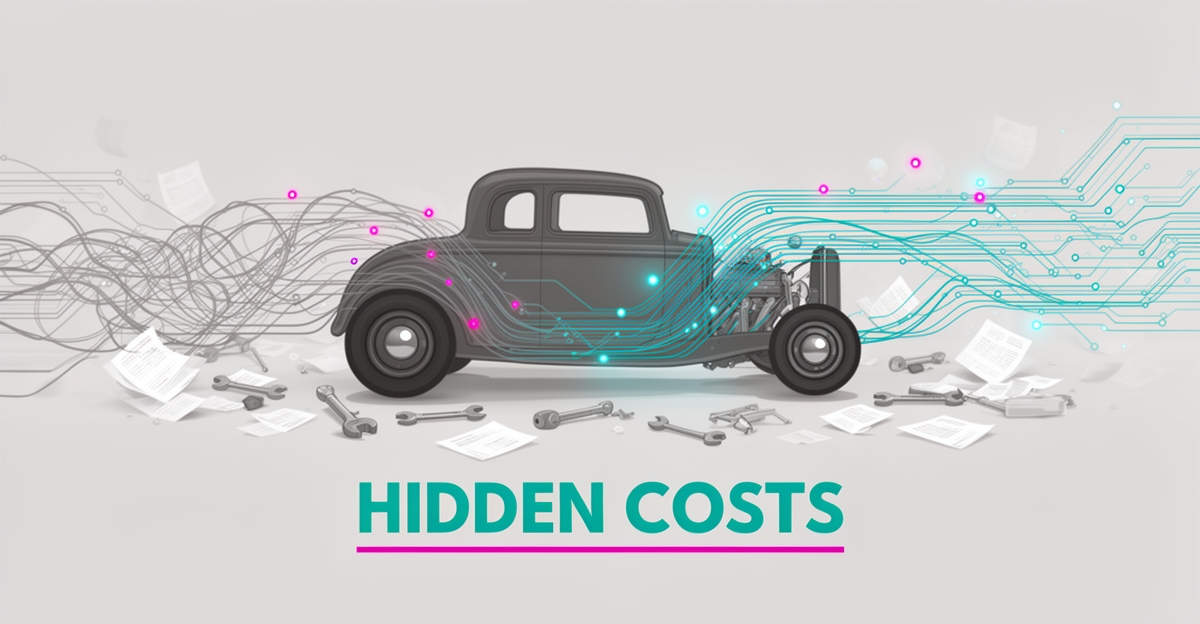
The hours your team spends on paperwork are only part of the bill. The larger share hides in error correction, decision latency, employee burnout, opportunity cost, scaling ceilings, and compliance risk. The bill is not on the payroll; it is in the work that never shows up on a timesheet.
Workplace research consistently finds that employees spend roughly a quarter of their workweek on repetitive tasks that could be automated. In a restoration shop that means parts lookups, order entry, status updates, and approval chasing instead of fabrication and finishing. Manual data entry carries a real error rate, and every bad parts order triggers rework, delayed approvals and missed deadlines that compound across a build.
The hidden factory shows up as:
- Error correction from incorrect parts orders and rework triggered by bad data entry
- Decision latency when approvals for critical parts or milestones stall projects
- Employee burnout as craftsmen are pulled into spreadsheets instead of creative work
- Compliance risk from poor documentation of modifications and parts sourcing
These loops cost more than any front-facing glitch. Most executives acknowledge that approval processes slow decision-making and add unnecessary complexity — a bottleneck that is especially painful when a car is on a lift waiting for a decision. As volume grows, manual processes scale linearly: twice the volume means twice the admin headcount, while quality consistency falls with fatigue and turnover.
AI process mining exposes these inefficiencies by mapping how work actually flows, identifying duplicated tasks, data entry errors, and missed deadlines. Process mining reveals bottlenecks and points to automation opportunities without guessing. AIQ Labs uses those insights through its AI Workflow Builds service — rebuilding the one workflow that costs your shop the most, at a fixed price, in phases.
The shift changes the cost structure. Automated systems route requests by predefined rules, eliminate forgotten steps, and provide real-time visibility into where every request stands. Organizations that automate well typically report substantial error reductions and strong returns within the first year — but the only numbers that matter are the ones you measure in your own shop.
How AI Process Mining Identifies and Eliminates Bottlenecks
Manual processes in a hot rod shop look busy, but the real work is hiding in the gaps between tasks. AI process mining exposes those gaps by mapping how parts ordering, project tracking, and customer communication actually flow, not how they're supposed to flow.
Process mining tools ingest event logs from existing systems and visualize the true path of work. The analysis reveals where approvals stall, where data is re-entered, and where repetitive steps multiply. In restoration shops, this often surfaces in parts ordering where manual entry creates delays and mistakes, in project tracking where status updates are chased by email, and in customer communication where follow-ups are missed.
The point of the exercise is to make the invisible cost visible: quantifying decision latency, rework and duplicated effort in dollars, per transaction, per month. Once you can see that number, you know exactly which workflow to rebuild first.
Once bottlenecks are mapped, AI suggests targeted automation that eliminates the root cause rather than adding another spreadsheet. The impact is measurable in your own shop's numbers: fewer bad parts orders, faster approvals, and status updates that go out without anyone chasing them.
In hot rod restoration, that translates to practical gains across the shop floor:
- Parts ordering: AI matches VIN and build specs to verified suppliers, auto-generates purchase requests, and flags price or lead-time anomalies before they reach a buyer.
- Project tracking: Milestones, labor hours, and parts arrivals are logged automatically, with alerts triggered when a task risks missing a deadline.
- Customer communication: Status updates, photo approvals, and billing inquiries are handled consistently, reducing back-and-forth and freeing craftsmen for build work.
The value is not just speed. AI process mining converts tribal knowledge into a governed, repeatable system that scales with demand. Manual processes scale linearly, meaning twice the volume requires twice the headcount, while AI automation handles added volume at near-flat cost.
AIQ Labs applies this process-mining lens as part of its AI Workflow Builds practice, using the insights to build production-ready AI systems for restoration shops. The focus is on identifying inefficiencies hidden in manual processes — data entry errors, duplicated tasks, missed deadlines — then designing automation that preserves craft quality while removing administrative drag. For ongoing roles like receptionists, SDRs and dispatchers, AI Employees handle the repetitive communication work at a fraction of the cost of a human hire.
Implementing AI Workflow Automation: A Practical Roadmap for Restoration Shops
Hot rod shops lose money on work that never shows up on a timesheet. The administrative loops around parts, approvals and customer updates quietly consume craft time and create costly rework.
Start by mapping the highest-volume manual workflows. Identify the repetitive tasks that happen more than 50 times a month and measure the fully loaded cost per transaction. That means labor plus error correction, decision latency and opportunity cost — not just hours billed. This is where most shops find their quarter-of-the-week problem: repetitive tasks that a machine should be doing.
Calculate true transaction cost before you automate. Labor hours are typically only a fraction of the true cost of manual workflows. The rest hides in error correction, decision latency, employee burnout, opportunity cost, scaling ceilings, and compliance risk. If you can't measure it precisely, estimate it conservatively — even a lowball figure usually justifies the work.
Use AI process mining to expose bottlenecks. Process mining tools surface the hidden factory that consumes a meaningful share of capacity through undocumented fixes and rework. In restoration shops this shows up as duplicate parts orders, delayed approvals for critical components, and customer status requests that pull builders off the floor. AIQ Labs uses these insights to rebuild the one workflow that costs your shop the most — fixed price, phased delivery, no surprises.
Design AI systems for shop-specific language. Effective automation requires industry benchmarking, compliance coordination and security testing, not just clever prompts. Build multi-step workflows with clear guardrails, fallback mechanisms and human-in-the-loop escalation for craftsmanship decisions.
Integrate with existing tools without disrupting craftsmanship. Connect CRM, inventory, project management and accounting systems so data synchronizes automatically and creates a single source of truth. Validate outputs before execution and maintain audit trails for parts sourcing and modifications.
Governance sustains adoption. Establish roles, monitoring and change management so teams trust the system. Train staff on exception handling and keep the human decision point where judgment, relationship nuance and creative problem solving matter.
The payoff is measurable in your own numbers: fewer errors, faster cycle times, and craftsmen back on the floor. Payment is straightforward — start monthly, build in milestones, or own the system outright. No fake prices, no invented case-study numbers; you measure the return against your own baseline.
A practical roadmap for shops looks like this:
- Map and cost high-volume workflows such as parts ordering, inventory checks and project updates
- Run AI process mining to find approval bottlenecks and data reconciliation issues
- Pilot an automated workflow with validation layers and human escalation
- Integrate with current shop tools and establish governance, monitoring and training
Adoption succeeds when automation handles repetitive, high-volume work and skilled craftsmen stay focused on restoration.
Still paying for 10+ subscriptions that don’t talk to each other?
We build custom AI systems you own outright. No vendor lock-in. Full control.
Not sure where to start? Ask our AI planner
Frequently Asked Questions
Why does manual work seem fine but still hurt my restoration shop's profit?
How much time are my craftsmen actually losing to admin tasks?
What's the real cost of data entry mistakes in a shop?
Can AI process mining actually find bottlenecks we don't see?
Will automating admin take work away from my skilled builders?
How does AIQ Labs charge for this work?
Stop Paying for the Hidden Factory
Manual workflows in hot rod restoration don't just cost labor — they cost the error correction, decision latency, burnout and missed opportunity that never show up on a timesheet. AI process mining makes that invisible drag visible by mapping how parts ordering, project tracking, and customer communication actually flow, then targeting the repetitive, high-volume steps that should never require a craftsman's attention. The result is a shift from linear scaling to near-flat scaling: automated routing, real-time visibility, and governed repeatability that preserves craft quality while removing administrative drag. AIQ Labs has deployed 200+ multi-agent systems and runs 4 live SaaS products daily — the patterns work in production. Take the 2-minute Fit Check at https://aiqlabs.ai/apply, then book your free 30-minute strategy call at https://aiqlabs.ai/book to map your biggest bottleneck. Prefer email? Reach the team at [email protected].
Make AI your competitive advantage — not just another tool.
Strategy, implementation and ongoing optimization. One partner, end to end.
Not sure where to start? Ask our AI planner