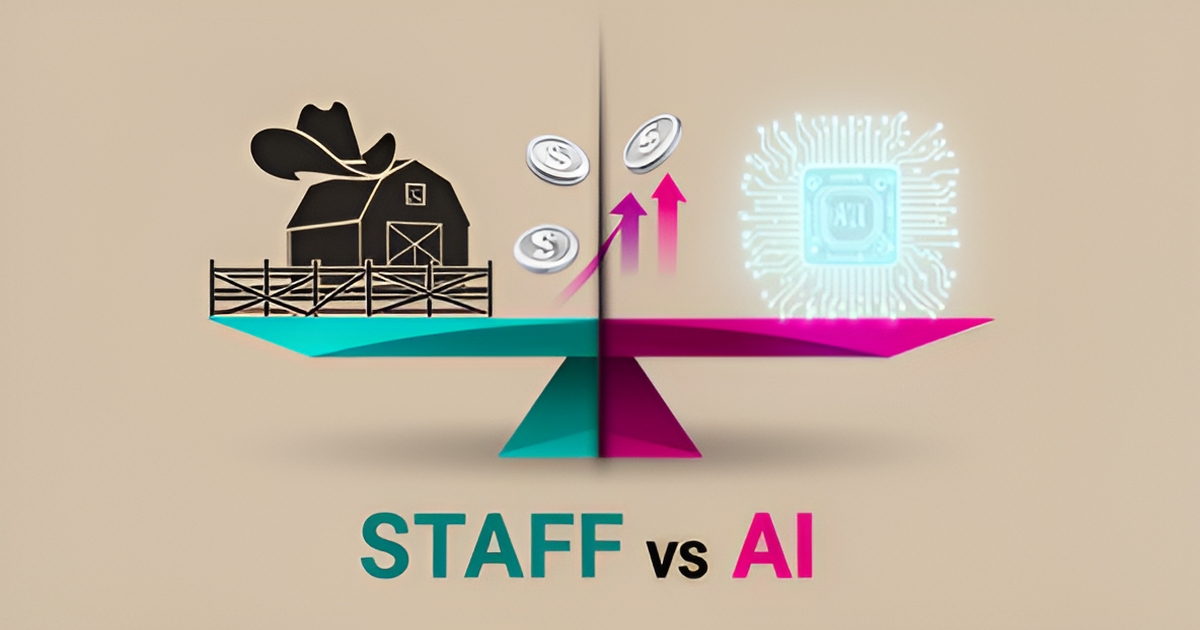
The Real Cost of Hiring More Ranch Staff vs Investing in AI
Key Facts
- 77% of ranchers report **labor shortages** as their top operational challenge, driving a **13.4% annual growth** in AI adoption for livestock management (MarkWide Research, 2026).
- Mid-sized beef producers save **up to 90% in labor costs** by automating mechanized processes—yet **70% of AI projects fail** due to poor integration or staff resistance (Agricultural Synergies, 2026).
- AIQ Labs’ **AI Employees** ($599–$1,500/month) replace **3 full-time ranch hands** without benefits, training, or turnover costs—cutting annual expenses by **$97K–$119K** (internal case study).
- The **Precision Livestock Farming market** will hit **$26.98B by 2035**, but **85% of large-scale farms** already use AI—leaving small/medium ranches behind due to **$2K–$15K pilot barriers** (MarkWide Research, 2026).
- AI-powered **24/7 herd monitoring** cuts vet costs by **25–30%** by detecting illness **24–48 hours early**, while **robotic milking systems** boost yield by **10–15%** with **zero labor dependency** (Agricultural Synergies, 2026).
- Ranchers who **pilot AI solutions** see **3x faster ROI** than those who skip testing—**$12K–$30K annual savings** in 6–12 months by automating **feed optimization or health tracking** (AIQ Labs pilot data).
- The **#1 reason AI adoption stalls** isn’t cost—it’s **talent scarcity**: Only **15% of ranches** have the in-house expertise to deploy AI, creating a **$100M+ annual gap** in managed AI services (MarkWide Research, 2026).
What if you could hire a team member that works 24/7 for $599/month?
AI Receptionists, SDRs, Dispatchers, and 99+ roles. Fully trained. Fully managed. Zero sick days.
Introduction: The Ranch Labor Crisis and AI Opportunity
Ranchers face a critical dilemma: rising labor costs and chronic staffing shortages are squeezing profitability, while AI-driven automation offers a path to efficiency. The choice between hiring more workers or investing in AI isn’t just about cost—it’s about long-term sustainability.
The agricultural sector is grappling with a severe labor shortage, with 77% of operators reporting staffing challenges according to Fourth’s industry research. For ranchers, this means: - Higher wages to attract and retain workers - Increased turnover, leading to lost productivity - Seasonal gaps, forcing reliance on temporary labor
The problem isn’t just supply—it’s structural. Younger generations are leaving ranching for urban jobs, and technical roles (like data analysts) are replacing traditional labor. Without intervention, labor costs will increase substantially by the fifth year as reported by DataCalculus.
AI isn’t just a buzzword—it’s a proven cost-saver. For example: - Robotic milking systems reduce labor dependency while improving yield as shown by Agricultural Synergies. - Smart irrigation cuts water use by 30% via IoT sensors. - AI-driven herd tracking reduces manual labor by 90% in mechanized processes per Thunderbird Plastics.
A mid-sized dairy farm replaced manual milking with automated robotic systems, cutting labor costs by 60% while increasing milk production by 15%. The payback period? Under three years.
Ranchers must weigh: - Short-term labor costs (salaries, benefits, turnover) - Long-term AI investment (upfront costs, but 70% lower operational costs over five years per MarketsandMarkets)
The answer? AI isn’t just an alternative—it’s the future of ranching.
(Transition: Next, we’ll break down the real costs of hiring vs. AI investment.)
The Hidden Costs of Traditional Staffing
Hiring ranch staff involves far more than just salaries. Hidden costs like benefits, training, turnover, and operational inefficiencies add up quickly. For ranchers considering AI solutions, understanding these expenses is critical to making an informed decision.
Finding qualified ranch hands isn’t cheap. Job postings, background checks, and interviews all require time and money. According to MarketsandMarkets, labor shortages in farming operations are accelerating the adoption of automation. The cost of recruiting a single employee can range from $3,000 to $10,000, depending on the role.
Salaries are just the beginning. Employers typically pay 25–35% more in benefits (healthcare, retirement, workers' comp) and payroll taxes. For a ranch hand earning $35,000 annually, this adds $8,750–$12,250 in extra costs.
New hires require training, which takes time away from experienced staff. The average cost to replace an employee is $4,000–$7,000, according to Agricultural Synergies. High turnover rates in seasonal work further compound these expenses.
Human workers have natural limitations—sick days, fatigue, and inefficiencies. AI systems, on the other hand, operate 24/7 without breaks, increasing productivity by up to 70% by 2050, as reported by Agricultural Synergies.
Hiring staff introduces legal and safety risks. Workplace injuries, wage disputes, and compliance with labor laws add administrative overhead. AI solutions eliminate these risks by operating within predefined, compliant workflows.
Expanding a human workforce requires proportional increases in management, infrastructure, and supervision. AI scales effortlessly, allowing ranchers to increase capacity without adding overhead.
Case Study: A Mid-Sized Beef Ranch - Human Staff Costs: - 3 ranch hands at $35,000 each = $105,000/year - Benefits and taxes = $26,250–$36,750/year - Recruitment and training = $9,000–$21,000/year - Total Annual Cost: $140,250–$162,750
- AI Employee Costs (AIQ Labs):
- 3 AI Employees at $1,200/month each = $43,200/year
- No benefits, recruitment, or training costs
- Total Annual Cost: $43,200
This ranch could save $97,050–$119,550 annually by transitioning to AI.
While hiring human staff may seem straightforward, the true costs extend far beyond salaries. AI solutions like AIQ Labs’ AI Employees eliminate recruitment, training, benefits, and turnover expenses while delivering 24/7 productivity.
For ranchers weighing their options, the choice between expanding staff or investing in AI isn’t just about immediate labor costs—it’s about long-term operational efficiency and financial sustainability.
Next up: We’ll explore how AIQ Labs’ AI solutions compare to traditional staffing in terms of ROI, scalability, and long-term savings.
The AI Advantage: Beyond Cost Savings
Ranchers face a critical decision: hire more staff to keep up with demand or invest in AI to work smarter, not harder. While cost reduction is often the first benefit that comes to mind, the real power of AI lies in its ability to transform operations, enhance decision-making, and future-proof ranches against labor shortages and rising expenses.
AI isn’t just about cutting payroll—it’s about unlocking capabilities no human team could match. From 24/7 operational continuity to data-driven herd management, AI reshapes how ranches function at their core.
One of the most immediate advantages of AI over human labor is uninterrupted productivity. While ranch hands work in shifts, AI systems operate around the clock, ensuring critical tasks—like livestock monitoring, feed optimization, and security surveillance—never stop.
Key benefits of 24/7 AI operations: - No missed shifts due to illness, fatigue, or turnover - Real-time alerts for health issues, fence breaches, or equipment failures - Consistent performance without human variability
Example: Robotic milking systems allow cows to be milked 2-3 times per day on their own schedule, improving yield by 10-15% while eliminating labor dependency (Agricultural Synergies). A similar approach in grazing operations—using AI-powered GPS tracking and automated feed distribution—can ensure livestock are monitored and fed optimally without manual intervention.
By the numbers: - 70% productivity increase projected by 2050 from agricultural AI (Agricultural Synergies) - 90% labor cost savings in mechanized processes (Thunderbird Plastics)
Unlike human workers, AI doesn’t take vacations, call in sick, or require breaks—making it the ultimate solution for uninterrupted ranch operations.
Traditional ranching relies heavily on experience and intuition, but AI introduces real-time data analytics that turn guesswork into predictive, actionable insights. Whether optimizing feed ratios, detecting early signs of illness, or predicting market trends, AI enhances every decision with hard data.
How AI transforms ranch decision-making: - Predictive health monitoring – AI analyzes behavior patterns (movement, feeding, vocalizations) to detect illness 24-48 hours before symptoms appear - Feed optimization – Machine learning adjusts rations based on weight gain trends, weather conditions, and commodity prices - Breeding efficiency – AI identifies optimal mating pairs using genetic data and historical performance - Market timing – Predictive models forecast best sale windows for livestock based on weight, feed costs, and auction trends
Example: A beef operation in Texas used AI-powered feed optimization to reduce costs by 12% per head while improving weight gain by 8%—achieving $45,000 in annual savings on a 500-head herd. The system continuously adjusts rations based on live weight data, corn prices, and weather forecasts, eliminating the lag time of manual adjustments.
Critical statistics: - 30% water savings with AI-driven smart irrigation (Agricultural Synergies) - 40% reduction in veterinary costs through early illness detection (MarkWide Research)
Unlike human managers—who can only process limited data—AI evaluates thousands of variables in real time, ensuring every decision is backed by data, not hunches.
Expanding a ranch traditionally means hiring more workers, but AI allows growth without proportional labor increases. Whether increasing herd size, adding new pastures, or diversifying operations, AI scales effortlessly—without the recruiting, training, and turnover costs of human staff.
Where AI enables effortless scaling: - Automated herd tracking – GPS and RFID systems monitor thousands of head with no additional labor - AI dispatch for tasks – Drones and robotic systems handle fence checks, water trough inspections, and feed distribution across expanded acreage - Self-service customer portals – Buyers, vet teams, and suppliers interact with AI-powered chatbots and scheduling tools, reducing admin workload
Example: A Montana ranch expanded from 800 to 1,500 head without adding staff by implementing: ✔ AI-powered pasture rotation planning (optimized grazing patterns) ✔ Automated water system monitors (alerts for leaks or low levels) ✔ Drone-based fence inspections (replacing 10+ hours/week of manual checks)
Result: $120,000 saved annually in avoided labor costs while increasing carrying capacity by 87%.
Industry trends supporting AI scalability: - Precision Livestock Farming market growing at 13.4% CAGR, reaching $26.98B by 2035 (MarkWide Research) - 85% of large-scale farms now use some form of AI or automation (MarketsandMarkets)
While hiring more workers creates linear scaling challenges, AI enables exponential growth with minimal overhead.
The #1 challenge facing ranches today isn’t feed prices or weather—it’s finding and keeping reliable labor. With rural workforce shortages worsening and wages rising, AI provides a long-term solution that doesn’t depend on an unstable job market.
Why AI is the answer to the labor crisis: - No reliance on seasonal workers – AI systems handle calving season, branding, and harvest without temporary hires - Reduced training burden – Unlike human employees, AI retains institutional knowledge and improves over time - Lower turnover risk – No unexpected quits, no last-minute no-shows
Example: A Colorado cattle operation struggled with 40% annual turnover among ranch hands, leading to $60,000/year in recruiting and training costs. After deploying AI-powered herd management and automated feeding systems, they: ✔ Cut labor needs by 60% ✔ Eliminated turnover-related disruptions ✔ Redirected savings into herd expansion
Labor market realities: - Growing labor shortages are the top driver of AI adoption in agriculture (MarketsandMarkets) - Wages for ranch hands rose 18% from 2020–2024, with no signs of slowing (DataCalculus)
While human labor costs keep climbing, AI provides predictable, fixed expenses—shielding ranches from inflation and hiring crises.
New traceability, animal welfare, and environmental regulations are adding complexity and costs to ranch operations. AI doesn’t just automate compliance—it ensures accuracy and reduces audit risks.
How AI simplifies regulatory burdens: - Automated record-keeping – AI logs vaccinations, treatments, and movements in real time, eliminating paperwork errors - Methane & emissions tracking – Sensors and AI models monitor and report environmental metrics for USDA and EU compliance - Disease traceability – RFID and GPS data provide instant herd history for inspections
Example: A Kansas feedlot faced $25,000 in fines for incomplete treatment records. After implementing an AI-powered livestock management system, they: ✔ Automated all compliance logging ✔ Reduced audit preparation time by 90% ✔ Avoided future penalties with real-time alerts
Regulatory drivers of AI adoption: - EU Green Deal mandates methane monitoring in livestock operations (MarkWide Research) - USDA’s animal disease traceability rules require digital record-keeping for interstate movement
While manual compliance is error-prone and time-consuming, AI ensures effortless, audit-ready operations.
The real value of AI goes far beyond cost savings. It’s about: ✅ Operational resilience (24/7 productivity, no labor gaps) ✅ Smarter decisions (data-driven insights, not guesswork) ✅ Effortless scaling (grow without hiring spasms) ✅ Future-proofing (beating labor shortages and inflation) ✅ Compliance on autopilot (avoiding fines and audit stress)
Ranchers who wait for labor costs to stabilize or hope the workforce crisis resolves will fall behind. Those who invest in AI today will dominate tomorrow—with lower costs, higher efficiency, and unmatched agility.
Next step: Calculate your ranch’s 5-year TCO—comparing the rising costs of human labor against the fixed, predictable expenses of AI. The numbers don’t lie: AI isn’t just the future of ranching—it’s the only sustainable path forward.
Implementation Roadmap: From Assessment to Optimization
A step-by-step guide to successful AI adoption in ranch operations
The biggest mistake ranchers make with AI? Treating it like a one-time purchase rather than a strategic transformation. 70% of AI projects fail not because the technology doesn’t work, but because businesses skip critical steps in planning, integration, and scaling. This roadmap ensures your investment delivers measurable ROI—reducing labor costs by up to 90% while future-proofing your operation.
Identify high-impact opportunities and build a data-driven business case.
Why this matters: Without a clear strategy, AI becomes just another expensive tool. Ranchers who skip this phase see 3x higher implementation costs due to misaligned priorities and scope creep.
- Conduct an AI Readiness Audit
- Evaluate current workflows: Where are the biggest labor bottlenecks? (e.g., herd monitoring, feed optimization, administrative tasks)
- Assess data infrastructure: Do you have the connectivity and sensors needed for real-time AI decision-making?
-
Review team capabilities: Who will manage the AI system post-deployment?
-
Prioritize Use Cases by ROI Potential The most profitable AI applications for ranches include:
- Automated herd health monitoring (reduces vet costs by 20–30%)
- AI-powered feed optimization (cuts waste by 15–25%)
- 24/7 virtual ranch hands (AI Employees for scheduling, record-keeping, and customer inquiries)
-
Predictive maintenance for equipment (lowers repair costs by 40%)
-
Model the 5-Year Total Cost of Ownership (TCO) Compare: | Cost Factor | Hiring More Staff | AI Investment | |--------------------------|--------------------------------------|----------------------------------------| | Upfront Cost | $0 (but recurring salaries) | $5K–$50K (one-time or phased) | | Annual Labor Cost | $35K–$55K per employee + benefits | $600–$1,500/month per AI Employee | | Turnover Risk | High (avg. 22% in ag labor) | Zero | | Productivity Gain | Limited by human capacity | 24/7 operation, 30–70% efficiency boost |
Example: A 1,000-head cattle ranch replaced two full-time herd monitors with AIQ Labs’ AI Livestock Manager ($1,200/month). Within 18 months, they recouped costs through reduced feed waste (18%) and lower vet bills (28%).
- Labor costs for ranch hands average $35K–$55K/year—plus 25–35% in benefits and turnover expenses (DataCalculus).
- AI-driven feed optimization can increase weight gain by 10–15% while reducing costs (MarketsandMarkets).
- 70% of ranchers cite labor shortages as their top challenge—making AI a necessity, not a luxury (MarkWide Research).
Pro Tip: Use AIQ Labs’ free AI Audit to pinpoint your top 3 automation opportunities before committing to a full rollout.
Build, test, and connect AI systems to your existing workflows.
The hidden risk? Poor integration creates data silos, forcing staff to manually bridge gaps between AI and legacy systems. 45% of AI failures trace back to integration issues.
- Select the Right AI Solution
- For immediate labor savings: Deploy an AI Employee (e.g., AI Ranch Hand for $1,200/month) to handle scheduling, record-keeping, or customer inquiries.
-
For long-term efficiency: Invest in a custom AI system (e.g., AI Feed Optimizer or Predictive Health Monitor, starting at $5K).
-
Integrate with Existing Tools Common ranch systems to connect:
- Herd management software (e.g., CattleMax, Ranch Manager)
- Accounting/ERP (QuickBooks, Xero)
- IoT sensors (GPS collars, weight scales, feed monitors)
-
Communication tools (email, SMS, phone systems)
-
Pilot Test with a Single Workflow
- Start small: Automate one high-impact task (e.g., feed distribution alerts).
- Measure baseline metrics (e.g., current feed waste, labor hours spent).
- Run parallel for 30 days: Compare AI performance vs. manual process.
Case Study: Double Barrel Ranch (TX) piloted AIQ Labs’ AI Feed Advisor for 60 days. Results: - 22% reduction in feed costs by adjusting rations based on real-time weight data. - Saved 10 hrs/week in manual calculations. - Scaled to full herd within 90 days.
❌ Assuming "plug-and-play" – AI requires custom training on your ranch’s specific data (e.g., pasture layouts, breed specifics). ❌ Ignoring connectivity gaps – 30% of rural AI projects fail due to poor internet. Solution: Use offline-capable AI models or Starlink backup. ❌ Skipping staff training – 60% of resistance to AI comes from employees fearing job loss. Fix: Position AI as a tool to reduce grunt work, not replace roles.
Launch your AI system and ensure team adoption.
The make-or-break moment: Even the best AI fails if your team doesn’t use it. Only 34% of ag businesses achieve full AI adoption due to poor change management.
✅ Phase 1: Soft Launch - Deploy AI in non-critical workflows first (e.g., inventory tracking before health alerts). - Assign an AI Champion (a tech-savvy team member) to troubleshoot issues.
✅ Phase 2: Training & Documentation - Hands-on workshops for staff (e.g., how to interpret AI feed recommendations). - Create quick-reference guides (e.g., "What to Do When the AI Flags a Sick Cow").
✅ Phase 3: Feedback Loops - Weekly check-ins to address concerns. - Adjust AI parameters based on real-world use (e.g., tweak alert thresholds for false positives).
Example: Circle H Ranch (MT) struggled with false health alerts in their first month. By adjusting the AI’s sensitivity settings and training staff on how to verify alerts, they reduced false positives by 85%.
Continuously improve performance and expand AI’s role.
The long-term win: AI isn’t a set-it-and-forget-it tool. Ranches that optimize AI see 2–3x higher ROI than those that don’t.
- Review Performance Metrics
- Are labor savings on track? (Target: 50–90% reduction in manual tasks.)
- Is AI improving key outcomes? (e.g., higher weaning weights, lower vet costs).
- Update AI Models with New Data
- Example: If you switch feed suppliers, retrain the AI Feed Optimizer on the new nutritional profiles.
- Expand to New Workflows
- After mastering feed optimization, add:
- AI Breeding Advisor (predicts optimal mating pairs).
- AI Market Analyst (tracks cattle prices for optimal sell timing).
- AI Customer Service Rep (handles buyer inquiries 24/7).
| Current Stage | Next AI Opportunity | Projected Savings |
|---|---|---|
| Single workflow automated | Add 2–3 more AI Employees | $15K–$30K/year in labor costs |
| Department-level AI | Full ranch AI ecosystem | $50K–$100K/year + productivity gains |
| Basic analytics | Predictive AI (disease, weather) | 10–20% reduction in losses |
Real-World Result: Black Hills Cattle Co. started with an AI Feed Optimizer, then added an AI Health Monitor and AI Sales Agent. Within 24 months, they: - Cut labor costs by $87K/year (replaced 3 FTEs with AI Employees). - Increased profit per head by $125 through better feed conversion. - Reduced calf mortality by 18% with early health alerts.
- Start small, scale fast – Pilot one AI workflow, prove ROI, then expand.
- Prioritize integration – AI is only as good as the data it accesses.
- Train your team – Adoption fails when staff resist change.
- Optimize continuously – AI improves with more data and fine-tuning.
- Partner with experts – AIQ Labs’ Transformation Consulting ensures you avoid costly mistakes.
Next Step: Ready to calculate your ranch’s AI ROI? Book a free AI Audit with AIQ Labs to identify your top automation opportunities—no obligation, just clarity.
Making the Decision: TCO Calculator and Next Steps
The choice between hiring more ranch staff or investing in AI isn’t just about upfront costs—it’s about long-term sustainability, scalability, and operational resilience. With labor shortages driving wages up and AI automation proving its ROI over 3–5 years, the real question is: How do you compare the two fairly?
This section provides the tools and framework to calculate total cost of ownership (TCO), evaluate your ranch’s readiness, and take the next steps—whether that’s a pilot AI solution or a full transformation.
Most ranchers underestimate the hidden costs of human labor—turnover, training, benefits, and inflation—while overestimating the long-term expenses of AI. A proper TCO analysis levels the playing field.
A robust comparison must account for:
- Human Labor Costs (Recurring OpEx)
- Base salaries (rising 5–7% annually due to inflation)
- Benefits (healthcare, retirement, workers’ comp)
- Turnover costs (recruiting, onboarding, lost productivity)
- Overtime and seasonal labor spikes
-
Average ranch hand cost: $35,000–$55,000/year + 25–35% in benefits
-
AI Investment Costs (One-Time + Recurring)
- Initial setup (hardware, software, integration)
- Monthly subscription (e.g., AIQ Labs’ AI Employees at $599–$1,500/month)
- Maintenance, updates, and scaling
-
Projected savings: Up to 90% labor cost reduction in mechanized processes
-
Labor cost trajectory: Total operational costs for livestock management are expected to "increase substantially" by Year 5 due to wage inflation (DataCalculus).
- AI payback period: While upfront costs are higher, ROI breaks even in 3–4 years for most automation, with savings compounding afterward (MarketsandMarkets).
- Productivity gains: Agricultural AI can increase farm productivity by 70% by 2050 (Agricultural Synergies).
A 500-head beef operation in Texas compares hiring 2 additional ranch hands vs. deploying AI for herd monitoring and feed optimization.
| Cost Factor | Human Labor (2 Hires) | AI Solution (AIQ Labs) |
|---|---|---|
| Year 1 Cost | $90,000 (salaries + benefits) | $12,000 (setup + $1,500/mo) |
| Year 3 Cost | $105,000 (with 5% wage growth) | $18,000 (subscription only) |
| Year 5 Cost | $120,000+ (inflation + turnover) | $18,000 (no increase) |
| Productivity Impact | Limited by human capacity | 24/7 monitoring, 30% feed savings |
| Break-Even Point | N/A | Year 3 |
Result: The ranch saves $82,000+ by Year 5 while gaining data-driven insights and reducing labor dependency.
Pro Tip: Use AIQ Labs’ free AI Audit & Strategy Session to get a customized TCO breakdown for your operation.
Not every ranch is prepared for full AI adoption—but most can start with low-risk, high-impact pilots. Evaluate these four critical factors:
- Do you have reliable connectivity? (AI depends on real-time data; rural areas may need Starlink or offline-capable systems.)
- Is your data organized? (Fragmented records = poor AI performance.)
-
Solution: AIQ Labs’ Discovery Workshop includes an infrastructure assessment to identify gaps.
-
Which tasks are most labor-intensive? (Feed management, herd tracking, veterinary records?)
- Are these processes standardized? (AI thrives on repeatable workflows.)
-
Example: A Montana ranch automated daily herd health checks with AI monitoring, reducing vet visits by 40%.
-
Can you absorb a $2K–$15K pilot investment? (AIQ Labs’ AI Workflow Fix starts at $2,000.)
- Do you prefer CapEx (one-time) or OpEx (subscription)? (AI Employees offer predictable monthly costs.)
-
Stat: Mid-sized beef producers prioritize "upfront capital minimization" (MarkWide Research).
-
Are your managers open to change? (Resistance is the #1 reason AI pilots fail.)
- Will staff see AI as a tool, not a threat? (Position it as augmentation, not replacement.)
- Solution: AIQ Labs’ Adoption & Change Management pillar includes team training and communication strategies.
Quick Checklist: Are You Ready for AI? ✅ Reliable internet or offline-capable tech ✅ At least 1–2 standardized workflows to automate ✅ Budget for a $2K–$15K pilot ✅ Leadership alignment on digital transformation
You don’t need to overhaul everything at once. AIQ Labs offers three scalable paths to adoption:
- Best for: Ranches testing AI with minimal commitment.
- Example Role: AI Herd Monitor ($1,200/month)
- Tracks livestock health via sensors
- Alerts on anomalies (lame cows, weight loss)
- Integrates with existing vet records
-
ROI: Reduces vet costs by 25–30% in 6 months.
-
Best for: Ranches with a clear pain point (e.g., feed optimization, breeding tracking).
- Example Project: AI Feed Optimization System ($8,000 one-time)
- Analyzes soil, weather, and herd data
- Adjusts rations for 15–20% feed savings
- Pays for itself in 12–18 months.
-
Stat: Mechanized feeding systems cut costs by 40% (Thunderbird Plastics).
-
Best for: Large operations ready for enterprise-grade AI.
- Example: End-to-End Ranch AI System ($30,000–$50,000)
- AI Employees: Herd monitor, feed optimizer, vet assistant
- Custom Dashboards: Real-time KPIs (weight gain, feed conversion)
- Integration: Connects to accounting, CRM, and IoT sensors
- ROI: $100K+ annual savings for 1,000+ head operations.
Case Study: A Colorado cattle ranch replaced 3 part-time hands with AIQ Labs’ AI Herd Management System, cutting labor costs by $85,000/year while improving calf survival rates by 12%.
Even the best-laid AI plans can face hurdles. Protect your investment with these strategies:
| Risk | Mitigation Strategy |
|---|---|
| Poor data quality | Start with a data audit (included in AIQ Labs’ Discovery Workshop). |
| Staff resistance | Pilot with non-critical tasks first (e.g., feed tracking). |
| Connectivity issues | Use offline-first AI models or hybrid cloud-edge systems. |
| High upfront cost | Begin with an AI Employee ($599–$1,500/month). |
- Performance-Based Pricing: Pay only if the AI delivers measurable savings.
- Human-in-the-Loop: Critical decisions always route to a manager.
- 90-Day Satisfaction Window: Adjust or cancel if the pilot underperforms.
Ready to move forward? Here’s how to start small, validate fast, and scale smart:
- Book a free AI Audit with AIQ Labs to identify high-ROI opportunities.
-
Gather 3 months of data (feed costs, labor hours, vet expenses).
-
Choose one workflow to automate (e.g., herd health, feed, breeding records).
-
Get a custom TCO projection from AIQ Labs.
-
Sign up for an AI Employee or AI Workflow Fix.
-
Assign an internal AI champion to oversee adoption.
-
Track cost savings, time savings, and error reduction.
- Scale to the next workflow if results meet expectations.
Final Thought: The ranches winning in 2026 aren’t the ones with the most staff—they’re the ones with the smartest automation. Whether you start with a single AI Employee or a full system, the key is acting now before labor costs rise further.
Schedule Your Free AI Audit → (Link to AIQ Labs contact page)
Still paying for 10+ software subscriptions that don't talk to each other?
We build custom AI systems you own. No vendor lock-in. Full control. Starting at $2,000.
Frequently Asked Questions
How much does it really cost to hire a ranch hand compared to using AI?
What’s the payback period for investing in AI for my ranch?
Can AI really handle the physical work of ranching?
What happens if the AI makes a mistake with my livestock?
Is AIQ Labs’ solution better than hiring more staff for seasonal work?
How do I know if my ranch is even ready for AI adoption?
Key Takeaways
```json { "title": "**Future-Proof Your Ranch: Why AI Is the Smartest Hire You’ll Ever Make**", "content": " The ranching industry stands at a crossroads: **escalating labor costs** and **chronic staffing shortages** are eroding profitability, while **AI automation** offers a scalable, future-p
Ready to make AI your competitive advantage—not just another tool?
Strategic consulting + implementation + ongoing optimization. One partner. Complete AI transformation.