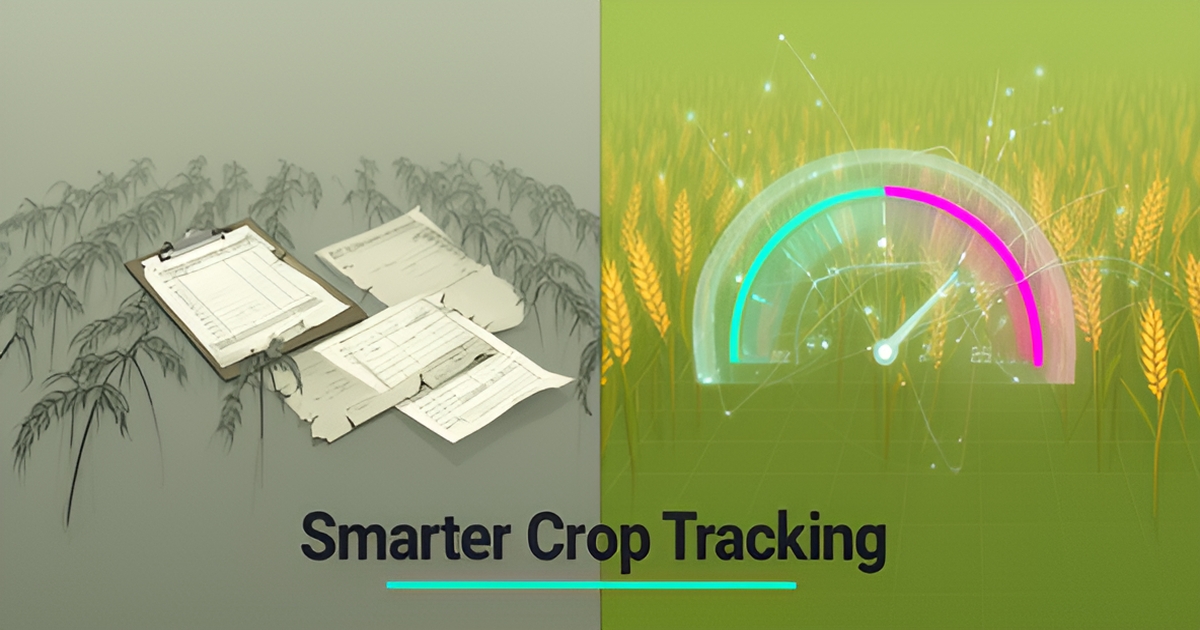
The Real Cost of Manual Crop Tracking — And How AI Fixes It
Key Facts
- Manual crop tracking typically creates fragmented records and delayed reporting that worsen as farms grow
- Pests and diseases can threaten a substantial share of crops when manual tracking delays detection
- AI-assisted yield prediction typically outperforms manual forecasting when fed consistent in-season data
- Precision agriculture AI commonly cuts fertilizer and pesticide waste by guiding application timing
- Drone and satellite monitoring can detect disease days or weeks earlier than manual scouting
- Satellite-based monitoring typically requires no on-farm hardware investment to start
Hire a team member that works 24/7 — for less than a part-time wage.
AI receptionists, SDRs, dispatchers and 99+ roles. Trained on your business, fully managed.
Not sure where to start? Ask our AI planner
Why Manual Crop Tracking Quietly Drains Your Operation
You know the field better than anyone — until the paperwork piles up and the details start slipping through the cracks.
Manual crop tracking creates a quiet drain that compounds with every acre and every season. Records fragment across notebooks, spreadsheets, and memory. Reporting lags behind the decisions you need to make today. Historical data becomes unusable because it was never captured consistently in the first place. As farm size, crop diversity, and operational complexity grow, manual tracking typically becomes harder to manage — turning what worked at five acres into a liability at five hundred.
- Fragmented records across paper, spreadsheets, and memory
- Delayed reporting that misses critical intervention windows
- Decisions based on recall rather than measurable data
- Historical data too inconsistent for year-over-year planning
The stakes are measurable. Pests and plant diseases can threaten a large share of crops when detection comes too late, and production losses tied to manual oversight are consistently reported in industry research as significant. Late identification means treatments cost more, cover more ground, and recover less yield. Modern AI yield prediction models can reach high accuracy at the field level when fed consistent in-season data — something manual systems rarely deliver.
AIQ Labs builds AI-powered monitoring systems that replace guesswork with real-time performance metrics. With 200+ multi-agent systems deployed and four live SaaS products we run daily, the same engineering rigor now applies to crop intelligence — turning scattered observations into a single, queryable view of every field, every day.
The Compounding Price of Bad Data and Slow Decisions
Manual records don't just slow the farm down — they quietly erode the margin on every acre. When data lives in notebooks, spreadsheets, and memory, decisions arrive late and with gaps that cost real money.
Fragmented records, delayed reporting, and limited historical data usability make accurate input application by crop stage nearly impossible and turn timely interventions into guesses.
Input waste compounds fast when application timing is off. Farms that move to precision agriculture AI routinely report meaningful reductions in fertilizer and pesticide use — the savings reflect what happens when inaccurate timing and over-application are removed from the routine.
Pest and disease windows are even less forgiving. Manual tracking increases the risk of missing early signs, and operations using drone- or satellite-based monitoring typically catch stress days to weeks earlier than walking-row scouting alone — a gap that represents real recoverable yield.
Yield forecasting errors lock in the damage late in the season. Manual systems struggle with visibility across teams, which drives planning errors and unreliable resource allocation. AI yield modeling, fed consistent in-season data, typically improves forecast accuracy enough to make sales commitments and input planning far more reliable.
The scale of loss is stark. Industry research consistently ties a substantial share of crop production losses to the limitations of manual tracking. That loss is not a single event; it is the accumulation of small, repeated missteps.
Bad data creates a cascade of expensive decisions:
- Fertilizer and pesticide applied at the wrong growth stage, increasing cost without return
- Pest and disease outbreaks missed until visible damage is irreversible
- Yield forecasts built on incomplete history, leading to overcommitment or missed contracts
- Administrative time spent reconciling records instead of acting on field conditions
Real-time performance metrics change the equation by replacing memory and paperwork with continuous field visibility. AIQ Labs designs AI-powered monitoring systems that deliver those metrics, enabling faster decision-making and closing the gap between observation and action.
What AI-Powered Crop Monitoring Actually Delivers
The numbers tell a story that spreadsheets never could. Farms that deploy drone- or satellite-based monitoring routinely catch disease stress earlier than walking-row scouting allows — often by a week or more. That gap between walking rows and seeing stress from above represents real money per acre in recoverable yield.
- Yield prediction accuracy typically improves meaningfully with in-season satellite updates
- Input costs commonly drop through variable-rate application guided by real-time field data
- Fertilizer and pesticide savings compound across every treated acre
- Satellite-based monitoring requires no on-farm hardware investment to start
These aren't pilot-project promises. As of late 2026, precision agriculture has moved well beyond early adoption, with a growing share of commercial farms running AI-assisted systems. The performance gap comes from replacing periodic human observation with continuous, multi-spectral data capture that feeds models trained on millions of field images. AIQ Labs builds monitoring pipelines that ingest this stream, flag anomalies against crop-stage baselines, and surface the exact intervention window — whether that's a nitrogen adjustment at V6 or a fungicide pass before sporulation. The difference between guessing and knowing is measured in bushels, not features.
How to Move from Spreadsheets to Smart Monitoring
Switching from spreadsheets to smart monitoring starts with picking one painful workflow, not the whole farm. Operations that try to digitize everything at once stall; those that target a single high-impact process see momentum fast.
Start with the workflow that costs the most in time and errors. Pest detection and irrigation scheduling are common first wins because delays here compound quickly. Digital crop tracking reduces reliance on memory or paperwork and supports more data-driven farming decisions, while manual systems create fragmented records, delayed reporting, and limited historical data usability.
A single pilot builds confidence and data. A practical first-step path looks like this:
- Map the current manual steps for one field or crop block and measure time spent per entry
- Define the decision the data must enable, such as spray timing or irrigation depth
- Capture field data instantly with a digital layer and validate accuracy against known outcomes
- Scale the workflow once error rates drop and decisions speed up
Satellite-based monitoring lowers the barrier for farms avoiding hardware investment. Satellite imagery can provide NDVI, biomass, and moisture proxies without new on-farm equipment. This approach is especially useful for irrigation scheduling and early stress detection across dispersed fields.
AI adds the interpretation layer that spreadsheets cannot. AI-powered systems deliver real-time performance metrics, enabling faster decision-making for farmers — and helping address the threat posed by pests and plant diseases that thrive when detection comes late.
Ownership matters when building long-term monitoring. AIQ Labs builds custom crop monitoring systems that farmers own outright, with no subscription lock-in. Development can be structured milestone by milestone, so you approve and pay for each phase as it ships and keep everything built so far. If you'd rather start with staff capacity instead of infrastructure, our AI Employees handle dispatch, reporting, and coordination roles at a fraction of a human hire's cost.
The model fits the AI Performance Metrics & Monitoring context by replacing manual tracking with systems that surface real-time KPIs for crop health, inputs, and yield risk. Teams get visibility across crews without chasing notebooks or reconciling spreadsheets at month-end. For farms with one workflow bleeding the most time and money, a focused Workflow Build is often the fastest entry point.
Implementation stays practical. Start with one high-pain workflow, prove value with satellite data and AI interpretation, then expand to additional fields and decisions. This staged approach reduces risk, builds internal buy-in, and creates an owned asset that compounds in value each season.
Still paying for 10+ subscriptions that don’t talk to each other?
We build custom AI systems you own outright. No vendor lock-in. Full control.
Not sure where to start? Ask our AI planner
Frequently Asked Questions
How much can manual crop tracking actually cost a farm in lost production?
Can AI really detect crop diseases earlier than manual scouting?
Do I need to buy expensive hardware to start using satellite-based crop monitoring?
How much can AI improve yield prediction accuracy compared to manual methods?
Is it better to digitize the whole farm at once or start small when switching from spreadsheets?
What kind of input cost savings can precision agriculture AI deliver?
From Paper Trails to Performance Metrics
Manual crop tracking quietly compounds into lost yield, wasted inputs, and late interventions. Fragmented records, delayed reporting, and decisions based on recall create a cascade of expensive missteps — from fertilizer applied at the wrong stage to disease caught after damage is irreversible. The farms seeing real gains are replacing that cycle with continuous visibility: satellite and drone data fed into models that flag stress early, tighten yield forecasts, and guide variable-rate applications that cut costs without cutting performance. You don't need to digitize everything at once. Start with one high-pain workflow — pest detection, irrigation scheduling, or spray timing — map the manual steps, define the decision the data must enable, and prove value with a focused pilot. AIQ Labs builds custom crop monitoring systems farmers own outright, with milestone-based development that lets you approve and pay per phase as it ships — or a fully connected AI Operating System built in phases when you're ready to connect more of the operation. Ready to see where the biggest ROI is hiding in your operation? Start the 2-minute Fit Check at https://aiqlabs.ai/apply for a free 30-minute strategy call to map your bottleneck and build a practical plan. Every season you stay on paper is a season of recoverable yield left in the field — real-time performance metrics close that gap.
Make AI your competitive advantage — not just another tool.
Strategy, implementation and ongoing optimization. One partner, end to end.
Not sure where to start? Ask our AI planner