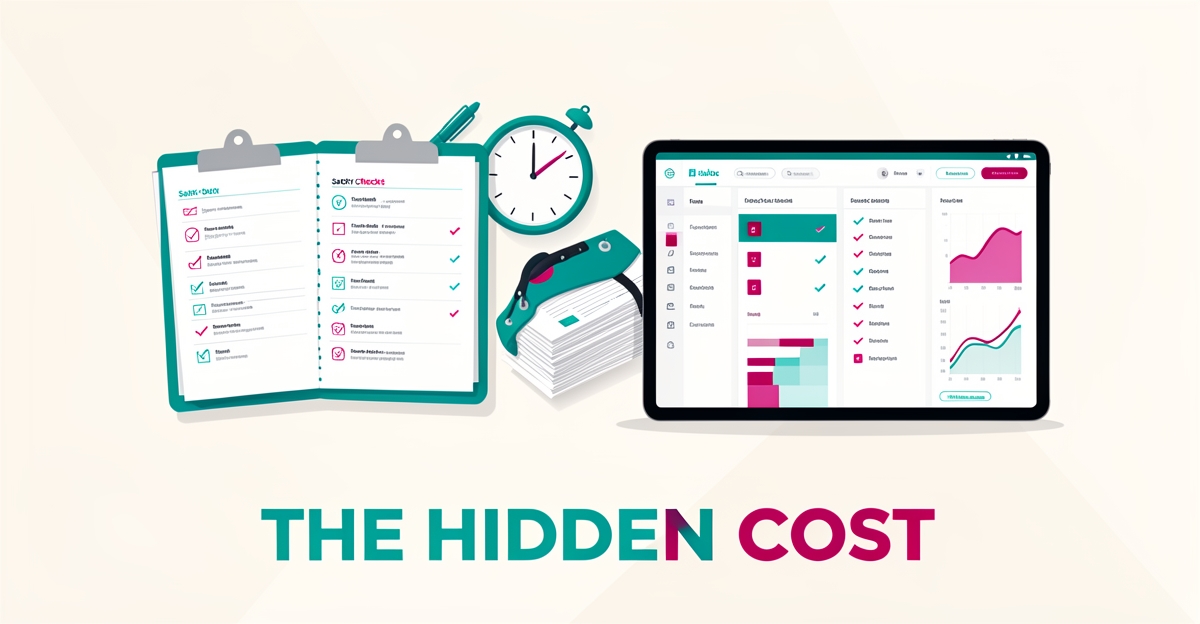
The Real Cost of Manual Dive Safety Recordkeeping: Why AI Saves Time and Money
Key Facts
- Manual safety recordkeeping means paying twice: once to record the data, and again to find and fix the mistakes.
- Missed inspection dates, expired certifications, and illegible logs are the most common failure points auditors and insurers notice first.
- Well-built automation typically eliminates a large share of weekly manual data entry — often 20+ hours for busy operations.
- Embedding validation directly into the workflow (required fields, expiry flags, audit-ready exports) is what actually reduces errors — not digitizing paper forms as-is.
- Dive shops that own their automation outright avoid vendor lock-in and keep full control over safety data.
Hire a team member that works 24/7 — for less than a part-time wage.
AI receptionists, SDRs, dispatchers and 99+ roles. Trained on your business, fully managed.
Not sure where to start? Ask our AI planner
The Hidden Financial Drain of Manual Dive Safety Recordkeeping
Walk into almost any dive shop and you will find the same quiet bottleneck: clipboards, spreadsheets, and staff re-entering the same safety information by hand. Manual recordkeeping remains the default across much of the industry, and that single dependency quietly inflates labor costs while multiplying compliance risk.
The first cost is pure labor time. Every dive generates paperwork — safety logs, equipment inspections, certification checks, waiver verification — and every one of those tasks consumes staff hours that could go toward customers, instruction, or revenue-generating work. Manual recordkeeping is inherently time-consuming and error-prone, which means managers pay twice: once to record the data, and again to find and fix the mistakes.
The second cost is error-driven risk. Handwritten logs get misread, inspection dates get missed, and certification records go stale without anyone noticing until an audit or an incident forces the issue. Those gaps translate directly into compliance exposure — and in a safety-critical industry, the financial consequences of a failed inspection or a liability claim dwarf the cost of the paperwork itself.
The hidden expenses compound in ways most shop owners never total up:
- Staff hours lost to duplicate data entry across logbooks, spreadsheets, and filing cabinets
- Missed inspection and certification deadlines that create regulatory exposure
- Illegible or incomplete safety records that weaken your position in liability disputes
- Lost or damaged paper records with no backup when they are needed most
- Manager time diverted from operations to manual compliance chasing
The alternative is already proven in practice. When validation is embedded directly into the workflow — automated expiry flags, enforced fields, audit-ready exports — busy operations routinely recover 20+ hours of manual data entry per week, and error rates drop sharply because mistakes are caught at the point of entry instead of after. The efficiency gains mirror what automation delivers in other regulated industries.
This is the problem space AIQ Labs works in every day — taking a manual, high-stakes workflow and rebuilding it as an automated system the business owns outright. For dive operators, the math is straightforward: every season spent on paper-based recordkeeping is another season of paying for labor, errors, and risk that automation has already made optional.
How AI Automation Reduces Dive Safety Errors and Compliance Risks
Manual safety logs are more than a paperwork headache — they're a liability. When instructors rely on paper forms or disconnected spreadsheets, missed inspections and expired certifications slip through the cracks, creating gaps that regulators and insurance auditors notice first. The dive industry runs on trust, and trust breaks when records don't hold up.
AI-powered tools flip that model by embedding validation directly into the workflow rather than bolting it on afterward. Instead of someone remembering to check an expiration date, the system flags it. Instead of a form that can be submitted half-complete, required fields and photo evidence are enforced at the point of entry. The result: fewer errors, fewer surprises, and far less time spent chasing signatures and cross-referencing dates.
- Automated certification tracking flags expiring credentials before they lapse
- Digital inspection forms enforce required fields and photo evidence at the point of entry
- Unified dashboards give owners real-time visibility across boats, sites, and instructors
- Audit-ready exports eliminate the scramble when regulators request records
The impact extends beyond admin. When recordkeeping and training share a digital backbone, instructors get consistent, current materials and safety data flows to the people who need it — before a trip, not after an incident. Training standards such as ISO 24801 continue to define what competent instruction looks like, and digital systems make it far easier to document that those standards are being met consistently.
AIQ Labs builds this class of workflow automation for regulated industries. Whether it's a targeted AI Workflow Build that rebuilds the one recordkeeping workflow costing you the most, or a full AI Operating System that connects safety logs, scheduling, and customer management into one layer, the pattern holds: when validation lives inside the process instead of after it, shops spend less time fixing records and more time running safe trips.
Implementing AI for Dive Operations: From Assessment to Automation
Dive shops still relying on manual safety recordkeeping face hidden costs that extend far beyond paper and ink. Errors and compliance risks are built into the manual workflow itself, leading to avoidable incidents and regulatory penalties. These inefficiencies drain staff hours that could be spent on customer experience or skill development instead of chasing down missing logs or correcting certification dates.
AIQ Labs helps dive shops transition from reactive paperwork to proactive automation through a structured, phased process. The journey begins with a discovery phase, where workflows are analyzed to pinpoint bottlenecks in safety logging, inspections, and certification tracking. Solutions are built around your real operational needs rather than generic templates — if the assessment shows the biggest drain is certification tracking, that's what gets rebuilt first.
During the build, custom AI agents are developed to automate safety gates, reduce manual entry, and synchronize data across your existing customer management and scheduling tools. The goal is a single source of truth for all safety records — not another disconnected app added to the pile. Where it makes sense, AI Employees can handle the repetitive coordination work (dispatching, scheduling follow-ups, record requests) at a fraction of the cost of another administrative hire.
Deployment and training follow, with staff brought up to speed on the new systems, and ongoing optimization ensures the automation evolves with the shop's growth. Because you own the custom-built system outright, you avoid vendor lock-in and keep full control over your safety data and future enhancements. Payment is flexible too: start monthly and pause anytime, build in milestones and stop whenever it's earned, or own it outright from day one. This end-to-end approach transforms recordkeeping from a liability into a streamlined, compliant advantage.
Still paying for 10+ subscriptions that don’t talk to each other?
We build custom AI systems you own outright. No vendor lock-in. Full control.
Not sure where to start? Ask our AI planner
Frequently Asked Questions
How much time and money does manual dive safety recordkeeping actually cost my shop?
Do most dive shops still use paper-based or manual methods for safety records?
How does AI automation reduce errors and compliance risks in dive safety recordkeeping?
Will switching to AI-powered recordkeeping disrupt my current operations or require replacing all my systems?
Are regulators and training agencies open to digitally assisted safety records and training content?
What does implementation look like, and do I have to commit to a long-term subscription or vendor lock-in?
From Paper Logs to Peace of Mind: The AI Advantage for Dive Shops
The picture is clear: manual dive safety recordkeeping isn't just tedious — it's a silent drain on time, money, and trust. The hidden costs of duplicate data entry, missed inspections, and compliance exposure add up fast, and they compound every season nothing changes. AI-powered automation changes that equation by embedding validation into safety logs, inspections, and certification tracking, cutting labor hours and shrinking error rates where it matters most. For dive operators ready to move beyond reactive paperwork, the path forward starts with understanding where the costs actually sit. AIQ Labs helps dive shops assess their workflows, build custom automation they own outright, and transform recordkeeping from a liability into a streamlined advantage. Start with the 2-minute Fit Check to map your biggest bottleneck, then take a free 30-minute strategy call to see where AI can save your team the most time — no obligation, just clarity.
Make AI your competitive advantage — not just another tool.
Strategy, implementation and ongoing optimization. One partner, end to end.
Not sure where to start? Ask our AI planner