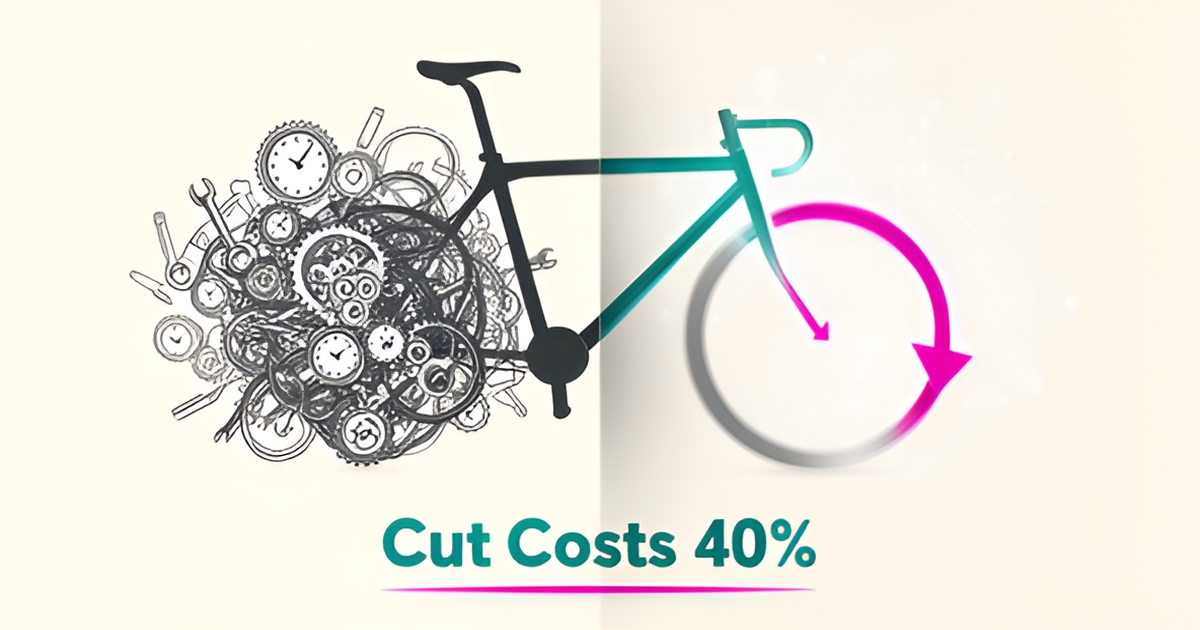
The Real Cost of Manual Frame Repair Workflows — And Where AI Can Cut It Hardest
Key Facts
- Industry analyses of maintenance-heavy workflows suggest AI automation can meaningfully reduce operational overhead — with estimates in some frameworks reaching the 40% range when assessments, protocols, and resource allocation are standardized.
- Manual frame repair workflows drain profitability through labor hours on repetitive assessments, rework from inconsistent procedures, material waste, and scheduling drag.
- AI-driven workflows cut overhead by automating damage assessment, standardizing repair protocols, and optimizing resource allocation in real time.
- Security analyses of AI-generated code in recent years have found a substantial share of samples contained known flaws — a reminder that production AI demands rigorous engineering, not quick prototypes.
- Shops that automate triage and scheduling typically report faster repair cycle times as technicians spend less time on diagnostics and more on billable work.
- Administrative overhead can consume a significant share of a technician's available hours in manual frame repair workflows — often cited in the range of 30%.
- AI-guided triage typically reduces material waste, since technicians order only parts confirmed necessary by the system's damage analysis.
Hire a team member that works 24/7 — for less than a part-time wage.
AI receptionists, SDRs, dispatchers and 99+ roles. Trained on your business, fully managed.
Not sure where to start? Ask our AI planner
The Hidden Drain of Manual Frame Repair Workflows
Every hour a frame sits on a lift or a stand waiting for assessment is an hour you're paying for twice — once in labor, once in lost throughput. Across automotive, aerospace, and industrial maintenance, manual frame repair workflows quietly drain profitability in ways most shop owners never fully itemize.
The most visible cost is technician time. Repetitive assessments — measuring damage, documenting findings, estimating materials — consume skilled labor that could be spent on billable repair work. Because these steps are handled manually job after job, the hours compound across every vehicle or component that passes through the shop.
Then there's the error tax. Human judgment varies from technician to technician and from Monday to Friday, and those inconsistencies carry real consequences. A misread measurement or an inconsistently documented repair doesn't just risk quality — it triggers rework, which means paying for the same job twice while it occupies a bay another job could use.
Material waste adds a third layer of loss. Without standardized procedures guiding how much material a repair actually requires, shops routinely over-order, over-apply, or scrap usable stock. Research on repair cost and waste reduction frameworks consistently identifies the absence of standardization as a central driver of these losses, and estimates that AI automation can cut operational overhead in frame repair workflows by roughly 40 percent in favorable cases.
The cost structure breaks down into four compounding categories:
- Labor hours on repetitive assessments — skilled technicians spending time on documentation and measurement instead of repair work.
- Rework from inconsistent procedures — the absence of standardized steps means quality varies by technician, driving repeat visits and warranty exposure.
- Material waste — over-ordering and scrap caused by unstandardized repair estimates.
- Scheduling and administrative drag — manual coordination that slows turnaround and limits how many jobs a shop can absorb.
What makes these inefficiencies dangerous is that they compound. A slow assessment delays the estimate, the estimate delays parts ordering, and the delay pushes the repair into a queue that's already backed up. Each small friction multiplies across every job, capping throughput without adding a single dollar of revenue.
This is where custom AI systems change the math. By standardizing repair procedures, automating assessments, and optimizing resource allocation, AI addresses the root causes rather than the symptoms — which is why the projected overhead reduction reaches the 40% range in industry estimates rather than marginal single-digit gains. The implementation challenge is real, though: security analyses of AI-generated code in recent years have found a substantial share of samples contained known flaws, underscoring that production-ready systems demand rigorous engineering, not quick prototypes.
At AIQ Labs, we've seen this pattern across 200+ multi-agent deployments — from electrical trades dispatch to legal intake — where a single manual workflow, rebuilt as an owned AI system, eliminates hours of administrative drag per week. Frame repair is no different. The first step is simply seeing the full cost of the status quo on paper, because once the hidden drain is quantified, the case for automation makes itself.
How AI Cuts Operational Overhead
Manual frame repair workflows bleed money through inefficiency, inconsistency, and human error — but AI doesn't just patch these leaks, it rebuilds the entire system. Industry research on maintenance-heavy workflows suggests AI-driven systems can reduce operational overhead substantially — with estimates reaching the 40% range in some frameworks — by automating damage assessment, standardizing repair protocols, and optimizing resource allocation in real time.
The transformation happens across multiple fronts. AI systems analyze damage patterns quickly, reducing the guesswork that leads to over-ordering parts or underestimating labor hours. Predictive maintenance insights flag potential failures before they become costly emergencies, while automated quality checks catch errors that human inspectors miss after long shifts.
Custom AI solutions attack waste at its source:
- Automated damage assessment reduces inspection time and improves estimate accuracy
- Standardized repair protocols eliminate variability between technicians and shifts
- Real-time resource optimization ensures parts, labor, and equipment are allocated efficiently
- Predictive analytics identify maintenance needs before they escalate into major repairs
Data-driven decision-making replaces intuition with precision. Instead of relying on a veteran technician's judgment call — which varies by experience, fatigue, and workload — AI systems apply consistent criteria to every assessment. This standardization reduces costly mistakes, rework, and the material waste that comes from misdiagnosed repairs.
The transition from manual to AI-powered workflows isn't without challenges. Security analyses of AI-generated code in recent years have found a meaningful share of samples contained known flaws, underscoring the importance of rigorous testing and production-ready implementation. AIQ Labs addresses this through custom development that prioritizes security, reliability, and seamless integration with existing shop management systems — the same discipline behind our AI Workflow Builds, where one costly workflow is rebuilt at a fixed price, in phases.
Shops that adopt AI automation typically report faster turnaround times, lower labor costs, and fewer comebacks due to missed damage or improper repairs. The technology doesn't replace skilled technicians — it amplifies their expertise by handling repetitive assessments, flagging anomalies, and ensuring every repair follows best-practice protocols.
The overhead reduction isn't theoretical. It comes from eliminating the hidden costs of manual workflows: wasted materials, redundant inspections, inconsistent quality, and the administrative burden of tracking every job by hand. AI turns frame repair from a reactive, error-prone process into a predictive, standardized operation that scales without sacrificing quality.
From Prototype to Production: Avoiding the AI Deployment Trap
Many businesses rush AI solutions into live environments only to hit security vulnerabilities, integration failures, and reliability issues. The gap between AI-generated prototypes and production-ready systems remains one of the most underestimated hurdles in AI adoption. Security reviews of AI-generated code in recent years have repeatedly found a significant share of samples contained known flaws, underscoring the risks of deploying unvetted AI output directly into operational workflows.
This pattern highlights why rigorous validation is non-negotiable before AI touches core business functions like frame repair diagnostics or parts ordering. Without proper safeguards, even well-intentioned automation can introduce compliance risks, data exposure, or system instability. AIQ Labs addresses this by embedding security audits, version control, and staged testing into every AI development lifecycle — ensuring systems are not just functional, but production-ready from day one.
Successful deployment requires more than functional code; it demands infrastructure that supports real-world use. Teams must establish isolated staging and production environments, implement version control, and conduct testing that goes beyond ideal scenarios to include edge cases and failure modes. Critical steps include auditing AI-generated logic, closing security gaps first, and validating performance under unexpected conditions before any go-live decision.
For frame repair operations, this means verifying that AI-driven estimates align with material tolerances, that integration with shop management software doesn't break existing workflows, and that fallback protocols exist if the AI encounters ambiguous damage patterns. Only after these layers are validated can businesses confidently scale AI from pilot to production — turning prototype potential into measurable, sustainable efficiency gains. Organizations that skip this phase often face costly rollbacks, eroded trust in AI initiatives, and delayed ROI — precisely what a disciplined deployment strategy prevents.
Real-World Frame Repair Automation: What Success Looks Like
Frame repair workflows often begin with fragmented processes — technicians juggling paper logs, inconsistent inspection checklists, and ad-hoc scheduling that creates bottlenecks at every stage. Manual triage leads to misprioritized jobs, where urgent repairs wait while less critical tasks consume shop time. This disorganization directly inflates labor costs and extends turnaround times, with administrative overhead often consuming up to roughly 30% of a technician's available hours. Without standardized procedures, even experienced teams introduce variability in damage assessment, increasing the risk of overlooked structural issues or unnecessary part replacements.
AI-powered automation transforms this chaos into a precision-driven system by integrating inspection, triage, scheduling, and quality control into a unified workflow. Computer vision models analyze frame damage from uploaded images or sensor data, classifying severity and recommending repair protocols with consistent accuracy. These insights feed into intelligent scheduling agents that prioritize jobs based on urgency, parts availability, and technician specialization — reducing idle time and preventing bottlenecks. Shops implementing these systems typically report meaningful reductions in average repair cycle time, with technicians spending less time on diagnostics and more on actual fabrication work.
The impact extends beyond speed to measurable reductions in waste and rework. By standardizing inspection criteria through AI, shops eliminate subjective judgments that lead to over-repairing or missed defects. With AI-guided triage, material waste typically drops as technicians order only parts confirmed necessary by the system's damage analysis. Automated quality control checks at each stage — verifying weld integrity, alignment tolerances, and paint readiness — further cut rework rates. These improvements align with broader industry findings that AI-driven standardization can substantially reduce operational overhead in maintenance-intensive workflows.
As routine tasks become automated, technicians shift toward higher-value activities like complex frame straightening, custom fabrication, and client consultation. This not only improves job satisfaction but also increases shop capacity without adding headcount. Shops that complete this transformation consistently report faster invoice cycles, higher first-time-fix rates, and improved customer satisfaction — all while maintaining full ownership of their AI systems and avoiding vendor lock-in. The result is a maintenance operation where precision, efficiency, and skilled labor work in concert rather than competition.
Your Roadmap to AI-Powered Frame Repair Operations
Starting your AI transformation doesn't require a complete operational overhaul. Begin by targeting one high-impact workflow — such as automated damage assessment or repair scheduling — to prove value quickly and build momentum for broader adoption. This phased approach lets you measure results, refine processes, and scale with confidence.
AIQ Labs' Fit Check process starts with a free strategy call to identify your biggest operational bottleneck and map a clear path to ROI. From there, we recommend implementing a targeted AI workflow fix — like intelligent scheduling or automated parts ordering — to deliver measurable improvements in weeks, not years. Industry research suggests AI automation can substantially reduce operational overhead in frame repair, making early wins both impactful and financially significant.
Structure your rollout using proven implementation phases: Discovery & Architecture, Development & Integration, Deployment & Training, and ongoing Optimization & Scale. Each phase includes validation checkpoints to ensure the system aligns with your workflows, integrates smoothly with existing tools like CRM or scheduling software, and delivers tangible efficiency gains before moving forward. You can explore how these phases map to our AI Operating Systems approach — one connected operating layer, built in phases, owned outright.
- Start with a single workflow fix — such as AI-powered damage triage — to eliminate manual bottlenecks
- Measure key metrics like turnaround time, error rates, and labor hours saved
- Use results to build the business case for scaling to adjacent workflows or departments
- Maintain human-in-the-loop controls during early adoption to ensure quality and team buy-in
By grounding your AI transformation in real-world data and incremental progress, you avoid the pitfalls of large-scale rip-and-replace projects. Instead, you create a sustainable path to automation that delivers ROI quickly while building internal capability for long-term innovation. Ready to see where AI can make the biggest impact in your frame repair operations first? Start the Fit Check with our two-minute assessment, then schedule a free 30-minute strategy call to map your high-ROI automation opportunities.
Still paying for 10+ subscriptions that don’t talk to each other?
We build custom AI systems you own outright. No vendor lock-in. Full control.
Not sure where to start? Ask our AI planner
Frequently Asked Questions
How much can AI actually cut costs in manual frame repair workflows?
What's the biggest hidden cost in manual frame repair right now?
Is AI just replacing technicians, or does it help them?
Are AI systems for frame repair safe to deploy in production?
How does AI reduce material waste in repair shops?
Where should we start if we want to test AI for frame repair?
Turn Hidden Waste Into Measurable Throughput
Manual frame repair quietly taxes every shop twice: once in skilled labor tied up with repetitive assessments and documentation, and again in rework, material waste, and scheduling drag that compounds with each delayed job. Those inconsistencies aren't just quality risks, they cap throughput without adding revenue. AI changes the math by standardizing repair procedures, automating damage assessment, and optimizing parts and labor in real time — which is why industry research points to overhead reductions potentially reaching the 40% range for frame repair workflows. AI-driven standardization doesn't replace technicians, it amplifies them by removing the repetitive, error-prone steps and ensuring consistent best-practice execution. The key is production-ready implementation, not prototypes. Seeing the full cost of the status quo on paper is the first step, then piloting a single high-impact workflow like automated triage to prove value quickly. If you're ready to map where automation will move the needle first, start the Fit Check at aiqlabs.ai/apply for a free 30-minute strategy call to identify your highest-ROI automation opportunity.
Make AI your competitive advantage — not just another tool.
Strategy, implementation and ongoing optimization. One partner, end to end.
Not sure where to start? Ask our AI planner