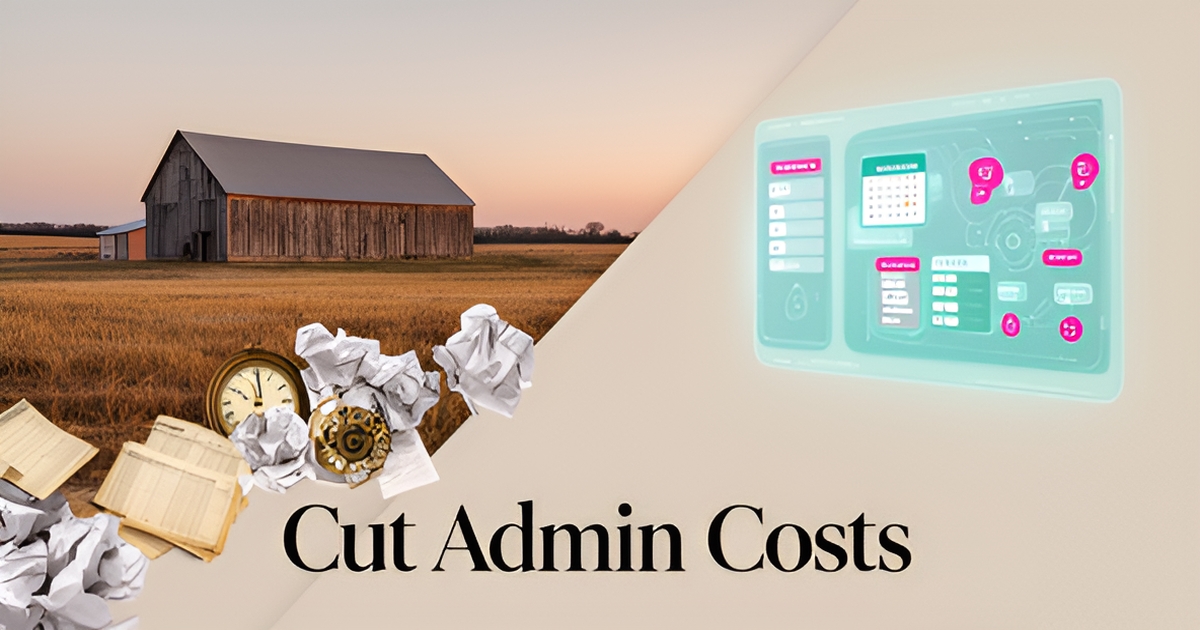
The Real Cost of Manual Operations in Agritourism: Why AI Saves Time and Money
Key Facts
- Automating guest records, bookings, and communications can meaningfully reduce the labor cost of those workflows, according to Iowa State Extension research.
- The hidden labor costs of managing guest records, bookings, and communications are substantial and often overlooked per case study analysis.
- AI and machine learning offer significant potential for enhancing economic impacts in agritourism says Colorado State University Extension.
- AI reduces long-term operating costs while manual work scales linearly with headcount according to efficiency research.
- AI accuracy improves over time with data and feedback loops while manual accuracy varies by person per comparative analysis.
- Agritourism businesses face persistent challenges optimizing resources, attracting visitors, and maintaining profitability per Extension research.
Hire a team member that works 24/7 — for less than a part-time wage.
AI receptionists, SDRs, dispatchers and 99+ roles. Trained on your business, fully managed.
Not sure where to start? Ask our AI planner
The Hidden Labor Crisis in Agritourism
The administrative workload in agritourism often operates below the surface, quietly draining resources that could fuel growth. Managing guest records, coordinating bookings, and handling multi-channel communications can consume 20 or more hours weekly for many farm owners—time that directly competes with revenue-generating activities like farm tours, product sales, and guest engagement. Industry analysis confirms these tasks represent a disproportionate share of operational expenses, creating bottlenecks during peak seasons when demand is highest.
This hidden labor crisis forces agritourism operators into administrative roles rather than strategic ones. Instead of enhancing visitor experiences or developing new offerings, owners find themselves buried in data entry, scheduling conflicts, and communication follow-ups. The cumulative effect is a misallocation of talent where human potential is spent on repetitive tasks that could be systematized. Research from agricultural extension programs highlights how these manual processes not only increase labor costs but also limit scalability and responsiveness to visitor needs.
- Guest record management requires constant updates across multiple systems
- Booking coordination involves back-and-forth communication that delays confirmations
- Multi-channel communications create fragmentation in guest interactions
- Peak season volumes amplify administrative strain disproportionately
- Manual processes increase error rates in reservations and guest data
The result is a cycle where operational inefficiencies suppress revenue potential. Farm owners report that administrative tasks prevent them from pursuing partnerships, refining marketing strategies, or investing in experience improvements—all critical for long-term competitiveness. Studies on work efficiency show that when owners shift from execution to oversight through automation, they reclaim time for high-impact decisions that drive profitability. Breaking this cycle begins with recognizing where labor is truly being spent—and where it could be better deployed.
Why Manual Processes Break Down at Scale
Every hour a farm spends manually updating guest records or reconciling bookings is an hour that doesn't scale. The problem isn't work ethic—it's structure. Human-dependent workflows carry built-in limitations that only get more expensive as visitor volume grows.
The most obvious limitation is cost. Manual work scales linearly with headcount: more bookings means more staff, and every hire brings salary plus benefits and taxes that typically add 25–35% on top of base pay, according to comparative research on AI versus manual efficiency. AI systems, by contrast, reduce long-term operating costs because they don't grow with volume. This is why automation can meaningfully cut the operational cost of managing guest records, bookings, and communications for farms.
Fatigue introduces a second, quieter cost. Human accuracy varies by person, by day, and by workload, while AI accuracy improves over time as data accumulates and feedback loops tighten. Manual processes carry well-documented risks of inconsistency and fatigue-driven errors—particularly in the tasks farms spend the most time on:
- Data entry and validation, where repetitive transcription invites mistakes
- Reconciliation of bookings, payments, and guest records across systems
- Customer support triage, where response times lag during peak seasons
- Demand forecasting, where manual estimates miss seasonal patterns
Coverage is the third structural gap. Manual work is constrained by human capacity—a 40-hour week at best—while AI enables continuous operation. For agritourism operators, that difference shows up at midnight, when a family is booking a pumpkin patch visit or asking about Saturday's hours. Providing 24/7 responsiveness with human staff alone would require prohibitive staffing expenses; an automated system answers instantly at no marginal cost.
Finally, there's the scaling problem. AI scales with minimal friction, while manual work requires workforce expansion—hiring, training, and onboarding that take weeks or months. During harvest festivals and holiday events, when demand spikes unpredictably, a human-dependent operation either absorbs the overload or drops inquiries on the floor. As Colorado State University Extension researcher Xue "Alice" Dong notes, agritourism businesses face persistent challenges in optimizing resources and maintaining profitability—precisely the pressures that linear-scaling workflows cannot absorb.
None of this means people disappear from the operation. The same research found that humans still outperform AI in strategic decision-making, complex negotiations, and relationship-driven roles—and that hybrid models often deliver better outcomes than full automation. The structural shift is this: AI changes cost curves, error distribution, and response time, while people concentrate on exceptions and judgment. Farms that recognize this distinction stop paying humans to do data entry and start paying them to create the experiences guests remember.
The AI Alternative: Ownership-Based Automation for Farms
The alternative to patching together a dozen software subscriptions isn't more software—it's owning a system built specifically for your farm. Instead of renting tools that never quite talk to each other, ownership-based automation replaces the subscription chaos with a single, unified digital asset that handles guest records, bookings, and communications end-to-end.
The concept isn't theoretical. The AI-Powered Agritourism Toolkit developed by Colorado State University Extension researchers demonstrates how AI and machine learning offer significant potential for enhancing economic and sustainable impacts in agritourism, streamlining operations while helping operators navigate complex regulations and optimize resources. The research identifies exactly the pain points farms feel daily: attracting visitors, managing resources, and staying profitable under regulatory complexity.
This is where ownership changes the economics. AIQ Labs builds custom AI systems that farms own outright—no vendor lock-in, no per-seat fees stacking up across platforms. Case study analysis suggests these ownership-based solutions can substantially reduce the labor costs of managing guest records, bookings, and communications.
The model works through AI Employees—managed AI staff trained on your specific operation that work like functional team members rather than website chatbots:
- AI Receptionist — answers every call 24/7, routes inquiries, takes messages, and schedules appointments, so no booking inquiry goes to voicemail during harvest season
- AI Booking Agent — handles reservations, confirms dates, and syncs directly with your calendar and payment tools
- AI Guest Coordinator — manages pre-visit communications, reminders, and follow-ups across phone, email, and SMS
The cost difference is structural, not marginal. A human employee in an equivalent role typically costs $35,000–$55,000 annually before benefits and taxes, and works 40 hours a week. AI Employees cost roughly 80% less than an equivalent human hire while working around the clock, every day of the year—no missed calls, no sick days, no seasonal hiring scramble. With 99+ roles available, the same model covers dispatchers, SDRs, and most back-office functions a growing farm operation needs.
This aligns with what efficiency research confirms broadly: AI reduces long-term operating costs while manual work scales linearly with headcount, and AI accuracy improves over time while manual accuracy varies by person and fatigue. AI excels precisely at the tasks that consume farm office hours—data entry, scheduling, customer support triage, and repetitive communications.
Farms can adopt this through three payment structures: Start Monthly (a flat monthly plan less than a part-time hire, with build, training, and monitoring included), Build in Milestones (pay per phase and keep everything built), or Own It Outright (full ownership of the code, agents, and data). The right path depends on whether you're fixing one workflow or automating the whole operation—and real numbers are provided in writing after a free strategy call, not behind invented price anchors.
Implementation Roadmap: From Manual to Automated in Weeks
Manual guest records, bookings and communications quietly drain agritourism margins every season. Phased automation moves farms from reactive admin work to continuous, owned operations without shutting down peak-season service.
A structured rollout typically spans 6 to 16 weeks and mirrors how seasonal businesses manage risk. Discovery and architecture starts with process mapping, data assessment and integration design. Development and integration builds custom workflows that connect existing booking, CRM and communication tools. Deployment and training puts the system live with role-based training for non-technical teams. Optimization and scale refines performance after the first busy period.
Phased approaches minimize disruption during peak seasons, a pattern seen in similar seasonal businesses where AI automation enables continuous operations while manual work is constrained by time and effort. Keeping human oversight in place during the first cycles protects guest experience while adoption grows.
The four-phase roadmap in practice:
- Discovery & Architecture, 1-2 weeks: map guest records, bookings and communications flows, assess data quality, design owned architecture and ROI model.
- Development & Integration, 4-12 weeks: build custom AI workflows, integrate with farm tools, validate accuracy and security.
- Deployment & Training, 1-2 weeks: go-live with human-in-the-loop controls, train farm teams on exception handling and daily use.
- Optimization & Scale, ongoing: monitor cost, error rates and response time, expand automation to additional workflows.
Governance is built in from the start. Human-in-the-loop controls govern guest-facing decisions like pricing exceptions, refunds and special requests. Audit trails, data privacy controls and role-based permissions support compliance for booking and personal data. Adoption strategies focus on simple interfaces, clear escalation paths and weekly feedback loops with farm staff.
AI and machine learning offer significant potential for enhancing economic and sustainable impacts in agritourism by streamlining operations and helping businesses navigate complex regulations while maintaining profitability. The hidden labor costs of managing guest records, bookings and communications can be substantial and often overlooked by operators, according to client challenge analysis.
AIQ Labs designs ownership-based automation for these exact workflows, whether that's a single Workflow Build targeting the one workflow that costs you the most, or a full AI Operating System connecting the whole operation. The result is a cost curve that shifts from headcount-dependent to oversight-driven, with accuracy that improves over time through feedback loops.
Start the 2-minute Fit Check at https://aiqlabs.ai/apply for a free 30-minute strategy call to map your biggest bottleneck and identify high-ROI automation opportunities.
Measuring ROI: Beyond Cost Reduction to Competitive Advantage
Manual operations in agritourism create hidden drains that extend far beyond visible labor costs. When guest records, bookings, and communications rely on manual processes, farms lose not just time but strategic opportunities to grow and innovate. AIQ Labs addresses these systemic inefficiencies through ownership-based automation that transforms cost centers into competitive advantages, with returns that compound over time.
The efficiency gains show up where the admin hours actually go. Routine inquiries get answered instantly instead of piling up in an inbox. Bookings confirm without back-and-forth email chains. Month-end reconciliation shrinks because records were validated at entry rather than chased down later. And because AI systems don't fatigue, error rates in reservations and guest data trend down over time rather than spiking during your busiest weeks. Efficiency research confirms AI excels in exactly these areas—data entry, reconciliation, and customer support triage—while scaling without fatigue.
- Capture early payment discounts through accelerated AP cycles
- Eliminate missed booking calls with 24/7 AI receptionists
- Enable dynamic pricing during peak demand using real-time demand forecasting
- Free owner time for experience innovation instead of administrative firefighting
These operational improvements compound into strategic benefits. Farms using AIQ Labs' owned systems—not perpetual SaaS subscriptions—gain control over their technology stack and long-term cost structure. By eliminating vendor lock-in and reducing dependency on recurring fees, AI becomes an appreciating asset that scales with the business. The result is a self-reinforcing cycle: lower costs fund innovation, innovation attracts more guests, and increased revenue enables further AI investment—all while maintaining true ownership of the systems driving growth.
Still paying for 10+ subscriptions that don’t talk to each other?
We build custom AI systems you own outright. No vendor lock-in. Full control.
Not sure where to start? Ask our AI planner
Frequently Asked Questions
How many hours a week do farm owners actually lose to admin work?
What’s the real cost of keeping everything manual?
Can AI actually cut agritourism operating costs?
Will automating admin mean laying off my team?
How long does it take to move from manual to automated?
Is owning an AI system better than subscribing to software?
From Admin Overload to Strategic Growth: Your Next Step
The hidden labor drain of manual guest records, bookings, and communications isn't just an inconvenience—it's a structural barrier to growth that scales with every booking and peaks during your busiest seasons. By shifting from execution to oversight through ownership-based AI automation, farms reclaim admin hours every week, cut the cost of routine operations, and free owners to focus on experience innovation instead of administrative firefighting. The path forward starts with clarity: take the 2-minute Fit Check at https://aiqlabs.ai/apply, then map your biggest bottleneck in a free 30-minute strategy call. You'll get real numbers and a plan built for your farm—no vendor lock-in, no guesswork. Prefer email? Reach the team at [email protected].
Make AI your competitive advantage — not just another tool.
Strategy, implementation and ongoing optimization. One partner, end to end.
Not sure where to start? Ask our AI planner