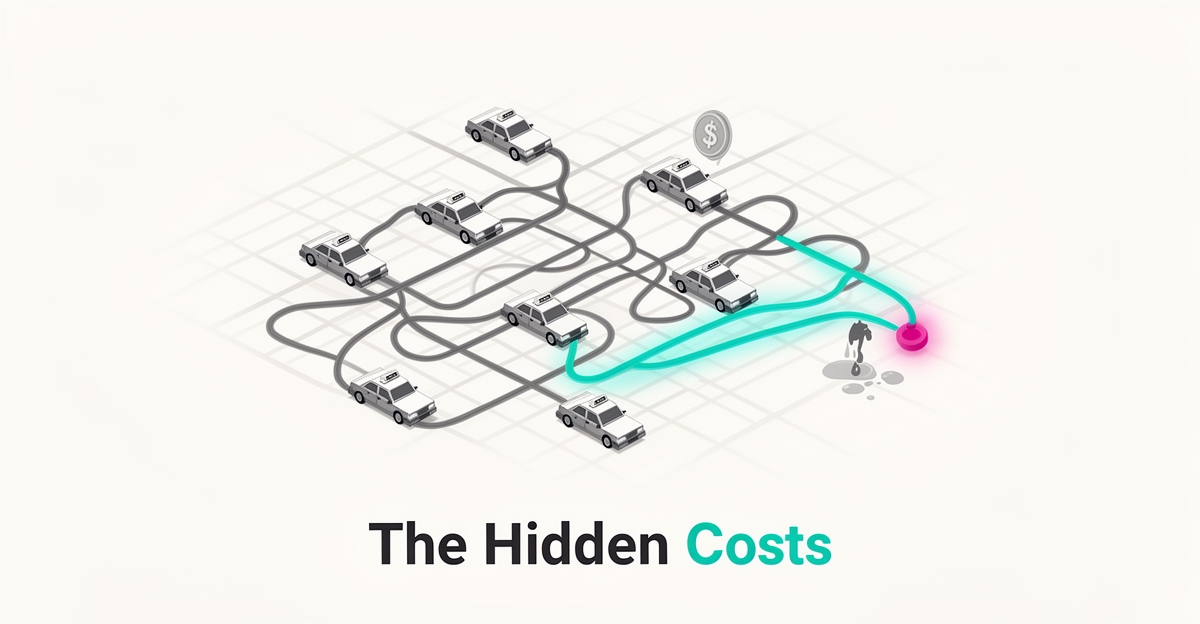
The Real Cost of Manual Ride Management in Taxi Operations
Key Facts
- Manual dispatching typically drives meaningfully higher total operating expenses than AI-optimized alternatives.
- A human dispatcher can typically manage only around 10–12 vehicles before service quality degrades.
- Human dispatchers typically cost several thousand dollars monthly, while AI systems carry a fraction of that per-vehicle cost.
- AI-assisted planning typically reduces daily planning time from hours to minutes.
- Intuition-based manual routing commonly produces higher fuel consumption through suboptimal paths and poor stop sequencing.
- Paper-based Hours of Service tracking creates compliance exposure, with fines for tracking errors that can reach into the thousands per incident.
- Fleets using AI-assisted routing typically reduce total miles driven, lowering fuel costs and vehicle wear.
Hire a team member that works 24/7 — for less than a part-time wage.
AI receptionists, SDRs, dispatchers and 99+ roles. Trained on your business, fully managed.
Not sure where to start? Ask our AI planner
The Hidden Cost Ceiling of Manual Dispatch
The hidden cost ceiling of manual dispatch isn't just an operational hiccup—it's a profitability limiter that scales with fleet size. Manual processes create a financial drag through labor inefficiency, fuel waste, and compliance exposure that compounds as vehicles increase, making growth increasingly expensive. For taxi and ride-hailing operations, this ceiling becomes particularly acute beyond modest fleet sizes.
Labor costs represent the most visible drain. A single human dispatcher can typically manage only around 10–12 vehicles before service quality degrades. Scaling beyond this means hiring additional dispatchers at a cost of several thousand dollars per month per role, creating a linear expense curve that AI systems flatten by enabling one dispatcher to oversee far more vehicles through automation. This dispatcher-to-vehicle ratio disparity is a major contributor to the higher total operating expenses fleets typically incur under manual dispatch.
Fuel inefficiency and compliance risks further erode margins. Manual routing, based on intuition rather than real-time data, commonly produces higher fuel consumption due to suboptimal paths and poor stop sequencing. Simultaneously, paper-based Hours of Service tracking introduces significant compliance vulnerability—fines for tracking errors can reach into the thousands of dollars per incident, and manual systems struggle to avoid them consistently.
These inefficiencies converge into substantial financial losses. For a mid-sized fleet, the combined cost of fuel waste, overtime, and administrative overhead under manual dispatch routinely reaches tens of thousands of dollars annually. AI-driven route optimization reduces total miles driven and slashes daily planning time from hours to minutes. The scalability limit of manual systems—typically breaking down past 25–30 vehicles—means these losses aren't static; they accelerate with every vehicle added beyond the threshold, turning operational growth into a profit drain rather than an advantage. AIQ Labs helps fleets break through this ceiling by building owned AI systems that automate dispatch logic while eliminating subscription dependencies.
Where Manual Processes Break Down at Scale
As taxi fleets grow beyond 25–30 vehicles, manual processes like paper logs and spreadsheets begin to break down under operational pressure. At this scale, dispatchers lose real-time visibility into vehicle locations and availability, leading to missed pickups, extended idle time, and inefficient routing that burns excess fuel. The result is typically higher total operating expenses compared to AI-optimized alternatives, with losses that grow alongside the fleet.
The time required for daily planning exposes another critical failure point: manual methods commonly consume an hour or more per day, while AI reduces this to minutes. This gap widens as fleet size increases, turning what was once a manageable task into a bottleneck that delays deployments and strains dispatcher capacity. Without real-time data, dispatchers cannot react instantly to breakdowns or traffic changes, forcing reliance on outdated schedules that compound delays and customer dissatisfaction.
These inefficiencies directly impact revenue and labor costs. Manual routing typically produces higher fuel consumption due to suboptimal paths, while poor vehicle allocation increases overtime and idle time. For fleets exceeding the 25–30 vehicle threshold, maintaining manual oversight often requires hiring additional dispatchers at several thousand dollars per month each—costs that vastly exceed the per-vehicle monthly cost of AI software. AIQ Labs helps taxi operators overcome these scaling limits by building custom AI systems that automate scheduling, fuel tracking, and compliance reporting, turning planning from a daily chore into a seamless background process. As fleets grow, the ability to make immediate, data-driven decisions becomes not just an advantage, but a necessity for profitability and service reliability.
How AI-Powered Ride Management Recovers Margin
Manual ride management quietly drains taxi operation margins through inefficiencies that compound daily. For fleets exceeding 25–30 vehicles, maintenance gaps emerge and route planning breaks down, forcing operators to absorb hidden costs from fuel waste, idle time, and administrative overload.
AI-powered ride management directly attacks these leaks by optimizing routes and automating core functions. Fleets using AI-assisted dispatch typically reduce total miles driven through optimized routing and better stop sequencing, which translates directly into fuel savings. Automated fare and time logs eliminate hours of daily manual data entry, cutting planning time from hours to minutes per day. These efficiency gains free up dispatcher capacity while lowering variable operating costs per ride.
Predictive maintenance further protects margins by shifting from reactive repairs to proactive servicing. Fleets using AI-driven predictive maintenance typically see meaningful reductions in downtime and maintenance costs, avoiding emergency repairs and extending vehicle lifespan. By analyzing sensor data for early failure signs, AI schedules service during optimal windows, keeping more cars on the road and revenue-generating.
The financial impact is immediate and measurable. With human dispatchers costing several thousand dollars monthly versus a fraction of that per vehicle for AI software, a mid-sized fleet saves substantially on labor substitution alone. Combined with fuel, mileage, and maintenance efficiencies, most operations reach payback quickly—often within the first quarter. This rapid payback turns AI from a cost center into a margin-recovery engine, especially when paired with AI Employees that handle dispatch workflows without subscription lock-in.
From Manual to Automated: A Practical Implementation Path
Transitioning from manual to automated ride management doesn't require a complete overhaul overnight. For taxi operators, a phased approach minimizes disruption while delivering measurable gains at each step. Start by assessing operational goals and auditing existing data—identifying pain points like excessive idle time or manual fare calculation errors. Then install telematics hardware to capture real-time vehicle data and cleanse it for accuracy, ensuring the foundation for automation is solid. Fleets that adopt AI-optimized routing typically see fuel savings and planning time cut from an hour or more to under five minutes, making early wins both tangible and motivating.
With clean data in place, pilot two high-impact automations: dynamic route optimization and fare calculation. Route optimization reduces total miles driven, directly lowering fuel costs and vehicle wear, while automated fare systems eliminate billing discrepancies and speed up reconciliation. These pilots typically require minimal staff retraining and can be validated within weeks, not months. AIQ Labs supports this phased rollout through flexible engagement models—Start Monthly for incremental adoption, Build in Milestones for workflow-specific automation, or Own It Outright for full system ownership—ensuring operators scale only when ROI is proven.
As confidence grows, expand automation across dispatch and maintenance workflows while investing in staff training. Hybrid human-AI dispatch models prove most effective: AI handles real-time vehicle assignment and predictive maintenance alerts, while human dispatchers focus on exception handling and customer escalations. This approach leverages AI's ability to manage far more vehicles per dispatcher than manual systems allow, without sacrificing the nuanced judgment drivers value. By aligning technology with human expertise, taxi operations transform from cost centers into agile, profitable services ready for sustainable growth.
Still paying for 10+ subscriptions that don’t talk to each other?
We build custom AI systems you own outright. No vendor lock-in. Full control.
Not sure where to start? Ask our AI planner
Frequently Asked Questions
How much does manual dispatching actually cost a taxi fleet compared to AI?
At what fleet size do manual processes typically break down?
What's the real ROI timeline for switching to AI ride management?
How does AI actually reduce fuel costs and planning time?
Do I need to replace my dispatchers with AI completely?
What are the compliance risks of sticking with manual logs?
Break the Ceiling Before It Breaks Your Margins
Manual ride management quietly caps growth. Beyond 25–30 vehicles, the 10–12 vehicle limit per dispatcher, fuel waste from intuition-based routing, and paper-based Hours of Service exposure compound into losses that accelerate with every added car. AI flattens that curve by automating dispatch logic, time logs, fuel tracking and fare calculations, cutting daily planning from hours to under five minutes and enabling one dispatcher to oversee far more vehicles. Start with a focused audit of idle time, overtime and billing errors, install telematics for clean real-time data, then pilot dynamic route optimization and automated fare reconciliation. AIQ Labs helps operators make that transition with owned, production-ready systems that eliminate subscription lock-in and keep the data and code in your control. Start the Fit Check at https://aiqlabs.ai/apply for a free 30-minute strategy call to map your highest-ROI automation opportunity.
Make AI your competitive advantage — not just another tool.
Strategy, implementation and ongoing optimization. One partner, end to end.
Not sure where to start? Ask our AI planner