The Real Cost of Manual Transmission Repair Tracking: Why AI Pays Off
Key Facts
- Industry comparisons of AI fleet management versus manual dispatch report annual savings often in the tens of thousands of dollars per fleet according to fleet operations research
- Fleets of 20+ vehicles typically recover their annual software cost within the first month or two per the same research
- AI-powered workflow automation can cut task completion time by more than 2 hours for processes that previously took that long according to implementation research
- Companies that automate without business process expertise typically waste a large share of their AI investment says recent industry research
- Business logic mapping before model building is linked to materially higher ROI per integration research
- AI tools that match existing shop terminology tend to see several-times-better adoption according to AI adoption research
- Structured feedback mechanisms are associated with significantly higher AI performance metrics per recent studies
Hire a team member that works 24/7 — for less than a part-time wage.
AI receptionists, SDRs, dispatchers and 99+ roles. Trained on your business, fully managed.
Not sure where to start? Ask our AI planner
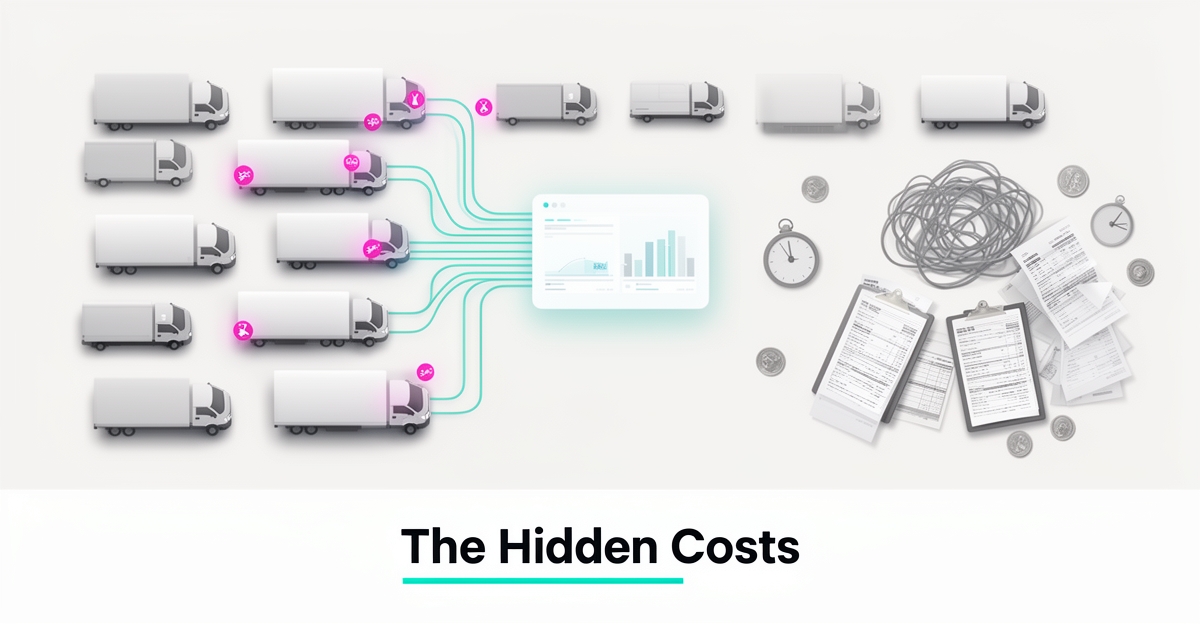
The Hidden Costs of Manual Repair Tracking
Manual tracking in transmission repair shops looks cheap until you add up the waste it creates every week. Shared calendars, paper tickets, and group chats hide the real cost of missed appointments, fuel burn, and overtime that never shows up on a single line item.
Manual dispatch relies on human judgment and static planning. That means routes are not optimized in real time, vehicle location and technician status stay invisible, and small errors compound into lost revenue. The industry continues to face a significant technician shortage, which magnifies every inefficiency in scheduling and dispatch.
Fleet management research shows the financial scale of the problem. Industry comparisons of AI fleet management versus manual dispatch report annual savings often reaching the tens of thousands of dollars, with larger fleets frequently recovering their annual software cost within the first month or two of implementation.
The losses show up across three pressure points that manual tracking cannot control:
- Fuel waste from non-optimized routes and deadhead miles between jobs
- Overtime driven by late arrivals, missed windows, and last-minute reassignments
- Administrative overhead from chasing updates, re-entering tickets, and reconciling paper logs
These are not one-off mistakes. They are structural. Without real-time visibility, dispatchers cannot make data-driven decisions, and shops absorb the cost through fuel inefficiency and payroll creep.
Time loss is another hidden tax. Implementation research notes AI-powered workflow automation can reduce the time taken to complete tasks by more than 2 hours for processes that previously took that long. In a repair environment, those hours translate to fewer jobs completed per day and slower turnaround.
Data loss compounds the problem. Manual tracking creates fragmented records, duplicate entries, and tribal knowledge that walks out the door with technicians. That limits performance measurement, erodes service trends, and makes continuous improvement impossible.
AI systems provide real-time visibility into repair turnaround, technician performance, and service trends. AIQ Labs rebuilds the one workflow that costs your shop the most — dispatch and tracking included — turning it from a cost center into a measurable operation. See AI Workflow Builds for how that works.
When technician capacity is tight, the multiplier effect is severe. One missed slot or one inefficient route does not just cost one job; it creates a cascade of delays, customer callbacks, and overtime that manual methods cannot recover.
Why AI Fleet Management Outperforms Manual Dispatch
Manual dispatch is not just a slower way to run a fleet; it is an expensive operating model that compounds cost, risk, and visibility gaps as you add vehicles. According to fleet operations research comparing AI fleet management to manual dispatch, the switch can save fleets tens of thousands of dollars per year, and operations with 20+ vehicles often recover the full annual software cost within the first month or two.
Cost is where the difference shows up first. Manual dispatch tends to burn money through fuel inefficiency, overtime, and administrative overhead, while AI-driven dispatch reduces waste with automated route optimization and more efficient scheduling. That same research notes the break-even point arrives fast for larger fleets because savings show up immediately in day-to-day routing and labor decisions.
Efficiency is the next gap, and it widens as service volume grows. AI-powered workflow automation can cut task completion time by more than two hours for processes that previously took that long, based on implementation research on integrating AI into existing processes. In practical terms, dispatchers spend less time reshuffling jobs and more time handling exceptions that actually need judgment.
Visibility changes how managers run the day. Manual methods like shared calendars, paper tickets, or group chats create blind spots around vehicle location, driver status, and job progress, which makes customer updates unreliable and performance hard to measure. AI fleet management uses real-time GPS tracking and telematics to make dispatch status observable — the same kind of operational visibility AIQ Labs builds into production systems for repair turnaround, technician performance, and service trend monitoring.
- Real-time GPS tracking replaces guesswork about vehicle location and arrival timing.
- Automated route optimization reduces fuel waste and supports tighter scheduling.
- Automated ELD compliance and HOS tracking reduce exposure from manual logging errors.
- Scalability improves because the system absorbs added vehicles without adding dispatcher load.
Scalability is where manual dispatch usually breaks. When your process depends on one coordinator's memory and phone calls, growth increases missed handoffs and inconsistent decisions, while AI dispatch scales through repeatable logic and real-time adjustments. This is also why many organizations stall after early pilots; the operational model has to be designed, not just the tool.
Compliance is the quiet risk multiplier. Manual logging increases the chance of missed HOS entries and audit gaps, while automated ELD compliance reduces that exposure by capturing required data as work happens. For shops and fleets that want this level of control without stitching together disconnected tools, AIQ Labs builds integrated systems in phases, with pricing you own outright — see how the payment models work.
The Waste Trap: Why Business Process Expertise Determines AI ROI
Manual transmission repair shops that rush to automate without understanding their own workflows pay the price in wasted spend and stalled adoption.
Companies implementing AI without business process expertise typically waste a large share of their investment, according to industry research. In auto service, that waste shows up as duplicate data entry, missed repair updates, and technicians reverting to paper tickets and group chats.
The difference is business logic mapping before model building. Implementations that start with business logic mapping are linked to materially higher ROI. Mapping means tracing how a repair request moves from call to quote to parts to completion, and naming each step in the shop's own language.
When AI matches existing terminology, adoption climbs. Adoption research found AI tools matching existing business terminology lead to several-times-better adoption. Technicians use a system that calls a "RO" a RO, not a work order ID, and service advisors see turnaround tracked the way they already talk about it.
Manual tracking creates the gap AI is meant to close. Shared calendars and paper tickets limit visibility into repair turnaround, technician performance, and service trends. AI systems provide real-time visibility into those metrics, but only if the data model reflects actual shop processes.
Business process expertise determines ROI because it shapes integration, not just accuracy. Shops that skip process mapping force staff to adapt to the tool, creating friction and data loss.
A process-first approach looks like this:
- Document current repair flow, handoffs, and exceptions in shop terminology
- Map data sources for repair time, parts, and technician utilization
- Design AI outputs to mirror existing dashboards and alerts
- Pilot on one workflow with feedback loops before scaling
AIQ Labs starts every engagement with process mapping rather than generic automation — rebuilding the workflow that costs you most at a fixed price, in phases. That alignment reduces rework and preserves institutional knowledge, which Deloitte research indicates well-designed AI systems can largely preserve.
The waste trap is avoidable. When AI is built around how repairs are actually tracked, adopted, and improved, shops gain real-time visibility without losing the operational logic that makes them run.
From Pilot to Production: A Phased Implementation Roadmap
Manual transmission repair shops that stay with paper tickets and shared calendars are bleeding time, data, and margin before a single wrench turns. A phased roadmap replaces that friction with real-time visibility into repair turnaround, technician performance, and service trends while keeping human expertise in the loop.
A research-backed phased framework moves AI from pilot to production without forcing process change. It starts with culture and ends with continuous measurement, preserving the bulk of institutional knowledge when human-AI collaboration is designed in from the start. According to integrating AI innovations research, organizations with structured feedback mechanisms achieve significantly higher AI performance metrics.
Establish a digital mindset first, then build change management practices that engage stakeholders and identify adoption champions. Role-based enablement aligns AI co-pilot models to specific shop roles, from service advisors to technicians. Seamless workflow integration embeds AI intuitively into existing repair tracking rather than replacing it.
Governance and risk come before scale. Introduce AI governance and ethical practices with transparent systems and ethics training. Create AI risk management protocols with assessment frameworks, scenario simulations, and bias monitoring. Foster confidence with human-in-the-loop systems and collaborative tools.
Measurement drives the final transition to production. Track time saved, error reduction, and new capabilities unlocked to continuously refine integration. Continuous evolution and support keep systems aligned as technology and business needs change.
The phased sequence in practice:
- Establish a Digital Mindset with AI awareness campaigns and role-specific training
- Build AI Change Management Practices with champions and iterative pilots
- Design Role-Based AI Enablement aligned to service advisor, technician, and manager workflows
- Enable Seamless Workflow Integration with contextual recommendations inside existing repair tracking
- Govern, Measure, and Evolve with transparent AI, risk protocols, and continuous performance tracking
Business logic mapping is critical. LinkedIn top content on AI trends shows implementations starting with business logic mapping achieve materially higher ROI, while companies implementing AI without business process expertise typically waste a large share of their investment. Tools matching existing business terminology see several-times-better adoption.
Organizations following structured AI implementation strategies are more likely to see positive ROI within the first year. AI-powered workflow automation can reduce the time taken to complete tasks by more than 2 hours for processes that previously took that long. For shops ready to move beyond pilot, AIQ Labs builds in milestones — you approve each phase before the next one starts, and you own the built asset outright. Larger operations can go further with a connected AI Operating System built in phases.
Measuring What Matters: KPIs That Prove AI Pays Off
Manual tracking hides the true cost of transmission work until the invoice is late, the bay is idle, or a comeback rolls back in. Shops that measure the right signals can see where time leaks and where AI creates durable advantage.
Time saved per repair is the first signal that matters. Manual logs, paper tickets, and group chats force technicians to hunt for history and re-diagnose issues. Industry research shows AI-powered workflow automation can reduce the time taken to complete tasks by more than 2 hours for processes that previously took that long. Real-time visibility into repair turnaround and technician performance turns that saving into capacity without adding headcount.
Error reduction rates reveal the financial impact of invisible mistakes. Missing parts, duplicate orders, and mis-recorded labor hours compound across jobs. With structured feedback loops, organizations see measurable gains in reliability. A recent study found organizations with structured feedback mechanisms achieve significantly higher AI performance metrics. That improvement shows up as fewer comebacks, cleaner estimates, and protected margins.
First-time fix percentages connect data to customer trust. AI systems that provide real-time visibility into service trends and repair history help technicians arrive with the right context. Shops can track the percentage of transmission jobs completed without a return visit and tie it directly to pre-work diagnostics, parts availability, and bay scheduling.
New capabilities unlocked complete the picture. Manual tracking limits shops to what a dispatcher can remember. AI opens capabilities such as predictive service trends and automated follow-up that were previously impractical.
Shops should monitor a focused set of KPIs:
- Time saved per repair from intake to close, measured against historical averages
- Error reduction rate for data entry, parts ordering, and labor coding
- First-time fix percentage for transmission and drivetrain jobs
- New capabilities unlocked, such as automated service reminders and trend reporting
These metrics move the conversation from cost to value. Manual tracking leads to inefficiencies, data loss, and missed opportunities, while AI platforms provide continuous measurement and improvement. AIQ Labs builds systems that make these KPIs visible daily — with 200+ multi-agent systems deployed and four live SaaS products the company runs daily, the measurement layer is not an afterthought.
Shops ready to baseline these numbers can start with the two-minute Fit Check at https://aiqlabs.ai/apply and book a free 30-minute strategy call at https://aiqlabs.ai/book to map the biggest bottleneck and identify high-ROI automation opportunities.
Still paying for 10+ subscriptions that don’t talk to each other?
We build custom AI systems you own outright. No vendor lock-in. Full control.
Not sure where to start? Ask our AI planner
Frequently Asked Questions
How much can AI fleet management save compared to manual dispatch?
Why do some AI implementations fail to deliver ROI in auto repair shops?
How much time can AI-powered automation save per repair task?
What KPIs should transmission repair shops track to measure AI success?
Is AI meant to replace human technicians in repair shops?
How does AI improve compliance and reduce risk in fleet operations?
Turn Hidden Waste into Measurable Gains
Manual transmission repair tracking quietly drains your shop through fuel waste, overtime, and administrative overhead — costs that compound with every missed appointment and inefficient route. AI fleet management doesn't just cut these losses; it turns dispatch into a source of real-time visibility, predictable scheduling, and measurable performance gains, with larger fleets often recovering their software investment within the first month or two. The difference isn't just in savings — it's in gaining control over workflows that once felt impossible to optimize. If you're ready to see where your biggest bottlenecks lie and how AI can unlock capacity without adding headcount, start with a free Fit Check to map your highest-ROI opportunities. Take the two-minute Fit Check and book your no-obligation strategy call to turn insight into action.
Make AI your competitive advantage — not just another tool.
Strategy, implementation and ongoing optimization. One partner, end to end.
Not sure where to start? Ask our AI planner