The Real Cost of Manual Vehicle Data Entry in Car Auctions
Key Facts
- Automated data quality scans validate vehicle data for completeness, validity, and consistency using built-in rule types like null checks and regex validation according to Google Cloud Dataplex documentation.
- Custom SQL checks enable anomaly detection for pricing outliers and specification mismatches that manual reviewers routinely miss per Google Cloud Dataplex validation capabilities.
- AI automation typically reduces vehicle data entry time and labor expense substantially while improving accuracy through consistent rule-based checks as demonstrated by AIQ Labs production systems.
- Government agencies like GPO are actively deploying AI for error checking, query analysis, and information search to enhance productivity and efficiency according to GPO AI Use Case Inventory.
- Manual data entry creates hidden labor costs through rekeying across systems, rework from inconsistent reports, delayed listings, and post-publication error correction identified in AIQ Labs auction workflow analysis.
- AIQ Labs has deployed 200+ multi-agent systems and runs 4 live SaaS products daily, proving multi-agent architectures work at scale from their verified production portfolio.
- Automated uniqueness checks prevent duplicate VIN entries that skew inventory counts and complicate reconciliation in high-volume auction operations using Dataplex built-in validation rules.
Hire a team member that works 24/7 — for less than a part-time wage.
AI receptionists, SDRs, dispatchers and 99+ roles. Trained on your business, fully managed.
Not sure where to start? Ask our AI planner
Where the Money Leaks: The Hidden Labor Cost of Manual Vehicle Data Entry
Manual entry looks cheap until you count the hours it steals from every listing. VINs, specs, condition reports and pricing sit in spreadsheets and forms where a single typo can stall a sale or trigger a rework cycle.
Staff time compounds quickly. Each vehicle requires repeated keystrokes for fields that must be complete, valid and consistent before an auction lot goes live. Human review is error-prone and time-consuming, while format validation relies on judgment that varies by operator and shift.
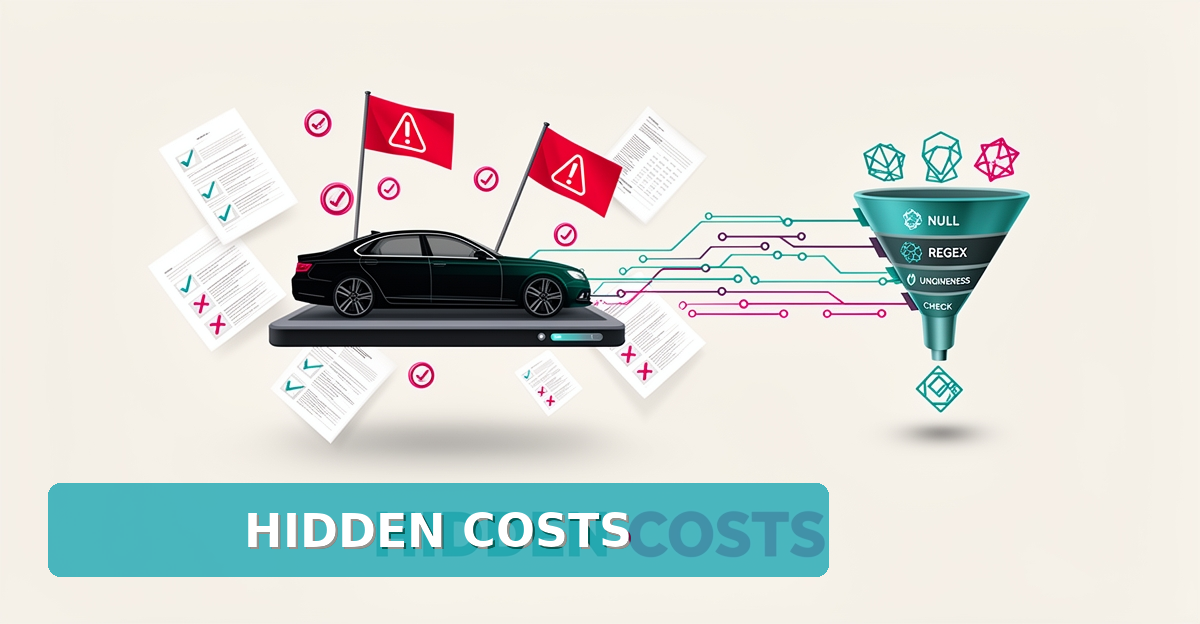
Automated validation changes the equation. Data quality scans help automate the process of validating data for completeness, validity, and consistency. Rules can be defined to check for missing values, ensure values match a regular expression or belong to a set, verify uniqueness, or use custom SQL for more complex validations such as anomaly detection.
That capability maps directly to auction data. A VIN can be checked with regex, prices can be tested against value sets, and required fields can be enforced with null checks. Built-in rule types include Uniqueness check, Null check, Regex check, Value set check, with custom SQL checks available for complex validations.
Errors create hidden labor. When a listing publishes with a missing odometer, mismatched trim, or duplicate VIN, teams spend time investigating buyer questions, correcting records, and relisting. Delay also erodes profitability; lots that are not ready on time miss the optimal sales window and absorb holding costs.
The broader trend favors automation. AI technology is already significantly impacting some key functions, such as how people search for information, check computer code for errors, and perform query analysis. Agencies are exploring AI to enhance productivity and increase efficiency, reflecting a move away from repetitive manual tasks.
Manual processes leak money in predictable places:
- Rekeying the same vehicle attributes across intake, inspection and listing systems
- Rework from incomplete or inconsistent condition reports and pricing
- Delayed listings while staff chase missing fields or validate formats by hand
- Error correction after publication, including buyer disputes and admin overhead
When validation is automated, the cost shifts from labor hours and rework to technology that runs consistently. AIQ Labs builds custom AI systems that capture, validate, and store vehicle data automatically, reducing overhead and improving accuracy for auction workflows. The result is fewer manual touchpoints, faster time-to-list, and a more predictable margin per lot. For teams that want to start with the single workflow that costs the most, an AI Workflow Build rebuilds that process at a fixed price, in phases.
Why Human Validation Fails at Scale: The Error Problem
Manual data entry in car auctions creates a cascade of validation failures that human reviewers simply cannot catch at scale. Auction teams spend hours cross-checking VINs, prices, and specifications, yet inconsistent formatting and rushed reviews lead to systemic gaps. These aren't isolated typos—they're structural weaknesses in a process designed for speed over precision, where completeness checks get skipped when lanes move fast and pricing anomalies slip through during peak bidding hours. The result is a data foundation riddled with silent errors that only surface when accounting reconciliations fail or buyers dispute vehicle descriptions.
Automated validation exposes what manual review routinely misses through systematic rule enforcement. Built-in rule types like null checks, regex validation, and uniqueness checks catch format inconsistencies and missing fields deterministically when properly configured—something human reviewers achieve only sporadically under pressure. Custom SQL checks further enable anomaly detection for pricing outliers or specification mismatches that defy simple pattern matching, turning vague suspicions into actionable alerts. This isn't about replacing human judgment; it's about freeing experts from repetitive validation so they can focus on exceptions that truly require expertise. Data quality scans help you automate the process of validating your data for completeness, validity, and consistency, transforming a reactive cleanup effort into a proactive quality gate.
AIQ Labs applies this validation framework directly to vehicle data pipelines, ensuring every VIN follows ISO 3779 standards, every price falls within model-year expectations, and no duplicate lot numbers enter the auction block. By implementing layered validation—null checks for missing odometer readings, regex for lot number formats, uniqueness checks against historical databases, and custom SQL for price anomaly detection—auction houses eliminate the rework cycles that erode profitability. The shift isn't merely technical; it's operational. When data enters the system clean, downstream processes like invoicing, title transfers, and buyer notifications run without manual intervention, turning data entry from a cost center into a reliability advantage. With data quality scans, you can define rules to check for missing values, ensure values match a regular expression or belong to a set, verify uniqueness, or use custom SQL for more complex validations such as anomaly detection, creating a foundation where human expertise addresses real exceptions rather than chasing preventable errors.
The Automated Alternative: AI-Powered Capture, Validation, and Storage
Manual vehicle data entry in car auctions creates significant operational drag through repetitive tasks that consume staff time and introduce costly errors. As organizations across sectors look to modernize these workflows, AI automation has emerged as a proven solution path—with government agencies like the GPO actively mainstreaming AI for repetitive data tasks, error checking, and query analysis to enhance productivity and increase efficiency. This shift reflects a broader trend where AI is applied to validate information, check for inconsistencies, and streamline query processing at scale.
AI systems can capture vehicle data from diverse sources, validate it against predefined business rules, and store it automatically—eliminating the need for manual transcription and verification. Built-in validation capabilities allow organizations to define checks for completeness, validity, and consistency, such as ensuring VINs follow correct formats or that required fields are populated before acceptance. Custom SQL rules further enable complex validations like anomaly detection for pricing or specification inconsistencies, directly addressing the pain points of manual review.
By automating these validation and storage processes, car auction businesses can meaningfully reduce related time and labor expenses, freeing staff to focus on higher-value activities like customer engagement and strategic decision-making. This approach not only cuts overhead but also improves data accuracy through consistent, rule-based checks that eliminate human variability. For SMBs seeking to implement such systems without complexity, AIQ Labs offers AI Workflow Builds and AI Operating Systems that build owned, production-ready solutions for end-to-end vehicle data automation—from capture through validation to secure storage—delivering efficiency gains while you maintain full control over the technology you own outright.
From Pilot to Production: Implementing Automated Data Quality in Your Auction Operation
Starting small builds confidence—begin with basic completeness checks to catch missing vehicle details like VINs or lot numbers before they disrupt auction workflows. These foundational validations ensure essential fields aren’t left blank, reducing downstream errors in bidding or title transfers. As your team gains trust in the system, layer in format validation to verify data consistency—ensuring, for example, that odometer readings use numeric values only and sale dates follow a standardized format. This phased approach lets you scale complexity without overwhelming operations. Built-in rule types like null and regex checks make these early steps straightforward to implement and maintain.
Next, introduce uniqueness validation to prevent duplicate entries—a common pain point when multiple staff enter data simultaneously across auction lanes. Automated uniqueness checks on critical fields like auction ID or vehicle stock number eliminate redundant records that skew inventory counts and complicate reconciliation. Once these core layers are stable, add custom anomaly detection using SQL-based rules to flag outliers, such as a luxury sedan listed at $500 or a 2020 model with 500,000 miles. These custom validations adapt to your auction’s specific patterns, catching issues manual reviewers might miss amid high-volume sales. Custom SQL checks enable this flexibility, turning raw data into a reliable foundation for pricing and bidding decisions.
Throughout implementation, address access controls early to avoid bottlenecks. Assign roles like Dataplex DataScan Creator for team members building validation rules and BigQuery Job User for those executing scans, ensuring permissions align with responsibilities without over-provisioning. Integrate these checks into your existing auction management system via API so validation runs automatically as data enters the pipeline—no manual triggering required. This seamless connection keeps staff focused on customer service and lot preparation, not data policing. By progressing from completeness to custom validation while managing access thoughtfully, you transform data quality from a periodic chore into a continuous, trustworthy process that protects profitability. Required IAM roles provide the framework to scale securely as your auction operation grows.
Calculating Your ROI and Next Steps
Ready to see what automation could save you? Start with the free 2-minute Fit Check at https://aiqlabs.ai/apply, then schedule a no-obligation 30-minute strategy call at https://aiqlabs.ai/book to map your bottlenecks and identify high-ROI opportunities. We’ll give you real numbers in writing—no fake anchors, just clarity on your AI opportunity.
Make AI your competitive advantage — not just another tool.
Strategy, implementation and ongoing optimization. One partner, end to end.
Not sure where to start? Ask our AI planner