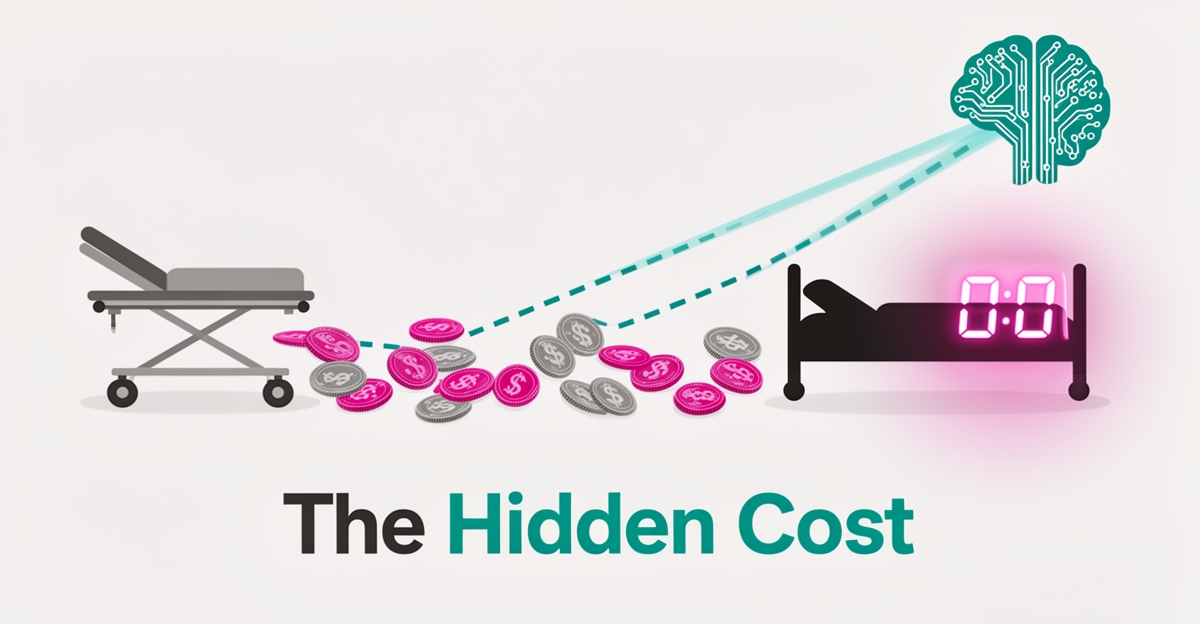
The Real Cost of Missed Patient Transfers in Medical Transport
Key Facts
- U.S. healthcare avoided an estimated $258 billion in administrative costs in 2024 through electronic transactions and improved data exchange, according to the 2025 CAQH Index.
- Industry reporting suggests AI-driven workflow automation can meaningfully reduce transfer coordination errors—often cited at up to 60%—though results vary by workflow and implementation.
- Provider organizations have historically lagged health plans in administrative AI adoption, creating coordination gaps where transfers break down, per CAQH Index adoption data.
- The CAQH Index has identified a multi-billion-dollar savings opportunity (reported at roughly $21 billion) through full automation of manual and partially manual transactions.
- AI adoption in healthcare is projected to keep climbing through 2028 based on industry growth trends.
- AI-driven workflow automation targets friction points like manual data entry and communication gaps that cause transfer failures.
- Organizations using automated transactions report meaningful increases in cost avoidance, per the 2025 CAQH Index.
Hire a team member that works 24/7 — for less than a part-time wage.
AI receptionists, SDRs, dispatchers and 99+ roles. Trained on your business, fully managed.
Not sure where to start? Ask our AI planner
The Financial and Operational Toll of Missed Patient Transfers
When a patient transfer falls through the cracks, the financial damage extends far beyond a single lost trip—it ripples through revenue cycles, care quality, and operational efficiency. The true cost compounds daily, often invisibly, until administrative bloat and delayed treatments become systemic problems.
The scale of this inefficiency is significant. According to the 2025 CAQH Index, U.S. healthcare avoided an estimated $258 billion in administrative costs in 2024 through electronic transactions and improved data exchange. Yet that achievement reveals how much waste persists in manual coordination—particularly in patient transport logistics, where missed handoffs trigger expensive downstream effects.
When transfers fail, the financial bleeding begins immediately. Emergency departments experience boarding delays that tie up staffed beds and divert resources. Inpatient beds sit empty while scheduled admissions wait in limbo, creating a revenue vacuum that compounds daily. Meanwhile, the administrative burden of rescheduling, re-authorizing, and reconciling these failures consumes staff hours that could otherwise support patient care.
The operational toll manifests in several critical areas:
- Lost revenue from canceled procedures and unfilled bed days
- Overtime pay for clinical staff managing transfer delays and extended patient stays
- Regulatory penalties and compliance risks when transfer delays violate EMTALA or state transport mandates
- Increased length-of-stay costs when patients cannot move to appropriate care levels
Despite progress in electronic transactions, a significant savings opportunity remains. The CAQH Index has identified roughly $21 billion in additional savings available through full automation of manual and partially manual transactions—precisely the category where missed transfers and coordination failures occur.
This gap represents more than administrative waste; it signals systemic vulnerability. Provider organizations have historically lagged health plans in adopting AI for administrative workflows, per CAQH Index adoption data. That disparity creates friction points where transfers break down, particularly at the intersection of transport scheduling and clinical handoffs.
Forward-thinking organizations are closing this gap with intelligent workflow automation that coordinates transport logistics in real time. AIQ Labs builds production-grade AI Workflow Builds that integrate directly with existing EHR and dispatch infrastructure, creating connected handoffs that reduce coordination errors. Unlike subscription software, these systems can be owned outright by the healthcare organization, ensuring long-term adaptability without vendor lock-in.
The financial imperative is clear. Every missed transfer represents not just a single failure, but a cascade of avoidable costs that automation can systematically eliminate.
How AI Automation Reduces Transfer Errors
Missed transfers rarely happen because of one bad decision. They accumulate from small, repetitive friction points in manual workflows that compound under pressure.
AI-driven workflow automation targets those friction points directly. By replacing manual data entry, fragmented communication, and reactive scheduling with connected, rules-based processes, organizations reduce the human error that drives transfer failures. The shift is already underway in healthcare administration.
Adoption is accelerating. CAQH Index data shows health plans well ahead of provider organizations in administrative AI use, and that gap reflects pressure to cut cost without disrupting care. Providers who close it gain a coordination advantage their competitors don't have.
The financial case is clear. U.S. healthcare avoided an estimated $258 billion in administrative costs in 2024 through electronic transactions and improved data exchange, with reported increases in cost avoidance through automated transactions. Missed transfers erode those gains quickly through lost revenue, delayed care, and regulatory exposure.
AI automation addresses the root causes that create missed transfers:
- Manual data entry and transcription errors across EHRs, dispatch logs, and transport manifests
- Communication gaps between hospitals, transport teams, and receiving facilities
- Scheduling failures from fragmented calendars and last-minute changes without real-time sync
- Lack of proactive alerts for eligibility, bed availability, or transport readiness
When these steps run on an integrated AI workflow, exceptions are surfaced before they become misses. Industry reporting has cited error reductions of up to 60% where AI automates handoffs and validates data at the point of capture—though actual results depend on the workflow and how thoroughly the automation is implemented.
In practice, that means an AI workflow can confirm patient details, verify destination readiness, and book transport in one connected flow instead of three separate manual touchpoints. Real-time validation reduces duplicate entries and ensures the right information reaches the right team at the right time.
AIQ Labs builds production-grade workflow automation systems that clients can own outright rather than rent, aligning with the broader move toward owned AI assets over perpetual subscriptions. The approach mirrors how administrative automation is scaling across healthcare, with AI adoption projected to keep climbing through 2028.
Security and compliance remain central. As AI use grows, organizations must design for continuous performance evaluation, interoperability with EHRs, and audit trails that support regulatory requirements. These design choices protect patient safety while enabling speed.
The result is fewer missed transfers, faster patient movement, and administrative cost avoidance that compounds over time.
Building Compliant, Ownable AI Systems for Medical Transport Workflows
Missed patient transfers in medical transport create ripple effects that extend far beyond a single delayed trip—impacting revenue, patient outcomes, and regulatory standing. With U.S. healthcare avoiding an estimated $258 billion in administrative costs through electronic transactions in 2024, the gap left by manual transfer processes remains a costly vulnerability. AIQ Labs addresses this by building production-grade AI systems that clients can own outright, designed to eliminate missed transfers through integration with EHRs and dispatch tools while maintaining strict HIPAA compliance.
Our approach centers on true ownership and operational resilience. With the Own It Outright model, clients receive complete control over the system and their data, avoiding vendor lock-in entirely. For those preferring phased investment, Build in Milestones allows payment per workflow component, with all progress retained regardless of engagement duration. The Start Monthly model offers a low-risk entry point—managed AI Employees like AI dispatchers and receptionists that handle intake, scheduling, and follow-up at a fraction of the cost of a human hire, with flexibility to pause or adjust as needs evolve.
These systems are engineered for reliability in high-stakes environments, using multi-agent architectures to manage complex, stateful workflows such as patient verification, transport scheduling, and real-time status updates. By connecting directly to EHRs, dispatch platforms, and communication tools, AI agents reduce manual handoff errors—industry reporting suggests automation can meaningfully cut such mistakes in administrative healthcare workflows. Every action is validated before execution, with guardrails, human-in-the-loop controls, and complete audit trails ensuring compliance and traceability.
AIQ Labs has deployed 200+ multi-agent systems and runs four live SaaS products daily—production experience that demonstrates our ability to deliver systems meeting healthcare's demands for security, explainability, and reliability. Unlike point solutions that create dependency, a custom-built system becomes a permanent, owned asset that scales with the organization—whether as a single rebuilt workflow or a full AI Operating System connecting intake, scheduling, and care coordination. This foundation not only prevents missed transfers but establishes the infrastructure for broader AI-driven optimization across the organization.
Start the Fit Check—a 2-minute assessment—then schedule a free 30-minute strategy call at https://aiqlabs.ai/book to map your biggest bottleneck and identify high-ROI automation opportunities. If there isn't a clear win, we'll say so—no obligation, just clarity.
Still paying for 10+ subscriptions that don’t talk to each other?
We build custom AI systems you own outright. No vendor lock-in. Full control.
Not sure where to start? Ask our AI planner
Frequently Asked Questions
What is the financial impact of a single missed patient transfer on a healthcare organization?
How much did U.S. healthcare avoid in administrative costs in 2024 through electronic transactions and improved data exchange?
Do provider organizations lag health plans in administrative AI adoption?
Can AI automation really reduce missed patient transfers by up to 60%?
What are the main operational consequences of missed patient transfers beyond just financial loss?
How does AIQ Labs ensure their AI systems for medical transport are compliant and secure?
Turn Transfer Friction Into Financial Control
Missed patient transfers are not isolated scheduling slips; they are compounding revenue leaks, care delays, and compliance risks that erode the administrative savings U.S. healthcare has already achieved through electronic transactions. The cost shows up in boarded ED hours, empty inpatient beds, overtime, and penalties under EMTALA and state mandates, while manual handoffs between EHRs, dispatch logs, and transport manifests keep error rates high. AI automation targets those exact friction points—validating patient details, confirming destination readiness, and syncing transport in one connected flow. Forward-thinking teams are closing the remaining savings gap by owning their automation rather than renting it. If you want to see where your transfer workflow is leaking, start the Fit Check, then book a free 30-minute strategy call at https://aiqlabs.ai/book. We'll map your biggest bottleneck and identify high-ROI automation opportunities, and if there isn't a clear win, we'll say so.
Make AI your competitive advantage — not just another tool.
Strategy, implementation and ongoing optimization. One partner, end to end.
Not sure where to start? Ask our AI planner